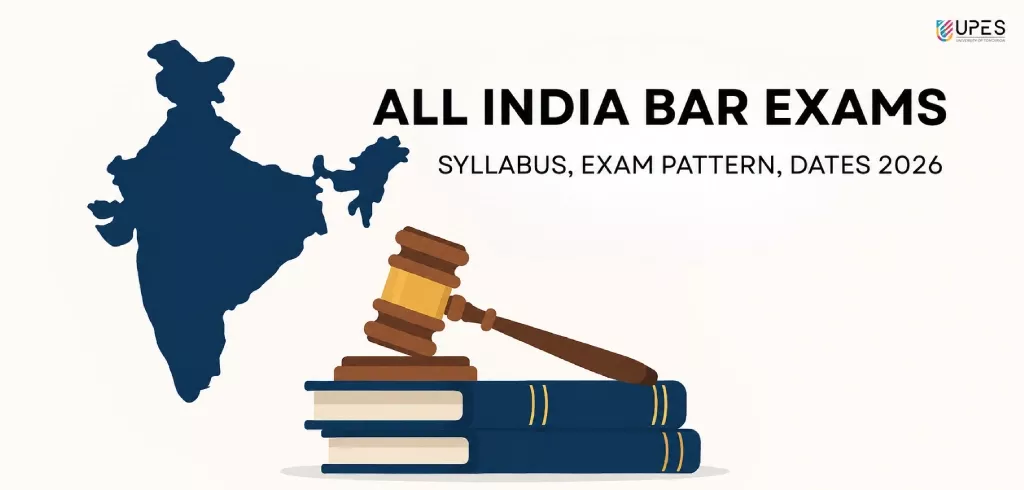
All India Bar Exam Syllabus, Pattern, Dates 2026
- UPES Editorial Team
- Published 16/06/2025


- What is the All India Bar Exam (AIBE)?
- AIBE Eligibility Criteria
- All India Bar Exam Dates 2026 (Tentative Schedule)
- AIBE Registration Process (Step-by-Step)
- AIBE Exam Fees
- All India Bar Exam Pattern 2026
- All India Bar Exam Syllabus 2026
- All India Bar Exam Syllabus PDF Topics (with estimated question weightage):
- Subject-wise Bare Acts to Study for AIBE
- How to Prepare for Each Topic
- Best Books and Resources
- AIBE Mock Test and Previous Year Papers
- How Much Time Should You Dedicate?
- AIBE Admit Card / Hall Ticket
- AIBE Result and Certificate of Practice (COP)
- AIBE vs Other Law Exams
- Career Opportunities After Clearing AIBE
Planning to practice law in India in 2026? Clearing the All India Bar Examination (AIBE) is your first milestone. Conducted by the Bar Council of India (BCI), the AIBE is a mandatory certification exam that law graduates must clear to obtain a Certificate of Practice (COP). Whether you're from a national law university or a private college, this exam is the final checkpoint to officially begin your legal career.
This blog offers a complete breakdown of the All India Bar Exam syllabus 2026, exam pattern, preparation tips, important dates, and recommended resources—all in one place.
What is the All India Bar Exam (AIBE)?
The All India Bar Examination (AIBE) is a national-level qualifying exam conducted by the Bar Council of India (BCI). It was introduced in 2010 under the Advocates Act, 1961, to ensure that every law graduate who wishes to practice law in India meets a minimum standard of professional competence.
In simple terms: you cannot appear in any Indian court as a practising advocate without clearing the AIBE and obtaining a Certificate of Practice (COP). Here's what makes AIBE unique:
- It is not a competitive exam — there is no merit list or rank. It is purely qualifying in nature.
- It tests your ability to apply legal knowledge to real-world scenarios, not just theoretical recall.
- The exam is open-book in spirit — bare acts (without annotations) are permitted inside the exam hall.
- It is conducted once or twice a year, typically in offline mode across designated centres nationwide.
- The exam is available in 11 languages including English, Hindi, and major regional languages, making it accessible to graduates from all states.
AIBE is not the same as competitive law exams like CLAT or judiciary exams. It does not determine your rank or get you a job — it simply licenses you to legally practice. Think of it as the bar exam equivalent in India, similar in concept to what the State Bar Exam is in the United States.
AIBE Eligibility Criteria
Before registering for the All India Bar Examination, it is essential to confirm that you meet the eligibility conditions set by the Bar Council of India. The criteria are straightforward but must be satisfied without exception.
1. Academic Qualification
- You must have completed a 3-year LLB or a 5-year integrated BA LLB / BBA LLB / B.Com LLB programme from a BCI-recognised law university or college.
- Candidates who are in their final semester of the LLB programme are also eligible to appear, provided they complete the degree before the Certificate of Practice is issued.
2. Enrolment with a State Bar Council
- This is the most critical requirement: you must be enrolled as an Advocate with any State Bar Council in India before appearing for AIBE.
- If you have not yet enrolled, complete your State Bar Council enrolment first — AIBE registration will not proceed without a valid enrolment number.
3. No Age Limit
- There is no upper or lower age bar for AIBE. Any enrolled advocate who has not yet cleared the exam can appear regardless of age or years since graduation.
4. Attempt Restriction
- There is no cap on the number of attempts. Candidates who do not qualify can re-appear in subsequent AIBE editions.
| Eligibility Parameter | Requirement |
Educational Qualification | LLB (3-year or 5-year integrated) from BCI-recognised institution |
State Bar Council Enrolment | Mandatory — must be enrolled as Advocate before applying |
Age Limit | None |
Nationality | Indian Citizen |
Attempt Limit | No limit — can re-appear until cleared |
Educational Qualification | LLB (3-year or 5-year integrated) from BCI-recognised institution |
If you completed your LLB from a foreign university, refer to the section on AIBE for Foreign Law Graduates later in this blog for specific guidance.
All India Bar Exam Dates 2026 (Tentative Schedule)
The All India Bar Examination (AIBE) 2026 is one of the most important law exams in india in order to start practicing law as a profession. It is tentatively scheduled for December 2026.
| Event | Tentative Date |
| Registration Window | 11th February 2026 |
| Online Registration Closes | 30th April 2026 |
| Admit Card Release | 22nd May 2026 |
| AIBE 2026 Exam Date | 7th June 2026 |
| Mode of Exam | Pen-and-Paper (Offline) |
| Result Declaration | January 2027 (Expected) |
AIBE Registration Process (Step-by-Step)
The AIBE registration is conducted entirely online through the Bar Council of India's official portal. Here is a clear, step-by-step walkthrough of the process:
- Visit the official BCI/AIBE registration portal (allindiabarexamination.com or as notified by BCI).
- Click on 'New Registration' and enter your State Bar Council enrolment number. This is mandatory — without it, registration cannot proceed.
- Fill in the online application form with personal details, educational qualifications, and communication address.
- Upload the required documents (see list below) in the specified format and size.
- Pay the registration fee online via net banking, debit card, or credit card.
- Submit the form and download the registration confirmation receipt. Keep this safely — it contains your application number.
- Admit card / hall ticket will be issued separately closer to the exam date. Log in to the portal to download it when available.
Documents Required for AIBE Registration
- Recent passport-size photograph (as per specified dimensions)
- Scanned signature
- LLB degree certificate or provisional certificate (if result awaited, a bonafide certificate from the institution)
- State Bar Council enrolment certificate
- Valid photo ID proof (Aadhaar, PAN card, passport, or driving licence)
Ensure all uploaded documents are clear and within the specified file size limits. Applications with blurry or incomplete documents may be rejected without prior notice.
AIBE Exam Fees
The AIBE registration fee is kept deliberately affordable to ensure that law graduates from all economic backgrounds can access the exam. Here is the current fee structure:
| Category | Registration Fee |
General / OBC Candidates | ₹3,500 (approx.) |
SC / ST Candidates | ₹2,500 (approx.) |
Payment Mode | Online only (Net Banking / Debit Card / Credit Card / UPI) |
Refund Policy | Non-refundable once submitted |
General / OBC Candidates | ₹3,500 (approx.) |
Note: The exact fee amount is declared by BCI at the time of the official notification. The figures above are based on previous AIBE editions and may be subject to revision. Always confirm the current fee on the official BCI notification before paying.
All India Bar Exam Pattern 2026
Understanding the All India Bar Exam pattern is crucial before you dive into preparation.
| Feature | Details |
| Mode | Offline (Pen-and-paper) |
| Duration | 3 hours 30 minutes |
| Total Questions | 100 |
| Type of Questions | Multiple Choice Questions (MCQs) |
| Total Marks | 100 |
| Negative Marking | No |
| Language Options | 11 Indian languages including English and Hindi |
| Minimum Qualifying Marks | 40% for General, 35% for SC/ST |
As of 2023, the open book system has been discontinued. Candidates are now only allowed bare acts (without notes or comments).
All India Bar Exam Syllabus 2026
The All India Bar Exam syllabus is based on core subjects taught during the 3-year or 5-year LLB program. The questions assess your conceptual clarity and ability to apply legal knowledge to real-world scenarios.
All India Bar Exam Syllabus PDF Topics (with estimated question weightage):
As you can see the below listed table is a long one. With so many topics to study, it can get extremely overwhelming very soon. However, not every topic needs to be covered with the same enthusiasm. For each topic, we have listed expected no. of questions from it so that you know which topic to focus on:
| Subject | Expected No. of Questions |
| Constitution of India | 10 |
| Indian Penal Code (IPC) | 8 |
| Criminal Procedure Code (CrPC) | 10 |
| Code of Civil Procedure (CPC) | 10 |
| Evidence Act | 8 |
| Contract Act | 8 |
| Family Law | 6 |
| Public Interest Litigation (PIL) | 4 |
| Environmental Law | 2 |
| Professional Ethics & Bar Council Rules | 4 |
| Company Law | 2 |
| Labour and Industrial Law | 4 |
| Alternative Dispute Redressal (ADR) | 4 |
| Cyber Law | 2 |
| Intellectual Property Law | 2 |
| Law of Torts | 5 |
| Other Minor Acts (e.g., Land Acquisition, Taxation) | 5 |
Download the All India Bar Exam syllabus PDF from the official BCI website or collect from your law school’s resource centre.
Subject-wise Bare Acts to Study for AIBE
Since bare acts (without annotations) are now the primary resource permitted in the exam hall, knowing exactly which acts to carry and study is half the battle. Here is a subject-wise list of the most important bare acts for AIBE 2026:
| Subject | Key Bare Acts |
Constitution of India | The Constitution of India (full text) — Parts III, IV, V, VI, and XIV are most critical |
Indian Penal Code | IPC 1860 — Sections 299–304 (homicide), 375–376 (sexual offences), 378–420 (property offences) |
Criminal Procedure Code | CrPC 1973 — Chapters IV (arrest), XII (information), XXXIII (bail), XXXIX (injunctions) |
Code of Civil Procedure | CPC 1908 — Orders I–VIII (pleadings), Order XXXIX (interim relief), Sections 9–20 (jurisdiction) |
Evidence Act | Indian Evidence Act 1872 — Sections 3–30, 45–51 (expert evidence), 65B (electronic records) |
Contract Act | Indian Contract Act 1872 — Sections 1–75 (essentials, void agreements, breach) |
Family Law | Hindu Marriage Act 1955, Hindu Succession Act 1956, Muslim Personal Law (Shariat) Application Act 1937, Special Marriage Act 1954 |
Law of Torts | No codified act — study landmark case law: Donoghue v Stevenson, Rylands v Fletcher, MC Mehta cases |
Professional Ethics | Advocates Act 1961 — Sections 29–35, BCI Rules on Professional Standards (Chapter II, Part VI) |
Company Law | Companies Act 2013 — Sections 1–100 (incorporation, directors, meetings) |
Labour Law | Industrial Disputes Act 1947, Factories Act 1948, Minimum Wages Act 1948 |
ADR | Arbitration and Conciliation Act 1996 — Parts I and II; Legal Services Authorities Act 1987 |
Cyber Law | Information Technology Act 2000 — Sections 43, 66, 67, 69, 72 |
IPR | Patents Act 1970, Trade Marks Act 1999, Copyright Act 1957 — key sections only |
Environmental Law | Environment Protection Act 1986, Wildlife Protection Act 1972, Forest Conservation Act 1980 |
PIL | No specific act — study landmark SC judgments: Hussainara Khatoon, Vishaka, MC Mehta, Bandhua Mukti Morcha |
Pro tip: Organise these bare acts in a zip-lock bag or labelled folder before the exam. Being able to quickly locate the right section during the exam can save crucial minutes.
How to Prepare for Each Topic
The AIBE is not about rote learning—it’s about understanding bare acts and legal principles. Here's how to prepare smartly:
High-Weightage Areas
- Constitution: Focus on Parts III (Fundamental Rights), IV (DPSPs), and V (Union Govt).
- Recommended: PM Bakshi’s Constitution Bare Act + Previous year MCQs
- CrPC & IPC: Practice sections related to arrest, bail, investigation, and offences.
- Recommended: Universal Bare Acts, LexisNexis CrPC handbook
- CPC: Learn about jurisdiction, limitation, and orders.
- Focus on Order I to XX*
Medium-Weightage Areas
- Family Law: Muslim & Hindu law essentials—marriage, divorce, inheritance
- Contract Law: Essentials of valid contracts, breach, indemnity
- Evidence Act: Sections 3–114A are highly testable
Low-Weightage/Scoring Boosters
- Professional Ethics: BCI Rules, Contempt of Court
- Environmental Law & PIL: Supreme Court judgments
- ADR, Cyber Law, IPR: Objective facts, definitions
Best Books and Resources
No preparation can ever be enough without the help of books. And law students have many! Listed below are some books you must thoroughly prepare to answer questions asked from anywhere:
| Resource | Use |
| Universal’s Guide to AIBE | Full syllabus + model papers |
| Bare Acts (Universal/CLA/Commercial’s) | Most essential for new format |
| LexisNexis MCQ Books | Practice for legal aptitude |
| YouTube Channels (Law Giri, LegalEdge) | Topic breakdowns and past paper discussion |
| Previous Year Papers (2011–2023) | Real-time exam understanding |
| UPES School of Law Mock Tests | Applied legal knowledge and case-based scenarios |
AIBE Mock Test and Previous Year Papers
If there is one preparation strategy that consistently separates AIBE qualifiers from those who fall short, it is the disciplined use of mock tests and previous year question papers. Here's how to make the most of them:
Why Previous Year Papers Matter
- AIBE questions follow recognisable patterns — certain sections (Constitution, CPC, CrPC) are tested in similar ways year after year.
- Solving past papers helps you understand the application-based framing of questions, not just the statutory text.
- It builds familiarity with the exam's difficulty level, helping you avoid surprises on the actual day.
How to Use Mock Tests Effectively
- Attempt at least 5 full-length mock tests before the exam, strictly within the 3.5-hour time limit.
- Simulate actual exam conditions — sit at a desk, use your bare acts as reference, and avoid distractions.
- After each mock test, analyse incorrect answers: was it a knowledge gap, a misread question, or a bare act you couldn't locate quickly?
- In the final week, focus on speed — practice locating specific sections in bare acts within 30–60 seconds.
Where to Find AIBE Mock Tests and Past Papers
Aim to cover AIBE papers from at least the last 5 editions (typically held from 2019 onwards for the updated format). Do not skip the analysis step — solving without reviewing mistakes offers very little preparation value.
How Much Time Should You Dedicate?
Having a dedicated timetable can ease your way into preparation. Remember, staying glued to books all day, doesn’t guarantee you’ll qualify. Better it would be to strategically divide the time into hours for preparation and other work to avoid burnout.
| Candidate Type | Suggested Prep Time |
| Recent LLB Graduate | 4–6 weeks (2 hrs/day) |
| Working Professionals | 6–8 weeks (1–2 hrs/day) |
| Long Gap from Studies | 8–10 weeks (structured plan) |
Consistency and practice are key. Daily revision + weekend full-length mock tests are highly recommended.
AIBE Admit Card / Hall Ticket
The AIBE admit card (also called hall ticket) is a mandatory document that every candidate must carry to the examination centre. You will not be permitted entry into the exam hall without it. Here is everything you need to know:
When is the Admit Card Released?
BCI typically releases the AIBE admit card 2–3 weeks before the examination date. Candidates are notified via email and through the official portal. There is no physical dispatch — it is available only as a downloadable PDF.
How to Download the AIBE Admit Card
- Log in to the official AIBE portal using your application number and password.
- Navigate to the 'Admit Card / Hall Ticket' section.
- Click 'Download' and save the PDF.
- Print the admit card on A4-size paper. A digital copy on your phone is not accepted at most centres.
Details Mentioned on the Admit Card
- Candidate's full name and photograph
- State Bar Council enrolment number
- Exam centre name, address, and centre code
- Exam date and reporting time
- Important exam-day instructions
What to Carry on Exam Day
- Printed AIBE admit card
- A valid original photo ID (Aadhaar card, PAN card, passport, or driving licence)
- Your set of bare acts (without handwritten notes, annotations, or sticky tabs with text)
- Stationery: blue or black ballpoint pen (pencils not permitted)
Arrive at the exam centre at least 30 minutes before the reporting time. Entry may be denied if you arrive after the gate-closing time, regardless of reason.
AIBE 2026 Cut-Off (Expected)
Based on previous trends:
Expected Cut-Off & Difficulty Level
- Cut-Off Trend: 40% (may vary slightly)
- Level: Easy to Moderate
- Tip: Don’t overanalyze. Focus on speed and understanding key legal principles.
| Category | Expected Cut-Off (Out of 100) |
| General/OBC | 40–45 marks |
| SC/ST | 35–40 marks |
Note: There is no merit list; the exam is qualifying in nature.
AIBE Passing Marks and Scoring
Understanding what it takes to pass the All India Bar Exam goes beyond just knowing the cut-off number. Here is a complete picture of the AIBE scoring system:
| Parameter | Details |
Total Marks | 100 (1 mark per question) |
Marks for Correct Answer | +1 |
Marks for Incorrect Answer | 0 (No negative marking) |
Minimum Passing Marks — General/OBC | 40 out of 100 (40%) |
Minimum Passing Marks — SC/ST | 35 out of 100 (35%) |
Merit List | Not applicable — exam is qualifying only |
Certificate Validity | Lifetime — COP does not expire once issued |
What Happens if You Score Below the Cut-Off?
- Your result will reflect 'Not Qualified'. You do not receive a Certificate of Practice.
- There is no time-bar — you can re-register and appear in the next available AIBE edition.
- Your previous attempt score is not carried forward in any way — each attempt is treated independently.
- There is no limit on the number of re-attempts.
Is There Sectional Cut-Off?
- No. AIBE does not have any section-wise minimum marks. You only need to meet the overall aggregate cut-off (40% for General, 35% for SC/ST). This means a very strong performance in high-weightage subjects like Constitution, CPC, and CrPC can compensate for a weaker performance in minor subjects.
How Many Times Can You Attempt AIBE?
- This is one of the most frequently asked questions by law graduates preparing for their first AIBE. The answer is reassuring: there is no limit on the number of AIBE attempts.
Parameter | Policy |
Maximum Attempts Allowed | Unlimited — no cap on attempts |
Cooling Period Between Attempts | None — you can appear in the very next scheduled AIBE |
Age Restriction on Re-Attempts | None |
Score Carryforward | Not applicable — each attempt is independent |
Enrolment Validity | State Bar Council enrolment must remain valid |
Maximum Attempts Allowed | Unlimited — no cap on attempts |
Key points to remember about AIBE attempts:
- You can appear in every subsequent AIBE edition until you qualify. There is no penalty for multiple attempts.
- Your State Bar Council enrolment must be active and valid at the time of each attempt. If your enrolment lapses, it must be renewed before you can re-register for AIBE.
- Candidates who qualified AIBE in a previous edition but lost their COP due to non-renewal may need to appear again depending on BCI's current policy — confirm directly with BCI.
- Each new attempt requires a fresh registration and payment of the applicable registration fee.
In summary, AIBE is designed to be inclusive rather than eliminatory. The unlimited attempts policy ensures that every eligible law graduate eventually has the opportunity to obtain their Certificate of Practice.
Is AIBE Difficult to Clear?
Straightforward answer: No, AIBE is not difficult — but it does require structured preparation. With a passing mark of just 40%, and no negative marking, the exam is deliberately designed to be qualifying rather than eliminatory. However, unprepared candidates do fail, and the pass percentage varies across editions.
Difficulty Assessment
| Parameter | AIBE Assessment |
| Overall Difficulty Level | Easy to Moderate |
| Conceptual Depth Required | Application of statutory law — not academic depth |
| Memory vs. Understanding | Primarily understanding — bare acts are allowed |
| Common Failure Reason | Poor time management + unfamiliarity with bare act locations |
| Typical Pass Percentage | 55–70% (varies by edition) |
| Hardest Subjects (by feedback) | CPC, CrPC, Evidence Act — due to procedural complexity |
| Easiest Subjects (by feedback) | Professional Ethics, Environmental Law, PIL |
Who Typically Struggles?
- Candidates who studied law more than 2–3 years ago and haven't revised since.
- Those who enter the exam without practising on bare act navigation — in a 3.5-hour exam, spending 10 minutes searching for one section is a costly mistake.
- Candidates who skip low-weightage subjects entirely, not realising those 10–15 marks can be the difference between qualifying and failing.
Who Clears It Comfortably?
- Recent LLB graduates who revise core bare acts for 4–6 weeks with consistent MCQ practice.
- Working advocates who maintain active engagement with legal statutes in their daily practice.
- Candidates who solve at least 5 previous year papers in exam conditions before appearing.
The bottom line: AIBE rewards preparation over brilliance. A law graduate who dedicates 4–8 weeks of focused preparation, understands their bare acts, and practices previous year papers has every reason to be confident walking into the exam hall.
Pro Tips for AIBE 2026
Those preparing for this exam, can sure use some pro tips to come out of the exam with flying colours. And of course, the tip that remains for every exam: Practise hard, and stay Confident.
- Don’t ignore small subjects—Professional Ethics or PIL may bring easy scoring opportunities
- Stick to bare acts only—avoid guidebooks with interpretations
- Solve at least 5 previous year papers before exam day
- Practice reading questions carefully—many are application-based, not memory-based.
AIBE Result and Certificate of Practice (COP)
Clearing AIBE is only half the journey — knowing what happens next, how results are declared, and how to obtain your Certificate of Practice (COP) is equally important.
How Are AIBE Results Declared?
- Results are published on the official BCI/AIBE portal, typically 4–8 weeks after the examination date.
- Candidates are notified via their registered email address. Results are not dispatched physically.
- The result is displayed as 'Qualified' or 'Not Qualified'. No individual marks breakdown is typically shared publicly.
How to Download the Certificate of Practice
- Log in to the official AIBE portal with your credentials.
- Navigate to the 'Result / Certificate' section.
- If qualified, click 'Download COP' to access your Certificate of Practice.
- Print the certificate for official use — it serves as your licence to practise law in India.
What Does the COP Enable?
- You can appear and argue cases in all Indian courts — District Courts, High Courts, and the Supreme Court (subject to enrolment conditions).
- It validates your enrolment as a practising advocate under the Advocates Act, 1961.
- Required for joining law firms, appearing in arbitration proceedings, and legal consultancy roles.
Certificate Validity
Once issued, the Certificate of Practice has lifetime validity. There is no need to renew it periodically. However, your State Bar Council enrolment must remain active for you to continue practising.
AIBE vs Other Law Exams
Many law graduates are simultaneously aware of multiple law-related exams and often confuse AIBE with other examinations. Here's a clear comparison to help you understand where AIBE sits in the broader landscape of law exams in India:
Parameter | AIBE | Judicial Services Exam | CLAT PG (LLM) | UPES (Law Optional) |
Purpose | Licence to practise as advocate | Entry into judiciary (judge) | Admission to LLM programme | IAS/IPS civil services |
Conducted By | Bar Council of India (BCI) | State High Courts | Consortium of NLUs | UPSC |
Eligibility | LLB + State Bar enrolment | LLB + age criteria (varies by state) | LLB / 5-yr law degree | Graduation in any subject |
Difficulty Level | Easy to Moderate | Very High | High | Very High |
Negative Marking | No | Yes (varies) | Yes | Yes |
Attempt Limit | Unlimited | 3–5 (varies by state) | No limit | 6 (General) |
Career Outcome | Practising Advocate (COP) | Civil Judge / Magistrate | LLM Degree | IAS/IPS Officer |
Nature of Exam | Qualifying only | Competitive (merit-based) | Competitive (merit-based) | Competitive (merit-based) |
Career Opportunities After Clearing AIBE
Clearing AIBE and receiving your Certificate of Practice is a significant milestone — but it is the beginning of your legal career, not the destination. The COP unlocks a wide range of professional paths across litigation, corporate law, public sector, and beyond.
1. Litigation Practice
The most traditional path — appear before District Courts, High Courts, and eventually the Supreme Court. Many advocates begin by joining a senior advocate's chamber as a junior, gaining courtroom experience while building their own client base over 3–5 years.
2. Corporate Law / Law Firms
India's top law firms (AZB & Partners, Cyril Amarchand Mangaldas, Shardul Amarchand, Khaitan & Co.) hire fresh advocates for transactional, advisory, and litigation support roles. Specialisations in M&A, banking law, IP, and technology law are in high demand.
3. In-House Legal Counsel
Corporates, startups, PSUs, and MNCs hire advocates directly as in-house legal counsel to handle contracts, compliance, regulatory matters, and dispute resolution without outsourcing to law firms.
4. Judicial Services
With your COP in hand, you become eligible to appear for State Judicial Services Exams (Civil Judge / Magistrate exams). These are competitive examinations conducted by State Public Service Commissions and High Courts.
5. Government Legal Jobs
Posts such as Assistant Government Advocate, Public Prosecutor, Legal Officer in PSUs (ONGC, NTPC, LIC), and Legal Advisor in regulatory bodies (SEBI, RBI, TRAI) require an LLB and ideally a COP.
6. Legal Academia
If you hold or pursue an LLM after your LLB, teaching law at universities and law schools is a respected and stable career. A NET qualification in law further strengthens this path.
7. Alternative Legal Careers
Legal tech startups, legal process outsourcing (LPO) companies, NGOs (human rights law, environmental law), policy think tanks, and international organisations (UN, WTO) are increasingly hiring advocates with domain specialisation.
At UPES School of Law, students receive industry-driven training across litigation, corporate law, IP law, international law, and public policy — preparing them not just to pass AIBE but to thrive across all these career paths.
AIBE for Foreign Law Graduates / NRI Students
A growing number of Indian students pursue law degrees from universities in the UK, USA, Australia, or other countries and return to India intending to practise. Here's what foreign law graduates and NRI students need to know about AIBE eligibility:
Are Foreign Law Graduates Eligible for AIBE?
The eligibility for AIBE requires a law degree from a BCI-recognised institution. Most foreign law degrees are not automatically recognised by the Bar Council of India. However, there is a process for foreign-qualified lawyers to seek recognition:
- Under Section 47 of the Advocates Act, 1961, foreign lawyers may be permitted to practise in India on the basis of reciprocity between India and the lawyer's home country.
- In 2023, the Supreme Court of India and BCI opened avenues for foreign lawyers and law firms to practise in India in specific areas (international commercial arbitration, non-litigious matters) — this is an evolving legal space.
- Foreign law graduates who hold an LLB-equivalent degree from a recognised foreign university and subsequently complete a BCI-approved bridging course or equivalent Indian LLB qualification may become eligible for AIBE.
Recommended Steps for Foreign Law Graduates
- Contact the Bar Council of India directly (barcouncilofindia.org) to assess if your foreign degree qualifies for recognition.
- If not recognised, consider enrolling in a 3-year LLB programme from a BCI-recognised Indian institution to obtain an Indian law degree.
- Once you hold a recognised degree and enrol with a State Bar Council, you are eligible to appear for AIBE.
- Monitor BCI's evolving policy on foreign lawyers — regulations in this area are changing rapidly following the 2023 Supreme Court ruling.
NRI Students Who Completed LLB in India
If you hold an Indian LLB degree from a BCI-recognised institution, your NRI status does not affect AIBE eligibility. You are fully eligible to enrol with a State Bar Council and appear for AIBE, regardless of your residential status.
Candidate Type | AIBE Eligibility State |
Indian LLB from BCI-recognised college (NRI student) | Fully eligible — enrol with State Bar Council and register |
Foreign LLB (UK, USA, Australia, etc.) | Not directly eligible — BCI recognition required first |
Foreign LLB + Indian bridging LLB | Eligible after completing Indian LLB |
Foreign lawyer seeking reciprocal practice rights | Covered under Section 47 of Advocates Act — case-by-case basis |
Indian LLB from BCI-recognised college (NRI student) | Fully eligible — enrol with State Bar Council and register |
Given that BCI's policies on foreign lawyers are evolving, it is strongly advised to contact BCI directly or consult a legal professional familiar with advocate enrolment norms before proceeding.
Law Education at UPES: Preparing You Beyond AIBE
Cracking AIBE is only the beginning. A truly impactful legal career demands research acumen, drafting skills, and interdisciplinary exposure. At UPES School of Law, students are trained not just to pass exams but to excel in litigation, corporate law, IP law, international law, and public policy.
UPES offers:
- Industry-driven curriculum aligned with BCI norms
- Courtroom simulation, legal clinics, and internships
- 100% placement assistance and moot court culture
- Electives in cyber law, tech law, sports law, and energy law
Conclusion
The All India Bar Exam syllabus 2026 may seem vast, but with a smart preparation strategy and focused revision, you can clear it confidently. Use the right resources, manage your time well, and stay consistent.
Whether you're aiming to practice in court, work in a corporate law firm, or pursue a legal startup, AIBE is your passport to the profession. Get a solid legal foundation—with programs at the UPES School of Law.

UPES Editorial Team
Written by the UPES Editorial Team
UPES Admission Enquiry
Trending Post
-
![]()
-
![]()
LSAT for Law Students- Dates, Syllabus, Exam Pattern, Fees, Mock Tests
05/02/2025By UPES Editorial Team
-
![]()


Related Articles







Subscribe to UPES Blogs
Join our community for exclusive stories, insights, and updates
By clicking the "Subscribe" button, I agree and accept the privacy policy of UPES.


