LSAT for Law Students- Dates, Syllabus, Exam Pattern, Fees, Mock Tests
- UPES Editorial Team
- Published 05/02/2025


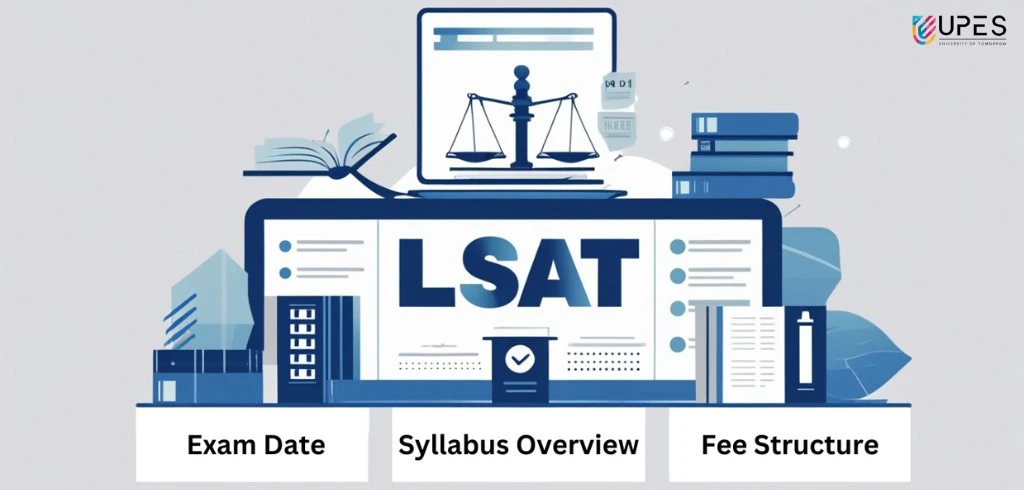
Are you planning to study in any prestigious law schools of US, Canada and other major countries? Gear yourself up for the LSAT India 2026! A standardized test called the Law School Admission Test (LSAT) is necessary for admission to law schools in the United States, Canada, and an increasing number of other nations. It is a key component of law school admissions and a means of assessing an applicant's linguistic and thinking skills. The LSAT is a test of critical thinking abilities that are developed over a lifetime, not memorization. Since the LSAT does not discriminate against students based on their field of study, its design aims to be inclusive and democratic for all test-takers.
Read the blog to get a complete understanding of LSAT dates, syllabus, exam pattern, fee, mock tests, and more.
Note: The LSAT India has been permanently discontinued.
What is LSAT Exam in India?
The Law School Admission Test (LSAT) India is a standardized entrance examination designed specifically for law school admissions in India. Unlike other entrance exams that test rote memorization or legal knowledge, LSAT India evaluates high-level cognitive skills. It measures critical thinking, logical reasoning, and reading comprehension—the core skills required for success in a rigorous legal career. Administered by the Law School Admission Council (LSAC) Global, this test is a gateway for students aiming to secure a seat in some of the most prestigious private law universities in the country.
LSAT Exam Eligibility
When thinking of taking the LSAT Exam, keep a few important information about eligibility in your mind. They are listed below:
- If you are planning on pursuing graduation in LAW, then you must have at least 45% in 10+2.
- For Postgraduation, you must have at least 45% in Graduation.
- You must have a Passport as it serves as the proof of identity.
- There is NO age-limit to taking LSAT.
- Have a look at rules of your Target law schools for eligibility. Some have unique, individual rules. Make sure to not miss them.
LSAT Age Limit
One of the most common queries among law aspirants is regarding the LSAT age limit. Fortunately, for LSAT India 2026, there is no upper age limit set by the Law School Admission Council (LSAC). Whether you are a fresh high school graduate or a working professional looking for a career shift into law, you are eligible to take the test.
However, candidates should verify the specific age requirements of their target law schools, as individual institutions may occasionally have their own criteria, though most follow the Bar Council of India’s flexible age norms.
LSAT Exam Pattern
The LSAT is a standardized test consisting of multiple-choice questions, designed to evaluate skills essential for success in law school. The exam spans 3 hours and 30 minutes and includes five timed sections, each lasting 35 minutes. Of these, four sections contribute to the total score, while one is an unscored experimental section used to test new questions or formats.
However, test-takers cannot identify which section is the experimental one. Additionally, there is an unscored writing section, completed at the end of the test, which is sent to the schools to which the candidate applies.
Scored Sections:
Reading Comprehension (1 section):
- Includes 4 reading passages (3 longer and 1 shorter) with a total of 27 questions.
- Assesses the ability to:
- Understand the main ideas of a complex text.
- Locate and interpret relevant details.
- Draw logical inferences.
- Analyze lengthy and intricate written materials.
Analytical Reasoning (1 section):
- Contains 25 questions.
- Tests the ability to:
- Analyze the impact of specific constraints on outcomes.
- Understand relationships between ideas or elements.
- Apply reasoning to uncertain or ambiguous scenarios.
- Develop conclusions based on provided conditions.
Logical Reasoning (2 sections):
- Each section comprises 25 questions, totalling 50 questions across both sections.
- Evaluates the ability to:
- Understand the central argument of a passage.
- Identify relevant information.
- Assess reasoning and logic.
- Apply abstract reasoning to draw conclusions.
Writing Section:
- This unscored section measures the ability to:
- Construct a cohesive and well-supported argument based on provided details.
- Use relevant examples or analogies to support a thesis.
- Write clearly and effectively in standard English.
The LSAT is designed to assess critical thinking, logical reasoning, and comprehension skills that are fundamental to success in legal studies and the practice of law.
LSAT Exam Duration
Efficiency and speed are key to cracking this test. The LSAT exam duration is typically 2 hours and 20 minutes for the main scored sections. The test is structured into four sections, with each section strictly timed at 35 minutes.
- Total Time: ~140 minutes (excluding breaks).
- Sectional Break: There is usually a short 10-minute break between the second and third sections.
- Time Management: Since there is no negative marking, the 35-minute-per-section limit makes it vital to answer every question without lingering too long on any single problem.
LSAT Exam Syllabus
The LSAT India syllabus is designed to assess critical reasoning, analytical thinking, and reading comprehension skills essential for success in legal studies. It consists of the following four sections:
1. Analytical Reasoning (AR):
This section evaluates your ability to analyze relationships and solve problems involving people, objects, and events. Key topics include:
- Linear Ordering: Understanding sequences and arrangements in a straight line.
- Sequencing: Arranging elements in a specific order based on given rules.
- Grouping: Categorizing items based on conditions.
- Arrangements: Structuring elements in a logical pattern.
- Logical Puzzles: Solving problems with deductive reasoning.
2. Logical Reasoning (LR):
This section tests your ability to evaluate, strengthen, or challenge arguments. Key topics include:
- Inference: Drawing conclusions from given information.
- Assumptions: Identifying unstated premises in arguments.
- Strengthening and Weakening Arguments: Evaluating factors that improve or undermine the logic of a statement.
- Fallacies: Recognizing flawed reasoning.
3. Reading Comprehension (RC):
This section measures your ability to understand and analyze complex written passages. Key focus areas include:
- Main Idea: Identifying the central theme or purpose.
- Supporting Details: Locating specific information that reinforces the main idea.
- Inference: Deriving logical conclusions from the text.
- Author’s Purpose: Understanding why the author wrote the passage.
- Tone: Recognizing the author’s attitude or perspective.
4. Writing Sample (Optional):
This 35-minute essay assesses your ability to construct a clear, concise, and persuasive argument. The topic is randomly chosen from a predefined pool, and while this section is not scored, it is sent to law schools as part of your application.
Preparation Resources:
The detailed syllabus is available on the LSAC website, along with preparation materials. Numerous LSAT preparation books and courses also provide comprehensive coverage of these topics to help candidates excel in the exam.
When is LSAT Exam 2026?
Preparing for LSAT requires dedication, accuracy, and patience. Knowing when the exam is to be conducted, you can create an exam preparation timetable accordingly. Read below:
Cancelled in 2025 (discontinued in 2026) |
Cancelled in 2026 (discontinued in 2026) |
When to Apply for LSAT 2026?
The Registration Deadline used to be for January session. Those who filled the form within the deadline window, were eligible to appear for the January session. But now the LSAT India exam has been discontinued.
How to Apply for LSAT Exam 2026
The application process is entirely digital. Follow this step-by-step guide on how to apply for the LSAT exam:
- Create an Account: Visit the official LSAT India website and register by providing your name, email ID, and mobile number.
- Fill the Profile: Complete your profile by entering academic details (Class 10, 12, or Graduation status) and personal information.
- Upload Documents: You will need to upload a recent passport-size photograph and a valid ID proof (Aadhar Card or Passport is highly recommended).
- Select Preferences: Choose your preferred test session (January or May) and list your target law colleges in order of priority.
- Pay the Fee: Complete the registration by paying the application fee through the online payment gateway (Credit/Debit Card, Net Banking, or UPI).
- Slot Booking: Once registered, keep an eye on your dashboard to book your preferred exam slot during the specified scheduling window.
LSAT India Exam Centres
| Bengaluru | Hyderabad | Gurugram | Pune |
How much does LSAT cost in India?
| LSAT India Registration Fee (January) (exam discontinued) | INR 3,999 |
| LSAT India Registration Fee (May) (exam discontinued) | INR 3,999 |
| LSAT India Registration Fee (combined for both sessions) (exam discontinued) | INR 7,998 |
LSAT Exam for Which Colleges?
If you are wondering LSAT exam for which colleges is applicable, it is important to note that over 50+ private law schools in India accept these scores. These institutions are part of the LSAC Global Alliance. Leading universities such as UPES (School of Law), Jindal Global Law School, and BML Munjal University utilize LSAT India scores for their BA LL.B., BBA LL.B., and LL.M. programs. Taking the LSAT India opens doors to premium infrastructure, international faculty, and global placement opportunities offered by these top-tier private institutions.
LSAT Exam Books and Preparation
Here’s a list of highly recommended books and resources for LSAT India preparation:
1. Comprehensive Guides
- The LSAT Trainer by Mike Kim:
- Comprehensive coverage of all question types.
- Effective strategies for tackling different sections.
2. Official Practice Materials
- 10 Actual, Official LSAT PrepTests by LSAC:
- Real past LSAT exams for practice.
- Ideal for familiarizing yourself with the test format.
3. Section-Specific Guides
- The LSAT Bible Series by David M. Killoran:
- Logic Games Bible: Detailed strategies for analytical reasoning and logical puzzles.
- Logical Reasoning Bible: In-depth explanations for logical reasoning questions.
- Reading Comprehension Bible: Techniques for mastering complex reading passages.
- LSAC Prep LSAT Strategy Guides:
- Subject-specific guides covering each section of the exam.
4. LSAT India-Specific Resources
- Books and materials tailored specifically for LSAT India format.
- Practice tests reflecting LSAT India’s question style.
5. Key Tips for Preparation
- Ensure the books are recent editions to stay updated with the latest LSAT format.
- Incorporate practice tests and official LSAT India prep materials into your study plan.
- These resources are beneficial for preparing for all LSAT versions, including LSAT India.
This structured approach ensures comprehensive preparation for every aspect of the LSAT India exam.
Pursue LAW in India:
For those of you who have missed their registration for LSAT and chances of studying in LSAT colleges, and are now worried for their future, you still have a silver lining left! You can choose to pursue LAW, either at the graduate or the postgraduate level from UPES, Dehradun. UPES School of Law is dedicated to excellence in legal education, emphasizing results-oriented learning. Through the integration of cutting-edge educational technologies, the school provides a flexible, skill-focused, and cooperative learning environment. This innovative approach prepares students with the expertise and capabilities required to succeed in the rapidly evolving field of law.
| BA LL.B. | BBA LL.B. | LL.B. | LL.M. |
Global Opportunities:
- Opportunities for master's degree advancement at ULaw, Maurer School of Law, Nottingham Trent University, and Moritz School of Law
- ULaw offers a tuition cost waiver for a semester abroad.
- The University of California, Berkeley is offering a semester abroad opportunity.
- Teaching alongside ULaw
The law programs allow students to specialize in distinct areas, each tailored to impart the expertise and knowledge essential for thriving in various legal domains. With a rigorous and well-rounded curriculum, students gain an in-depth understanding of the law and its influence on society. The highly qualified faculty fosters an engaging and enriching academic environment, enabling students to develop the critical skills needed to excel in their chosen legal specialization.
Conclusion
As you prepare for LSAT or any other law exams, make sure you are very thorough with the syllabus, exam pattern, dates, centres, and more. Keep the resources handy and study them rigorously for a robust foundation. LSAT faces one of the highest number of applications so it’s important to study for it diligently to prepare for it. Study hard and crack it. A successful career in law awaits you!
UPES Dehradun’s School of Law is an equally fruitful and enriching legal journey you can decide to embark on. Their law program provides a unique platform for students to pursue their interests while equipping them with the tools and knowledge necessary for a successful career in law. Apply Today!
FAQs:
1. Is LSAT India discontinued?
LSAT India has been officially cancelled by Law School Admission Council (LSAC) and Pearson VUE. International LSAT, though is fully active and conducted for law school admissions in US, Canada, and other global regions.
2. Is LSAT conducted twice a year?
Yes, LSAT is conducted twice, once in January and next in May, offering students the chance to better their score.
3. Is 3 months enough for LSAT?
You will have to rigorously dedicate 10-12 hours a week to crack the exam with only three months of preparation. If you lack the required time for preparation, you can stretch it to 6 months.
4. What is a good LSAT Score?
For the top 50 law schools, the median LSAT scores typically range from 164 to 174. For top-tier law schools, specifically the T14 schools, a competitive LSAT score falls between 171 and 174.
5. Is LSAT tougher than CLAT?
CLAT is considered the most challenging law entrance exam in India, whereas LSAT India is relatively easier but remains a demanding test. Administered by LSAC, a globally renowned organization recognized for its high standards in testing, LSAT India ensures a rigorous assessment of candidates' skills.

UPES Editorial Team
Written by the UPES Editorial Team
UPES Admission Enquiry
Trending Post


Related Articles














Subscribe to UPES Blogs
Join our community for exclusive stories, insights, and updates
By clicking the "Subscribe" button, I agree and accept the privacy policy of UPES.


