- Home
- Faculty
- School of Computer Science
- Mohd Hanief Wani
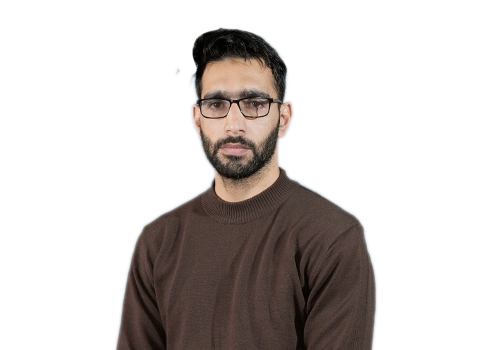
Mohd Hanief Wani
Assistant Professor
Profile Summary
Mohd Hanief Wani is a dedicated Computer Science professional with a Ph.D. specializing in deep learning-based video surveillance systems.
He has extensive expertise in computer vision, action recognition, and intelligent monitoring frameworks, along with strong skills in TensorFlow, PyTorch, and OpenCV.
He has published more than twelve research papers in SCI, SCIE, and Scopus Q1–Q2 journals and international conferences, focusing on AI-driven systems for surveillance and intelligent analysis.
Work Experience
Mohd Hanief Wani has teaching and mentoring experience in core computer science subjects with a focus on conceptual clarity and technical skill development.
He has conducted lab-based sessions, guided real-time projects, and supported students through structured mentoring, academic guidance, and skill development initiatives.
Education Qualification
Ph.D. in Computer Science (Specialization in Deep Learning-based Video Surveillance Systems).
Research Interests
Deep Learning, Computer Vision, Video Surveillance Systems, Action Recognition, Intelligent Monitoring Frameworks, Machine Learning, Multi-Object Tracking, Image Segmentation.
Teaching Philosophy
Prof. Hanief believes that conceptual clarity forms the foundation of effective learning.
He fosters an engaging and collaborative classroom environment where students connect theory with real-world applications.
His teaching approach emphasizes analytical thinking, active participation, curiosity, and continuous learning.
Courses Taught
Probability, Statistics, Linear Algebra, Applied Machine Learning.
Awards and Achievements
Qualified JKSET (2018).
Qualified UGC-NET in 2018 and 2019 for Assistant Professor in Computer Science and Applications.
Awarded UGC Junior Research Fellowship (2019–2021) and Senior Research Fellowship (2021–2024).
Scholarly Activities
Mohd Hanief Wani has published over twelve research papers in SCI, SCIE, and Scopus Q1–Q2 journals and international conferences including IEEE, Elsevier, and AIP.
His research focuses on AI-enabled surveillance systems, suspicious activity detection, multi-object tracking, and segmentation-based analysis.
He actively contributes to advancements in deep learning, computer vision, and intelligent monitoring technologies.
Contact


