Food Technology Courses: Eligibility, Scope, Salary & Your Best Fit
- UPES Editorial Team
- Published 07/12/2025


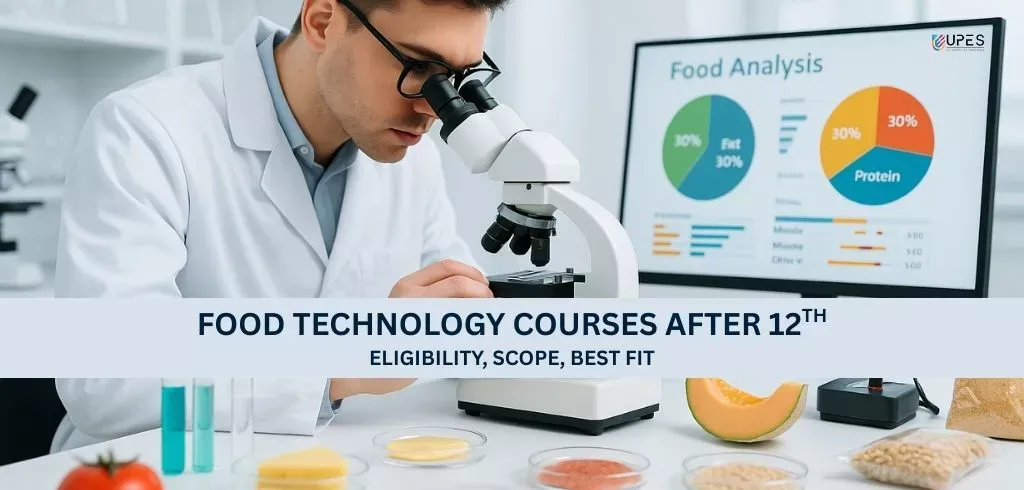
If you’re reading this, you’re probably in that confusing space where food technology courses sound exciting… but also a bit mysterious. Is it about cooking? Is it only factory work? Will you earn well? And which course should you actually choose after 12th?
You’re not alone. Many students who like science and food struggle to connect their interests to a clear career path. This guide is designed to calm that anxiety and walk you through food technology courses after 12th, eligibility, fees, scope in India, how to know whether Food Technology is a good career for you, and what to consider if, halfway through, you realise your heart lies in core engineering instead.
Become future-ready with our Health Sciences & Technology programs
Know MoreFood Technology Courses After 12th
Let’s start with the practical question: what are your options after Class 12?
Based on typical offerings in Indian universities (including the list collated by Jain University), students interested in Food Science and Technology generally choose from three broad buckets:
Degree Courses in Food Technology
These are ideal if you are serious about building a long-term career in the food sector.
1. B.Tech in Food Technology
- A 4-year btech food technology programme focusing on food processing, preservation, food plant operations, quality, and equipment. Best for students who enjoy PCM + engineering applications.
2. B.Tech in Food Engineering
- Similar to Food Technology, but with a stronger emphasis on process engineering, machinery, plant layout, and industrial systems.
3. B.Sc. Food, Nutrition and Dietetics
- A three-year course that builds a strong foundation in food science, public health, food safety, and therapeutic diets for managing disease across all age groups. Students gain practical skills through labs, industrial visits, hospital internships, and expert led master classes in areas like sports nutrition and nutrition in stressed conditions.
4. B.Sc in Food Technology
- A 3-year science-based course that dives into food chemistry, microbiology, nutrition, and quality control. More lab-heavy, less machinery-heavy.
5. B.Sc in Food Preservation
- Focused on extending shelf life – drying, freezing, canning, packaging, additives, and new preservation technologies.
6. B.Sc in Food Science and Nutrition
- Blends nutritional science with food science – great if you’re interested in health, diet, and product formulation (like fortified foods, low-sugar options, etc.).
Diplomas and Certificates
If you want a quicker entry into the workforce or want to “test the waters” before committing to a full degree:
1. Diploma in Food Technology
- Typically 1–2 years, covering the basics of food processing, hygiene, and operations.
2. Diploma in Dairy Technology
- Focuses on milk processing, value-added dairy products, and cold chain.
3. Certificate in Food Technology
- Short courses (6–12 months) for specific skills or entry-level roles.
Think of degrees as “deep dives” and diplomas/certificates as “fast tracks” or “side doors” into the industry.
Food Technology Course Eligibility
Here’s the good news: if you’re from a Science stream, you probably already meet the basic food technology course eligibility criteria.
For most B.Tech Food Technology / Food Engineering programmes, colleges typically expect:
- 10+2 with Physics, Chemistry, Mathematics (PCM)
- Minimum 50–60% aggregate, depending on the institute
- A valid score in national/state/university-level entrance exams (like JEE Main, ICAR AIEEA, or state CETs)
For B.Sc courses like Food Technology, Food Preservation, or Food Science and Nutrition, eligibility is a bit more flexible:
- 10+2 with Science stream (PCM / PCB / PCMB)
- Usually around 45–50% aggregate
- Admissions often merit-based; some universities conduct their own tests
- Diploma and certificate courses may even be open after 10th with 40–50% marks.
If you enjoy science, can handle basic chemistry and biology, and don’t mind labs and hygiene rules, you’re already in a good position to apply.
🔗Career Path: A Guide on How to Become a Nutritionist
Food Technology Courses Fees
Fees vary widely across India, especially between public and private institutions. You’ll see a broad pattern like this:
- B.Tech Food Technology / Food Engineering
- Government colleges: relatively lower fees
- Private/deemed universities: higher, often in the mid-to-upper engineering range
- B.Sc Food Technology / Food Science / Nutrition
- Generally lower than B.Tech programmes. Affordable options in state universities and colleges
- Diplomas / Certificates
- Lower overall cost. Shorter duration, so quicker return to earning
A slightly higher fee is often justified if it translates into practical skills + meaningful internships + better placements.
Food Technology Courses Salary: What Can You Expect as a Fresher?
Most students secretly want to know this first. As a fresher with a B.Tech or B.Sc in Food Technology / related fields, you can typically expect:
| Level | Salary Range | Industry/Role |
| Entry-level Salary | ₹2.5–4.5 LPA | Food processing units, QA/QC labs, FMCG manufacturing, production trainee roles |
| Mid-career (3–5 years) | ₹5–8 LPA | R&D labs, product development, food safety compliance, process optimization |
| Senior / specialised roles | ₹8–12+ LPA | Food technologist (specialist), regulatory affairs, senior R&D roles, supply chain & manufacturing supervisors |
Sources: Naukri, Indeed, Glassdoor | ||
Your salary trajectory will strongly depend on:
- The type of company you join – local plant vs established FMCG vs multinational
- Whether you work in operations, QC/QA, R&D, regulatory, or corporate roles.
- How quickly you upgrade your skills (food safety certifications, management skills, or PG degrees)
It’s not a “become-a-millionaire-in-2-years” field—but it is steady, essential, and growing, with lots of room for serious professionals to rise.
Which Course is Best in Food Technology?
Here’s where student psychology matters. The “best course” is the one that feels natural to how you like to think and work.
Choose B.Tech Food Technology / Food Engineering if you:
- Enjoy maths + physics + machines
- Can imagine yourself dealing with production lines, equipment, plant design, industrial layouts
Choose B.Sc Food Technology / Food Preservation / Food Science and Nutrition if you:
- Love chemistry, biology, and lab experiments
- Are curious about ingredients, shelf-life, nutrition, food safety
- Can see yourself working in labs, quality control, or R&D centres
Choose Diplomas / Certificates if you:
- Want to enter the industry quickly
- Prefer hands-on, skill-based roles in production, QA, or support
If you’re still unsure, imagine two days:
- One where you are in a lab, testing food samples under a microscope.
- One where you are on a factory floor, watching machines pack 10,000 packets an hour.
Which day feels more “you”? Your answer will tell you a lot.
What is the Scope of Food Technology Course in India?
The scope isn’t just “good”. It’s growing, and for a simple reason: India has a huge population, rising incomes, and a massive shift towards packaged, branded, and ready-to-eat foods.
According to sector overviews (like those shared in university blogs), graduates in Food Technology can work in:
- Food manufacturing and processing companies
- Dairy, beverages, bakery, meat and poultry units
- Food safety and regulatory bodies
- Government-run food processing units and R&D labs
- Public health offices, inspection agencies, and quality labs
Popular roles include Food Technologist, Food Safety Officer, Food Inspector, Quality Manager, Product Development Executive, and Research Associate.
Add emerging trends like health foods, plant-based products, clean labels, sustainable packaging, and online grocery ecosystems, and you can see why the sector’s demand is not going anywhere.
Is Food Technology a Good Career?
Short answer: Yes—if you are the right kind of person for it. You will likely enjoy a Food Technology career if you:
- Feel genuinely curious about what’s inside packaged foods, and how safe, tasty, and long-lasting they are
- Don’t mind following strict hygiene, safety, and documentation protocols
- Are okay with industrial environments (factories, processing plants), at least in the early years
- Enjoy steady, structured growth rather than overnight glamour
You may struggle if you:
- Expect a “desk-only, no-lab, no-factory” job from day one
- Absolutely dislike science subjects or can’t stand the smell of processing plants
- Are chasing only the highest headline salary without caring about the work itself
The most satisfied people in Food Technology are usually those who say things like: “I like knowing that the products on shelves are safe because of systems I helped design or monitor.” If that resonates with you, you’re probably on the right track.
What if You Realise You Prefer Core Engineering Over Food?
Many students researching food technology courses also look at allied science and engineering fields. Sometimes, during this process, they realise:
- “I actually get more excited about circuits, chips, and semiconductors than about food products.”
- If that’s you, it’s worth pausing and considering a core engineering specialisation, rather than forcing yourself into Food Technology just because it sounds “safe”.
- It’s okay to start by exploring one field and discover that another actually fits you better—that’s smart, not confusing.
FAQs on Food Technology Courses
- Can I pursue Food technology courses after 12th Science?
- Yes. After 10+2 with Science (PCM/PCB), you can apply for B.Tech or B.Sc Food Technology / Food Science programmes, as well as diplomas. A 4-year B.Tech or 3-year B.Sc is the standard route into the field.
- Yes. After 10+2 with Science (PCM/PCB), you can apply for B.Tech or B.Sc Food Technology / Food Science programmes, as well as diplomas. A 4-year B.Tech or 3-year B.Sc is the standard route into the field.
- What entrance exams are needed for B.Tech Food Technology?
- Many institutes accept scores from exams like JEE Main, ICAR AIEEA, MHT CET, KCET, or their own university-level entrance tests. For B.Sc programmes, admissions are often merit-based, but some universities conduct separate entrance exams.
- Many institutes accept scores from exams like JEE Main, ICAR AIEEA, MHT CET, KCET, or their own university-level entrance tests. For B.Sc programmes, admissions are often merit-based, but some universities conduct separate entrance exams.
- Is Maths compulsory for Food Technology?
- For B.Tech Food Technology / Food Engineering, Maths is typically compulsory in 12th (PCM). For many B.Sc Food-related programmes, Maths may not be mandatory if you have PCB, but criteria vary by university.
- For B.Tech Food Technology / Food Engineering, Maths is typically compulsory in 12th (PCM). For many B.Sc Food-related programmes, Maths may not be mandatory if you have PCB, but criteria vary by university.
- How many years does a Food Technology course take?
- B.Tech: 4 years
- B.Sc: 3 years
- Diplomas: usually 1–2 years
- Certificates: 6–12 months
- Postgraduate options like M.Tech/M.Sc take an additional 2 years.
- Which job is best in Food Technology?
- There is no single “best” job, but many students aim for roles like Food Scientist, Food Technologist, Quality Assurance Manager, Food Safety Officer, or Product Development Executive, depending on whether they prefer lab work, inspection, or innovation.
- There is no single “best” job, but many students aim for roles like Food Scientist, Food Technologist, Quality Assurance Manager, Food Safety Officer, or Product Development Executive, depending on whether they prefer lab work, inspection, or innovation.
- Can I become a Food Inspector or Food Safety Officer?
Yes. You generally need a relevant degree in Food Technology, Food Science, Microbiology, or related fields, and then you must clear competitive exams conducted by agencies like FSSAI or State Public Service Commissions.

Our counsellors are just a click away.
Conclusion
Your decision of opting for a Food Technology course boils down to a few honest questions:
- Do I enjoy science enough to study food at a technical level, not just as a hobby?
- Do I see myself in labs and plants, working on safety, quality, and processes?
- Am I okay with steady, structured growth in a sector that will always matter?
If your answers are mostly “yes”, then exploring food technology courses after 12th, whether B.Tech, B.Sc, or a diploma, is a very sensible next step.
Whatever you choose, let it be based on self-awareness, not pressure. That’s how careers become satisfying, not just “safe”.

UPES Editorial Team
Written by the UPES Editorial Team
UPES Admission Enquiry
Trending Post
-

-

Paramedical Courses After 12th – Streams, Salary & Non-Exam Courses
22/08/2025By UPES Editorial Team
-

Study Medicine Globally: 5-Year Accelerated MD Pathway by UPES and MUA
10/07/2025By UPES Editorial Team


Related Articles
























Subscribe to UPES Blogs
Join our community for exclusive stories, insights, and updates
By clicking the "Subscribe" button, I agree and accept the privacy policy of UPES.


