Entrance Exams for Humanities Students After 12th & Prep Tips
- UPES Editorial Team
- Published 10/04/2026


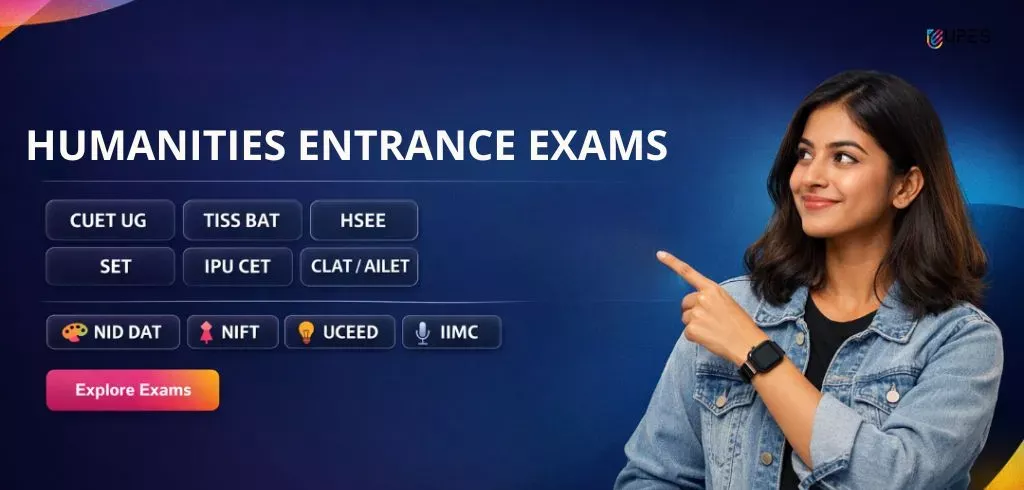
If you’re from the Humanities/Arts stream, the hardest part isn’t “lack of options.” It’s the opposite: too many options, too many entrance exams, and too much confusing advice (“Do BA,” “Try CLAT,” “Design is risky,” “CUET solves everything”). No wonder you feel stuck.
This blog is designed to give you clarity. You’ll learn what humanities entrance exams are, which ones matter after 12th, how eligibility works (exam vs university rules), what the syllabus typically includes, and how to pick between a common entrance exam and a specialized entrance exam, without wasting months on the wrong prep plan.
Humanities Entrance Exams
Humanities entrance exams are tests used by universities/institutes to shortlist students for undergraduate programmes commonly chosen after 12th Humanities- like BA (Hons), Liberal Arts, Psychology, Sociology, Journalism & Mass Communication, Social Work, Design, Performing Arts, and even Hotel Management.
The two buckets you should understand first
Common entrance exam (one exam, many universities)
- Examples: CUET (UG), widely used for UG admissions across participating universities.
- Examples: CUET (UG), widely used for UG admissions across participating universities.
Specialized entrance exam (one field-focused exam)
- Examples: CLAT (law), ULSAT (law), UPESDAT (design selection), UCEED (design aptitude), NID DAT (design selection), NIFT entrance (fashion/design).
A high-utility list of entrance exams after 12th Humanities (not just CUET)
Apart from CUET UG, there are many Humanities entrance exams you can undertake depending on the career path you wish to walk upon:
- HSEE (IIT Madras) for a 5-year integrated programme
- FEAT (FLAME Entrance Aptitude Test)
- Azim Premji University NET
- SNUSAT (Shiv Nadar University Scholastic Aptitude Test)
- NCHMCT JEE (Hotel Management)
Many universities and institutes also have their unique entrance exams for the programs they are offering. Major ones are listed below:
- UPES ULSAT for law programs
- IPU CET (BA programmes at GGSIPU)
- Ashoka University exam (liberal arts)
- SET (Symbiosis) (BA pathway)
- NID DAT / UPESDAT/ UCEED / NIFT / MITID DAT (Design & Fine Arts)
- NSD entrance (drama), FTII/SRFTI JET (film/TV), IIMC entrance (journalism/mass communication)
Quick decision table (pick your direction before you pick your exam)
| If you want to study… | Start with these exams | Why they fit |
| BA/Liberal Arts/Social Sciences | CUET + Liberal Arts exams (FEAT/SNUSAT/Azim Premji NET) | Tests core aptitude + broad academic readiness |
| Law (5-year integrated) | ULSAT/CLAT / AILET | Tests reading + reasoning + current affairs |
| Design (interiors/communication/product/fashion) | UPESDAT/UCEED / NID DAT / NIFT | Tests design aptitude + creativity + observation |
| Hospitality/Hotel Management | NCHMCT JEE | Specific to hospitality programmes |
Humanities Entrance Exams Eligibility
Most students waste time because they assume “Humanities eligibility” is one thing. In reality, eligibility changes by (a) exam and (b) the programme/university.
CUET (UG) eligibility
The official CUET (UG) 2026 bulletin clearly lays out key points:
- Exam mode is CBT (computer-based test).
- You can choose up to five subjects, including languages and the General Aptitude Test—irrespective of subjects in Class XII, but your choices should match university programme eligibility.
So CUET can be flexible, but you still need to align your subject choices with the course you want.
Law eligibility
CLAT, ULSAT, and AILET are not “Humanities-only” exams—students from any stream appear. What matters more is your reading ability, reasoning skills, and consistency in prep.
Design eligibility
UPESDAT, UCEED, NID DAT, and NIFT pathways typically allow students from different streams (check the year’s brochure/handbook).
Where UPES fits (and why this can simplify your decision)
If you’re leaning toward a multidisciplinary, career-oriented Humanities path, UPES offers a structured option through the School of Liberal Studies and Humanities—built around a multidisciplinary, learner-driven approach and “live connection to the real world.”
Programmes offered are:
| B.Sc. (H) Economics and Finance | B.Sc. (H) Economics with Data Science | B.Sc. (H) Psychology and Behaviour | BA (H) English |
| BA (H) Political Science | BA (H) History | BA (H) Sociology | BA (H) Philosophy |
| BA (H) Diplomacy and Foreign Policy | BA (H) Environmental and Sustainability Studies | BA (H) Governance and Public Administration | BA Digital and Mass Media |
| BA Journalism and Mass Communication | BA Journalism and Mass Communication (Global) — 2 Years in UPES Campus +2 Years in Overseas Campus |
Below are the eligibility and the selection criteria at UPES:
- Eligibility: minimum 50% marks in Class X and XII
- Selection criteria: Personal Interview / CUET
Humanities entrance exams syllabus
The syllabus depends on the exam type. The smartest strategy is to prepare the overlap first (English + reasoning + basic quant + GK), then add the specialised layer (legal reasoning or design aptitude or domain subjects).
Most Humanities entrance tests overlap in 4 areas:
- English & comprehension
- Reasoning (logical/analytical)
- General awareness / current affairs
- Basic quantitative ability (usually arithmetic-level)
Then each exam adds its specialised layer.
CUET (UG) 2026 syllabus
CUET (UG) 2026 key structure (as per the official Information Bulletin):
- Total subjects: 37 (13 languages + 23 domain subjects + 1 General Aptitude Test)
- Choice: up to 5 subjects
- Marking: +5 for correct, -1 for incorrect
- Per paper: 50 compulsory questions, 60 minutes
- Syllabus cues:
- Language: reading comprehension + vocabulary
- Domain: as per NCERT syllabus
- General Aptitude Test: GK, current affairs, mental ability, numerical ability, reasoning
Practical takeaway for Humanities students: CUET rewards accuracy + speed. Build reading habits early and do timed mocks.
HSEE (IIT Madras) syllabus
HSEE syllabus is as follows:
- Part I: English & comprehension, analytical/quant ability, general studies
- Part II: essay writing (argument + perspective + examples)
If you’re strong at reading + structured writing, HSEE can be a great fit.
FEAT (FLAME) syllabus
Find FEAT exam pattern listed below as:
- 4 sections: Verbal Ability, Reasoning, Quantitative Ability, General Knowledge
- 100 MCQs, 120 minutes, no negative marking
Azim Premji University NET syllabus
The syllabus is listed below:
- Paper I: English + quantitative reasoning
- Paper II: written test (essay/data analysis/problem solving)
- Marking scheme and two-part mode are also described in their summary.
SNUSAT syllabus
SNUSAT pattern is:
- Sections: verbal reasoning, quantitative ability, abstract reasoning, essay writing
- No negative marking and remote-proctored format (as per their summary).
CLAT, ULSAT & AILET syllabus
- CLAT UG 2026: 2 hours, 120 MCQs, negative marking 0.25; sections include English, GK, legal reasoning, logical reasoning, quantitative techniques.
- ULSAT 2026: 150 MCQs, 120 minutes; Language Comprehension (30), Quantitative & Numerical Ability (30), Logical Reasoning (30), Legal General Knowledge (30), and Legal Aptitude (30).
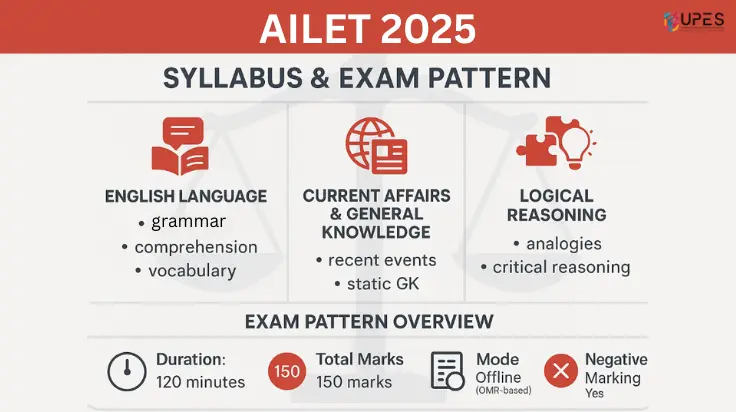
- AILET UG 2026: 150 MCQs, 120 minutes; English (50), GK/Current Affairs (30), Logical Reasoning (70).
Design exams syllabus
- UCEED tests design aptitude areas like visualization/spatial reasoning, practical/scientific knowledge, observation/design sensitivity, etc.
- UPESDAT is conducted online for a duration of 1 hour in which your knowledge of visual analogy, design, and general awareness is tested. There are a total of 40 questions.
- NID DAT admissions handbook explains DAT Prelims is used for shortlisting only, and final admission weightage comes through DAT Mains (studio + in-person sensitivity tests).
- NIFT admissions guidelines explain GAT + CAT for B.Des, followed by a Situation Test; and mention negative marking (+1 / -0.25) for the objective test.
Mini-prep checklist (works for most humanities entrance exams)
- Daily reading (editorials + long-form articles): 45 minutes
- 20–30 reasoning questions/day (mixed sets)
- Weekly current affairs notes + monthly revision
- 1 mock/week → then 2 mocks/week as exam nears
- Maintain an “error log” (most underrated score booster)
Check Out: Scholarship for Humanities Students in India
Common Entrance Exam
A common entrance exam is one test that can unlock admissions across multiple universities—reducing the number of separate tests you need to prepare for. CUET (UG) is the big one for Humanities admissions
CUET (UG) 2026 is structured with:
- Up to 5 subject choices
- 50 compulsory MCQs, 60 minutes per paper
- +5/-1 marking
But here’s the catch: the bulletin also makes it clear you should select subjects based on programme eligibility criteria of the university you want.
How to use CUET strategically (simple 4-step plan)
- Shortlist 6–10 target programmes/universities
- Note required subject combinations
- Choose CUET papers accordingly (don’t guess)
- Prepare through timed mocks + error log
Specialized Entrance Exam
A specialized entrance exam is field-focused. It tests whether you can thrive in that specific discipline. Specialized exams that Humanities students commonly take
- CLAT / ULSAT/ AILET for Law
- UCEED / UPESDAT/ NID DAT / NIFT for Design
- HSEE for IIT Madras integrated humanities route
- Liberal arts institute tests like FEAT / SNUSAT / Azim Premji NET
When a specialised exam is the better choice than CUET
Choose specialised exams if:
- you’re sure about a professional track (law/design)
- you prefer skill-based evaluation (portfolio, studio tests, reasoning)
- you want institute-specific advantages (curriculum design, ecosystem, exposure)
Conclusion: How to choose the best humanities entrance exams for you (and take action)
If you’re confused right now, that’s normal—Humanities has the widest range of pathways after 12th. The mistake isn’t confusion. The mistake is random preparation.
Do this instead:
- Pick your direction (Liberal Arts / Law / Design / Hospitality)
- Choose 1 primary exam + 1 backup
- Prepare the common core (English + reasoning + GK + basic quant)
- Add the specialised layer only after your path is clear
And if you want a future-facing Humanities education with interdisciplinary options and a structured selection route (Personal Interview/CUET), explore UPES’s School of Liberal Studies and Humanities.

UPES Editorial Team
Written by the UPES Editorial Team
UPES Admission Enquiry
Trending Post
-
![]()
-
![]()
LSAT for Law Students- Dates, Syllabus, Exam Pattern, Fees, Mock Tests
05/02/2025By UPES Editorial Team
-
![]()


Related Articles









Subscribe to UPES Blogs
Join our community for exclusive stories, insights, and updates
By clicking the "Subscribe" button, I agree and accept the privacy policy of UPES.


