PhD Colleges in Dehradun: Merit-Based Comparison
- UPES Editorial Team
- Published 03/02/2026


- What Makes Dehradun a Top Destination for a PhD Program?
- Duration and Eligibility for a PhD in Dehradun
- Government PhD Colleges in Dehradun
- PhD Colleges in Dehradun with Fees: Private Universities and Value
- Choosing the Right PhD Program in Dehradun: Courses and Scope
- The PhD Admissions Process in Dehradun: A Step-by-Step Checklist
- How to Choose the Best PhD College in Dehradun for You
Choosing a PhD is one of the most critical decisions of your life, and the institution you select will shape your career for decades. With a mix of prestigious government institutions, specialised research centres, and modern private universities, the choices among PhD colleges in Dehradun can be overwhelming.
We will give you a clear, comprehensive breakdown of the best PhD colleges in Dehradun, covering everything from admission criteria and diverse course offerings to fee structures and career scope. By the end, you'll have the actionable insights you need to confidently begin your doctoral application process.
What Makes Dehradun a Top Destination for a PhD Program?
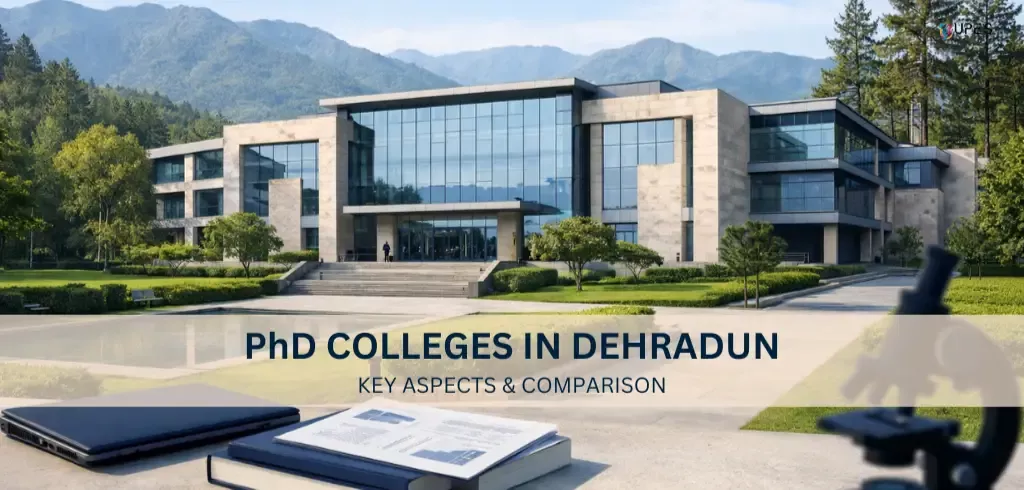
Dehradun is often called the "Education Hub of Uttarakhand." It strikes a perfect balance: a city with a pleasant climate and low distraction environment yet hosting world-class institutes.
Beyond the academic institutions themselves, Dehradun’s strength lies in its ecosystem. It is home to nationally important research bodies like the Forest Research Institute (FRI), the Wildlife Institute of India (WII), and the Indian Institute of Remote Sensing (IIRS). This concentration of specialised government bodies offers unique opportunities for interdisciplinary research, especially in Environmental Science, Forestry, Geology, and related fields.
Duration and Eligibility for a PhD in Dehradun
A PhD is a commitment, and understanding the basic requirements is the first step.
| Aspect | Full-Time PhD (Typical) | Part-Time PhD (For Working Professionals) |
Duration | Minimum 3 years, Maximum 6 years (including Course Work) | Minimum 4 years, Maximum 8 years (including Course Work) |
Basic Eligibility | Master's degree (or equivalent professional degree) in a relevant field with a minimum of 55% marks (50% for reserved categories, as per UGC norms). | Same as Full-Time; additionally, a No-Objection Certificate (NOC) from the current employer is mandatory. |
Admission Process | Entrance Test (RET/University Test) + Interview/Viva-Voce | Entrance Test (RET/University Test) + Interview/Viva-Voce |
Exemption | Candidates with a valid UGC-NET/CSIR-NET/GATE/SLET/JRF score are generally exempt from the University Entrance Test. | Candidates with a valid UGC-NET/CSIR-NET/GATE/SLET/JRF score are generally exempt from the University Entrance Test. |
Government PhD Colleges in Dehradun
For many aspiring researchers, a government-run institution represents a gold standard in terms of academic rigor, affordability, and research-focused funding. While a few major government research centres are located near Dehradun (like IIT Roorkee, which is close by), Dehradun itself has key State Government Universities and specialised institutes.
Top Government/State University Options
- Doon University (DU): As a State Government University, DU is known for its multi-disciplinary approach.
- PhD Programs: Strong focus on Social Sciences, Languages (e.g., Chinese, Japanese, French), Media & Communication, Environmental Studies, and Physical Sciences (Physics, Chemistry, Maths).
- Admission: Based on a University-level entrance test or UGC-NET score, followed by an interview where candidates discuss their research proposal.
- Uttarakhand Technical University (UTU): This is the leading technical university in the region, focusing on engineering and applied sciences.
- PhD Programs: Engineering specialisations (CSE, Mechanical, Civil, Electrical), Applied Sciences (Biotech, Physics, Maths), and Management.
- Focus: Strong emphasis on technological research, innovation, and industry-aligned projects.
- Forest Research Institute (FRI): A globally renowned premier institute for forestry, biodiversity, and environmental science.
- PhD Programs: Forestry, Ecology, Environmental Management, Wood Science, and allied disciplines.
- Unique Feature: Offers an unparalleled research environment for students pursuing highly specialised work in ecological studies and resource management.
Key Advantage: Scholarships and Fellowships
The major benefit of pursuing a PhD from government PhD colleges in Dehradun is access to numerous government-funded scholarships and fellowships.
- JRF/SRF: UGC-NET/CSIR-NET JRF recipients get a substantial monthly stipend (currently ₹31,000 for JRF and ₹35,000 for SRF, plus HRA).
- Project-Based Grants: Many government institutes run projects funded by bodies like DST, DBT, and CSIR, offering Research Assistantships (RAs).
PhD Colleges in Dehradun with Fees: Private Universities and Value
Private universities in Dehradun have rapidly evolved to offer state-of-the-art infrastructure, flexible PhD formats (full-time and part-time), and interdisciplinary research centres that rival their public counterparts. While the fee structure is generally higher, many top private institutions offer substantial scholarships/waivers for meritorious and full-time research scholars.
Top Private Research Universities
| University Name | Specialisation Highlights | Fees | Scholarship/Waiver Potential |
| UPES | Engineering, Computer Science, Law, Health Sciences, Management, Design, Liberal Studies | 1 lakh per semester | Up to 75% fee waiver and monthly stipend for full-time scholars. |
| DIT University | Computer Science, Engineering, Management, Pharmacy | Check Official Website | Merit-based scholarships often available. |
| Graphic Era University | Engineering, Computer Science, Management, Humanities | Check Official Website | Often offers scholarships for UGC-NET/GATE qualified candidates. |
| ICFAI University | Management, Law, Technology, Education | Check Official Website | Based on the entrance exam and academic merit. |
Note: The above fee range is for tuition only and is an approximate estimate. It can vary significantly based on the specific program, duration, and whether you are full-time or part-time. Always check the official college website for the most accurate and current fee structure.
Focus on Value: UPES's Full-Time PhD Model
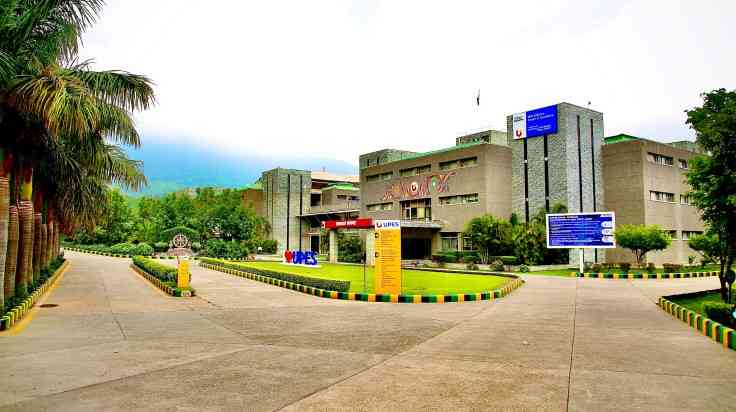
Among the PhD colleges in Dehradun, UPES stands out for its strong emphasis on high-impact research across diverse fields. Their PhD programs are structured not just for academic pursuit but also for real-world application, supported by dedicated research centres.
Why consider the PhD Program at UPES?
- Significant Financial Support: Full-time scholars at UPES may receive a 75% waiver on the program semester fee. Additionally, selected full-time scholars may receive a monthly fellowship (stipend) of up to ₹30,000.
- Interdisciplinary Centres: UPES hosts specialized research centres like the Centre for Data-Science and Artificial Intelligence (C-DSAI) and the Centre for Inter-Disciplinary Research and Innovation (CIDRI), which foster cross-boundary research—a critical need in today's complex world.
- Industry Integration: The curriculum focuses on developing skills in alignment with industry demands, ensuring that the research has translational value.
If a research-driven environment with substantial financial support in emerging areas is your goal, you should explore the specialised PhD programs and fellowship criteria at UPES.
Choosing the Right PhD Program in Dehradun: Courses and Scope
The right PhD program should align your passion with market demand and the university's research strengths. Dehradun offers specialisations across every major domain.
1. PhD in Engineering & Technology
This is a major research area in Dehradun, especially at institutions like UTU, UPES, and DIT University.
| Specialisation | Key Focus Areas | Career Scope & Salary Potential |
Computer Science & Engineering (CSE) | AI/ML, Cyber Security, Data Science, Advanced Algorithms. | Research Scientist (R&D Labs), Academic Professor, Senior Data Scientist. |
Petroleum/Chemical Engineering | Oil & Gas exploration, Renewable Energy Systems, Sustainable Chemical Processes. | Research Consultant (Energy Sector), R&D Manager (Oil/Gas PSU/Pvt.), Professor. |
Aerospace Engineering | Advanced Materials, Propulsion Systems, Drone/UAV Technology. | Scientist/Engineer (DRDO, ISRO, Private Defence firms). |
Pick one target role, double down on 2–3 technical skills and 2–3 soft skills from the table, and build real projects or experiences around them, that’s what gets you shortlisted and remembered.
2. PhD in Management (Business Research)
A PhD in Management (often called FPM or Fellow Programme in Management) is about original theoretical or empirical research in business functions.
- Specialisations: Finance, Marketing, Human Resource Management (HRM), Operations Management, Strategy, and Business Analytics.
- Institutes: UPES School of Business, IMS Unison University, and others.
- Career Scope: Academic faculty in IIMs/Top B-Schools, Management Consultants, Chief Economists, or Senior Research Analysts in corporate strategy teams.
3. PhD in Law and Policy
With a focus on legal research, institutions in Dehradun are increasingly offering PhDs in Law.
- Specialisations: Constitutional Law, Intellectual Property Rights (IPR), Criminal Law, Environmental Law, and Public Policy.
- Key Skills: Deep legal analysis, comparative jurisprudence, public policy critique, and drafting skills.
- Career Scope: Legal Scholar, High Court Advocate/Consultant, Policy Advisor (Government/Think Tanks), and Law School Professor.
4. PhD in Health & Life Sciences
Institutes like Swami Rama Himalayan University (SRHU) and UPES School of Health Sciences & Technology offer robust research in medical and life sciences.
- Specialisations: Biotechnology, Microbiology, Biochemistry, Epidemiology, Cancer Biology, and Pharmacy.
- Research Focus: Translational research—moving discoveries from the lab (bench) to patient care (bedside) and industrial application.
- Career Scope: Lab Director, Pharma R&D Scientist, Clinical Researcher, and Academic Professor.
5. PhD in Liberal Studies / Liberal Arts
This discipline focuses on interdisciplinary research that transcends traditional academic boundaries, blending humanities, social sciences, and often technology to solve complex, real-world problems.
- Specialisations: English, Digital Humanities, Cultural Policy, Ethics of Technology (AI/Data), Gender and Social Justice, Environmental Humanities.
- Institutes: UPES School of Liberal Studies, Doon University, and others.
- Career Scope: Academic Professor (Liberal Arts/HSS), Policy Analyst (Think Tanks/NGOs), Senior Communications Director, Cultural Researcher/Curator.
The PhD Admissions Process in Dehradun: A Step-by-Step Checklist
Understanding the admission sequence is crucial to secure a seat in your desired PhD program in Dehradun. The process is fairly standardised across both government and private universities, following UGC guidelines.
Step 1: Meet the Minimum Eligibility Criteria
- Verify you have the required Master’s degree percentage (typically 55%).
- If you are a working professional, obtain the necessary NOC from your employer for a Part-Time PhD.
Step 2: Clear the Entrance Requirement
This is the most critical hurdle.
- Option A: Exemption: If you have qualified for UGC-NET/CSIR-NET/GATE (especially JRF), you are often exempt from the university-specific Entrance Test (RET). This is a massive advantage.
- Option B: University Entrance Test (RET): If you don't have a National-level qualification, you must appear for the university's Research Entrance Test (RET).
- Syllabus: Usually 50% Research Methodology and 50% Subject-Specific Aptitude.
Step 3: Prepare the Research Proposal
After clearing the test (or securing an exemption), you must submit a detailed research proposal (typically 1000–2500 words).
- Expert Tip: Your proposal must clearly define a Research Gap (what hasn't been studied), your Research Question (what you will study), and the Methodology (how you will study it). A strong proposal is key to the final interview.
Step 4: The Interview / Viva-Voce
This is the final selection stage, where your research aptitude is assessed.
- Key Focus: The panel (Research Degree Committee or RDC) will question you on your proposed research topic, your understanding of the relevant literature, and your commitment to the long-term research process.
- Weightage: In many universities, the entrance score carries 70% weightage, and the interview carries 30%.
How to Choose the Best PhD College in Dehradun for You
The journey to earn a doctoral degree is a marathon, not a sprint. The best PhD colleges in Dehradun offer an inspiring blend of natural serenity and serious research focus. Your choice should not be based on a ranking number alone, but on a critical match between the university’s resources and your research ambitions.
Your Final Selection Checklist:
- Match your research area: Does the university have faculty with expertise in your exact research niche?
- Assess the infrastructure: Does the college have the specialised lab, data centre, or library resources you need for your thesis?
- Evaluate the financial model: Can you secure a JRF/SRF, or does the college offer substantial fee waivers and stipends for full-time research?
For high-demand, interdisciplinary fields like Artificial Intelligence, Energy, or Public Policy, institutions like UPES provide a modern, industry-aligned platform with dedicated research centres and financial support.
FAQs on PhD Colleges in Dehradun
Q1. Is a PhD from a private university in Dehradun valuable?
A PhD's value comes from the quality of research and publications, not just the college tag. Top private universities in Dehradun like UPES, DIT, and Graphic Era offer excellent infrastructure, high-end labs, industry tie-ups, and a strong culture of interdisciplinary research, making their PhDs highly valuable in both academia and industry.
What is the approximate fee for a PhD in Dehradun?
The tuition fee can range widely. For government universities and institutes like FRI or Doon University, the fees are generally lower (tens of thousands per year). For private PhD colleges in Dehradun, the fees can range from ₹70,000 to ₹1,50,000 per semester. However, many private institutions offer substantial fee waivers and monthly stipends for full-time research scholars, which can effectively cover a significant portion of the cost.
Is a full-time PhD better than a part-time PhD?
A Full-time PhD is generally preferred as it allows the scholar to dedicate all their time and energy to research, leading to faster completion and better publication quality. A Part-time PhD is suitable for working professionals who need to balance their job with research, but it requires more discipline and typically takes longer (up to 8 years).
Which research areas are growing the fastest in Dehradun?
Due to the city’s environment and focus, the fastest-growing research areas are:
- Environmental Science/Sustainability: Leveraging institutes like FRI and WII.
- Data Science & AI: Driven by leading technical universities.
- Energy & Petroleum Technology: Focused on the energy sector's demands.
Are there scholarships for PhD students in Dehradun?
Yes, absolutely. Apart from the central government's UGC/CSIR JRF (which is the most common), many private PhD colleges in Dehradun offer their own merit-based scholarships and monthly stipends specifically for full-time researchers. Always check the scholarships page on the university website.
Conclusion
Don’t let confusion lead to inaction. Start by finalising your research topic and compiling your documents. Take the next step in your academic career. Explore the detailed PhD specialisations, admission schedule, and available research fellowships at UPES to find the program that will turn your research idea into a lasting contribution.

UPES Editorial Team
Written by the UPES Editorial Team
Tags
- Guest Blogs
UPES Admission Enquiry
Trending Post
-
![]()
Best Law Colleges in North India 2026: Government, Private, Rankings & Fees
15/10/2026By UPES Editorial Team
-
![]()
Best Private Engineering Colleges in North India 2026: Rankings, Fees & Admissions
08/10/2026By UPES Editorial Team
-
![]()
MBA Colleges in North India 2026: Government, Private, Rankings & Fees
28/09/2026By UPES Editorial Team


Related Articles



















Subscribe to UPES Blogs
Join our community for exclusive stories, insights, and updates
By clicking the "Subscribe" button, I agree and accept the privacy policy of UPES.


