Technical skills vs Soft Skills: What employers in India value more in entry-level hires
- UPES Editorial Team
- Published 19/12/2025


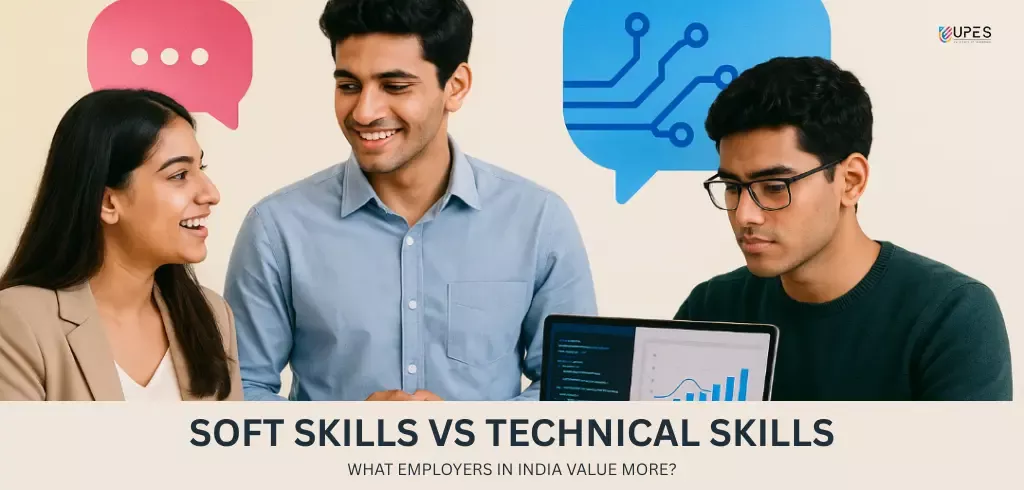
- Technical Skills Vs Soft Skills: The Quick Definition
- Technical Skills vs Soft Skills Examples (With Role-Wise Priorities)
- Soft Skills vs Technical Skills: Group Discussion (How to Stand Out)
- Soft Skills vs Hard Skills (Understand the Recruiter’s Lens)
- Common hard skills by function (entry-level)
- Most valued soft skills (with micro-behaviours)
- Technical Skills and Soft Skills in Resume (ATS-Friendly Templates)
Breaking into your first job can feel like decoding a secret formula. Do companies care more about coding or communication, Excel or empathy? The truth is: both matter but how they matter is different. This blog unpacks soft skills vs technical skills for Indian entry-level roles, shows what to prioritise for the job you want, and gives ready-to-use examples for your resume, group discussions, and interviews.
You’ll learn: clear definitions, sector-wise priorities, resume templates, GD strategies, and a practical checklist, plus where a university like UPES can help you build job-ready skills with industry projects and mentoring.
Technical Skills Vs Soft Skills: The Quick Definition
Technical skills are job-specific abilities you can measure and test (e.g., Python, Tally, AutoCAD, FEA). Soft skills are people and work-habits that transfer across roles (e.g., communication, problem-solving, teamwork, ownership). For most entry-level hiring in India, recruiters use technical skills to screen and soft skills to select.
Technical Skills vs Soft Skills Examples (With Role-Wise Priorities)
Use this table to decide where to invest your prep time based on the role you’re targeting.
| Target Role (Entry-Level) | Technical Skills (Screening) | Soft Skills (Selection) | What Usually Matters More |
DSA, Python/Java, SQL, Git, basic cloud, EDA | Problem-solving clarity, collaboration, communication | Both, slight tilt to technical | |
Business Analyst / Consulting Analyst | Excel/SQL, data visualisation, market sizing | Structured thinking, client communication, stakeholder management | Soft skills after a basic tech bar |
Digital Marketing / Growth | SEO/SEM basics, GA4, Excel, experimentation | Storytelling, creativity, analytical curiosity | Balanced |
Finance / Accounting | Tally/ERP, Excel (lookups, pivots), basics of tax/IFRS | Accuracy, integrity, deadline discipline | Technical to enter; soft to grow |
Mechanical / Civil / Electrical | CAD, basics of simulation/estimation/quality | Safety mindset, coordination on site, documentation | Technical to qualify; soft to keep projects on track |
UX / Product / Media | Figma, research methods, prototyping/editing | Empathy, feedback handling, presentation | Portfolio + soft skills |
Pro Tip: Recruiters often start with an online assessment to check your technical skills. After you clear that bar, interviewers compare soft skills to judge culture fit, client-readiness, and leadership potential.
Soft Skills vs Technical Skills: Group Discussion (How to Stand Out)
Group Discussions (GD) are designed to stress-test soft skills under time pressure while verifying domain awareness. Here’s a mini-playbook:
A. 90-Second Setup (Your Opening)
- Frame the topic: Define terms (e.g., Technical skills are job-specific; soft skills transfer across functions.).
- State a stance: For entry-level hiring, technical skills get you shortlisted; soft skills decide the offer.
- Offer a structure: Let’s compare across IT, finance, and operations, then conclude with a hiring sequence.
B. During the Discussion
- Advance the conversation, don’t dominate. Add 1 new point per turn.
- Use micro-data points: short examples (“A fresher with SQL + clear problem-framing often beats a topper who can’t explain results.”)
- Bridge and build: “Adding to Aditi’s point on client-facing roles…”
- Invite voices: “We haven’t heard from Rohan—what do you think from a design angle?”
- Stay time-aware: “We have 2 minutes—shall we converge on 3 hiring takeaways?
C. 30-Second Close
Summarise the consensus and clearly state the tech-then-soft hiring funnel: screen on technicals; select on softs.
Soft Skills vs Hard Skills (Understand the Recruiter’s Lens)
Hard skills are the “must-have” baseline that reduces on-the-job training time; soft skills reduce project risk (missed deadlines, poor communication, rework). Recruiters optimise for time-to-productivity and risk-reduction. That’s why you’ll see this pattern:
- Shortlist: hard/technical skills (tests, portfolios, case tasks)
- Select: soft skills (communication, ownership, teamwork, growth mindset)
Common hard skills by function (entry-level)
- IT/Analytics: DSA, Python/Java, SQL, Git, basic cloud, Excel/Power BI
- Finance/Accounting: Excel, Tally/ERP, GST/TDS basics, reporting hygiene
- Engineering Core: CAD, GD&T, estimation, QA/QC, safety norms
- Marketing/Growth: SEO/SEM, analytics tools, campaign ops, copy basics
- Design/Media: Figma/Adobe, research, prototyping/editing.
Most valued soft skills (with micro-behaviours)
- Structured thinking: turns a vague problem into steps; uses MECE lists
- Communication: concise updates, visual summaries, clear asks
- Collaboration: documents decisions; hands off work cleanly
- Ownership: flags risks early; meets commitments; asks for help in time
- Learning agility: ships quick MVPs; iterates after feedback.
Soft Skills and Hard Skills: Key Differences (At a Glance)
| Aspect | Hard/Technical Skills | Soft Skills |
What it is | Job-specific, measurable abilities | Interpersonal, cognitive, self-management |
How assessed | Tests, assignments, simulations, portfolios | Interviews, GDs, behavioural questions, references |
Time to acquire | Faster with focused practice/courses | Slower; built via projects, reflection, feedback |
Shelf-life | Can get outdated (tools/versions) | Long-lasting, compound with experience |
Impact on hiring | Shortlisting | Final selection & growth |
Hiring takeaway: Meet the technical bar to enter the room; show soft-skill signals to win the seat.
Technical Skills and Soft Skills in Resume (ATS-Friendly Templates)
When recruiters skim your CV, they’re scanning for two things: “Can you do the job?” and “Will you be easy to work with?” That’s exactly where technical skills and soft skills in your resume come in. Use the table below to see which skills matter most for different roles and how to actually build them before you graduate:
| Target Role | Most Sought-After Technical Skills (for Resume) | Most Sought-After Soft Skills (for Resume) | How to Develop Technical Skills | How to Develop Soft Skills |
Software Engineer / Data Analyst | DSA, Python/Java, SQL, Git, basic cloud (AWS/Azure), Excel/Power BI, APIs | Problem-solving, debugging mindset, clear communication, teamwork, time management | Complete structured courses (Coursera/Udemy), solve LeetCode/HackerRank, build 2–3 GitHub projects (CRUD app, dashboard, API), contribute to open source |
|
Business / Consulting / Management Analyst | Advanced Excel, SQL, Power BI/Tableau, PPT structuring, basic statistics, market research tools | Structured thinking, stakeholder management, presentation skills, business storytelling, adaptability | Do 2–3 case-study projects, build dashboards from open data, analyse a company/industry, make slide decks summarising insights | Join case clubs, do mock case interviews, lead small college projects, present findings in class, participate in consulting competitions |
Digital Marketing / Growth Marketer | SEO/SEM, Google Analytics/GA4, Meta/Google Ads, email tools (Mailchimp), Excel, basic Canva | Creativity, copywriting, analytical thinking, experimentation mindset, collaboration | Run small campaigns for a club/startup, build a personal website/blog, get Google certifications, audit live websites and document suggestions | Write daily (posts, ad copies), A/B test creatives, work in small marketing teams, seek feedback from seniors, analyse campaign results in simple language |
Finance / Accounting / Investment Roles | Excel (Lookups, Pivots), Tally/ERP, basic GST/TDS, financial modelling, Bloomberg/finance tools (if available) | Attention to detail, integrity, deadline discipline, number sense, communication with non-finance teams | Build simple financial models (P&L, cash flow), volunteer for college finance roles, intern with CA firms/SMEs, practise reconciliations & reports | Own class/club budgets, handle event finances, document processes, share concise email summaries, reflect on errors and how you fixed them |
Core Engineering (Mechanical/Civil/Electrical) | CAD tools (AutoCAD/SolidWorks), basic simulation/analysis tools, project planning (MS Project), QA/QC, safety standards | Safety awareness, coordination, documentation, problem-solving on site, resilience | Do design projects, simulate small components/structures, join tech fests, intern on-site/plant, create drawings/BoQs as portfolio | Take responsibility in lab/mini-projects, coordinate with vendors/teammates, write clear site/lab reports, debrief after issues and note learnings |
UX/UI / Product / Visual Designer | Figma/Adobe XD, wireframing, prototyping, user research basics, usability testing, basic HTML/CSS (bonus) | Empathy, feedback receptiveness, visual storytelling, collaboration with devs, communication | Redesign existing apps/sites, run 3–4 usability interviews, build a Behance/Dribbble portfolio, join design hackathons | Present designs and rationale, ask for harsh critique, collaborate with devs/PMs in college projects, practice concise design case write-ups |
Product Management / Operations Roles | Excel, SQL (basic), Jira/Trello/Notion, process mapping, basics of analytics & experimentation | Prioritisation, stakeholder management, structured communication, ownership, conflict resolution | Map a real process (e.g., food delivery), create PRDs/user stories for an app idea, run small experiments in clubs/events, analyse simple metrics | Lead cross-functional college teams, run meetings with agendas and recap notes, mediate conflicts, practise written updates and status mails |
HR / People / Talent Roles | HRMS basics, Excel, ATS familiarity, survey tools (Google Forms/Typeform), basic labour law awareness | Empathy, active listening, conflict handling, discretion, facilitation & communication | Volunteer in college HR/placement cell, help screen CVs, run small surveys, shadow HR interns, create simple HR dashboards | Conduct mock interviews, facilitate group activities, practise one-on-one feedback, role-play difficult conversations, reflect after each interaction |
Pick one target role, double down on 2–3 technical skills and 2–3 soft skills from the table, and build real projects or experiences around them, that’s what gets you shortlisted and remembered.
What About Salaries & Growth at Entry Level?
While pay varies by city, company size, and your portfolio strength, here are broad entry-level bands in India:
- Software/Data/AI: ₹6–12 LPA (higher for standout projects/DSA performance)
- Business/Finance/Analytics: ₹4–8 LPA (boost with Excel/SQL + storytelling)
- Core Engineering (Mech/Civil/Elec): ₹4–8 LPA (site roles vary; certifications help)
- Design/UX/Content/Media: ₹4–9 LPA (portfolio quality drives offers)
- Marketing/Growth: ₹3–7 LPA (performance + certifications elevate pay)
Soft skills move you faster after landing the job—into client exposure, stretch projects, and early leadership.
Where a University Helps (Value-Driven, Not Salesy)
If you prefer structured, industry-linked learning, universities like UPES offer:
- Specialised programs in AI/ML, Cybersecurity, Cloud, Energy, Logistics, Law, Design, Media, and Healthcare.
- Labs & studios (hands-on build culture), industry projects, and capstones.
- Career services for internships, mock interviews, GD/PI prep, and portfolio reviews.
- Soft-skill scaffolding: communication labs, presentation clinics, teamwork sprints.
FAQs: Soft Skills vs Technical Skills (India Freshers)
1) Do companies really hire for soft skills at fresher level?
- Yes, after you meet the basic technical bar. Recruiters look for clarity of thought, ownership, and teamwork to reduce project risk.
2) What if my technical skills aren’t perfect yet?
- Ship a small, real project and explain it clearly. Demonstrated learning beats long lists of buzzwords.
3) How do I show soft skills without experience?
- Use college projects, societies, hackathons, internships, volunteering—highlight the situation → action → result and what you learned.
4) Which soft skills matter most for tech roles?
- Problem-framing, communication (written + visual), collaboration, and time management—especially in agile teams.
5) How should I prepare for a “soft skills vs technical skills” GD?
- Open with definitions, compare across 2–3 functions, and close with tech for shortlisting, soft for selection.
6) How does UPES help me build both skill sets?
- Through specialised curricula, capstone projects, communication labs, and guided internships that create portfolio-ready evidence.
Conclusion: The Smart Way to Balance Soft Skills vs Technical Skills
You don’t need perfect skills to start. You need enough technical depth to clear the screen and strong soft-skill signals to win the offer. Build one solid project, practice clear explanations, and show you can learn fast with others. That combination is what Indian employers consistently reward in entry-level hires.
Next step: If structured guidance, projects, and placement support appeal to you, explore programs at UPES to see how a specialised track can accelerate your outcomes.

UPES Editorial Team
Written by the UPES Editorial Team
Tags
- Guest Blogs
UPES Admission Enquiry
Trending Post
-
![]()
Best Law Colleges in North India 2026: Government, Private, Rankings & Fees
15/10/2026By UPES Editorial Team
-
![]()
Best Private Engineering Colleges in North India 2026: Rankings, Fees & Admissions
08/10/2026By UPES Editorial Team
-
![]()
MBA Colleges in North India 2026: Government, Private, Rankings & Fees
28/09/2026By UPES Editorial Team


Related Articles






Subscribe to UPES Blogs
Join our community for exclusive stories, insights, and updates
By clicking the "Subscribe" button, I agree and accept the privacy policy of UPES.


