Careers in Public Policy: Govt., Non-Profit, Private, International & Other Sectors
- UPES Editorial Team
- Published 06/03/2026


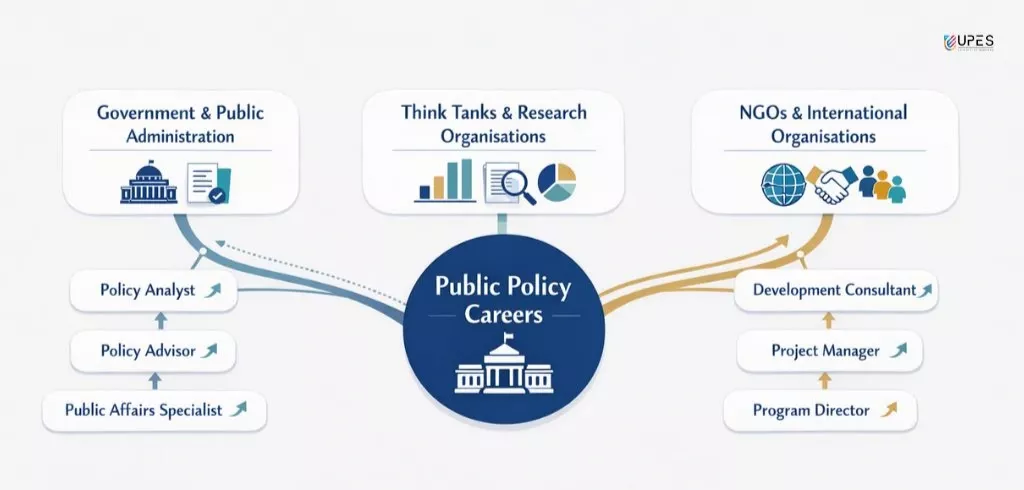
The landscape of careers in public policy has shifted dramatically in India. It is no longer just for retired bureaucrats or academics. Today, it’s a high-growth field where data science, law, economics, and social empathy collide to solve real-world problems—from urban planning and climate change to digital privacy and healthcare access.
Whether you are a student exploring your options or a professional looking to pivot, this guide will break down the sectors, the roles, and the exact steps you need to take to build a successful career in this space.
Become future-ready with our Liberal Studies programs
Know MoreWhat is Public Policy?
At its simplest, public policy is a system of laws, regulatory measures, courses of action, and funding priorities concerning a given topic promulgated by a government entity or its representatives.
Think of it as the "instruction manual" for how a country or city runs. If the government decides to provide free internet in rural areas, the policy is the roadmap that defines who gets it, how it’s funded, and how success is measured.
The Policy Cycle
Public policy isn't a static document; it’s a living process:
- Agenda Setting: Identifying a problem (e.g., rising air pollution).
- Formulation: Designing a solution (e.g., the Odd-Even rule or EV subsidies).
- Adoption: Getting the legal or political green light.
- Implementation: Putting the plan into action on the ground.
- Evaluation: Checking if it actually worked.
Importance and Impact of Public Policy
Why should you care about a career in this field? Because public policy is the most significant lever for large-scale change.
- Scalability: While a doctor can save thousands of lives in a lifetime, a well-drafted health policy can save millions.
- Systemic Change: Policy addresses the root cause of issues rather than just the symptoms.
- Economic Stability: Policies regarding taxation and trade determine the ease of doing business and the nation's GDP growth.
For those pursuing a BA in Political Science, understanding these impacts is the first step toward becoming a decision-maker. These programs provide the foundational theories of power and governance that make modern policy possible.
Types of Roles in Public Policy
The beauty of careers in public policy is the diversity of roles. You don’t have to be a "politician" to be in policy. Here are the most common job functions:
1. Policy Analyst
The "researchers" of the policy world. They spend their time gathering data, analyzing trends, and predicting the outcomes of proposed regulations.
2. Legislative Assistant
Often working directly with Members of Parliament (MPs) or MLAs, these professionals help draft speeches, research bills, and manage communication with constituents.
3. Program Manager
Common in the non-profit and developmental sectors, these individuals ensure that a policy is being executed efficiently on the ground.
4. Government Relations/Public Affairs Specialist
Found in the private sector (like Google, Uber, or Tata), these experts help corporations navigate government regulations and advocate for policies that favor their industry.
5. Research Fellow
Usually based in think tanks, these roles focus on deep-dive academic and empirical research to publish white papers that influence future laws.
Scope of Public Policy Careers: Where Can You Work?
The "scope" is often what worries parents and students. Is there a demand? Absolutely. The demand for policy professionals is growing across four main pillars:
| Sector | Example Organizations | Focus Area |
| Government | NITI Aayog, Ministry of Finance, Municipal Corps | Strategy, implementation, and regulation. |
| Private Sector | Amazon, Reliance, Big 4 Consulting (EY, PwC) | Compliance, ESG, and corporate advocacy. |
| Non-Profits/NGOs | Bill & Melinda Gates Foundation, Pratham | Social impact, grassroots delivery. |
| International | United Nations, World Bank, WHO | Global standards, human rights, climate. |
| Think Tanks | ORF, CPR, Brookings India | Intellectual discourse and data research. |
Public Policy Jobs: Salary and Expectations
While the "impact" is a great motivator, the financial aspect is equally important. In India, the salary for jobs in public policy varies significantly based on the sector.
- Entry-Level (0-2 years): ₹4 LPA – ₹8 LPA (Think tanks, NGOs, Junior Analysts)
- Mid-Level (5-10 years): ₹12 LPA – ₹25 LPA (Consulting firms, Private Public Affairs)
- Senior Level (10+ years): ₹30 LPA+ (Directors, Partners at Consulting firms, Senior Leads in MNCs)
Note: Government fellowships (like the CM’s Fellowship) usually offer a fixed stipend ranging from ₹50,000 to ₹1,00,000 per month.
Government Jobs in Public Policy
In India, working as public policy professional with the government is the "Gold Standard" for many. There are two main pathways:
1. The UPSC Route
The traditional way to enter policy is through the Civil Services (IAS, IFS, IRS). Here, you are a generalist administrator who eventually specializes in policy drafting at the secretarial level.
2. Lateral Entry & Fellowships
The government is increasingly hiring "Subject Matter Experts."
- NITI Aayog: Frequently hires Young Professionals and Consultants.
- State Fellowships: Many states (Delhi, Maharashtra, Haryana) have "Chief Minister’s Fellowships" where young graduates work directly on state projects.
- LAMPS Fellowship: Work directly with an MP to understand the legislative process.
How to Build Your Career in Public Policy and Governance?
If you are convinced that this is the path for you, here is a step-by-step roadmap to get there.
Step 1: Build a Strong Educational Foundation
You need a degree that teaches you how to think critically. While many come from Law or Economics, a BA in Political Science can also be a good best starting point.
For instance, the BA (Hons.) Political Science program is designed for the modern world. It doesn't just focus on old textbooks; it integrates liberal studies with data awareness, helping students understand the "why" behind political movements and the "how" of governance.
Step 2: Master Quantitative and Qualitative Skills
Modern policy is data driven. You should be comfortable with:
- Statistics: Understanding how to read data sets.
- Writing: Being able to summarize a 200-page report into a 2-page brief.
- Public Speaking: Presenting your findings to stakeholders.
Step 3: Internships are Non-Negotiable
You cannot learn policy in a classroom alone. Seek internships at:
- Local NGOs.
- Research institutes (Think Tanks).
- Corporate Public Affairs departments.
- Offices of local political representatives.
Step 4: Networking and Specialization
Public policy is vast. Eventually, you should specialize in a niche like Health Policy, Tech Policy, Climate Policy, or Urban Governance. Join LinkedIn groups, attend seminars, and follow policy-makers on social media to stay updated on current "Pain Points" in the industry.
Read More: Top BA Specializations for Students in 2025
FAQs About Careers in Public Policy
1. Is public policy a good career in India?
- Yes, with the rise of "New India" and complex regulatory challenges in tech and climate, the demand for policy experts in both the government and private sectors is at an all-time high.
2. What is the difference between Public Administration and Public Policy?
- Public Administration focuses on the management and execution of government programs (the "how"), while Public Policy focuses on the design, research, and logic behind those programs (the "what" and "why").
3. Do I need a Master’s degree to get a job?
- While entry-level roles are available for graduates, a Master's (MPP or MPA) or a specialized Bachelor's degree from a reputed institution like UPES can significantly boost your starting salary and seniority.
4. Can an engineer or doctor switch to public policy?
- Absolutely! In fact, "subject matter experts" are highly valued. A doctor can become a Health Policy expert, and an engineer can pivot to Tech or Infrastructure policy.
5. Which skills are most important for public policy?
- Critical thinking, data analysis, persuasive writing, and an understanding of the legal/political framework of the country.

Our counsellors are just a click away.
Conclusion
The world doesn't lack problems; it lacks people who know how to solve them systematically. Choosing a career in public policy means you are choosing to be in the room where it happens. It’s a path that offers intellectual stimulation, financial stability, and the deep satisfaction of seeing your work improve lives.
If you are ready to take the first step, start with an education that broadens your horizon. Exploring a program like the BA (Hons.) Political Science can provide you with the interdisciplinary edge you need to stand out in a competitive job market.
Don't just watch the news; start shaping it!

UPES Editorial Team
Written by the UPES Editorial Team
UPES Admission Enquiry
Trending Post
-

-

Exploring the Past, Building the Future: My Journey as a History Student at UPES
03/08/2026By Pritha Agarwal
-


Related Articles


























Subscribe to UPES Blogs
Join our community for exclusive stories, insights, and updates
By clicking the "Subscribe" button, I agree and accept the privacy policy of UPES.


