B.Tech CSE Colleges- Students Checklist & What makes a College Worth it?
- UPES Editorial Team
- Published 06/01/2026


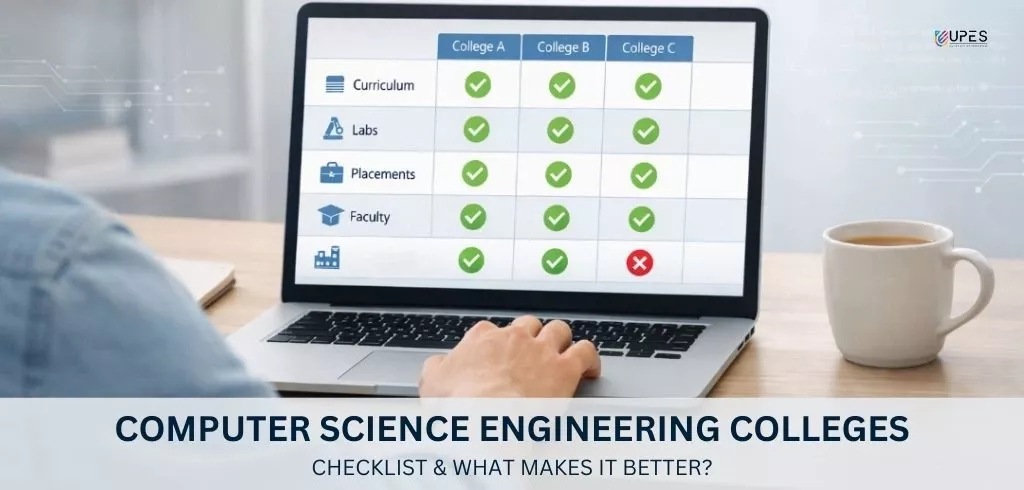
- BTech CSE college: Why the right choice matters more than ever
- What makes a good BTech CSE college: Faculty, research & infrastructure Checklist
- BTech colleges for computer science: How to compare your options
- Which college is best for BTech CSE? How to shortlist wisely
- Which College we get for BTech CSE through CUET?
Choosing among India’s many CSE colleges can feel overwhelming. Every website says “world-class faculty”, “100% placement”, “state-of-the-art labs”. But when you actually dig deeper, it’s hard to know what really matters for your future career in tech.
Become future-ready with our Computer Science programs
Know MoreBTech CSE college: Why the right choice matters more than ever
A BTech CSE college is not just a place to learn programming. For four years, it shapes:
- How you think about problems
- How strong your fundamentals in computer science become
- What kind of internships, projects, and networks you build
- The quality of your first job and how fast you can grow
Good CSE colleges do three things well:
| Teach the basics extremely well- Data structures, algorithms, OS, networks, DBMS, maths, and core CS concepts |
Expose you to future technologies- AI/ML, data science, cloud, cybersecurity, DevOps, IoT, gaming, etc.
|
Connect you with industry- Internships, hackathons, live projects, and serious placement support.
|
What makes a good BTech CSE college: Faculty, research & infrastructure Checklist
Let’s turn the vague question “Is this college good?” into a specific checklist you can actually use.
1. Faculty quality: more than just degrees
Good signs:
- A mix of PhDs and experienced industry professionals in CSE
- Faculty involved in research, consulting, or product development
- Professors publishing papers, filing patents, or winning grants
Why it matters:
- Faculty who are active in research and industry stay updated with current tools and problems.
- They can guide you on projects, internships, and higher studies.
What to check:
- Faculty profiles on the website (look for qualifications + research/industry experience)
- Whether the CSE department has dedicated research groups or labs (AI, cybersecurity, data science, etc.)
2. Curriculum & specialisations: core + future-focused
A good B.Tech CSE curriculum should balance:
- Core CS subjects
- Programming in C/Python, data structures & algorithms, computer organisation, OS, DBMS, software engineering, networks, theory of computation, compiler design, crypto & security, etc.
- Mathematics & problem solving
- Engineering maths, discrete structures, linear algebra, probability & statistics.
- Advanced & emerging areas
- AI & ML, data science, cloud computing, cybersecurity, DevOps, big data, IoT, graphics & gaming, etc.
Pro tip: Download the semester-wise syllabus from each college website and check:
- Are the subjects updated (AI/ML, cloud, security, DevOps)?
- Are there electives and minors you can choose?
- Are there courses on communication, leadership, and entrepreneurship?
3. Infrastructure: labs, tools & campus environment
Computer lab is not enough. Check for:
- Number and quality of labs dedicated to:
- Programming
- Networks & security
- AI/ML & data science
- Cloud / virtualisation
- Hardware and IoT
- Availability of licensed tools, cloud credits, and access to online platforms.
- Decent hostel, library, wifi, and study spaces – you’ll be spending four years here.
4. Research, projects & industry exposure
Ask yourself: Will I just do assignments, or will I build real things? Strong b tech colleges for computer science usually have:
- Minor + capstone projects in 3rd/4th year
- Opportunities to publish research or present at conferences
- Industry-sponsored projects and hackathons
- Internships in public sector, social sector and industry as a formal part of the program
5. Placements & outcomes: not just “100% placed”
Every college claims “great placements”. Look closer:
- Highest CTC vs average CTC vs median CTC
- Top recruiters (product companies, MNCs, fast-growing startups)
- Roles offered – are they actual engineering roles (developer, data scientist, security engineer) or mostly support/BPO?
UPES School of Computer Science reports:
- B.Tech CSE students placed at tech giants like Microsoft, Amazon, Accenture, Deloitte, EY, Cisco, Samsung, ZS and more.
- Highest packages up to ₹50 LPA in recent years and lifetime placement assistance.
Use those as benchmarks while comparing other CSE colleges.
BTech colleges for computer science: How to compare your options
Once you shortlist a few b tech colleges for computer science, compare them across these parameters:
| Academics & flexibility | Teaching–learning style | Industry connection & location | Value for money |
|
|
|
|
Which college is best for BTech CSE? How to shortlist wisely
Let’s be honest: there is no single answer to “Which college is best for BTech CSE?” It depends on:
- Your rank and scores (JEE, CUET, other exams)
- Your budget and location preference
- Whether you prefer a central university, private university, or state engineering college
- Your target: CSE Jobs in core software, product roles, high CTC, higher studies, or foreign opportunities
A simple 5-step framework to pick your best-fit CSE college
| Define your goal | Bucket your options | Use the checklist | Shortlist 5–10 realistic colleges | Deep dive into 2–3 top options |
|
|
|
|
|
In this process, universities like UPES School of Computer Science often come up for students who want:
- Industry-linked curriculum and multiple CSE specialisations
- Strong placements with top tech companies
- Global exposure via semester abroad and credit-transfer programs (e.g., University of Queensland, UC Berkeley)
If you’re building a shortlist of future-ready CSE colleges, it’s worth exploring the details of B.Tech CSE at UPES—check the syllabus, placement stats, and specialisations to see how they align with your goals.
Which College we get for BTech CSE through CUET?
Answering the most common question asked by students- Through CUET which college we get for BTech CSE? Let's look at it.
CUET and B.Tech CSE: the basics
- CUET-UG is primarily for central universities, but many state and private universities now also consider CUET scores for admissions.
- For B.Tech CSE, colleges may use:
- Only CUET
- CUET + Class 12 marks
- CUET as one of several pathways (along with JEE, board merit, or institute-level exams).
Popular categories of institutes accepting CUET scores for B.Tech include:
- Central universities (e.g., some CUs offering CSE or ECE)
- State universities and technical institutes
- Private universities and deemed-to-be universities
CUET and UPES B.Tech CSE
UPES clearly lists CUET among the selection criteria for B.Tech CSE alongside UPESEAT, JEE Main, Board Merit, and SAT. In simple terms:
- For UPES B.Tech CSE, you need:
- Minimum 50% marks in Class X & XII, and 50% in PCM for eligibility
- Then you can be considered through UPESEAT / JEE Main / Board Merit / SAT / CUET based on the admission route you choose.
So if you’re asking “through CUET which college we get for BTech CSE?”, the answer is:
- Many central, state, and private CSE colleges now accept CUET; exact options depend on your score, category, and counselling choices.
- UPES is one of the private universities where a good CUET score can be a valid pathway for B.Tech CSE admission, alongside other routes.
Always check:
- The latest participating universities list on CUET’s official website
- Individual college/university websites for exact admission rules for that year

Our counsellors are just a click away.
Conclusion
Choosing among India’s many CSE colleges is a big decision but it becomes far easier when you focus on fundamentals. If you want a future-focused program with multiple CSE specialisations, industry collaborations, strong placements, and global pathways, it’s worth taking a deeper look at B.Tech CSE at UPES School of Computer Science. Explore the syllabus, see the specialisations, and talk to a counsellor to understand how it aligns with your goals.

UPES Editorial Team
Written by the UPES Editorial Team
UPES Admission Enquiry
Trending Post
-

Full Stack Developer Interview Questions- Freshers to Experienced & High Level
08/08/2025By UPES Editorial Team
-

Gender Digital Divide: Challenges in Undergraduate Computer Science Programs
29/09/2025By Dr. Avita Katal
-

How to Create a Web Developer Portfolio & Why is it important (Examples, Templates, Ideas, Content & Website)
11/02/2025By UPES Editorial Team


Related Articles





































Subscribe to UPES Blogs
Join our community for exclusive stories, insights, and updates
By clicking the "Subscribe" button, I agree and accept the privacy policy of UPES.


