Cyber-Physical Systems Engineering: The Future of B.Tech CSE
- UPES Editorial Team
- Published 05/01/2026


- What is cyber physical systems engineering?
- What does a cyber physical systems engineer actually do?
- Cyber physical systems engineering Scope
- What skills do I need for a career in Cyber Physical Systems Engineering?
- Cyber Physical Systems Examples
- Cyber Physical Systems Engineering Syllabus
- Sample CPS-oriented study path (illustrative)
- What & Where is the demand for Cyber-Physical Systems Engineering?
Every day you interact with cyber physical systems without realising it. The metro that slows down automatically, a car that parks itself, a wearable that tracks your heart rate, even smart traffic lights that change based on live congestion data – all of these are examples of the physical world tightly connected with software and networks.
No surprise then those students searching for “the future of B.Tech CSE” increasingly stumble on cyber physical systems engineering and wonder:
- What exactly is it?
- Is it just another buzzword for IoT or AI?
- Does it have real career scope and salaries in India?
In this blog, we will break down cyber physical systems engineering in simple language, show you real-world examples, discuss scope, careers, salaries, and how a strong B.Tech CSE foundation can launch you into this future-ready field.
Become future-ready with our Computer Science programs
Know MoreWhat is cyber physical systems engineering?
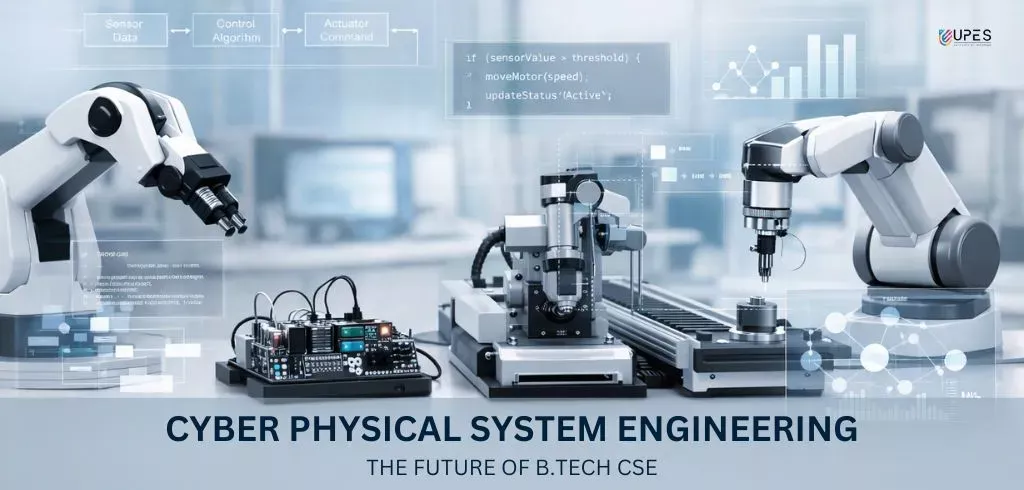
Cyber physical systems engineering deals with designing and building systems where:
- Physical components like sensors, motors, machines, vehicles and devices
- Are tightly integrated with software, networks and algorithms
- To monitor, control and optimise real-world processes in real time
Formally, cyber physical systems (CPS) are systems where computational elements continuously sense the physical environment and send control signals back, creating a feedback loop between the digital and physical worlds.
You can think of CPS as the “next level” of:
- Embedded systems (microcontrollers inside machines), and
- Internet of Things (IoT) (networked devices)
- The difference is that CPS focuses on:
- Real-time decisions
- Safety and reliability
- Tight coordination between hardware, software and networks
What does a cyber physical systems engineer actually do?
A CPS engineer might:
- Design sensor networks for a smart factory
- Build algorithms to make an autonomous vehicle brake safely
- Develop software that balances power flow in a smart grid
- Integrate AI models into drones or robots to react intelligently to their surroundings
In practice, it is a blend of computer science, electronics, control systems, networking and AI.
Cyber physical systems engineering Scope
The scope of cyber physical systems engineering is huge because almost every industry is adding sensors, connectivity and AI on top of physical assets.
Global research and standards organisations highlight CPS as a key technology for:
- Smart grids and energy systems
- Transportation and autonomous mobility
- Healthcare and medical devices
- Industrial automation and robotics
- Smart agriculture and environment monitoring
What skills do I need for a career in Cyber Physical Systems Engineering?
You should aim to build skills in programming (C, C++, Python), embedded systems, sensors and actuators, real-time operating systems, computer networks, control systems, AI or machine learning, and cybersecurity basics. Project experience in robotics, IoT devices or automation will give you a strong edge.
Rising focus in India
In India, CPS is not just a theoretical concept. Government and industry are actively investing in it:
- Recent policy discussions and budgets have included dedicated allocations to AI and cyber physical systems, signalling that CPS is seen as a strategic area for future innovation and security.
- Smart city projects, digital health initiatives, metro rail systems, and Industry 4.0 adoption in manufacturing all rely heavily on CPS-style architectures.
This translates into growing demand for talent in:
- Smart manufacturing and industrial IoT
- Mobility and automotive electronics
- Power and utilities (smart grids)
- Healthcare tech and med-tech startups
- Defence, aerospace and critical infrastructure
For students, this means that CPS is not a niche, but a cross-cutting skill set that fits into multiple high-growth sectors.
Cyber Physical Systems Examples
To make this concrete, here are some classic cyber physical systems examples you should know for interviews and SOPs:
1. Smart grid
- Electricity networks that use sensors, smart meters and control algorithms to balance supply and demand in real time.
- They detect faults, reroute power and integrate renewable energy efficiently.
2. Autonomous vehicles
- Self-driving cars use cameras, LiDAR, radar and GPS combined with AI to perceive the environment and take safe driving decisions.
- The car constantly senses, computes and acts, which is a textbook CPS.
3. Industrial robots and smart factories
- Robot arms in an automotive plant that coordinate with conveyor belts, sensors and quality-control cameras.
- Data from machines is analysed in real time to predict failures and optimise throughput.
4. Medical monitoring systems
Pacemakers, insulin pumps, or remote ICU monitoring systems that automatically adjust treatment based on live patient data.
5. Smart buildings and homes
- HVAC, lighting and security controlled by sensors and algorithms to save energy and improve comfort.
6. Drones and intelligent transportation systems
- Delivery drones that navigate cities
- Smart traffic systems that change signals based on real-time vehicle density
If you enjoy thinking about “systems that sense, think and act”, CPS is exactly your zone.
Cyber Physical Systems Engineering Syllabus
Every university structures the cyber physical systems engineering syllabus differently, but the core building blocks are similar. Many Indian institutes now offer specialised B.Tech or B.Tech programs in CSE with Cyber Physical Systems, IoT or related tracks.
A typical CPS-focused pathway built on top of B.Tech CSE will include:
Core CSE foundation (Years 1–2)
- Programming in C, C++, Python, Java
- Data structures and algorithms
- Computer networks and operating systems
- Discrete mathematics, probability and statistics
- Database management systems
CPS and embedded-focused subjects (Years 2–4)
- Digital electronics and microprocessors
- Embedded systems and real-time operating systems
- Sensors, actuators and interfacing
- Control systems and feedback
- Internet of Things and wireless sensor networks
- Robotics and mechatronics
- Cloud computing and edge computing architectures
Advanced and emerging topics
• Artificial Intelligence and Machine Learning
• Computer vision and perception
• Cybersecurity for CPS and IoT
• Safety-critical systems and formal verification
• Human–machine interaction
• Data analytics, digital twins and simulation
Sample CPS-oriented study path (illustrative)
| Year | Focus area | Example subjects / skills |
| 1 | CS fundamentals | Programming, maths, basic electronics |
| 2 | Embedded + networking basics | Microcontrollers, digital systems, computer networks |
| 3 | CPS core and IoT | Embedded OS, IoT, control systems, sensor networks |
| 4 | Specialisation + projects | Robotics, AI for CPS, cybersecurity, capstone project |
What & Where is the demand for Cyber-Physical Systems Engineering?
The demand for cyber physical systems engineering talent comes from multiple directions:
Core engineering and manufacturing companies
Automotive, aerospace, energy utilities, industrial automation and robotics companies need CPS engineers for both R&D and operations.
IT and tech services
These companies design, deploy and manage CPS solutions for global clients: smart factories, connected logistics, digital rail and so on.
Startups and deep-tech firms
Startups working on drones, med-tech devices, agritech sensors or smart home gadgets actively hire engineers who understand embedded systems plus software.
Government and public sector projects
Smart city missions, smart grids, safe transportation and digital public infrastructure all lean on CPS architectures, creating roles in government projects, PSUs and research labs.
Salary Outlook
While “Cyber Physical Systems Engineer” as a job title is still emerging, related salary data shows:
- Average reported salary for CPS engineers in India around ₹5.5–6 LPA for early careers, based on limited but growing data. (Glassdoor)
- Professionals who list CPS skills typically earn in the ₹12–60 LPA band, reflecting a mix of mid-level and senior roles. (6figr)
Realistically, if you pair B.Tech CSE from a strong institution like UPES with internships and projects in IoT, AI, robotics or automation, you can aim for roles that start in the lucrative range and grow sharply with experience.
How B.Tech CSE at UPES fits into Cyber Physical Systems
The B.Tech CSE program at UPES School of Computer Science is a 4-year degree that already offers specialisations in areas directly linked to CPS, such as:
- Internet of Things
- Artificial Intelligence and Machine Learning
- Cyber Security and Digital Forensics
- Cloud Computing, Data Science and others
With this structure you can:
- Build your CSE fundamentals,
- Choose CPS-related streams like IoT or AI,
- Work on smart city, robotics or automation projects,
- And graduate with a profile suited to CPS roles even if the degree name says CSE.
UPES also highlights strong placements for IoT-focused CSE students, with average packages in double-digit LPA and top offers from companies like Amazon, Accenture and Barclays, which shows strong industry linkages in emerging tech areas.
If CPS excites you, look at the UPES B.Tech CSE page and identify specialisations like IoT, AI or Cyber Security that align with cyber physical systems work.
Is Cyber Physical Systems a Good Career?
Short answer: Yes, it is a very promising career if you enjoy both software and hardware and are ready for continuous learning. Why it is a strong career choice
Multi-industry relevance
CPS is core to energy, transport, manufacturing, healthcare, agriculture, logistics, defence and more. This means you are not locked into a single sector.
Alignment with national priorities
With dedicated spending and policy attention on AI and cyber physical systems, there is institutional backing for research, startups and large-scale deployments in India.
High-value roles
Professionals with CPS skills (embedded systems, control, IoT, AI) often move into roles like system architect, principal engineer or technical lead as they gain experience. Salary analytics platforms show that professionals with cyber physical systems skills in India often earn in the mid-to-high range, with many profiles in the 12–60 LPA band depending on experience and company.
Innovation and impact
You get to work on problems like energy efficiency, safe mobility, precision healthcare and smart cities, which have social as well as economic impact.
What is the future of Cyber-Physical Systems?
Trends shaping the future of cyber physical systems include:
- AI-first CPS: AI models are being embedded directly into CPS to enhance safety and real-time decision-making, for example collision avoidance in autonomous vehicles and anomaly detection in industrial plants.
- Edge and 5G: With 5G networks and edge computing, CPS can make decisions closer to where data is generated, reducing latency and improving reliability.
- Digital twins: Digital replicas of physical systems are used for simulation, testing and optimisation, tightly connected with CPS deployments.
- Security by design: As CPS get integrated into critical infrastructure, cybersecurity and resilience become mandatory, opening a lot of roles at the intersection of security and CPS.
If you start your B.Tech CSE now and build a CPS-focused profile, you will graduate into a market that is still growing and evolving, rather than saturating.
How B.Tech CSE at UPES can prepare you for Cyber Physical Systems Engineering
If you are thinking, “I like CPS, but my degree will just say CSE, is that enough?” – the answer is yes, provided you choose the right ecosystem.
The UPES School of Computer Science focuses on emerging technologies like AI, data science, IoT and cybersecurity, and emphasises real-world projects, labs and industry collaboration. As a B.Tech CSE student at UPES you can:
- Pick specialisations such as Internet of Things, AI & ML, Cyber Security that map directly to CPS skills
- Work on projects involving smart cities, connected devices, robotics or automation
- Leverage strong placement support and industry tie-ups to enter CPS-related roles after graduation
If you are exploring a career in cyber physical systems engineering, start by reviewing the UPES B.Tech CSE curriculum and see how their IoT, AI and security tracks can help you build a CPS-ready profile.
FAQs
1. Is cyber physical systems engineering the same as IoT?
- Not exactly. IoT focuses on connecting devices to the internet and exchanging data. Cyber physical systems engineering goes further, focusing on tightly coupled sensing, computation and control in real time, often in safety-critical environments. IoT is a key building block of CPS.
2. Can I work in cyber physical systems after a general B.Tech CSE?
- Yes. Most CPS roles expect strong computer science fundamentals plus knowledge of embedded systems, networking and AI. A B.Tech CSE from a university that offers IoT, AI, robotics or embedded electives, like UPES, is an excellent path into CPS.
3. What is the starting salary for cyber physical systems roles in India?
- Early-career CPS engineers and related roles (embedded developer, IoT engineer, robotics engineer) often start in the ₹5–10 LPA range, depending on institute brand, skills and company. With experience and advanced skills, salaries can move into the mid and high double-digit LPA range.
4. Which companies hire cyber physical systems engineers?
- Automotive companies, industrial automation firms, robotics startups, power and energy utilities, healthcare device manufacturers, IT services firms and deep-tech startups all hire CPS talent. Examples include companies working on smart factories, self-driving systems, drones, med-tech and smart infrastructure.
5. Is cyber physical systems engineering hard without electronics background?
- You need comfort with both software and basic electronics, but you do not have to be an electrical purist. If you enjoy coding, logical problem-solving and are willing to learn about sensors, circuits and control systems step by step, CPS is very achievable. A well-structured B.Tech CSE program makes this bridge for you.
6. How do I decide if cyber physical systems is right for me?
- Ask yourself: do you like seeing your code control something in the real world, such as a robot, drone or device? Do you enjoy both software and hardware? If yes, building your B.Tech CSE journey around CPS-related electives, labs and projects is a smart move.

Our counsellors are just a click away.
Conclusion
Cyber physical systems engineering is where code meets concrete: powering smarter cars, factories and hospitals. For Indian students, it brings multi industry scope, alignment with national tech priorities, high impact work and strong salary growth. If you’re unsure, start small: choose a B.Tech CSE with IoT/AI/cybersecurity tracks, do CPS style projects or internships, and build a portfolio that shows systems that sense, think and act. Programs like UPES’s B.Tech CSE, which offer in demand specialisations and industry exposure, are a practical launchpad, worth exploring and discussing with a counsellor.

UPES Editorial Team
Written by the UPES Editorial Team
UPES Admission Enquiry
Trending Post
-

Full Stack Developer Interview Questions- Freshers to Experienced & High Level
08/08/2025By UPES Editorial Team
-

Gender Digital Divide: Challenges in Undergraduate Computer Science Programs
29/09/2025By Dr. Avita Katal
-

How to Create a Web Developer Portfolio & Why is it important (Examples, Templates, Ideas, Content & Website)
11/02/2025By UPES Editorial Team


Related Articles



































Subscribe to UPES Blogs
Join our community for exclusive stories, insights, and updates
By clicking the "Subscribe" button, I agree and accept the privacy policy of UPES.


