Cyber Security Courses: For 10th, 12th, Beginners, Professionals, Requirements, & Scope
- UPES Editorial Team
- Published 17/02/2026


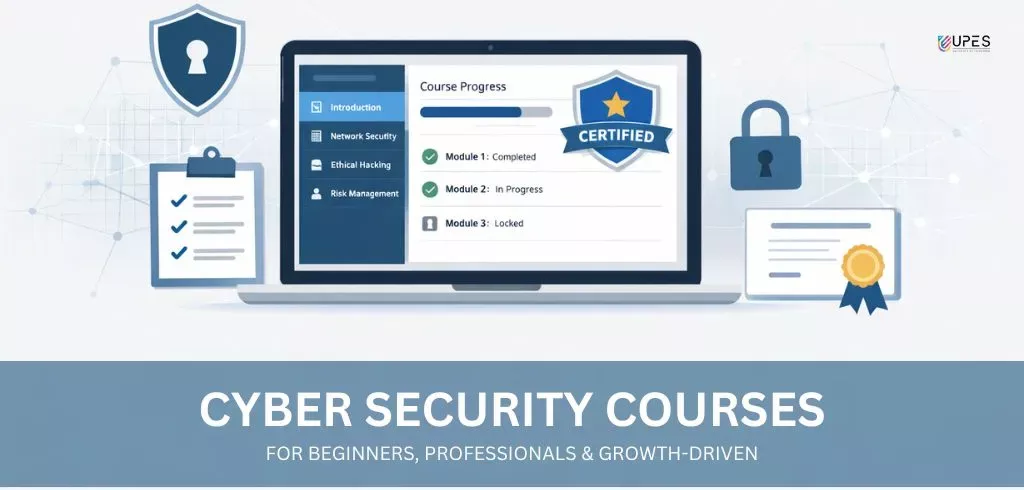
- Cyber Security Courses for Beginners: Where to Start?
- Cyber security courses after 10th: What You Can realistically do
- Cyber Security courses after 12th
- Cyber Security Courses Requirements: Do You Have What It Takes?
- Cyber Security Courses Fees : How much do you have to invest?
- Government Funded Cyber Security Courses
- The Scope of Cyber Security: Roles & Salaries in 2026
- How to choose the right Cyber Security Course for you
If you’ve been searching for Cyber Security Courses, you’ve probably seen everything—free YouTube playlists, 6-week certificates, “ethical hacking in 30 days,” and full degrees like BCA/B.Tech. The confusion is normal because cybersecurity is not one job. It’s a whole career ecosystem: SOC, cloud security, digital forensics, app security, threat hunting, GRC (governance), and more. This guide helps you choose the right path based on where you are right now (after 10th/12th/college), what you can afford, and what employers actually want.
Become future-ready with our Computer Science programs
Know MoreCyber Security Courses for Beginners: Where to Start?
You don't need a PhD to start learning how to protect networks. In fact, many of the world’s best security analysts started with simple, foundational Cyber Security courses designed for absolute beginners.
Why Start Early?
The digital world is expanding faster than we can secure it. By 2026, India alone is projected to need over 1 million cybersecurity professionals. Starting as a beginner allows you to build the "hacker mindset"—the ability to think like an attacker to build better defenses.
Top Beginner Paths
- Certificate Programs: These are short-term (3–6 months) programs that introduce you to Linux, Networking basics, and the "CIA Triad" (Confidentiality, Integrity, and Availability).
- Diploma in Cyber Security: Usually a 1-year course after the 10th or 12th, focusing on practical tools like Wireshark and Nmap.
- Self-Paced Certifications: Platforms like Google and Cisco offer foundational certificates that are highly respected by HR managers for entry-level roles.
The Professional Edge: If you are looking for a more structured academic start that balances theory with hands-on lab work, exploring a BCA in Cyber Security is a fantastic way to turn beginner curiosity into a professional degree
What beginners should learn first (in the right order)
Here’s a clean sequence that prevents you from getting stuck:
- Computer + OS basics: Windows + Linux basics (files, users, permissions)
- Networking fundamentals: IP, DNS, HTTP/HTTPS, ports, routing
- Security basics: CIA triad, authentication, encryption basics, common attacks (phishing, malware)
- One tool track: pick one—SOC/Blue team, ethical hacking/Red team, or forensics
- Mini-project + documentation: write up what you did (screenshots + steps + learnings)
Why this order works: Most “hacking” concepts make no sense if you don’t understand networking and OS internals first.
Cyber security courses after 10th: What You Can realistically do
After 10th, you usually won’t do a full cybersecurity degree yet—but you can build a strong base before 11th/12th.
Smart moves after 10th:
- Choose Maths + Computer Science / IT in 11th–12th if possible (helps for BCA/B.Tech eligibility later).
- Learn Linux basics and networking basics through beginner courses.
- Build a safe home lab: VirtualBox + a Linux VM + basic networking experiments (no illegal activity—keep it ethical).
Beginner goal by end of Class 12: You should be able to explain (in simple words) how websites work (DNS → IP → HTTPS), what a firewall does, and why strong passwords/MFA matter.
Cyber Security courses after 12th
After 12th, your options open up. The two most common “career-building” routes are:
- BCA (Cyber Security + Digital Forensics) if you want a strong CS foundation with applied security
- B.Tech CSE (Cyber Security + Digital Forensics) if you want deeper engineering + wider CS core
- For students who are equally interested in the legal and regulatory side of digital security, Cyber Law courses offer a strong alternative or complement to technical cyber security programs such as cybercrime investigation, data protection, IT laws, and compliance.
Best course options after 12th (quick comparison)
| Course type | Duration | Best for | Typical Outcome |
| BCA in Cyber Security | 3 years | Students who want a CS degree + focused security/forensics | SOC/analyst roles, junior pentest, forensics support, security operations |
| B.Sc in Cyber Security | 3 years | Students preferring a science-focused, security-first degree | SOC analyst, threat analyst, cyber ops, junior security engineer |
| B.Tech CSE in Cyber Security | 4 years | Students who want engineering depth + stronger core CS | broader roles: security engineer, cloud security, IR, forensics, product security |
| Diploma / certificate | 6–12 months | Fast entry / exploration | entry-level internships + portfolio starter |
| Cyber Law Courses / Certifications | 6–12 months | Students interested in legal, policy, compliance & cybercrime | Cyber law consultant, GRC analyst, compliance support, legal-tech roles |
| Online certification route | flexible | working professionals / self-paced learners | skills validation + role transitions |
Cyber Security Courses Requirements: Do You Have What It Takes?
Before you hit the "Apply" button, it is essential to understand both the academic and personal requirements for these programs.
Academic Eligibility
- After 10th: You can pursue basic certificates or a Diploma in IT/Cyber Security. Most polytechnic colleges offer these.
- After 12th (Degree): * B.Tech: Typically requires Physics, Chemistry, and Maths with a minimum of 50–60%. Entrance exams like JEE Main or university-specific tests are common.
- BCA/B.Sc: Requirements are more flexible. While some colleges mandate Maths, many are open to Commerce or Arts students who have a strong interest in computers.
Technical & Soft Skills
Cybersecurity isn't just about staring at green text on a black screen. To succeed in Cyber Security courses, you should aim to develop:
- Problem-Solving: You are essentially a digital detective.
- Ethical Mindset: You must use your skills for defense, never for unauthorized harm.
- Continuous Learning: Technology changes every week; your knowledge must too.
- Networking Basics: Understanding how the internet "talks" (TCP/IP, DNS) is mandatory.
Cyber Security Courses Fees : How much do you have to invest?
The cost of education is always a major concern for Indian families. In 2026, the fee structure for Cyber Security courses varies significantly based on the type of institution.
| Course Type | Fee Range (Total) | Key Benefit |
| Short-term Certificates | ₹10,000 – ₹50,000 | Fast entry into the market. |
| Diploma Programs | ₹50,000 – ₹1.5 Lakh | Strong technical foundation. |
| BCA in Cyber Security | Higher investment | Recognized degree, good placements. |
| B.Tech in Cyber Security | Higher investment | Highest ROI, global opportunities. |
| B.Sc in Cyber Security | Moderate–High investment | Focused security degree with early specialisation |
| Cyber Law Courses / Certifications | ₹30,000 – ₹1.2 Lakh | Legal awareness, compliance, cybercrime expertise |
While government colleges like IITs have lower tuition, they are extremely competitive. Private universities often provide more modern labs and direct industry tie-ups, which can lead to faster job placements.
Government Funded Cyber Security Courses
If budget is a constraint (or you want credible credentials), government-backed ecosystems are a smart starting point. Here are the most practical ones for Indian students.
1) NPTEL / SWAYAM cybersecurity courses
SWAYAM describes NPTEL as a project initiated by MHRD (now Ministry of Education) involving IITs and IISc, offering free online courses with an optional certification exam (₹1,000).
- It also shows scale indicators like number of courses and enrolment stats.
- Best for: beginners building fundamentals + credibility
2) NIELIT (MeitY) short-term cybersecurity certifications
NIELIT’s certificate course page clearly lays out duration, fee, prerequisites, eligibility and syllabus topics like Linux/networking basics, threats/vulnerabilities, firewall/IDS, IAM, cryptography/PKI, penetration testing, cloud, and vulnerability assessment.
- NIELIT is described as an autonomous scientific society under MeitY on its official website.
- Best for: structured short-term learning with a government institution tag
3) FutureSkills Prime (MeitY + NASSCOM)
The Government of India’s Digital India site describes FutureSkills Prime as a collaborative effort between MeitY and NASSCOM to build digital talent across areas including cybersecurity.
- FutureSkills Prime itself positions as a MeitY + NASSCOM initiative and offers cybersecurity pathways and certificates.
- Best for: role-based skilling paths + industry certification alignment
4) Skill India Digital (for entry-level awareness + introductory learning)
Skill India Digital Hub lists cybersecurity courses (for example, a course designed by Tech Mahindra Foundation is shown in search snippets on the official domain).
- (These portals can be dynamic, so treat them as discovery tools: shortlist → verify → enrol.)
- Best for: exploratory learners who want free/low-cost introductions
5) CERT-In training & awareness
CERT-In hosts training programme listings and national awareness initiatives (including cybersecurity awareness month). While not a “beginner course catalogue,” it’s useful for understanding India’s official security ecosystem and best practices.
The Scope of Cyber Security: Roles & Salaries in 2026
Is the "hype" real? Absolutely. As more Indian businesses move to the cloud, the "Attack Surface" increases, making security experts indispensable.
Popular Job Roles
- Ethical Hacker / Penetration Tester: You are paid to find vulnerabilities before the bad guys do.
- SOC Analyst (Security Operations Center): You monitor the company’s network in real-time for any suspicious activity.
- Digital Forensic Investigator: You analyze data after a breach to find out "who did it" and "how."
- Cloud Security Engineer: Specializing in protecting data on platforms like AWS, Azure, and Google Cloud.
Salary Insights (India 2026)
- Freshers: ₹5 LPA to ₹9 LPA (Certified professionals earn on the higher end).
- Mid-Level (4-7 years): ₹12 LPA to ₹22 LPA.
- Senior/Leadership (CISO): ₹35 LPA to ₹1 Crore+.
Sources: Indeed, Glassdoor, Naukri.
Why Choose UPES for Cyber Security?
Choosing where to study is as important as what you study. UPES has established itself as a leader in specialized technology education.
Their programs, such as the BCA Cyber Security and Digital Forensics and B.Tech in Cyber Security and Digital Forensics, are not just about textbooks. They offer:
- Industry Collaboration: Curriculum designed with input from global tech giants.
- Advanced Labs: Access to high-end digital forensics and SOC simulation tools.
- Placement Excellence: A dedicated track record of placing students in top-tier firms like Microsoft, Deloitte, and Amazon.
- Certifications: Students are encouraged and supported to clear global certifications like CEH (Certified Ethical Hacker) alongside their degree.
Eligibility snapshot (so you don’t get surprised later)
- For BCA eligibility is 50% marks in Class 10 and 12 with Mathematics/Computer Science/IT as a main subject in Class 12 (plus selection via PI/CUET).
- For B.Tech CSE, eligibility is minimum 50% in Class X and XII and minimum 50% in Physics, Chemistry and Maths.
How to choose the right Cyber Security Course for you
If you’re overwhelmed, here’s the simplest way to decide:
- After 10th: build foundations + small projects
- After 12th: pick a strong long-term pathway (BCA/B.Tech) or a structured diploma if you need faster entry
- On any path: add government-backed learning (NPTEL/NIELIT/FutureSkills) + hands-on labs
If you want a structured academic pathway that blends core computing with cybersecurity and digital forensics, explore UPES’ programmes and compare curriculum, labs, tools exposure, and internship opportunities before finalising.

Our counsellors are just a click away.
Conclusion
The world of cybersecurity is vast, exciting, and deeply rewarding. It is one of the few fields where you can truly say you are "making the world a safer place" every day. Whether you choose a short-term diploma or a full-fledged degree, the key is to stay curious and never stop practicing in the labs.
If you are a student after the 12th looking for a degree that combines prestige with practical skills, the B.Tech or BCA programs at UPES are specifically designed to bridge the gap between classroom learning and industrial demands.
Don’t let the complexity of the field stop you.
FAQs: Cyber Security Courses
1. Can I do a Cyber Security course after 12th Commerce or Arts?
Yes! While engineering (B.Tech) requires Science, courses like BCA in Cyber Security or specialized Diplomas are often open to students from all streams, provided they have a basic aptitude for computers.
2. Which is the best certification for beginners?
CompTIA Security+ and the Google Cybersecurity Professional Certificate are currently the most recognized entry-level certifications globally.
3. Is coding required for a career in Cyber Security?
Basic scripting (especially in Python) is highly beneficial for automating security tasks, but you don't need to be a "hardcore" programmer for every security role.
4. How long does it take to become a Cyber Security expert?
A degree takes 3–4 years, but you can become "job-ready" for entry-level roles in 6–12 months with intensive certification and lab practice.
5. Are online Cyber Security courses worth it?
Yes, if they offer hands-on labs. Theory is only 20% of the job; being able to use security tools is the other 80%.
6. What is the difference between Cyber Security and Cyber Law courses?
Cyber Security courses focus on technical defence, networks, systems, and tools, while Cyber Law courses focus on legal frameworks, cybercrime investigation, digital evidence, and compliance. Many professionals combine both to move into governance, risk, and compliance (GRC) roles.

UPES Editorial Team
Written by the UPES Editorial Team
UPES Admission Enquiry
Trending Post
-

Full Stack Developer Interview Questions- Freshers to Experienced & High Level
08/08/2025By UPES Editorial Team
-

Gender Digital Divide: Challenges in Undergraduate Computer Science Programs
29/09/2025By Dr. Avita Katal
-

How to Create a Web Developer Portfolio & Why is it important (Examples, Templates, Ideas, Content & Website)
11/02/2025By UPES Editorial Team


Related Articles






































Subscribe to UPES Blogs
Join our community for exclusive stories, insights, and updates
By clicking the "Subscribe" button, I agree and accept the privacy policy of UPES.


