ROI of a Specialised BTech in Artificial Intelligence: Salary Trends, Hiring Companies, Growth Factors
- UPES Editorial Team
- Published 02/01/2026



- AI Engineer Salary in India: Where Do You Stand After a BTech?
- AI Engineer Salary Per Month: What It Looks Like in Real Life
- Average Salary of an AI Engineer in India: How It Compares
- Is AI a High Paying Job?
- Are AI Engineers in High Demand?
- Which Country Pays the Highest Salary for AI Engineers?
- How a Specialised BTech in AI and ML Helps Your ROI
Many students love the idea of working in AI, but the real question at home is usually very practical: Will a specialised BTech in Artificial Intelligence actually give a good return on investment in terms of AI engineer salary, job security, and long-term growth?
If you are trying to choose between a generic CSE degree and a focused AI programme, it helps to look calmly at numbers, real career paths, and how your four years of study convert into salary and opportunities. This blog walks you through salary trends in India and abroad, hiring demand, and how a specialised BTech in AI and Machine Learning can shape your ROI.
Become future-ready with our Computer Science programs
Know MoreAI Engineer Salary in India: Where Do You Stand After a BTech?
Different platforms give slightly different figures, but they broadly agree that AI engineers sit at the higher end of tech pay.
According to Glassdoor, the average AI engineer salary in India is about ₹12.2 lakh per year, with most salaries falling between ₹6.8 lakh and ₹20.4 lakh, and some senior professionals earning more than ₹30 lakh per year.
A simplified view based on common fresher and mid-career ranges looks like this:
| Career Stage | Experience | Typical AI Engineer Salary in India (Yearly) |
| Entry level fresher | 0–2 years | ₹6 – ₹8 lakh |
| Early professional | 2–5 years | ₹10 – ₹18 lakh |
| Senior / specialist | 5+ years | ₹20 lakh and above |
These numbers are not guaranteed, but they give you a realistic band for planning. A strong profile, good company, and right location usually keep you in the upper half of the range.
AI Engineer Salary Per Month: What It Looks Like in Real Life
Annual salaries sound impressive, but most students and parents think in monthly terms. Roughly, the same ranges translate into:
| Level | Yearly Range | Approx Monthly Salary (Before Tax) |
| Entry level | ₹6 – ₹8 lakh | ₹50,000 – ₹65,000 |
| Early professional | ₹10 – ₹18 lakh | ₹80,000 – ₹1,50,000 |
| Senior engineer | ₹20 – ₹30+ lakh | ₹1,65,000 – ₹2,50,000+ |
Source: Glassdoor | ||
Your exact in-hand amount will vary with tax, city, company, and benefits, but this table helps you visualise what a BTech in AI can eventually translate into on your payslip if you build good skills.
Average Salary of an AI Engineer in India: How It Compares
When comparing B Tech Artificial Intelligence vs Computer Science salary, AI career roles often command slightly higher packages due to niche skills and growing demand. However, core CSE roles are more abundant and provide stable long-term growth.
To understand ROI, you need context. The average AI engineer salary sits higher than many generic software roles because it combines:
- Strong computer science fundamentals
- Mathematics and statistics
- Practical experience with machine learning, deep learning, or NLP
Glassdoor’s estimated average salary of an AI engineer in India at around ₹12.2 lakh per year puts AI engineers in a premium bracket within the broader tech market.
In simple terms:
- A typical fresher AI role can pay more than many basic development roles
- The salary gap widens as you gain 3–5 years of solid AI experience
Is AI a High Paying Job?
Globally, AI is recognised as one of the better paying tech careers. While exact numbers change year to year, most recent salary studies for AI and ML roles in developed markets show average compensation comfortably above general software roles. Many AI engineers abroad earn well above 100,000 US dollars per year once they have a few years of experience, especially in product companies and Big Tech.
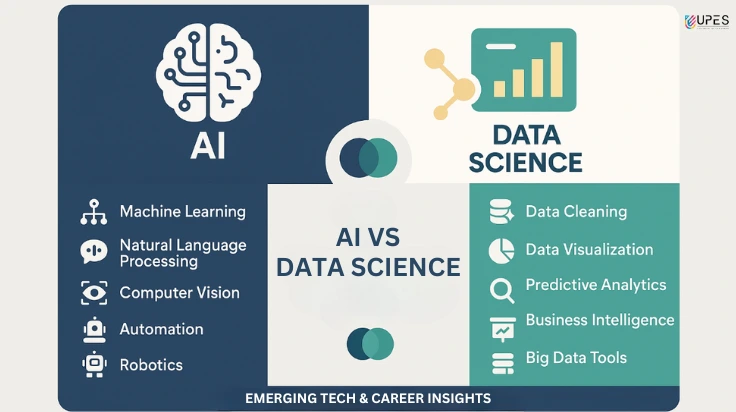
Artificial Intelligence (AI) and Data Science are two of the most sought-after fields in technology today, shaping innovations in industries ranging from healthcare and finance to gaming and cybersecurity. As the digital economy grows, students and professionals often ask: AI vs Data Science—which is better?
Put simply, AI is considered a high paying job because:
- The skill set is specialised and mathematically demanding
- The work directly impacts revenue, efficiency, and strategic advantage
- There is a limited pool of well-trained professionals
However, the high pay is not automatic. It is a reward for depth: strong fundamentals, real projects, and the ability to ship working AI systems, not just toy models.
Are AI Engineers in High Demand?
Yes, and not just in tech companies. AI is now used in:
- Finance and fintech for credit scoring, fraud detection, and trading
- Healthcare for diagnostics, imaging, and personalised treatment support
- Retail and e-commerce for recommendations, demand forecasting, and pricing
- Manufacturing for predictive maintenance and quality control
- Media, gaming, and entertainment for content personalisation and generation
Companies need people who can:
- Clean and understand data
- Choose and train the right models
- Deploy and monitor models in production
- Explain results to non-technical teams
Because these skills are rare and business critical, AI engineers remain in high demand. For an Indian student, this demand shows up in:
- Campus recruitment by IT and product firms
- Global capability centres of multinationals in Indian cities
- Startups looking for their “first AI hire”
- Postgraduate and research opportunities in India and abroad
Which Country Pays the Highest Salary for AI Engineers?
While rankings shift slightly between reports, a few countries consistently appear at the top in terms of AI engineer pay:
| Country | Typical AI Salary Band (Yearly, Approx) | Notes |
| United States | High six-figure USD possible | Big Tech, FAANG, and strong startup scene |
| Switzerland | Among the highest in Europe | Very high cost of living |
| Singapore | High salaries within Asia | Regional tech and finance hub |
| Canada, UK | Competitive and growing | Strong AI research ecosystems |
Higher salary also means higher costs, visas, and competition. For many Indian students, the practical path is:
- Do a solid BTech in AI or AI-focused CSE
- Build a strong project and internship portfolio in India
- Use that profile to apply either for overseas jobs or for higher studies in top international universities
A focused undergraduate programme makes that journey smoother because you start accumulating relevant work from day one.
How a Specialised BTech in AI and ML Helps Your ROI
You can learn AI after a general CSE degree, but a good specialised BTech in AI can make your learning curve faster and your profile sharper. The BTech in Artificial Intelligence and Machine Learning at UPES School of Computer Science is designed exactly with this in mind. Key aspects that matter for ROI:
Early and Deep Exposure to AI
The curriculum brings AI and ML into the picture early, rather than keeping them as just final year electives. You build a foundation in:
- Data structures and algorithms
- Probability and statistics
- Machine learning fundamentals
- Deep learning basics
That means by second and third year you are already good enough to contribute to real projects and internships.
Strong Mathematical Backbone
The programme places clear emphasis on the maths behind AI models. You do not just use a library. You understand what the loss function, gradient, and optimisation step are doing. That kind of understanding is what global employers look for when recruiting AI talent for serious work.
Projects, Labs, and Industry Exposure
UPES routinely encourages:
- Application based projects in AI and ML
- Participation in hackathons, competitions, and research work with faculty
- Interaction with industry practitioners through talks and masterclasses
By the time you graduate, you have more than a certificate. You have a portfolio you can show on your CV, LinkedIn, and in interviews.
If your goal is to reach the upper end of the AI engineer salary range rather than just hold an AI degree in name, it is worth exploring the BTech in Artificial Intelligence and Machine Learning at UPES.
What Students Should Focus on to Reach Better Salary Bands
Even with a good programme, your personal effort makes the biggest difference. During your BTech, three areas matter most.
| Foundations | Real Projects | Career Readiness |
Make sure you are genuinely comfortable with:
These are the bedrock of everything else in AI. | Move beyond classroom assignments and work on:
Quality matters more than quantity. Three strong projects that you can explain in depth are better than ten half-finished ones. | Alongside technical skills, work on:
|

Our counsellors are just a click away.
Conclusion
The ROI of a specialised BTech in Artificial Intelligence is not only about the first salary slip. It is about the kind of problems you get to solve, the industries that want to hire you, and your ability to compete globally in a field that is still growing. If you can see yourself enjoying maths, coding, and working with data to build intelligent systems, an AI and ML engineer career can be a powerful investment in your future.
In India, AI engineers already earn better than many entry level tech roles and have stronger long term growth potential. Globally, AI remains one of the most sought after and better paying careers in technology. At the same time, the real reward goes to students who treat their four years not as a checkbox, but as a launchpad to build deep skills and visible work.

UPES Editorial Team
Written by the UPES Editorial Team
UPES Admission Enquiry
Trending Post
-

Full Stack Developer Interview Questions- Freshers to Experienced & High Level
08/08/2025By UPES Editorial Team
-

Gender Digital Divide: Challenges in Undergraduate Computer Science Programs
29/09/2025By Dr. Avita Katal
-

How to Create a Web Developer Portfolio & Why is it important (Examples, Templates, Ideas, Content & Website)
11/02/2025By UPES Editorial Team


Related Articles










































Subscribe to UPES Blogs
Join our community for exclusive stories, insights, and updates
By clicking the "Subscribe" button, I agree and accept the privacy policy of UPES.


