Political Science Courses: Types, Subjects, Fees & Career Scope
- UPES Editorial Team
- Published 21/04/2026


Choosing a career path in the humanities often feels like standing at a crossroads. You might hear people say, "What will you do with a degree in politics besides teaching?" or "Isn't it just about memorizing dates?" If you’ve found yourself questioning the practical value of political science courses, you aren't alone.
The reality, however, is far more exciting. In 2026, political science has transformed into a high-stakes, data-driven field. From advising global tech giants on policy regulations to shaping national election strategies, the scope is massive. This blog will clear the fog, covering everything from courses after 12th to specialized degrees for UPSC and high-paying corporate roles.
Become future-ready with our Liberal Studies programs
Know MoreWhat are political science courses after 12th?
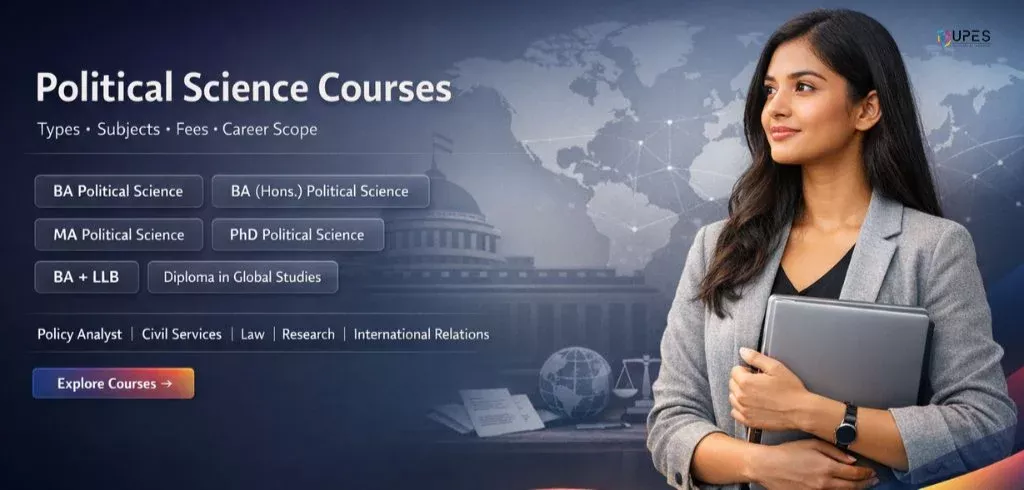
Political science courses after 12th include:
- BA in Political Science
- BA (Hons.) Political Science
- integrated BA LLB
- Diploma-level programs in governance, global studies, and public policy.
Political Science Courses After 12th: Getting Started
The journey into the world of power, governance, and diplomacy usually begins right after high school. Whether you come from a Humanities, Commerce, or even a Science background, political science courses are accessible to all.
Popular UG Options
- BA in Political Science: A foundational 3-year program focusing on political theory and Indian government.
- BA (Hons.) Political Science: An intensive version of the standard degree, offering deeper specialization in international relations and public policy.
- Integrated BA + LLB: A 5-year program that combines political science with legal studies, perfect for aspiring lawyers.
- Diploma in Global Studies: Shorter, 1-2 year courses focusing on specific regions or international diplomacy.
Quick Eligibility Checklist
To apply for these programs, you generally need:
- A 10+2 certificate from a recognized board.
- A minimum aggregate of 45% to 60% (varies by university).
- For top-tier colleges, a valid score in entrance exams like CUET (Common University Entrance Test).
Political Science Degree Courses: From Bachelors to PhD
If you are looking for a long-term academic or professional career, understanding the hierarchy of political science degree courses is essential.
1. Bachelor of Arts (BA / BA Hons.)
This is where you build your "Political IQ." You’ll study how power is distributed and how constitutions are formed.
- Fees: ₹10,000 (Govt) to ₹3,00,000+ (Private) total.
- Salary Potential: ₹3 LPA – ₹6 LPA (Entry-level).
2. Master of Arts (MA)
A postgraduate degree allows you to specialize. Popular niches include Comparative Politics, International Relations (IR), and Subaltern Studies.
- Fees: ₹15,000 to ₹2,50,000 total.
- Salary Potential: ₹5 LPA – ₹10 LPA
3. PhD in Political Science
For those who want to enter high-level research or become a university professor. This involves 3–5 years of original research and a thesis defense.
Pro-Tip: If you want a degree that doesn't just stick to the classroom, look for programs that offer a "Liberal Arts" approach. For example, the BA (Hons.) Political Science emphasizes critical thinking and digital literacy, preparing you for the tech-driven policy world of today.
Political Science Courses for UPSC: The Civil Services Edge
It is no secret that Political Science and International Relations (PSIR) is one of the most popular optional subjects for the UPSC Civil Services Examination.
Why Choose This Path?
- Syllabus Overlap: Almost 60-70% of the UPSC General Studies Paper II (Polity & Governance) is covered in a standard Political Science degree.
- Current Affairs Foundation: The course helps you decode daily news—from Supreme Court judgments to international summits.
- Interview Prep: It builds the analytical mindset required to answer complex questions about India's foreign policy and internal security.
Comparison: Standard BA vs. UPSC-Focused BA
| Feature | Standard BA | UPSC-Aligned BA |
| Focus | General Theory | Constitution & Administration |
| Writing | Academic Essays | Analytical & Precise Answers |
| Extras | Electives (Music/PE) | General Studies Workshops |
Many students now opt for universities that offer dedicated "Civil Services" wings or mentorship programs alongside their regular political science courses.
Read More: Top BA Specializations for Students in 2026
Key Subjects Covered in Political Science
What exactly will you be reading? It’s not just history; it’s a mix of philosophy, law, and economics.
- Political Theory: Studying thinkers like Plato, Marx, and Gandhi.
- Comparative Politics: Comparing how different countries (like the UK vs. India) run their governments.
- International Relations: Understanding war, peace, and trade between nations.
- Public Policy: Learning how to design and evaluate government schemes.
Career Scope and Salary: What to Expect?
The "scope" of political science is no longer limited to the library. Here is a breakdown of the modern job market in India:
| Job Role | Sector | Average Salary (Freshers) |
| Policy Analyst | Think Tanks / NGOs | ₹4.5 LPA – ₹7 LPA |
| Corporate Affairs Specialist | Tech/MNCs (Google, Amazon) | ₹6 LPA – ₹12 LPA |
| Political Consultant | Election Management Firms | ₹4 LPA – ₹15 LPA |
| Journalist | Media Houses | ₹3.5 LPA – ₹6 LPA |
| Professor | Universities | ₹6 LPA – ₹9 LPA (NET qualified) |
Sources: Indeed, Glassdoor | ||
How to Choose the Right Political Science Course?
With so many options, how do you pick? Use this mini-checklist:
- Curriculum: Does it cover modern topics like Digital Governance or Environmental Policy?
- Exposure: Are there internships with NGOs, media houses, or government bodies?
- Infrastructure: Does the university have a strong library and debate culture?
- Brand Value: Does the institution have industry tie-ups for placements?
For instance, the UPES Political Science program stands out because it blends traditional social sciences with future-ready skills like data analysis and communication. This is vital because today's political scientist needs to be as comfortable with a spreadsheet as they are with a constitution.
FAQs: Your Questions Answered
1. Is Political Science a good career for the future?
Absolutely. As global regulations become more complex (AI ethics, climate laws), companies and governments need experts who understand policy and power dynamics.
2. Can I do Political Science if I was a Science student in 12th?
Yes! Most universities welcome students from all streams. In fact, "Science-turned-PolSci" students often excel at data-heavy policy analysis.
3. What are the best political science courses after 12th for high salaries?
An Honours degree (BA Hons) followed by a Master's in Public Policy (MPP) or an MBA in Public Affairs usually leads to the highest-paying corporate roles.
4. Are there any short-term certificate courses?
Yes, many platforms offer 3-6 month certifications in Human Rights, Public Policy, or International Law to supplement your degree.
5. Does Political Science only lead to government jobs?
No. While many graduates aim for the IAS or SSC, a huge number now work in private consulting, PR, and international organizations like the UN.

Our counsellors are just a click away.
Conclusion
If you want low fees and freedom to prepare for exams like CA/CS or government jobs, choose a government BCom college in Dehradun. If you want stronger campus exposure, internships and placements, go for a good private BCom/BCom (Hons) programme. And if you’re already sure about a corporate/management career, an integrated BCom (Hons) + MBA like UPES can give you a faster, more structured route into those roles.

UPES Editorial Team
Written by the UPES Editorial Team
UPES Admission Enquiry
Trending Post
-

-

Exploring the Past, Building the Future: My Journey as a History Student at UPES
03/08/2026By Pritha Agarwal
-


Related Articles




















Subscribe to UPES Blogs
Join our community for exclusive stories, insights, and updates
By clicking the "Subscribe" button, I agree and accept the privacy policy of UPES.


