CAT Exam 2026: Dates, Eligibility, Syllabus, Pattern & Preparation
- UPES Editorial Team
- Published 27/11/2026



- What Is the CAT Exam? Full Form and Purpose
- CAT Exam 2026: Overview
- CAT Exam: Important Dates
- CAT 2026 Admit Card and Exam-Day Guidelines
- CAT Exam 2026 Eligibility Criteria
- CAT Exam Pattern and Marking Scheme 2026
- CAT Exam Marking Scheme
- CAT Syllabus for MBA Entrance Exam
- CAT Exam Fees 2026
- CAT Exam Preparation Tips
- CAT 2026 Result
The Common Admission Test is a national-level management entrance examination conducted annually by the Indian Institutes of Management (IIMs) for admission to MBA and other postgraduate management programs. CAT 2026, conducted by IIM Indore, is scheduled for 29 November 2026 and is relevant to the MBA 2027 admission cycle. The examination assesses candidates across three sections: Verbal Ability and Reading Comprehension (VARC), Data Interpretation and Logical Reasoning (DILR), and Quantitative Ability (QA). This guide explains the CAT exam dates, eligibility criteria, syllabus, exam pattern, fees, preparation strategy and participating colleges.
What Is the CAT Exam? Full Form and Purpose
The CAT full form is Common Admission Test. It is a national-level entrance examination used by IIMs and several other business schools in India for admission to postgraduate management programmes. CAT scores are used for shortlisting candidates, while final admission may depend on academic performance, work experience, personal interviews and other institution-specific selection criteria.
The exam is conducted annually by an IIM on a rotational basis. The CAT exam is held in computer-based test mode for a duration of 120 minutes consisting of 3 sections. The three sections in the CAT exam include Verbal Ability and Reading Comprehension (VARC), Data Interpretation and Logical Reasoning (DILR), and Quantitative Aptitude (QA).
CAT Exam 2026: Overview
Common Admission Test is held annually by IIMs, while the exam structure largely remains the same over the years, the difficulty level and the exam conducting IIM may change. The following is a brief overview of the CAT exam:
| Particulars | Details |
| Full name | Common Admission Test |
| Conducting body | One of IIMs in rotations |
| Mode of exam | Computer-based test at designated test centres |
| Duration | 120 minutes (2 hours) |
| Frequency of exam | Once a year |
| Language | English |
| Total questions | 66 to 68 |
| Question types | MCQ and non-MCQ/TITA |
| Number of sections | • Verbal Ability and Reading Comprehension (VARC) • Data Interpretation and Logical Reasoning (DILR) • Quantitative Aptitude (QA) |
| Admission cycle | 2027 |
| Official website | iimcat.ac.in |
CAT Exam: Important Dates
The schedule for the CAT exam is released through an official notification on the official exam website. The registration process typically begins in August and remains open until September. The following are important dates for the CAT exam 2026.
Events | Dates |
CAT 2026 Notification | July 26, 2026 |
CAT 2026 Registration Begins | August 3, 2026 |
CAT 2026 Registration Last Date | September 22, 2026 |
CAT 2026 Admit Card Release Date | November 6, 2026 |
CAT Exam 2026 | November 29, 2026 |
CAT Exam Result 2026 | 1st week of January 2027 (Expected) |
CAT 2026 Admit Card and Exam-Day Guidelines
The CAT 2026 admit card was released on 6 November 2026 and can be downloaded from the official CAT website, iimcat.ac.in, using their registered login credentials. The admit card contains important details such as the examination date, test centre, exam slot, reporting time and examination-day instructions.
Candidates appearing for CAT 2026 on 29 November 2026 should follow these exam-day guidelines:
- Carry a printed copy of the CAT admit card and an approved original photo ID.
- Reach the designated examination centre before the reporting time mentioned on the admit card.
- Verify the examination centre, allotted slot and personal details in advance.
- Avoid carrying prohibited items such as mobile phones, calculators, smartwatches and study materials.
- Follow the official dress code, identification requirements and instructions issued by the examination authorities.
Read the instructions mentioned on their CAT admit card to avoid any last-minute inconvenience.
CAT Exam 2026 Eligibility Criteria
As per the general eligibility criteria, students who have completed their UG level degree or are in final year of their respective degrees can apply for the CAT 2026 exam. The detailed eligibility criteria are provided below including minimum marks, academic qualification, and other CAT exam requirements.
Eligibility Parameter | Criteria |
Educational Qualification | Candidates must hold a bachelor's degree from a recognized university or educational institution in any discipline. |
Minimum Marks | For General/EWS/NC-OBC categories- At least 50% aggregate marks or equivalent CGPA |
Final-Year Students | Candidates appearing for the final year of their bachelor's degree or equivalent qualification can apply provisionally, subject to requirements |
Candidates Awaiting Results | Candidates who have completed their degree requirements but are awaiting results are eligible to apply, subject to applicable conditions |
Professional Qualifications | Candidates with professional qualifications such as CA, CS, ICWA/CMA or Fellow of the Institute of Actuaries of India (FIAI) are also eligible, subject to the prescribed minimum marks. |
CGPA Conversion | If candidates are awarded grades or CGPA, the conversion to percentage must follow the procedure certified by their respective university or institution. |
| Age limit | No prescribed upper age limit |
| Work experience | Not mandatory for appearing in CAT |
CAT Exam Pattern and Marking Scheme 2026
The CAT exam paper is divided into three sections: Verbal Ability and Reading Comprehension, Data Interpretation and Logical Reasoning, and Quantitative Aptitude. The CAT exam follows a negative marking scheme, which means a certain number of marks are deducted for wrong answers.
CAT 2026 Exam Pattern
Detailed CAT 2026 exam pattern is provided in the table below. The exam will be held in online mode, and candidates will have 40 minutes to complete each section of the exam.
Particulars | Details |
Mode of Exam | Online (Computer-based Test) |
Duration | 120 Minutes (2 Hours) 40 minutes for each section |
Language | English |
Sections |
|
Number of Questions | 66 to 68 |
Maximum Marks | 198 to 204 |
Question Types | Multiple Choice Questions and Type in the Answer questions |
Negative Marking | Yes (only for MCQs) |
CAT Exam Marking Scheme
As per the marking scheme, +3 marks are awarded for each correct answer, while a –1 is deducted for wrong MCQ answers. CAT marking scheme doesn't award negative marks for incorrect Type in the Answer Questions.
Question Type | Marks for Correct Answer | Marks for Incorrect Answer |
Multiple Choice Questions | +3 marks | -1 mark |
Type in the Answer Questions | +3 marks | 0 marks |
Unattempted questions | 0 marks | 0 marks |
CAT Score vs CAT Percentile
A CAT raw score is calculated using the examination's marking scheme. The scaled score is obtained after normalisation across examination sessions. CAT percentile indicates a candidate's relative performance compared with other test-takers. For example, a 95 percentile indicates that a candidate has performed better than approximately 95% of test-takers. It does not mean that the candidate has scored 95% marks in the examination.
CAT Syllabus for MBA Entrance Exam
The IIMs do not release a detailed, topic-wise syllabus for the CAT exam; however, the exam pattern and different sections in the exam are provided. Based on the previous year question papers and trends, you can plan your studies. The following is a typical CAT exam syllabus.
Section | Topics | |
Verbal Ability and Reading Comprehension (VARC) |
| |
Data Interpretation and Logical Reasoning (DILR) |
| |
Quantitative Aptitude (QA) : | Arithmetic | Percentages, ratios, averages, profit and loss, time and work, time and distance |
| Algebra | Equations, inequalities, functions, logarithms | |
| Geometry | Triangles, circles, quadrilaterals, mensuration | |
| Number System | Divisibility, factors, remainders | |
| Modern Mathematics | Permutations, combinations and probability | |
How to Apply for CAT Exam 2026?
The application process for the CAT exam is held online and generally begins in August. As of now, CAT 2026 registration has closed. The following steps explain the general application process for candidates planning to appear in future CAT examination cycles:
- Go to the official CAT 2026 exam website
- Click on the New Candidate Registration.
- You may be required to generate a One-Time Password using your email or mobile number.
- Once logged in, go to the Application Form option.
- Fill out the online application form and provide your details such as name, email, academic qualification, and more.
- Upload the required documents such as academic certificates, photographs, and signatures.
- Finally, pay the application form fees to complete the registration process.
CAT Exam Fees 2026
To successfully register for the CAT exam, students will be required to pay application form fees. The fee amount may vary based on the student category. As per CAT 2026 notification the following are application form fees for CAT exam:
Category | Application form fees |
General, EWS, and NC-OBC candidates | INR 2,700 |
SC, ST, and PwBD candidates | INR 1,350 |
CAT Exam Preparation Tips
CAT is considered one of the premier management entrance examinations in India. Therefore, to secure a seat among top B-Schools in India, you need a structured and well-thought-out preparation plan. A strong CAT preparation plan includes understanding the CAT exam pattern, creating a dedicated study plan, solving previous year's question papers, and practicing mock tests. The following are some of the key CAT exam preparation tips that students must consider:
- Understand the exam pattern: The first step in your CAT preparation is to understand the exam pattern. Aspirants should understand the exam structure, the number of sections, and the marking scheme. The CAT exam is held online for a duration of 2 hours. The question paper consists of 3 sections, Verbal Ability and Reading Comprehension, Data Interpretation and Logical Reasoning, and Quantitative Aptitude. Students should plan their exam preparation strategy as per exam pattern and different sections of the exam.
- Create a structured study plan: Once you have a good understanding of how the CAT exam is conducted, the second step is to prepare a structured study plan. An ideal plan to crack the CAT exam generally defines dedicated study hours for each subject.
- Create a section-wise study plan: CAT exam includes 3 sections, and students are allotted only 40 minutes to solve each section. To ensure you can attempt all the questions in a limited time, you should consider planning a section-wise exam preparation plan. This approach also helps students to identify their weak subject areas and timely improve their exam preparations.
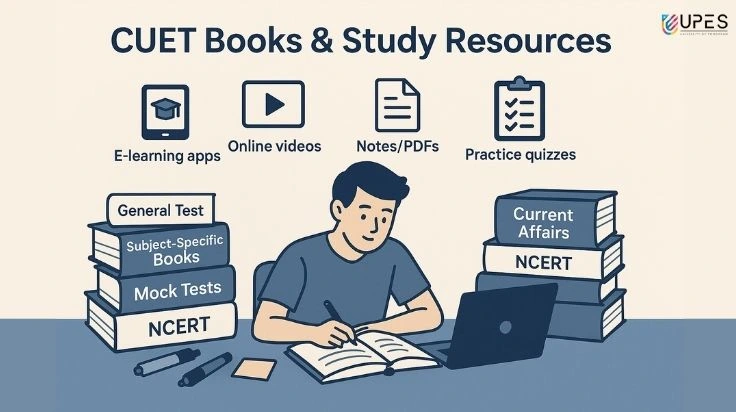
- Read from reputable preparation books: Good study materials are essential for proper exam preparation. To ensure you get the best concepts and practice materials, refer to recommended books, authors, and study resources.
- Attempt mock tests and PYQs: Previous year question papers and mock tests are an excellent way to simulate real-exam conditions and assess your overall preparation. There are several CAT online mock tests available that you can attempt and incorporate into your exam preparations.
- Explore online resources and exam strategies: Besides relying on the traditional educational materials and study resources, you can also consider checking out online study materials and resources such as YouTube lectures, online test series, online notes, and more.
Last-Minute Preparation Tips for CAT 2026
For last-minute preparation tips and exam-day readiness, focus on these few things:
- Revise important formulas and familiar concepts.
- Review mistakes from previous CAT mock tests.
- Focus on accuracy, time management and question selection.
- Avoid studying new topics just before the exam.
- Keep your admit card and required documents ready, and get sufficient rest.
Best Books for CAT Preparation
Choosing the right books for CAT preparation helps students strengthen their concepts, improve problem-solving skills and practise questions based on the CAT exam pattern. Aspirants should focus on reliable study materials for VARC, DILR and Quantitative Ability rather than referring to multiple books for the same topic.
Check the list of some of the most common books used for the CAT exam preparations:
Book title | Author name/Publication |
VARC | Arun Sharma and Meenakshi Upadhyay's VARC preparation guide |
DILR | Nishit K. Sinha's Logical Reasoning and Data Interpretation guide |
| QA | Arun Sharma's Quantitative Aptitude preparation guide or Quantum CAT |
For a detailed section-wise list of recommended study materials, explore our guide to the best books for CAT preparation.
CAT 2026 Result
The CAT 2026 result is expected to be announced in the first week of January 2027 on the official website, subject to official confirmation. The CAT scorecard includes sectional and overall scaled scores and percentiles. Since CAT is conducted across multiple examination sessions, scores are normalised to account for differences across test forms. Percentiles indicate a candidate's relative performance compared with other test-takers. Each participating institution independently determines their admission cut-off score and shortlisting criteria.
What is a Good Score in CAT Exam?
A good CAT percentile score depends on the target business school, academic profile, candidate category and admission criteria. A percentile of 95 or above can make a candidate competitive for several management institutes including IIMs, but it does not guarantee an IIM admission or interview shortlist. Highly competitive IIMs may require substantially higher percentiles, along with strong academic performance and other selection criteria.
Which Colleges Accept CAT Scores
CAT is one of the most sought-after management entrance exams and is accepted by all the 22 IIMs in India for admission to their MBA programs. Along with IIMs, some of the top private and government B-Schools in India also accept CAT scores for admission to their management programs.
IIMs Accepting CAT Scores
The CAT exam is conducted by IIMs for Admission to postgraduate management program. All 22 IIMs in India accept CAT scores for admission to MBA programs.
S. No. | Name of IIM | Location (City, State) | Approx. MBA Fees (2 Years) |
1 | IIM Ahmedabad | Ahmedabad, Gujarat | ₹36.20 lakh |
2 | IIM Bangalore | Bengaluru, Karnataka | ₹33.68 lakh |
3 | IIM Calcutta | Kolkata, West Bengal | ₹25 lakh |
4 | IIM Lucknow | Lucknow, Uttar Pradesh | ₹14.30 lakh |
5 | IIM Kozhikode | Kozhikode, Kerala | ₹22.50 lakh |
6 | IIM Indore | Indore, Madhya Pradesh | ₹24 lakh |
7 | IIM Shillong | Shillong, Meghalaya | ₹26.18 lakh |
8 | IIM Rohtak | Rohtak, Haryana | ₹17.90 lakh |
9 | IIM Ranchi | Ranchi, Jharkhand | ₹19.20 lakh |
10 | IIM Raipur | Raipur, Chhattisgarh | ₹18.00 lakh |
11 | IIM Tiruchirappalli | Tiruchirappalli, Tamil Nadu | ₹22.50 lakh |
12 | IIM Kashipur | Kashipur, Uttarakhand | ₹20.80 lakh |
13 | IIM Udaipur | Udaipur, Rajasthan | ₹24.41 lakh |
14 | IIM Amritsar | Amritsar, Punjab | ₹19.50 lakh |
15 | IIM Bodh Gaya | Bodh Gaya, Bihar | ₹17.96 lakh |
16 | IIM Nagpur | Nagpur, Maharashtra | ₹21 lakh |
17 | IIM Sambalpur | Sambalpur, Odisha | ₹21.13 lakh |
18 | IIM Sirmaur | Sirmaur, Himachal Pradesh | ₹21 lakh |
19 | IIM Visakhapatnam | Visakhapatnam, Andhra Pradesh | ₹23.59 lakh |
20 | IIM Jammu | Jammu, Jammu & Kashmir | ₹22.81 lakh |
21 | IIM Mumbai | Mumbai, Maharashtra | ₹25 lakh |
22 | IIM Guwahati | Guwahati, Assam | ₹18 lakh |
Top Private B-Schools Accepting CAT Scores
Along with IIMs, several private business schools in India also accept CAT scores for admission to their respective MBA programs. The following are some of the top management schools accepting CAT scores:
S. No. | Name of College | Location (City, State) | NIRF 2025 Rank | Approx. MBA/PGDM Fees (2 Years) |
1 | Management Development Institute (MDI) | Gurugram, Haryana | 9 | ₹26.55 lakh |
2 | S. P. Jain Institute of Management and Research (SPJIMR) | Mumbai, Maharashtra | 20 | ₹24.50 lakh |
3 | Amrita Vishwa Vidyapeetham | Coimbatore, Tamil Nadu | 26 | ₹14.52 lakh |
4 | Institute of Management Technology | Ghaziabad, Uttar Pradesh | 30 | ₹21 to 23 lakh |
5 | MICA (Mudra Institute of Communications, Ahmedabad) | Ahmedabad, Gujarat | 33 | ₹26 to 29.50 lakh |
6 | UPES (University of Petroleum and Energy Studies) | Dehradun, Uttarakhand | 36 | ₹18.37 lakh |
7 | Great Lakes Institute of Management | Chennai, Tamil Nadu | 37 | ₹20 to 22.50 lakh |
8 | T. A. Pai Management Institute (TAPMI) | Manipal, Karnataka | 39 | ₹21.56 lakh |
9 | International Management Institute (IMI) | New Delhi, Delhi | 40 | ₹23 to 25 lakh |
10 | Jaipuria Institute of Management | Noida, Uttar Pradesh | 41 | ₹16.50 lakh |
11 | International Management Institute (IMI) | Kolkata, West Bengal | 42 | ₹14.98 lakh |
What Happens After the CAT Exam?
Once the CAT exam is over, candidates can go through different stages of the MBA admission process, from checking their scores to attending selection rounds. The key steps include:
- Response Sheet and Answer Key: Check the CAT answer key and response sheet to estimate your score.
- CAT Result and Scorecard: Download your CAT scorecard to check your sectional and overall scores and percentiles.
- College Shortlisting: Shortlist IIMs and other B-schools based on your CAT percentile, eligibility and career goals.
- MBA Applications: Apply to your preferred colleges before their respective application deadlines.
- Selection Rounds: Appear for Personal Interviews (PI), Written Ability Tests (WAT) or Group Discussions (GD), wherever applicable.
- Final Admission: Colleges offer admission based on CAT scores, academic performance, work experience and selection round performance, as applicable.
Keep track of MBA application deadlines, as some colleges close their applications before the CAT results are announced.
Conclusion
The CAT exam is an important pathway to pursuing an MBA or other postgraduate management programs at leading B-schools in India. Understanding its eligibility criteria, exam pattern, syllabus, registration process, and marking scheme can help you prepare in a more structured manner. Along with choosing the right study materials, regular practice, mock tests, and a section-wise preparation strategy can help you improve your performance. Before applying, make sure to check out the latest CAT notification and the admission requirements of your preferred IIMs and other B-schools, as their selection criteria may vary.
FAQs
What are the CAT eligibility criteria?
To appear in the CAT exam, you are required to meet certain eligibility criteria such as the applicants are required to have completed their UG level education from a recognized institute or are currently studying in the final year of UG degree. Additionally, applicants are also required to have scored 50% marks in UG (45% for reserved categories).
Is 95 percentiles enough for IIM?
CAT percentile of 95 can make candidates competitive for some IIMs, depending on their academic profile, category and the institute's admission criteria. However, it does not guarantee admission, as IIMs also consider sectional percentiles, academic performance and selection round performance.
Which is the best private college for MBA through CAT?
There are several private colleges that accept CAT scores for admission to MBA programs some of these institutes include Management Development Institute, UPES Dehradun, Amrita Vishwa Vidyapeetham, and more.
How many times is the CAT exam held in a year?
The CAT exam is held only once per academic year. Generally, the exam is held in the latter half of the year, usually in November.
Who conducts the CAT exam?
- One of the IIMs conducts the CAT exam each year. IIMs take turns every year in rotational basis to decide which institute will conduct the exam for the particular year.

UPES Editorial Team
Written by the UPES Editorial Team
UPES Admission Enquiry
Trending Post
-
![]()
-
![]()
Best CAT Preparation Books for Students in 2026: VARC, DILR & QA Guide
07/07/2025By UPES Editorial Team
-
![]()


Related Articles




















Subscribe to UPES Blogs
Join our community for exclusive stories, insights, and updates
By clicking the "Subscribe" button, I agree and accept the privacy policy of UPES.


