Key Student Struggles in a Data Science & AI Programme: Projects, Internships & Industry Readiness
- UPES Editorial Team
- Published 14/04/2026


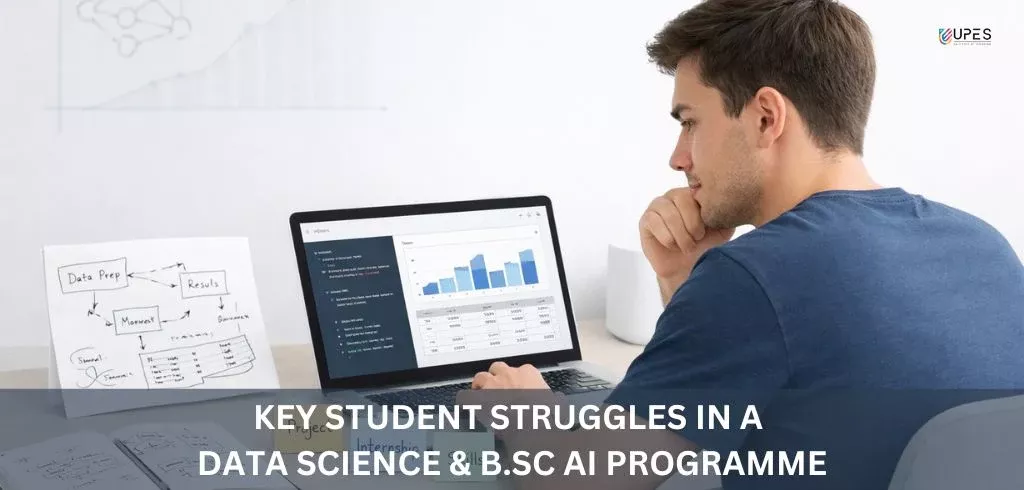
Choosing a BSc in Data Science or AI can feel like picking a “future-proof” degree and in many ways, it is. But if you’re searching for data science student struggles India, you’re probably sensing a gap between what brochures promise and what students actually experience once the semester begins.
This blog takes an outcomes-first view of the most common pain points students face in India, especially around projects, internships, and job readiness, and what you can do (and what your college should provide) to reduce those risks. We also map these struggles to industry realities such as data quality issues, skill gaps, and expectations in the job market, as discussed in Indian ecosystem analyses.
Become future-ready with our Computer Science programs
Know MoreData science & AI students’ struggles
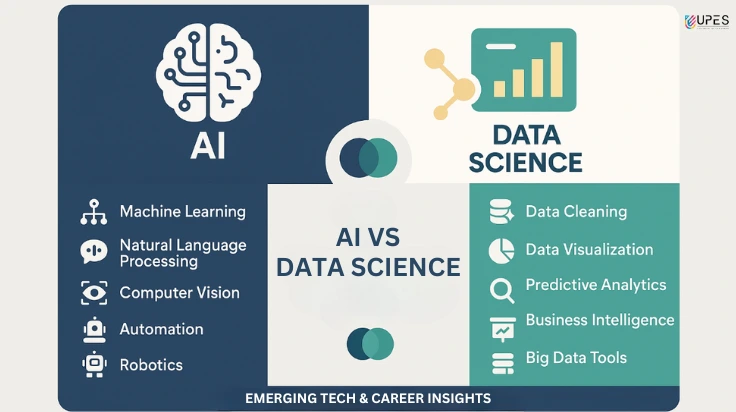
AI vs Data Science differences lie mainly in goals—AI aims to make machines intelligent, while Data Science uncovers patterns for decision-making. Key student struggles in a Data Science & AI BSc programme generally stem from the field's interdisciplinary nature, which requires a blend of skills across mathematics, programming, and real-world problem-solving.
1) The “theory-to-practice” gap in projects
A recurring challenge is that students learn concepts (supervised learning, probability, evaluation metrics), but struggle to apply them to messy, real datasets. One reason is that many learners over-index on theoretical learning and under-invest in hands-on practice, even though data roles demand both.
What this looks like in college:
In college, this gap typically shows up in predictable ways. Students may be able to explain algorithms in class or exams, but they find it difficult to build a reliable end-to-end workflow from raw data to a defensible output. Feature engineering often becomes trial-and-error without clear reasoning, and models that look strong inside a notebook may fail when exposed to realistic constraints such as missing data, inconsistent labels, leakage risks, or shifting data distributions.
What reduces this struggle (project design checklist):
Students tend to benefit when they are required to complete at least two to three portfolio-grade projects that increase in complexity over time, moving from exploratory analysis to modelling and then to basic deployment or reproducibility practices. The learning becomes more “industry-like” when projects include formal checkpoints—such as problem framing, baseline creation, and error analysis—and when grading rewards reproducibility, documentation quality, and justification of decisions rather than only chasing high accuracy.
2) Poor data quality and fragmented access
In India, data is often fragmented across departments and organisations, and data quality problems (missing values, inconsistencies, inaccuracies) can limit the reliability of insights.
Even the best student cannot “model their way out” of broken inputs—so data cleaning, consolidation, and validation become core skills, not side skills.
Why students feel stuck:
Students usually struggle here because the datasets used in classroom exercises are cleaner than what they encounter in capstones, internships, or real assignments. As a result, many underestimate the time needed for consolidation and validation, and projects suffer either because cleaning is rushed or because the modelling stage becomes an afterthought.
What to do as a student:
A practical way to handle this is to treat data quality work as a core deliverable. Students can explicitly document why they made certain cleaning decisions, build reusable preprocessing scripts, and add basic validation checks that make their pipeline more credible and repeatable.
3) Weak “industry context” and problem framing
Data work is rarely “build a model.” It is usually: Define the decision, identify constraints, measure trade-offs, communicate findings. Beginners commonly struggle with industry nuances and domain-specific needs.
How this hits student outcomes:
Projects feel like academic demos, not business solutions. Students cannot explain “why this matters” in interviews. Résumés look tool-heavy but impact-light.
A practical fix (use in every project):
A simple academic practice that improves industry framing is to start every project with a one-page brief that clarifies the stakeholder, the decision the model supports, the cost of errors (false positives/false negatives), and the realistic availability of data. When students consistently do this, their projects read less like classroom demos and more like applied work.
4) Tool overload and shallow competence
Students often learn many tools/programming languages lightly (Python, SQL, Tableau, ML libraries) but lack depth in the few that matter most for internships. This is worsened by the breadth of the field—and the fact that organisations face a “skill gap” in job-ready talent.
A better approach:
A more effective approach is to pick a small “core stack” and build depth in it instead of spreading yourself thin across too many tools. Typically, this means becoming genuinely comfortable with Python, SQL, Git, and one machine learning framework, while also adding one visualisation tool so you can communicate insights clearly.
You can then demonstrate real mastery by maintaining a clean and well-organised repository structure, writing readable and well-commented code, including basic unit checks or data validation steps, and ensuring your work is reproducible through repeatable runs—supported by a requirements file, fixed random seeds where relevant, and clear documentation.
5) Ethical concerns, bias, and privacy constraints
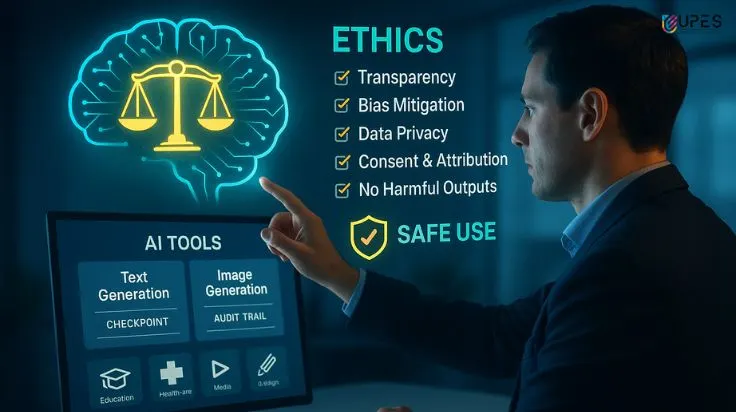
As data use and GEN AI use expands, concerns around privacy, ethical use of AI, bias, and fairness become more prominent. Students often treat ethics as a theory chapter, but industry expects applied judgment—what can be collected, how it can be used, and how to prevent discriminatory outcomes.
Project-ready ethical components:
Make your project ethically job-ready by using only necessary data, checking for bias (subgroup performance and imbalance), noting which features drive predictions, and adding a brief “risks and mitigations” section on limitations and safeguards.
Data Science students struggle in Career
Listed below are the struggles students of Data Science and AI face when entering the job market. Along with it, you can also find how to tackle those problems and the mindset to adopt.
1) Internships: access is not the same as readiness
A common myth is: “If I get an internship, I’m set.” In reality, internships reward students who can contribute quickly—clean data, write SQL, build baselines, communicate results. Meanwhile, the ecosystem also reflects high competition, especially for entry roles.
- Internship readiness signals (what interviewers notice fast):
- Can you take a dataset from raw → cleaned → baseline → improved?
- Can you explain trade-offs and limitations clearly?
- Can you collaborate (Git, code reviews, documentation)?
2) The “unrealistic expectations” mismatch
Companies sometimes expect rapid results, while data science requires experimentation and iteration; clear communication is essential.
Students feel this as pressure: “Why isn’t my model working? Why isn’t my project ‘industry-level’?”
How to respond like a professional:
Set baselines early. Track experiments. Communicate uncertainty and constraints. Present next-best actions, not only final accuracy.
3) Salary expectations vs entry-level reality
Salaries vary by role, city, and experience, but credible aggregators show approximate baselines that are useful for planning (not guarantees).
Data scientist average in India (as of June 2025): about ₹10.22L/year. Data analyst averages are commonly reported around ₹6–7L/year, depending on the source and methodology. An AI Engineer's average salary in India varies significantly with experience but generally ranges from ₹6-12 LPA for freshers to ₹15-25+ LPA for senior roles. (Sources: PayScale, Naukri).
Interpretation for students/parents:
Entry roles often start at analyst/associate levels; moving up is strongly tied to demonstrable project depth and real internship outputs, especially in a competitive market.
UPES Pathways: Where the right BSc program can reduce these struggles
A strong undergraduate program should systematically address the main pain points above: real tooling, structured projects, internship support, and industry exposure.
UPES B.Sc. Computer Science (Data Science)
UPES explicitly highlights foundations in forecasting, predictive modelling, and statistical fundamentals, with exposure to tools such as NoSQL, data warehousing, PyTorch, Tableau, R, and Splunk. The kind of stack that can reduce “tool anxiety” and strengthen applied readiness for B.Sc Data Science students.
UPES B.Sc. Computer Science (AI & ML)
UPES describes a BSc AI curriculum combining theoretical underpinnings with practical applications, including work with TensorFlow, Keras, PyTorch, and NoSQL, alongside hands-on projects, case studies, and industry-linked elements such as internships and partnerships.
If a program cannot show you how students build portfolios, get reviewed, and access internships, it may increase the very struggles you’re trying to avoid. If you’re comparing options, it’s worth exploring the BSc Data Science and BSc AI/ML curriculum structures and the tool exposure they explicitly commit to.
FAQs (data science student struggles India)
What are the most common data science student struggles India face?
The most frequent issues involve applying theory to messy datasets, building portfolio-grade projects, and converting coursework into internship-ready skills. Data quality and fragmented access can further slow real-world learning.
Why do data science projects feel “too academic”?
Often because they use clean datasets and focus on algorithm performance rather than decision context, constraints, and reproducibility. Adding problem framing, error analysis, and stakeholder storytelling makes projects more industry-aligned.
Is it normal to struggle with data cleaning more than modelling?
Yes. Data quality and consolidation challenges are widely recognised in the Indian ecosystem, and preprocessing is a major part of real work. Treat cleaning and validation as core deliverables.
Do I need internships to get placed in data roles?
Internships significantly improve employability because they produce verifiable outputs and professional workflows. But strong projects with reproducible pipelines and clear communication can also compensate when internships are limited.
Which is better for undergrad: Data Science or AI/ML?
If you want breadth (analytics → ML → business applications), Data Science is often a direct path. If you want deeper ML systems work, AI/ML can be a better fit—provided the program offers hands-on projects and industry exposure.
How do I know if a BSc program will make me “industry-ready”?
Look for explicit evidence: tool stack, project sequence, internship structure, and evaluation mechanisms (juries, external reviews, live projects). Program pages that specify tools and hands-on emphasis provide stronger signals than generic claims.
s

Our counsellors are just a click away.
Conclusion
If you’re worried about data science and AI student struggles India, the goal is not to find a “perfect” degree. It is to reduce predictable risks: shallow projects, weak internships, and low job readiness.
Focus on outcomes: portfolio depth, real-data competence, communication, and professional workflow. When you evaluate colleges, prioritise programs that clearly show how they deliver these outputs through tools, projects, and structured exposure.
If you’re exploring undergraduate pathways, review structured options like UPES’s BSc Data Science or BSc AI/ML to see how their tool exposure, hands-on emphasis, and internship orientation align with your readiness goals.

UPES Editorial Team
Written by the UPES Editorial Team
UPES Admission Enquiry
Trending Post
-

Full Stack Developer Interview Questions- Freshers to Experienced & High Level
08/08/2025By UPES Editorial Team
-

Gender Digital Divide: Challenges in Undergraduate Computer Science Programs
29/09/2025By Dr. Avita Katal
-

How to Create a Web Developer Portfolio & Why is it important (Examples, Templates, Ideas, Content & Website)
11/02/2025By UPES Editorial Team


Related Articles

























Subscribe to UPES Blogs
Join our community for exclusive stories, insights, and updates
By clicking the "Subscribe" button, I agree and accept the privacy policy of UPES.


