Dot net interview questions: Freshers to Experienced Developers
- UPES Editorial Team
- Published 16/06/2026


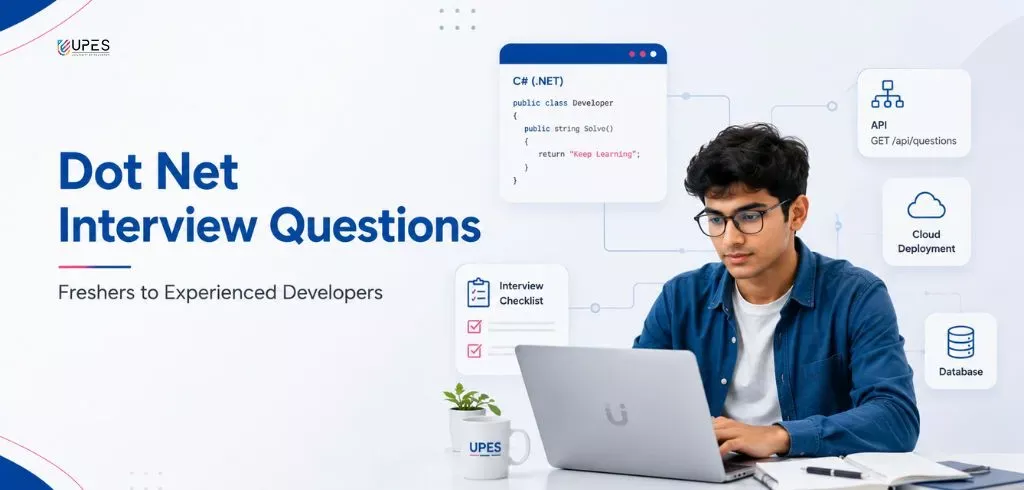
- What are the most important Dot Net interview questions?
- The 2026 .NET Developer Landscape: A Reality Check
- Essential Dot Net Interview Questions for Freshers
- Intermediate & Dot Net Interview Questions for Experienced
- Dot Net API Interview Questions: Mastering the Backend
- Advanced Technical Challenges: Dot Net Coding Interview Questions
Mastering the .NET ecosystem is a high-yield career move in the Indian IT landscape. Whether you are a final-year student in Bengaluru or a Senior Developer in Pune, the technical bar for interviews has shifted toward architectural depth, cloud-native proficiency, and high-scale performance.
This guide provides a deep-dive list of Dot net interview questions categorized by experience level, alongside a roadmap to help you navigate the competitive hiring market of 2026.
Become future-ready with our Computer Science programs
Know MoreWhat are the most important Dot Net interview questions?
The most important Dot Net interview questions usually cover:
- CLR, JIT compiler, managed code, OOPs, constructors, boxing and unboxing,
- .NET Core vs .NET Framework, dependency injection, middleware
- Web API, async/await
- SOLID principles, and coding problems like string reversal, palindrome checks, and singleton implementation.
The 2026 .NET Developer Landscape: A Reality Check
The demand for .NET professionals in India remains robust, but the "basic" developer role is evolving. Companies now prioritize "Full-Stack" capabilities and familiarity with dot net api interview questions, as microservices and containerization become the standard.
What is .NET?
.NET is a free, open-source, cross-platform developer platform created by Microsoft for building many different types of applications. It provides a programming model, a comprehensive set of libraries, and a runtime (CLR) that allows developers to build high-performance web, mobile, desktop, and IoT applications using languages like C#, F#, and VB.NET.
Essential Dot Net Interview Questions for Freshers
For entry-level roles, interviewers focus on your understanding of the Common Language Runtime (CLR) and Object-Oriented Programming (OOP) principles.
What is the difference between Managed and Unmanaged code?
- Managed Code: Runs under the control of the CLR. It benefits from automatic services like garbage collection, exception handling, and type checking.
- Unmanaged Code: Runs directly on the operating system (e.g., C++ code). The developer is responsible for memory management and security.
Explain the JIT (Just-In-Time) compiler.
- The JIT compiler is a part of the CLR that converts Microsoft Intermediate Language (MSIL) into native machine code at runtime, just before execution, optimizing it for the specific hardware.
- The JIT compiler is a part of the CLR that converts Microsoft Intermediate Language (MSIL) into native machine code at runtime, just before execution, optimizing it for the specific hardware.
What are Boxing and Unboxing?
- Boxing: Converting a value type (like int) to a reference type (object). This involves heap allocation.
- Unboxing: The explicit conversion of an object back to a value type. This requires a cast and is performance-heavy.
What are the different types of Constructors in C#?
- C# supports Default, Parameterized, Copy, Static, and Private constructors. Private constructors are often used in Singleton patterns to prevent external instantiation.
Quick Comparison: .NET Framework vs. .NET Core
| Feature | .NET Framework | .NET Core (Modern .NET) |
Platform | Windows Only | Cross-platform (Linux, macOS, Windows) |
Open Source | No | Yes |
Performance | Standard | High (Optimized for Cloud/Containers) |
Best For | Legacy Enterprise Apps | Microservices & Modern Web |
Intermediate & Dot Net Interview Questions for Experienced
If you have 3–7 years of experience, the focus shifts to design patterns, performance tuning, and specialized dot net api interview questions.
How does Dependency Injection (DI) work in ASP.NET Core?
- ASP.NET Core has built-in DI. You register services in Program.cs and inject them via constructors. Common lifetimes include:
- Transient: New instance every time.
- Scoped: One instance per client request.
- Singleton: One instance for the entire application lifetime.
- ASP.NET Core has built-in DI. You register services in Program.cs and inject them via constructors. Common lifetimes include:
What is Middleware in ASP.NET Core?
- Middleware are software components assembled into an application pipeline to handle requests and responses. Examples include authentication, logging, and CORS.
- Middleware are software components assembled into an application pipeline to handle requests and responses. Examples include authentication, logging, and CORS.
Explain the difference between IEnumerable and IQueryable.
- Use IEnumerable for in-memory collections (LINQ to Objects); it brings all data into memory before filtering. Use IQueryable for database queries (LINQ to SQL); it translates the query into SQL and filters at the database level.
- Use IEnumerable for in-memory collections (LINQ to Objects); it brings all data into memory before filtering. Use IQueryable for database queries (LINQ to SQL); it translates the query into SQL and filters at the database level.
What are Solid Principles?
- A set of five design principles (Single Responsibility, Open/Closed, Liskov Substitution, Interface Segregation, and Dependency Inversion) used to make software designs more understandable, flexible, and maintainable.
- A set of five design principles (Single Responsibility, Open/Closed, Liskov Substitution, Interface Segregation, and Dependency Inversion) used to make software designs more understandable, flexible, and maintainable.
You'd be interested in: Top CSE Sub-Branches in B.Tech
Common Coding Mistake: The "Async-Void" Trap
The Mistake: Using public async void MyMethod() in a service or logic layer.
The Fix: Always use public async Task MyMethod(). Using void prevents the caller from awaiting the task, making exception handling nearly impossible and potentially crashing the process.
The demand for .NET professionals in India remains robust, but the "basic" developer role is evolving. In a market where Python and Java are often cited as high demand programming languages, .NET has carved a specialized niche in high-scale enterprise applications and fintech.
Dot Net API Interview Questions: Mastering the Backend
With the rise of React and Angular frontends, being an "API Expert" is a major career advantage.
How do you handle Versioning in Web API?
- You can version via URL (e.g., /api/v1/users), Query string (/api/users?api-version=1.0), or Custom Headers.
What is Content Negotiation?
- It is the process of selecting the best representation for a response when there are multiple types available (e.g., JSON vs. XML), based on the Accept header sent by the client.
What is the difference between PUT and PATCH?
- PUT replaces the entire resource with a new version, while PATCH performs a partial update to the resource.
Advanced Technical Challenges: Dot Net Coding Interview Questions
Expect to be asked to write code or explain logic for these scenarios:
Reverse a string without using built-in methods.
- Tip: Use a char array and swap elements from both ends toward the middle.
Check for a Palindrome.
- Tip: Compare the string with its reverse or use a two-pointer approach for $O(n)$ efficiency.
Implement a Singleton Pattern.
- Tip: Use a private constructor and a static property with a "thread-safe" lock to ensure only one instance is created.
The "If...Then" Decision Guide for Interview Prep
Not sure where to focus your study time this week? Use this logic:
- IF you are a fresher with 0 experience:
- THEN Master OOPs, C# basics, and the difference between Value/Reference types.
- THEN Master OOPs, C# basics, and the difference between Value/Reference types.
- IF you have 3+ years of experience:
- THEN Focus on Dot net coding interview questions involving SOLID principles and SQL optimization.
- THEN Focus on Dot net coding interview questions involving SOLID principles and SQL optimization.
- IF you are targeting Lead/Architect roles:
- THEN Deep dive into Microservices, Azure/AWS deployment, and System Design.
Career Roadmap: From Student to ₹1.3 Crore CTC
Preparing for Dot net coding interview questions is only half the battle. To reach elite salary brackets in India, your foundation must be world-class.
For students and young professionals looking to bridge the gap between "knowing code" and "architecting systems," the B.Tech Computer Science Engineering program at UPES offers a distinct advantage. Ranked as India's #1 Private University (QS World University Rankings 2025 for Academic Reputation), UPES provides a high-impact learning environment.
Where a Strong Computer Science Foundation Helps
A structured computer science program can help students build fundamentals in programming, backend development, APIs, cloud deployment, databases, and system design. Students comparing programs should check curriculum depth, industry projects, internships, faculty exposure, coding labs, and placement outcomes before choosing.
Next Steps to Ace Your Interview
To ensure you stay ahead of the curve, take these three practical actions this week:
- Refactor an Old Project: Take a C# project you wrote and apply the SOLID principles. Be ready to explain why you made those changes.
- Practice System Design: Draw out how you would design a scalable e-commerce backend using .NET microservices.
Upgrade Your Credentials: If you are seeking a structured path to a high-paying career, review the industry-aligned curriculum at UPES School of Computer Science to see how world-class mentorship can elevate your trajectory.

Our counsellors are just a click away.
Conclusion: Mastering the .NET Ecosystem
To excel in 2026, a .NET developer must transition from basic syntax to architectural mastery. Dot net interview questions for freshers primarily test core concepts like the CLR, Garbage Collection, and OOPs. However, for experienced professionals, the focus shifts toward Dot net api interview questions involving microservices, middleware, and dependency injection lifetimes.
Success in the Indian tech market now requires a blend of high-performance coding and cloud-native design. By grounding yourself in industry-aligned education such as the B.Tech CSE programs at UPES and practicing real-world scenarios, you can bridge the gap from a junior coder to a high-value system architect.
Frequently Asked Questions (India Context)
1. What is the average salary for a .NET Developer in India?
In 2026, freshers typically start at ₹4–₹8 LPA. For those with 5+ years of experience, salaries range from ₹18–₹40 LPA, while top-tier architects can exceed ₹60 LPA in product-based companies.
2. Are .NET developers still in demand compared to Java or Python?
Yes. While Python dominates AI/ML, .NET is the backbone of enterprise-grade backend systems and fintech in India due to its security and speed.
3. Is .NET Core different from .NET 5/6/7/8/9?
"Core" was the name for the cross-platform reboot. Since .NET 5, Microsoft dropped the "Core" branding to signify a single, unified framework for all platforms.
4. Do I need to learn SQL for a .NET interview?
Absolutely. Most Indian technical rounds include a live coding session where you'll write joins, stored procedures, or optimize an Entity Framework query.
5. What is the role of Azure in .NET roles?
Highly significant. Most .NET shops are moving to the cloud. Knowing how to deploy an App Service or use Azure Functions will put you in the top 10% of candidates.
6. Which is better: .NET or Full-Stack MERN?
- Both are excellent. MERN is popular for startups. .NET is preferred for large-scale, secure, and maintainable corporate software.

UPES Editorial Team
Written by the UPES Editorial Team
UPES Admission Enquiry
Trending Post
-

Full Stack Developer Interview Questions- Freshers to Experienced & High Level
08/08/2025By UPES Editorial Team
-

Gender Digital Divide: Challenges in Undergraduate Computer Science Programs
29/09/2025By Dr. Avita Katal
-

How to Create a Web Developer Portfolio & Why is it important (Examples, Templates, Ideas, Content & Website)
11/02/2025By UPES Editorial Team


Related Articles







































Subscribe to UPES Blogs
Join our community for exclusive stories, insights, and updates
By clicking the "Subscribe" button, I agree and accept the privacy policy of UPES.


