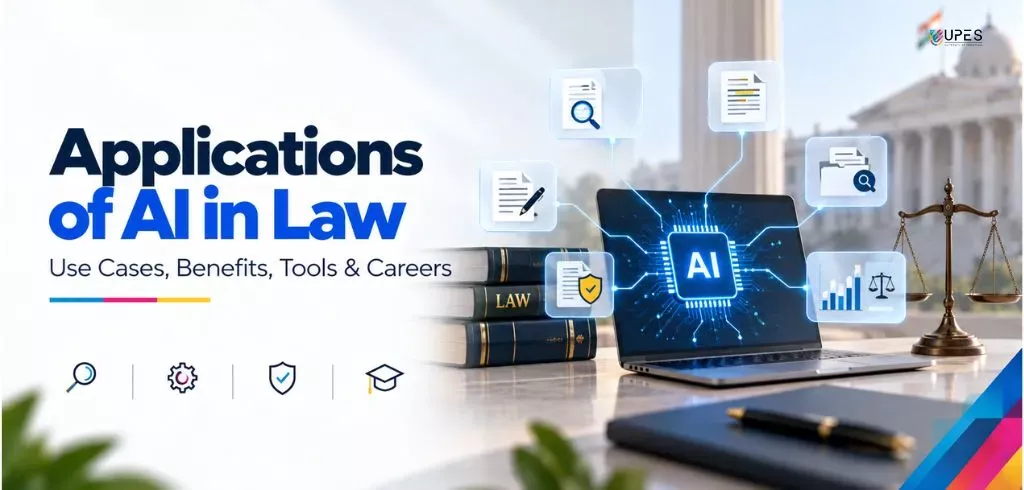
Applications of AI in Law: Use Cases, Benefits, Tools & Careers
- UPES Editorial Team
- Published 10/09/2026


- What is AI in Law?
- What Technologies are Used in AI in Law?
- Why are Law Firms Using AI Technology in 2026?
- Top Applications of AI in Law
- Benefits of AI Integration in Legal Services
- Real World Examples of AI in Law
- What are the Career Opportunities in AI in Law?
- Challenges of Artificial Intelligence in Legal Services
The Indian legal system faces significant challenges today, with more than 5.3 crore cases pending across various levels of courts. According to data from the National Judicial Data Grid (NJDG), the Supreme Court of India alone has over 92,000 pending cases. This growing judicial backlog is often attributed to factors such as a shortage of legal professionals, extensive documentation requirements, and the time-intensive nature of legal research and contract review processes.
In this context, the applications of AI in law are helping legal professionals and law firms improve efficiency while creating new career opportunities in legal technology. Technologies such as Artificial Intelligence (AI), Natural Language Processing (NLP), and Generative AI (GenAI) are streamlining legal workflows by automating documentation, paperwork, and routine administrative tasks. They are also assisting lawyers with legal research, contract drafting, compliance analysis, and even predicting case outcomes, enabling faster and more informed decision-making.
In the following article, we will discuss top applications of AI in Law firms along with its benefits, use cases, and career prospects.
Become future-ready with our Law programs
Know More
What is AI in Law?
Artificial Intelligence in Law refers to integrating machine learning, data analytics, natural language processing, and generative AI technologies to support legal services such as legal research, contact analysis, and document drafting. Modern law firms use several AI-supported platforms to help reduce paperwork and utilize data-driven analytics to make efficient and informed decisions.
What Technologies are Used in AI in Law?
AI tools used to streamline legal services use different technologies to produce informed insights and accurate documentation. The role of AI in Law doesn’t intend to replace lawyers with AI tools; rather, it is focused on simplifying complex legal processes such as documentation of cases, contract analysis, legal research, drafting, and more. The following technologies are typically used:
1. Machine Learning
Law firms use ML technology to analyze historical data to study patterns and identify anomalies. Generally used in contract analysis, machine learning models are able to scan through thousands of contracts and spot discrepancies. Firms also use ML to determine which documents are relevant to the case by scanning hundreds of emails and documents through machine learning models.
2. Generative AI
Through generative AI technology, legal firms are able to produce original texts that help them quickly draft initial contracts, briefs, and pleadings. Furthermore, GenAI also helps lawyers and firms create brief summaries of lengthy legal documents.
3. Natural Language Processing
NLP technologies help computers read texts and give detailed outputs. Lawyers and firms use NLP for legal research, as they can simply put up queries and get responses. Furthermore, NLP technology is also used for information extortion as it can easily pull important dates, names of parties involved, and obligations.
4. Predictive Analytics
Predictive analytics gives future possibilities based on the large historical data. Lawyers can use the predictive analysis frameworks to predict the chances of winning a case based on past rulings. The technology can also be used to determine legal fees with better estimates.
Why are Law Firms Using AI Technology in 2026?
Indian legal framework faces a recurring challenge of case pendency and often suffers from slow progress in resolution of cases. According to National Judicial Data Grid (NJDG) data, as of December 2025, over 5.3 crore cases were pending across all levels of Indian courts, comprising 4.74 crore cases in district courts, 63.66 lakh cases in High Courts, and over 92,000 cases in the Supreme Court. Often, the legal battles are delayed due to large documentation, complex paperwork, and ensuring the proper storage of legal data. Using AI technology, legal firms can streamline these complex and time-taking processes and speed up the legal system.
Key reasons why firms are utilizing AI technology in law include:
- Fast-paced legal research: AI tools help lawyers to accelerate their legal research by providing comprehensive information about the case at one place.
- Simplified document review: While handling cases, lawyers are often required to review important legal documents, which can be a rigorous process. However, AI simplifies this step by scanning documents quickly and identifying discrepancies.
- In-depth contract analysis: Legal contracts can have complex language, legal jargons, and terms & conditions that require careful analysis. Lawyers can utilize AI tools to quickly analyze a legal contract, observe findings, and even check recommendations based on the findings.
- Caseload optimization: AI helps simplify the legal framework and reduce human effort by easing the documentation and contract analysis process. This helps lawyers and legal firms manage their caseloads and take on new cases efficiently.
- Language accessibility: AI technology enables lawyers to easily translate information in cases where language barriers exist.
Key insights:
- As per NJDG data, India has over 5.3 crore pending legal cases, including 4.74 crore in district courts, 63.66 lakh in High Courts, and more than 92,000 in the Supreme Court, driving the need for AI-powered legal solutions.
- AI-powered contract review tools can reduce document turnaround time, enabling faster identification of legal risks, obligations, and compliance issues.
- AI is transforming legal services through applications such as legal research, contract analysis, e-discovery, litigation analytics, compliance monitoring, and intellectual property management.
- According to a Thomson Reuters Legal study, 85% of business and law firm legal professionals believe Generative AI can be applied to legal work.
Top Applications of AI in Law
The applications of AI in Law are still largely in beginning stages, while judgement on cases and legal proceedings is largely requiring human intervention, AI helps lawyers in managing, processing, and scanning the documentation process that comes along with a case. The applications of AI in law can be understood from the following points:
1. Legal Research and Case Law Analysis
Legal research requires lawyers to deep dive into case subjects, respective frameworks, penal codes, past judgements, and more. The process can be rigorous and tiring, using machine learning and AI and technologies lawyers can gather important case information quickly and build a good understanding of the case. Furthermore, using NLP and Predictive Analytics technologies, AI tools can help create initial litigation documents, summarize case history, and predict the outcome of the case.
2. Contract Review and Contract Analysis
Using NLP and machine learning technologies, AI tools can quickly read, review, and extract important clauses from a contract such as NDAs, vendor agreements, and leases. This helps in quickly identifying key points in contract including obligations, liability caps, termination dates, and renewal windows.
3. Document Review and E-Discovery
Using AI, ML, NPL, and GenAI technologies, law firms can review thousands of documents at once and produce key findings and evidence. Therefore, AI helps firms save a significant amount of manual labor and cost in the review process. Legal teams can analyze the AI reviewed documentation at the beginning of the case hearing and identify strengths and weaknesses of the case.
4. Legal Document Drafting
Generative AI technology is used for creating documents from scratch, which allows legal teams to draft legal documents in a seamless manner. Furthermore, AI tools can also be used to quickly scan legal documents to identify legal risk points and compliance issues.
5. Due Diligence in Mergers and Acquisitions
Through automated contract review, risk & liability identification, and compliance and regulatory tracking, AI tools drastically save time for legal teams, reduce manual effort, and ensure proper documentation of important paperwork throughout the mergers and acquisition process.
6. Predictive Analytics for Litigation
Using predictive analytics, lawyers can plan their case strategies. Predictive analytics use past data such as case history and past rulings to determine the possible case outcome. Lawyers can use this data-driven analysis to plan their litigation strategy and prepare even before the case hearings.
7. Compliance Monitoring and Regulatory Tracking
AI helps legal firms ensure compliance monitoring and regulatory tracking is timely and continuous. Using real-time audits, AI helps reduce time and labor. Additionally, AI tools also offer actionable insights to lawyers to flag risks and major regulatory and compliance issues.
8. Intellectual Property Management
Legal AI tools can be used in managing Intellectual Property cases. AI can help understand vast legal framework around global intellectual property rights as well as patent verification, past arts, and plagiarism claims. Machine learning models analyze historical court records and case law to predict litigation outcomes and forecast trends in IP infringement.
9. Legal Chatbots and Virtual Assistants
Law firms and legal services providing organizations use legal chatbots and virtual assistants to collect important client information, case details, and offer legal advice and recommendations accordingly. Chatbots can be used 24x7 for client interactions; these tools can help qualify leads, schedule consultations, and brief clients with the legal frameworks.
Benefits of AI Integration in Legal Services
Integrating AI technology in a legal framework allows firms and lawyers to minimize workload, speed up the litigation process, and efficiently manage documentation and paperwork. The following are some of the key benefits of AI integration in legal services.
1. Faster Legal Research
Legal firms use AI, machine learning, predictive analytics, and GenAI technologies for deep legal research purposes. Through these AI-based models, legal firms are able to get crucial details such as case laws, statutes, and legal opinions within seconds.
2. Improved Productivity
AI technology in law allows firms to automate basic activities such as data entry, scheduling, and receiving basic client updates, allowing teams to focus on research work. AI models can accelerate the documentation processes such as drafting initial contracts, pleadings, and memos, which saves lawyers a significant amount of time annually.
3. Reduced Operational Costs
Accelerated documentation and paperwork allow lawyers to focus more time on case litigation, eventually saving a huge number of billable hours. Furthermore, AI integration allows law firms to manage resources efficiently and take on higher volumes of cases.
4. Better Accuracy and Risk Management
AI models use historical data, legal frameworks and regulations, past cases and judgements, and predictive analytics processes to give reasonable outcomes. Lawyers can also use these models to fact check and flag possible risk clauses in contracts and case documents.
5. Enhanced Client Satisfaction
Quick resolution of legal matters, data-backed insights, and fast-paced documentation process allows for a long-term client relationship. Additionally, as firms save operation costs due to AI integration, they are in a better position to offer affordable services to their clients.
6. Data-Driven Decision Making
AI models process past data, judges' rulings, and precedent case outcomes to predict the outcome and risks related to a particular case. This helps firms plan their legal strategy to win a case. Many AI models also process data related to firm’s past cases and their results.
Real World Examples of AI in Law
AI integration into legal systems is growing rapidly with law firms utilizing the technology in case research, paperwork, and analyzing risk related to the case. Several GenAI and machine learning tools serve different purposes for firms. The following are some of the real-world examples of AI in Law:
AI-Powered Legal Research Platforms
Legal research platforms use Natural Learning Processing technology to skim through millions of pages of legal reports, case documents, and jurisprudence to gather crucial case information in seconds. The following are some of the key AI-powered legal research platforms:
- Lexis AI: Typically used for conversational research, drafting case summaries, and drafting arguments
- Westlaw Edge: Tool is used by lawyers to gain AI-based predictive insights to flag overruled and unreliable law.
- Legalspace: The tool helps Indian law firms and teams in integrating research, matter management, and getting Indian law references.
AI Contract Management Solutions
Contract management AI tools help law firms to skim through thousands of files in seconds, outline key clauses from contracts, compare different clauses, and extract obligations. The following are some of the most widely used AI contract management tools:
- Legalfly: The tool is designed to perform quick documentation review, drafting, and compliance management through agentic workflows.
- Bloomberg Law Draft Analyzer: Offers comparisons between contracts to evaluate deviations in contract languages based on market standards.
Generative AI Assistants for Lawyers
Several Agentic AI programs are created specifically for lawyers to help draft, brainstorm, and help with daily administrative work. Some of these tools include:
- CoCounsel Legal: Assists in reviewing lengthy and complex documents, identifying risk cases, and contract reviews.
- Vincent AI by Clio: The AI assistant tool uses historical data and conducts analysis of primary law-datasets to produce case summaries and draft strategic legal guidelines.
Predictive Analytics Platforms
Predictive analytical platforms use historical legal data to produce results and assist lawyers with legal strategy and planning. Some of the tools include:
- Lex Machina: The tool is designed to pull historical data from legal cases across all levels of judiciary to predict a possible future outcome of a particular case.
- Premonition: The AI tool scans court dockets and calculates possible win rates based on the case. The tool also analyzes an attorney’s performance and past records to determine possible case results.
What are the Career Opportunities in AI in Law?
The career prospects in AI in Law are growing rapidly thanks to the increasing industry wide adoption of the technology in basic tasks. The following are some of the top jobs one can purse after AI and Law course along with average salaries:
Job Role | Key Responsibilities | Average Salary in India (Approx.) |
Legal AI Specialist |
| 8.6 LPA to 9.7 LPA |
Legal Technology Consultant |
| 7.6 LPA to 8.4 LPA |
AI Compliance Officer |
| 33 LPA to 34 LPA |
Contract Analytics Manager |
| 5.7 LPA to 6.4 LPA |
Legal Data Analyst |
| 5.6 LPA to 6.2 LPA |
E-Discovery Specialist |
| 4.5 LPA to 4.9 LPA |
Legal Operations Manager |
| 10 LPA to 11.4 LPA |
AI Policy & Governance Analyst |
| 6.9 LPA to 7.9 LPA |
Intellectual Property (IP) Analyst |
| 5.2 LPA to 5.7 LPA |
Legal Research Analyst |
| 3.8 LPA to 4.2 LPA |
RegTech Specialist |
| 8 LPA to 8.9 LPA |
Legal Product Manager |
| 11 LPA TO 25 LPA |
Litigation Analytics Specialist |
| 4.9 LPA to 5.5 LPA |
Disclaimer: Please note that salary figures may vary based on different factors including experience levels, industry, organization, roles, and responsibilities. The above-mentioned salaries are sourced from Glassdoor and AmbitionBox data.
Challenges of Artificial Intelligence in Legal Services
While integration of AI into legal services increases efficiency, reduces workload, and helps in legal research, it also poses several challenges with respect to data collection, case bias, compliance, and oversight.
1. Data Privacy and Confidentiality
Processing private or sensitive client information into publicly accessible AI tool can jeopardies client privacy and raise several data protection challenges.
2. AI Bias and Fairness
AI tools generally process historical data to produce information. Therefore, it may have biased responses through embedded societal racial and gender, resulting in unfair judgement.
3. Hallucinations in Generative AI
Since LLM tools are designed to predict language rather than verifying facts. Therefore, often AI responses may carry discrepancies.
4. Regulatory Compliance Issues
The legal framework around use of AI in litigation and legal services is fragmented and doesn’t always have specific guidelines. Bar Council of India and regional judicial authorities emphasize AI as a supportive "co-pilot" mechanism rather than a replacement for human advocate standing.

Our counsellors are just a click away.
How AI Integration can Shape Legal Services & Industry
One of the main forces supporting the adoption of AI in the Indian legal profession is the enormous backlog of over 5 crore pending cases. AI-powered legal research, document review, e-discovery, contract analysis, case summarizing, and predictive analytics can help courts and attorneys handle massive amounts of legal data more quickly, possibly cutting down on delays and enhancing access to justice.
According to a Thompson Reuters Legal study, 85% of business and law firm legal professionals think generative AI may be used in legal work. This suggests that AI-driven legal processes including research, drafting, and document review are widely accepted.
AI integration can fundamentally reshape the legal industry by automating time-consuming tasks and paperwork like document review and legal research. This drives incredible efficiency, lowers service costs for clients, and shifts the lawyer’s role from routine data gathering to high-level strategic advisory and client-facing work.
FAQs
Can I pursue AI and Law course after 12th?
- Yes, you can pursue AI and Law related courses after completing your 12th class. Courses such as BA in AI and Law are available for students who have completed their 10+2 education. The course offers AI integrated legal studies and explores applications of AI in Law and litigation. After completing the course, you can pursue a career as legal advisor, Legal Data Analyst, and Legal Research Analyst.
What career opportunities are available after AI Law courses?
- After completing a degree in AI and Law, students can pursue a career as a legal analyst and AI legal specialists. Some of the top careers for students include Intellectual Property (IP) Analyst, E-Discovery Analyst, Legal Product Manager, Contract Analyst Manager, and AI Compliance Officer.
What are the benefits of applications of AI in Law?
- Applications of AI in Law extends across different litigation activities including case research, contract drafting, documentation, gathering case history, and even making predictions based on past patterns, AI integrations help firms to scale their efficiency and reduce caseloads and costs.
What are the challenges with the application of AI in Law?
- AI integration in legal services poses significant challenges for lawyer firms. While several firms increase their productivity with AI integration, the use cases also raise concerns regarding fair use, bias, discrepancies, regulatory compliance, governance issues.
How does AI help lawyers in case research?
- Legal firms and lawyers use AI and Machine Learning models to scan through millions of documents, contracts, and case histories to highlight important case pointers, jurisprudence, and arguments. Furthermore, GenAI tools also help create initial contract draft and case files. that's how it

UPES Editorial Team
Written by the UPES Editorial Team
UPES Admission Enquiry
Trending Post


Related Articles






























Subscribe to UPES Blogs
Join our community for exclusive stories, insights, and updates
By clicking the "Subscribe" button, I agree and accept the privacy policy of UPES.


