What is Legal Tech? Benefits, Usage, Software, Platforms
- UPES Editorial Team
- Published 17/03/2025


- What is Legal Tech?
- Benefits of Using Legal Tech
- What are different Types of Legal Tech Law Firms Use
- How is AI Changing Legal Technology?
- Examples of Legal Tech Software and Platforms
- Legal Tech Examples in India
- Real World Legal Tech Use Cases and Examples
- How Does Legal Tech Work in Practice?
- Future of Legal Tech in Law Services
Legal tech refers to software, AI tools, and digital platforms designed to help lawyers, law firms, and legal departments automate tasks such as legal research, document management, contract review, billing, and case management. In India, its relevance is increasing as legal professionals manage growing volumes of digital information, regulatory requirements and complex legal workflows.
Did you know India also continues to face a substantial judicial backlog, with over 5.3 crore pending legal cases across all levels of courts. As per data shared by the National Judicial Data Grid 2025 report, the highest judicial body, the Supreme Court, alone accounts for over 88,000 pending cases.
For a long time, authorities and law professionals have been trying to solve the pendency issue, and now legal tech might just be the answer. Using specialized software programs and digital platforms, law firms and lawyers can save time and cost and speed up the judicial process by automating significant amounts of legal work such as case research, documentation, and contract drafting. Modern legal firms are using platform management tools, case management software, and legal billing software to increase efficiency, save costs and effort, and improve overall client satisfaction.
In the article below we will explain what is legal tech, its benefits, and applications of law and technology in legal services.
Become future-ready with our Law programs
Know MoreLegal Tech in Simple Terms
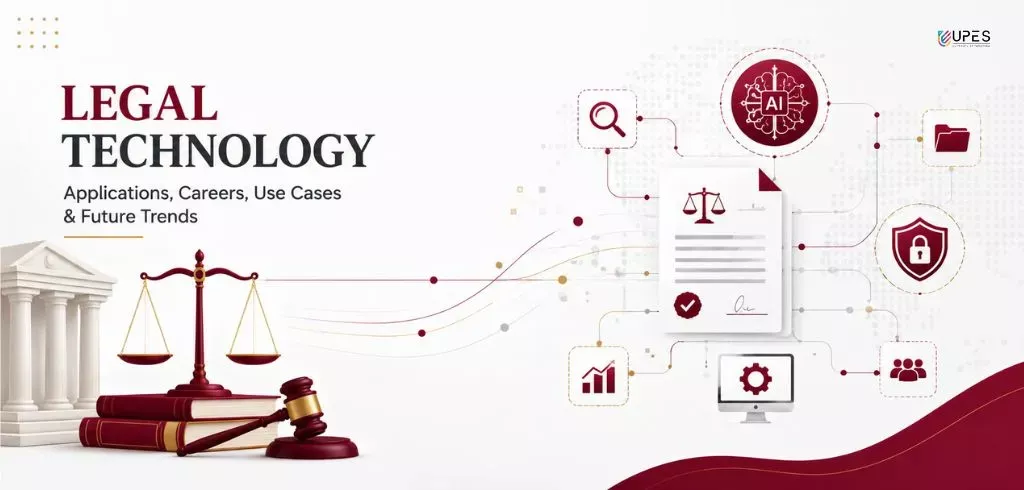
Legal tech, or legal technology, is the use of software, artificial intelligence, automation and digital platforms to support the delivery and management of legal services. It can help lawyers research cases, review contracts, manage documents, track matters, automate repetitive work and collaborate securely.
Example: Instead of manually reviewing hundreds of contracts, a legal team may use a contract-analysis platform to identify clauses, obligations, renewal dates and potential risks, followed by review from a qualified legal professional.
What is Legal Tech?
Legal tech is defined as a category of software and digital tools that are specifically designed to assist lawyers and firms in performing legal tasks such as case research, documentation, and analytical review of a case. Legal tech tools may include platforms such as cloud-based document management systems, contract lifecycle management software, legal research and analytics tools, practice management software, eDiscovery & document review platforms, etc. Legal tech helps law firms to reduce their manual effort and cost significantly; additionally, firms are also able to receive real-time data-backed insights and recommendations.
Why are Law Firms Using Legal Tech Today?
Law firms and corporate legal teams are adopting legal technology primarily to handle growing volumes of documents and data, reduce repetitive work, improve research and collaboration, control costs and respond faster to clients. AI has accelerated this shift by making activities such as document review, summarisation, legal research and contract drafting more efficient when used with appropriate professional oversight.
India has one of the most complicated judicial systems, with several levels of courts in place in a hierarchical manner. Furthermore, the Indian judiciary faces the increasing challenge of case dependency, with over 5.3 crore cases pending across all levels of courts in India.
In order to recover this massive backlog, Indian courts and the legal system require a major shift to speed up legal processes and deliver judicial resolutions more efficiently. Legal tech in this context works as a streamliner for legal firms to reduce costs and increase overall productivity.
According to IMARC Group, India's legal services market was valued at approximately USD 27.95 billion in 2025 and is projected to reach USD 42.09 billion by 2034, representing a CAGR of 4.66% during 2026–2034. Legal-tech adoption is identified as one of several factors contributing to the market's evolution.
Also Read: Cyber Law Courses: Types, Topics, Scope & Opportunities
Benefits of Using Legal Tech
Law firms leverage legal tech to not only reduce their manual effort in researching and documenting, but they are also using legal tech to review and draft contracts, get possible case outcomes, and strategize their case strategies. The following are some of the key benefits of using legal tech:
Increased efficiency: Using advanced software and digital tools, firms can streamline tasks and manage resources efficiently. Tools help employees reduce caseloads and focus on more important tasks that require deep research and critical thinking.
Improved accuracy: A swift documentation and quick access to information allows law firms to draw accurate information from case histories and legal frameworks. This helps in reducing errors during documentation and reporting processes.
Empowered collaboration: Legal tech allows different teams to collaborate and work together in cases. Cloud-based software allows teams to digitally and securely share information across departments and stakeholders.
Managing risk: Some legal analytics tools can identify historical patterns, litigation trends and risk indicators that may assist lawyers in evaluating cases. Such outputs should support, not replace, professional legal judgement. This helps firms to plan their strategies and set an effective action plan.
Reduced cost: By using Legal Tech tools and applications, firms often save big bucks by reducing manual labor.
Better client services: With fast-paced resolutions, cost-effective services, and seamless documentation process, law firms are able to improve their client satisfaction rates and offer overall enhanced services.
What are different Types of Legal Tech Law Firms Use
Based on applications, legal firms may use different kinds of Legal Tech platforms. Legal Tech can majorly be classified into the following types based on their purpose:
1. Practice Management Software
Practice Management Software are programs designed to help law firms manage their day-to-day tasks. Typically, a Practice Management Software combines functions such as case management, documentation, client information, billing, and time tracking into a single integrated system. These systems are widely used across the industry by individual legal practitioners, small and large law firms, and corporate lawyers.
2. Legal Research Software
Legal Research Software is programmed to assist law firms in research cases and prepare crucial documents. These programs help law firms in locating, analyzing, and validating case law, statutes, regulations, and legal precedents.
3. Document Management Software
Document Management Software is a specialized platform that allows law firms and corporate legal departments to create, store, organize, and track legal documents. Unlike regular cloud drives, these systems are designed to manage legal workflows.
4. Case Management Software
Case Management Software is a centralized digital program that works as a command center for law firms and legal departments. It replaces hefty and scattered spreadsheets, emails, and paper files with an integrated system to manage the entire lifecycle of a case.
5. Legal Billing Software
Legal billing software automates timekeeping, expense collection, invoicing, and payment processing for law firms and corporate legal departments.
6. Contract Lifecycle Management
Contract Lifecycle Management software helps legal teams manage contracts from creation to completion. It supports drafting, approvals, negotiations, e-signatures, renewals, and obligation tracking from a centralized platform.
7. Compliance/RegTech
Compliance and Regulatory Technology (RegTech) software helps organizations monitor regulatory requirements and manage compliance obligations. It can assist with regulatory updates, risk assessments, audits, reporting, and compliance workflows.
8. eDiscovery
eDiscovery software helps legal teams identify, collect, organize, search, and review electronic evidence for litigation and investigations. It is commonly used for emails, documents, messages, and other electronically stored information.
9. Legal Analytics
Legal analytics software analyzes legal and case-related data to identify patterns and generate actionable insights. Lawyers can use these tools for legal research, litigation strategy, risk assessment, and data-driven decision-making.
10. AI Legal Assistants
AI legal assistants use artificial intelligence to support tasks such as legal research, document summarization, drafting, contract review, and information retrieval. They help lawyers reduce repetitive work and improve productivity.
11. E-signature/Workflow Automation
E-signature and workflow automation platforms allow legal documents to be reviewed, approved, signed, and processed digitally. They help streamline transactions, reduce paperwork, and accelerate document execution.
General Purpose AI vs Purpose-Build Legal AI
Generic AI tools can support legal professionals for appropriate lower-risk tasks, depending on enterprise controls, privacy configuration, verification and organizational policies. Law requires precise, jurisdiction-specific interpretation, while general models are prone to high rates of hallucinations and fail to meet client confidentiality standards.
Purpose-built legal AI systems may offer advantages such as access to curated legal databases, citation-linked research, matter-specific workflows, enterprise security controls and integrations with legal practice systems. Regardless of the platform used, lawyers should verify citations and legal propositions, protect confidential information and apply professional judgement before relying on AI-generated output.
How is AI Changing Legal Technology?
AI is expanding legal technology beyond basic workflow automation. Modern systems can assist with document review, contract analysis, legal research, summarisation, due diligence, knowledge management and first-draft preparation. However, legal AI still requires human oversight because outputs may contain factual errors, incomplete legal reasoning, incorrect citations or jurisdictional inaccuracies.
For lawyers, the emerging skill is therefore not simply “using AI”, but knowing how to validate AI-assisted work against statutes, case law, client facts and professional obligations
Examples of Legal Tech Software and Platforms
The following are some of the top legal tech software and platforms used by major law firms:
| Legal Tech Category | Examples of Platforms | Primary Use |
Legal Research – India | SCC Online, Manupatra | Indian case law, statutes, judgments, regulations and legal research |
Legal Research – International | Westlaw, LexisNexis, Fastcase | Case law, legislation, precedents and legal research across jurisdictions |
Practice & Case Management | Clio, MyCase | Matters, clients, documents, billing, deadlines and law firm workflows |
Document Management | NetDocuments, iManage, M-Files | Secure document storage, organization, search, version control and collaboration |
Contract Lifecycle Management (CLM) | Ironclad, Icertis | Contract creation, negotiation, approvals, execution, renewals and obligation management |
AI-Assisted Legal Work | Thomson Reuters CoCounsel, Lexis+ AI, Harvey | Legal research, document analysis, summarisation, drafting and workflow assistance |
AI-Assisted Legal Research – India | SCC Online AI Pro, Manupatra AI | AI-assisted research of Indian case law, judgments and other legal information |
eDiscovery | Relativity, Everlaw | Electronic evidence collection, processing, review, investigations and litigation workflows |
Legal Analytics | Lex Machina, Westlaw Precision | Legal data analysis, litigation insights, case strategy and research |
E-signature & Document Workflows | DocuSign, Adobe Acrobat Sign | Electronic signatures, approvals and digital document execution |
Legal Billing & Payments | Clio Manage, MyCase | Time tracking, legal billing, invoicing, expenses and payment management |
Compliance & RegTech | Thomson Reuters Regulatory Intelligence, CUBE | Regulatory monitoring, compliance management and regulatory-change tracking |
Legal Knowledge Management | iManage, NetDocuments | Managing internal precedents, legal knowledge, documents and institutional information |
Other business tools used by law firms: Legal practices may also use general business platforms such as Zoho applications, QuickBooks and Tally for functions including CRM, invoicing, accounting and financial administration.
The right Legal Tech platform depends on the firm's requirements. Indian lawyers conducting case-law research may use platforms such as SCC Online or Manupatra, while international legal teams may work with Westlaw or LexisNexis. Increasingly, AI-powered legal assistants are being integrated into these workflows to support research, document review, summarisation and drafting.
Legal Tech Examples in India
India’s legal ecosystem is increasingly adopting digital platforms and AI-assisted technologies to make judicial information more accessible, improve legal research, reduce administrative effort, and support faster case management. These examples show how Legal Tech is being applied across courts, judicial data, research, and language accessibility.
1. eCourts Services
eCourts Services is part of India’s judicial digitisation initiative aimed at improving access to court-related information and services. Lawyers, litigants, and citizens can access case status, court orders, judgments, cause lists, and other case-related information digitally, reducing dependence on physical court records.
2. National Judicial Data Grid
The National Judicial Data Grid is an online platform that provides data on cases across the Indian judicial system. It improves visibility into pending and disposed cases, case age, institution and disposal trends, helping stakeholders better understand court workloads and judicial pendency.
3. SUPACE
SUPACE, or the Supreme Court Portal for Assistance in Court Efficiency, was introduced to explore AI-assisted support for judicial work. It is designed to assist with tasks such as organising and accessing relevant case information, while judicial decision-making remains with judges.
4. SUVAS
SUVAS, or Supreme Court Vidhik Anuvaad Software, is an AI-assisted translation initiative developed to improve access to judicial content across Indian languages. Such technology can help overcome language barriers and make legal information more accessible to citizens and legal professionals.
5. SCC Online / Manupatra
SCC Online and Manupatra are prominent Indian legal research platforms used by lawyers, students, researchers, and legal professionals. They provide digital access to case law, judgments, statutes, legislation and other legal materials, making legal research significantly faster than traditional manual research methods.
Real World Legal Tech Use Cases and Examples
Law firms, lawyers, and legal scholars benefit from legal tech significantly in their day-to-day activities. Using modern technologies such as AI, data analytics, and software applications, firms are able to conduct deep research, automate documentation processes, manage caseloads, and store evidence digitally. The following are some of the key use cases and examples for legal tech in the real world:
1. Case Law Research
Using Legal Research Tools, lawyers are able to research crucial details about a case in minutes. They can use these tools to find past judgements, precedents, statutes, and legal opinions, without needing to turn thousands of pages of documents.
- Example: Law firms use software programs such as LexisNexis and Fastcase to research cases, history, and past supreme court judgements. These programs save a significant amount of time for lawyers along with a lot of manual effort.
2. Document Automation
Document Management Tools are used to prepare, draft, and even manage documents. Several cloud-based legal tech platforms allow lawyers and firms to work in collaboration with secure sharing of legal information across teams. By automating documentation process, lawyers are able to get scattered information and prepare ready to sign original documents.
- Example: Several large and small legal firms are now using software such as NetDocuments and M-Files to auto-generate legal contracts, prepare drafts, and review thousands of pages of legal documents in seconds.
3. Matter Management
Firms typically use case management platforms to manage matters related to a particular case. These programs help legal teams stay aligned with the case timeline and keep track of case dates, client information, hearings, past rulings, and more.
- Example: Platforms such as Zoho Legal, MyCase, and Clio are popular among firms to manage case activities such as important dates, scheduling, and client details.
4. Due Diligence
Corporate transactions such as mergers, acquisitions, investments, and financing can require legal teams to review large volumes of contracts and business documents. AI-assisted review tools can help classify documents, extract important clauses and identify potential risks, allowing lawyers to conduct due diligence more efficiently.
5. Legal Marketing
Using legal tech tools, firms maintain a positive client relationship. Law firms often use technology for automated follow-ups, reputation tracking, and targeted SEO-driven campaigns to attract clients from a specific demography.
- Example: Indian law firms often use SEO tools, CRM platforms, and analytics software to publish legal insights, track website traffic, and generate leads.
6. Electronic Evidence Management
eDiscovery software search through thousands of emails, pages, texts, and digital files. Firms can use these platforms to identify discrepancies and extract useful information with respect to litigation.
- Example: Westlaw and LexisNexis tools are used for legal research and eDiscovery purposes. This software can scan through thousands of pages of documents which helps lawyers spot key evidence and anomalies in case files.
7. Contract Review
Using AI technologies, businesses can immediately read contracts to identify non-standard clauses, assess risk, extract critical dates, and ensure corporate norms are followed during mergers or due diligence.
- Example: Multinational companies use legal tech platforms such as M-Files, to review thousands of contracts during mergers and acquisitions, reducing review time from weeks to days while improving accuracy.
8. Compliance Monitoring
Businesses operate under changing laws, regulations, and industry-specific compliance requirements. Legal and regulatory technology can help organisations track regulatory developments, manage compliance obligations, maintain records, and identify areas that may require legal review.
9. Litigation Preparation
Legal Tech platforms can help litigation teams organise case files, evidence, authorities, timelines, pleadings, and other case-related information. Digital systems can also make it easier for multiple lawyers working on the same matter to access relevant information and coordinate their work.
10. Legal Knowledge Management
Large law firms and corporate legal departments accumulate substantial institutional knowledge through previous matters, legal opinions, research, contracts, and precedents. Knowledge-management systems make this information searchable and reusable, helping lawyers find relevant previous work rather than repeatedly starting research from scratch.
11. Court Digitisation
Legal technology is also transforming court administration and access to judicial services. E-filing systems, digital case-status tracking, online access to judgments and orders, electronic cause lists, and virtual hearings are examples of how technology can make certain court processes more accessible and efficient.
How Does Legal Tech Work in Practice?

Legal technology rarely replaces the complete legal workflow. Instead, different tools automate or assist specific stages while lawyers retain responsibility for legal strategy, judgement, client advice and final decisions.
Challenges with Legal Tech Implementation
While Legal Tech promises a fast-paced judicial system in future, however, there are several genuine challenges often associated with legal tech implementation across legal services:
Resistance to change: Attorneys at legal firms and judicial systems are often skeptical towards legal tech adoption in justice system.
Ethical concerns: Legal tech poses significant ethical concerns with large scale applications across legal systems. The Justice System is inherently required to remain unbiased, neutral, and maintain confidentiality. However, AI-based legal tech can pose risks of hallucination, and AI-based bias.
Cybersecurity risks: Legal firms are generally at high risk of getting cyberattacks due to storing a large amount of sensitive client information, causing serious privacy concerns.
Access disparity: Legal tech tools often are costly, and smaller firms or individual legal service providers may not be able to access these platforms.
Regulatory challenges: Regulations and rules around legal tech applications in justice system are still vague, therefore, often causing compliance issues.
AI hallucinations: AI systems can generate incorrect facts, cases or citations.
Confidentiality: Sensitive client data shouldn't be entered into tools without appropriate safeguards and policies.
Bias: Models can reproduce biases present in training data.
Explainability: Lawyers may need to understand how an automated recommendation was produced.
Data localisation/privacy: Relevant particularly for Indian firms handling sensitive or personal information.
Over-reliance: Automation should support—not replace—professional judgement.
Legal Tech Skills Law Students Need
| Skill | Why it matters |
AI literacy | Understand capabilities and limitations of AI |
Legal research | Verify AI-generated propositions |
Prompting/query formulation | Get structured AI-assisted outputs |
Data privacy | Handle confidential information responsibly |
Contract analysis | Important for corporate legal work |
Legal databases | Essential research capability |
Cyber law awareness | Understand technology-related legal risks |
Data literacy | Interpret analytics and structured information |
Legal writing | Evaluate and improve AI-generated drafts |
Critical thinking | Detect errors, bias and weak reasoning |
Career Opportunities in Legal Tech
Legal Tech is creating interdisciplinary career opportunities for professionals who understand both legal processes and technology. Law graduates do not necessarily need to become software developers to work in this field. Depending on the role, knowledge of legal research, contracts, compliance, data, AI tools, cybersecurity, or legal operations can be particularly valuable.
| Career | What Professionals Typically Do |
Legal Technology Consultant | Helps law firms and legal departments select, implement, and optimise legal technology solutions. |
Legal Operations Analyst | Improves legal workflows, reporting, vendor management, technology adoption, budgeting, and operational efficiency. |
LegalTech Product Specialist | Works with product and technology teams to develop or implement software designed for lawyers and legal departments. |
Legal Knowledge Management Specialist | Organises legal precedents, research, templates, and institutional knowledge so lawyers can retrieve and reuse information efficiently. |
Contract Analyst | Reviews contracts, tracks obligations and clauses, supports contract lifecycle processes, and may work with AI-assisted contract tools. |
Legal Data Analyst | Analyses legal and operational data to identify patterns, measure performance, and support evidence-based decisions. |
eDiscovery Specialist | Helps identify, process, review, and manage electronically stored information required for litigation or investigations. |
Compliance Technology Specialist | Uses technology to support regulatory monitoring, compliance workflows, reporting, and risk management. |
AI Governance / Responsible AI Specialist | Helps organisations establish policies, controls, risk assessments, and governance frameworks for responsible use of AI. |
Technology Lawyer | Advises businesses on legal issues arising from technology, digital platforms, software, AI, and technology transactions. |
Cyber/Data Privacy Lawyer | Works on cybersecurity, privacy, data protection, digital compliance, and legal issues involving the collection and processing of data. |
For law students, Legal Tech therefore represents more than learning how to use new software. Building a combination of legal research, critical thinking, contract analysis, AI literacy, data privacy awareness, technology understanding, and strong legal writing skills can prepare students for emerging roles at the intersection of law and technology.
Will AI Replace Lawyers?
AI is more likely to change legal work than eliminate the need for lawyers. It can automate or accelerate tasks such as research, document review, summarisation and drafting, but legal professionals remain responsible for interpreting law, understanding client circumstances, exercising judgement, negotiating, advocating and making ethically accountable decisions.
Future of Legal Tech in Law Services
Legal tech platforms such as Practice Management Tools, Case Management Software, and Document Management Software, and Legal Billing Solutions are transforming the way modern legal services are delivered. These smart tools utilize historical data, analytics, and AI ML technologies to automate redundant tasks such as documentation, case research, and drafting legal contracts, allowing legal professionals to focus on other important case tasks.
1. Legal AI Agents
Legal AI is evolving from tools that respond to individual prompts towards systems capable of assisting with multi-step workflows. AI agents may help gather information, search documents, summarise findings, compare clauses, prepare preliminary drafts, and organise outputs for lawyer review. Human supervision will remain important, particularly where legal interpretation or client advice is involved.
2. Retrieval-Grounded Legal AI
One of the most important developments in legal AI is connecting generative AI systems with authoritative legal information. Instead of relying only on a model's general knowledge, retrieval-grounded systems can retrieve relevant judgments, statutes, regulations, or an organisation's approved legal documents before generating an answer. This can make outputs easier for legal professionals to verify, although retrieved sources and citations still require review.
3. Contract Intelligence
Contract technology is becoming more sophisticated through AI-assisted extraction and analysis. Modern systems can help identify clauses, obligations, renewal dates, inconsistencies, and potential risks across large contract repositories. This could shift contract management from document storage towards continuous contract intelligence and obligation monitoring.
4. Legal Operations Automation
Automation is expected to expand across administrative and operational legal work, including matter intake, task allocation, approvals, document workflows, billing, reporting, and performance tracking. This can allow legal teams to spend less time coordinating routine processes and more time on strategic and complex legal work.
5. AI Governance and Responsible Legal AI
As AI becomes embedded in legal workflows, firms and organisations will need stronger policies governing how it is used. Issues such as confidentiality, data privacy, hallucinated information, incorrect citations, bias, security, auditability, and human oversight will become increasingly important. Legal professionals with expertise in AI governance and technology regulation may therefore see growing opportunities.
6. Human + AI Legal Teams
The future of legal work is more likely to involve collaboration between lawyers and AI than complete replacement of legal professionals. AI can assist with information-intensive and repetitive tasks, while lawyers remain responsible for legal strategy, interpretation, negotiation, advocacy, ethical judgement, client relationships, and final decisions.
As per a recent survey conducted by Thomson Reuters, 26% of legal organisations were actively using generative AI, up from 14% in 2024. Among law-firm respondents, 78% expected generative AI to become central to their workflows within five years, highlighting the growing importance of AI literacy for legal professionals.

Our counsellors are just a click away.
Conclusion
Legal tech is transforming how lawyers work by automating a significant amount of their day-to-day activities, such as case research, contract formatting, and more. As per trends, law professionals expect AI to play a crucial role in legal workflows. These shifts signal towards a major systematic shift in legal services and demand for future professionals with skills in AI and Law, leading to unique career opportunities.
FAQs
What are examples of LegalTech?
Practice Management Systems, Legal Billing Software, Legal Document Management Software are some of the common examples of LegalTech. Some of the popular software programs used by law firms include LexisNexis, Zoho Legal, Clio, and Tally.ERP 9.
What is the difference between LegalTech and LawTech?
The terms LegalTech and LawTech are often used interchangeably. Some industry discussions use “LegalTech” for technology supporting lawyers and law firms and “LawTech” for consumer-facing legal services, but there is no universally accepted distinction.
What are the benefits of LegalTech?
LegalTech platforms help law firms and lawyers reduce time, increase efficiency, reduce human effort, manage risk, and speed up the case research process.
Is Legal Tech the future?
Yes, LegalTech is expected to transform the legal system in the coming years by automating a significant amount of redundant legal tasks while maintaining human judgement as the decisive factor in case rulings. With increasing AI integration across industries and use cases across big and small law firms, LegalTech offers a fast-paced, efficient, and data-backed future of legal services.
Can AI replace LLB?
- No, AI can help minimize the workload of a lawyer, not the lawyer themselves. Lawyers can streamline their daily procedures by leveraging AI technology and LegalTech technologies. However, human effort is still required for brainstorming case points and making a decision based on evidence.

UPES Editorial Team
Written by the UPES Editorial Team
UPES Admission Enquiry
Trending Post


Related Articles































Subscribe to UPES Blogs
Join our community for exclusive stories, insights, and updates
By clicking the "Subscribe" button, I agree and accept the privacy policy of UPES.


