What Is Technology Law? Key Areas, Examples, Careers & Future Scope
- UPES Editorial Team
- Published 19/10/2026


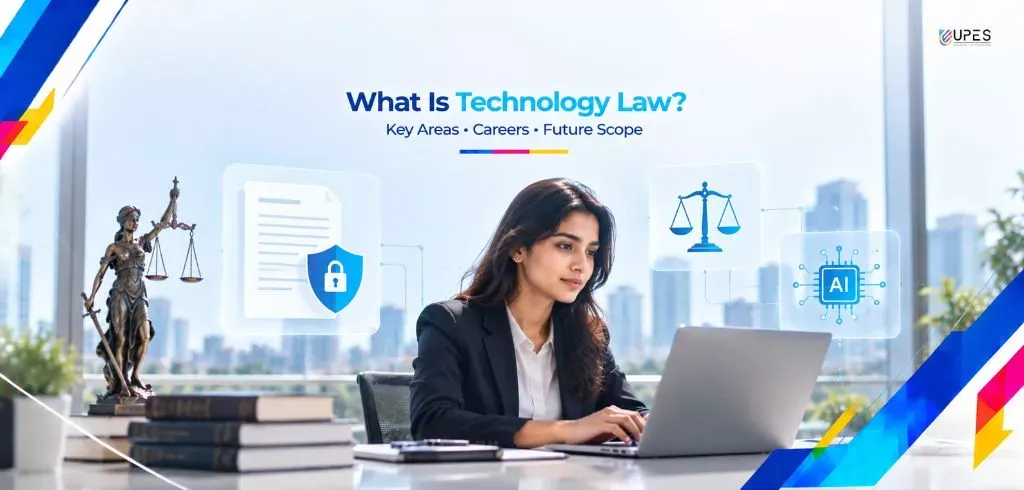
Technology law refers to the legal principles, statutes and regulations that govern the development, use and commercialization of technology. It covers areas such as data privacy, cybersecurity-related legal obligations, intellectual property, digital contracts, e-commerce, artificial intelligence and telecommunications.
In India, technology-related legal issues are addressed through several laws rather than a single comprehensive technology law statute. These include the Information Technology Act, 2000, the Digital Personal Data Protection Act, 2023, the Telecommunications Act, 2023, consumer protection legislation and intellectual property laws.
Become future-ready with our Law programs
Know MoreWhat is Technology Law?
Technology law is a broad legal field dealing with legal issues created or affected by technology. It can include data protection, cybersecurity, intellectual property, electronic transactions, digital contracts, online platforms, telecommunications, artificial intelligence, and technology-related regulatory compliance.
Technology law often intersects with other legal fields. For example, a technology company may face questions involving employment law, competition law, consumer protection or contract law, but those areas do not automatically become technology law simply because the business operates in the technology sector. The following are examples of some of the common legal issues that may fall under technology law:
- Personal data collection and privacy compliance
- Cybercrime and electronic evidence
- Software licensing and digital contracts
- Intellectual property in software and digital content
- E-commerce and digital consumer protection
- AI governance and automated decision-making
- Telecommunications and cloud-service agreements
Why Do We Need Technology Law?
Technology continues to evolve faster than the traditional legal frameworks that are designed to regulate the same. Digital technology has now evolved from social media, and Google searches online shopping, e-commerce, digital content, and even electronic banking. Technology law helps establish rights, responsibilities, and legal safeguards for governments, businesses, technology providers, and users. Depending on the context, it can support data protection, recognize electronic transactions, address cybercrime, protect intellectual property, regulate digital services, and establish accountability when technology causes or contributes to harm.
Technology Law vs Cyber Law: How are they Different?
Technology law and cyber law overlap in several areas, but technology law is generally broader and can cover legal issues involving technology, digital businesses, data, intellectual property, contracts and emerging technologies. Let's understand the difference between the two from the table below:
Factor | Technology law | Cyber law |
Scope | Broad legal field covering technology, data, platforms, IP and AI | Focuses primarily on internet, digital activity and cybercrime |
Key areas | Privacy, contracts, AI, IP, e-commerce, regulation and cybersecurity | Cybercrime, electronic evidence, online offences and security |
Use case | Advising technology businesses and digital transformation projects | Addressing online crime, security incidents and internet-related legal issues |
Cyber law is often treated as a specialised or overlapping area of technology law. However, the terminology is not universally standardised, and the boundaries between these fields may vary by jurisdiction and legal context.
Key Areas of technology law
The main pillars of technology law comprise data protection laws, cybersecurity measures, intellectual property rights, e-commerce security, and more. It includes:
1. Data Protection and Privacy Laws
Data protection and privacy laws govern how user data is collected, processed, stored, and shared in digital spaces. Different governments and regulatory bodies lay rules for organizations, companies, and digital platforms to manage data protection such as India's Digital Personal Data Protection Act (DPDPA) 2023 and The EU's GDPR establishes requirements around lawful processing, transparency, data minimization, security and accountability.
2. Cybersecurity and Cyberlaw
Cybersecurity and cyberlaw are core pillars of technology laws, while cybersecurity involves technical and organisational measures to protect systems, networks and information against unauthorised access, disruption and cyberattacks. Cyber law, on the other hand, addresses legal rights, duties, offences and regulatory obligations connected with digital systems and online activities. Technology-law professionals may advise organisations on incident reporting, contractual security obligations, cybercrime legislation and related compliance requirements.
3. IP Rights and Digital Content Governance
Intellectual Property rights and digital content governance lays important pillars for modern technology laws and offers measures for online creator protection and access. Technology law frequently intersects with copyright, patent, trademark and trade-secret law. Legal questions may arise around software, source code, digital content, inventions, databases, licensing, online infringement and ownership of technology-related intellectual property.
4. E-Commerce & Digital Laws
E-commerce platforms are required to comply with technology laws to ensure user safety, data protection, and secure digital transactions. the Information Technology Act, 2000, the Consumer Protection Act, 2019, and the Digital Personal Data Protection Act, 2023 are some of the main legal frameworks established in India for digital platforms.
5. AI and Algorithmic Accountability
Technology law addresses legal questions arising from AI systems, including privacy, intellectual property, liability, discrimination, consumer protection and accountability. In India, these issues may be governed by existing sector-specific and general laws rather than one comprehensive standalone AI statute. The applicable obligations depend on the use case and legal context.
6. Telecommunication, Cloud, and Digital Infrastructure
Technology law covers connectivity, cloud contracts, data localization considerations, service availability, and infrastructure regulation. Technology law provides a legal framework to maintain privacy, security, and data protection for telecommunication networks, cloud platforms, and digital platforms.
7. Consumer Protection in Digital Markets
Technology law offers rules, regulations, and frameworks for consumer data protection, and digital marketplaces. Technology law frameworks ensure fairness, transparency, and accountability as trade shifts online.
Benefits of Technology Law
In the modern age of expanding digital businesses and transactions, the technology law is essential to ensure consumer data protection. The following are some of the benefits of technology law:
1. Builds Trusts in Digital Services
Businesses and users are more likely to use digital services such as online banking, digital transactions, online shopping, and e-commerce platforms when they are aware that strong legal frameworks are available to protect their personal data and financial details securing their online presence.
2. Protects Rights and Intellectual Property
Intellectual property laws protect different types of rights. Patent law can protect qualifying inventions, copyright can protect original expression such as software code and digital content, and trademark law can protect distinctive brand identifiers, subject to the applicable legal requirements.
3. Supports Responsible Technology Adoption
Technology law can ensure that careful measures are taken to evaluate the effects of evolving techs such as artificial intelligence and machine learning before these technologies are implemented for wider public use. Tech laws also help lawmakers create boundaries for cybercrimes such online scams, fraudes, and more.
4. Helps Organisations Manage Legal and Regulatory Risks
A standardized technology legal framework helps lawmakers comprehend proper data handling, transfer, and storage, reducing the risk of regulatory fines. Furthermore, as governments across the globe adopt tech law, global organizations can easily align their tech law policies to ensure uniformity and transparency.
Technology Law Examples in Everyday Life
You probably interact with technology law in your day-to-day life in more ways than you may realize. A small action such as downloading a mobile application on your phone to ordering food online. Legal frameworks define how these platforms will collect, store, and share your data eventually. The following are some of the common real-life examples of technology law in action:
Buying a product from an online marketplace: When consumers purchase products through e-commerce platforms, consumer protection laws may govern disclosures, grievance redressal and unfair trade practices. Where platforms process personal data, applicable data protection requirements may also apply. The precise obligations depend on the platform's role, transaction and legal framework.
Receiving promotional calls, emails or app notifications: Brands using customer information such as mobile number, emails, or other information are required to consider consent, notice, and data-governance obligations. Tech law provides rules and regulations and limitations for companies to follow to send promotional calls and emails.
Signing up for a shopping or food-delivery app: A food-delivery service may process personal information such as a phone number, delivery address and order history. Applicable data protection requirements govern relevant personal data processing, while consumer protection rules may apply to disclosures, service complaints and other commercial practices.
Making a UPI, wallet or card payment: Another common example of technology law in real life is UPI, wallet, and card payment. UPI transactions offer a fast payment option for both users and merchants, allowing rapid growth in quick commerce. However, in case of fraud or malfunction, RBI’s customer-protection framework requires issuers to provide mechanisms to report unauthorized electronic transactions.
Posting content or running a creator page on social media: Content creators, and social media influencers can use copyright laws, and IP regulations to secure their creative outputs and content. Social media platforms are also prompted to lay out clear guidelines on fair content use, avoid plagiarism, and safe content.
Technology Law in India
Technology law in India is governed by several laws and regulatory frameworks. The Information Technology Act, 2000 serves as one of the key legal frameworks for electronic records, electronic signatures, cybercrimes, and certain aspects of electronic commerce. Other laws and regulations address areas such as data protection, telecommunications, intellectual property, and digital services. Let’s explore some of the key legal frameworks that shape and regulate technology law in India:
Law / Framework | Why It Matters to Technology Law |
Information Technology Act, 2000 | Electronic records, electronic signatures, computer-related offences and other digital matters |
IT Rules, 2021, as amended/applicable | Intermediary and digital-media obligations |
Digital Personal Data Protection Act, 2023 | Framework for processing digital personal data |
Digital Personal Data Protection Rules, 2025 | Implementation framework under the DPDP Act, subject to phased commencement |
Telecommunications Act, 2023 + applicable rules | Telecommunications services, networks and related regulation |
Consumer Protection Act, 2019 | Consumer rights and unfair trade practices |
Consumer Protection (E-Commerce) Rules, 2020 | Obligations relevant to e-commerce entities |
Copyright Act, 1957 | Copyright in software and digital content |
Patents Act, 1970 | Protection of qualifying inventions |
Trademarks Act, 1999 | Brand and trademark protection |
Regulatory note: Indian technology-related laws have different scopes, enforcement mechanisms and commencement dates. The Digital Personal Data Protection Act, 2023 and Digital Personal Data Protection Rules, 2025 are subject to notified implementation timelines. Readers should check the provisions in force at the relevant date and consult official government notifications for current requirements.
Technology Law vs Legal Tech
Technology law regulates legal issues involving technology, whereas legal tech uses technology to perform or improve legal work.
Technology Law | Legal Tech |
Area of law dealing with technology-related legal issues | Technology used to deliver or support legal services |
Focuses on regulation, rights and obligations | Focuses on tools, processes and legal-service efficiency |
Examples: privacy, cyber law, AI regulation | Examples: legal research tools, contract automation, e-discovery |
Careers in Technology Law
Students pursuing legal education can pursue careers in technology law in different domains including Cyber Attorney, Data Privacy Officer, Policy Researcher, and more. The following are some of the jobs that you can pick in technology law:
| Career pathway | Typical work | Background |
| Technology lawyer | Technology contracts, digital regulation and advisory | Qualifying law degree |
| Data privacy lawyer | Privacy compliance, policies and legal advice | Law degree and privacy expertise |
| Cyber law practitioner | Cybercrime, digital evidence and related legal issues | Law degree; advocate requirements where applicable |
| IP lawyer | Intellectual property protection and disputes | Law degree and IP knowledge |
| Technology contracts specialist | Software licensing, cloud and commercial contracts | Legal or relevant contract-management background |
| Compliance specialist | Regulatory processes and internal controls | Law, business or compliance background |
| AI governance specialist | AI policies, risk assessment and governance | Law, policy, technology or risk background |
| Information security officer | Security operations and technical risk management | Usually technical cybersecurity background |
Skills Needed for a Career in Technology Law
Technology law offers a promising career path for students; however, you are required to gain key skills to build a strong career in the field. Some of the key skills required to build a career in technology law include:
- Legal research and statutory interpretation
- Contract drafting and negotiation
- Data-protection and privacy awareness
- Cybersecurity fundamentals
- Intellectual-property knowledge
- Digital-platform and e-commerce understanding
- Technology-risk and compliance assessment
- AI and emerging-technology literacy
- Clear writing and stakeholder communication
How to Build a Career in Technology Law
Students interested in pursuing a career in technology law can begin with a recognised qualifying law degree, such as a five-year integrated law programme after Class 12 or a 3-year LLB after graduation. They can then develop specialised knowledge in data protection, intellectual property, technology contracts, cybercrime and AI governance.
Alternatively, students interested in the intersection of artificial intelligence, legal systems and digital governance can explore interdisciplinary academic pathways. For example, UPES offers a BA in AI and Law, which combines the study of emerging technologies with legal and regulatory concepts. This pathway may be relevant for students exploring careers in AI governance, technology policy, digital regulation and related fields.
Internships with law firms, in-house legal teams, technology companies, policy organisations or regulatory-focused practices can help students understand practical legal issues. Legal research, drafting, digital literacy and familiarity with evolving legislation are useful skills. Specialised courses or certifications can complement legal education but do not replace the professional qualifications required for practising as an advocate.
What is the Future of Technology Law
The future of technology law in India lies in holding digital innovation accountable. As artificial intelligence, online payments, data-driven services, and linked platforms become more commonplace, enterprises will want specialists who can assist them in responsibly innovating while protecting customers, managing cyber risk, and fulfilling changing legal requirements. The following are some of the potential trends that can be seen in technology law in near future:
1. Privacy and data protection will remain in the core focus: As digital spaces become prominent in the coming year, the core focus of technology law is expected to remain on deploying strong privacy and data protection measures. Legal frameworks are required to adopt dynamic regulations that evolve as technology continues to grow and change.
2. AI governance will be more important: As AI systems become more widely used in law, organisations may require additional legal and governance expertise to assess privacy, contractual, intellectual property, consumer protection and accountability issues.
3. Cybersecurity requirements will evolve: As tech evolves so does internet crimes and frauds; to deal with online hacking, phishing attacks, and cybercrimes, online platforms and technology law needs to evolve with time and lay out stronger measures to deal with online threats.
4. Future lawyers will need cross-disciplinary skills: An important part of evolving technology law is the fact that lawyers handling such cases will be required to have sufficient knowledge and skills to deal with technical intricacies. Future lawyers will need to have legal knowledge along with artificial intelligence, cybercrimes, and digital governance.
5. Digital platform accountability will increase: As digital spaces evolve drastically, people spend more time interacting online, whether it is sharing pictures on a social media website or ordering food from a mobile application, more people are signing up for digital services than ever. This requires digital platforms to take accountability for data privacy, user safety, and secure transactions.

Our counsellors are just a click away.
Conclusion
Technology law plays an important role in regulating how digital technologies are developed, used, and adopted. From data privacy and cybersecurity to intellectual property, e-commerce, and AI governance, it covers several areas of modern digital life. As technology continues to evolve, the demand for professionals with legal and technical knowledge is expected to grow, making technology law an emerging career field with strong future potential.
FAQs
What is technology law in India?
Technology law in India refers to the laws and regulations that govern the development, use, and commercialization of technology. It covers areas such as data protection, cybersecurity, digital transactions, intellectual property, artificial intelligence, e-commerce, and online platforms.
What is the scope of technology law?
The scope of technology law includes several areas of digital and emerging technology, including data privacy, cybersecurity, intellectual property, AI regulation, digital contracts, e-commerce, telecommunications, and cybercrime. As technology continues to evolve, new areas of legal practice are also emerging.
What is the difference between technology law and cyber law?
Cyber law primarily focuses on legal issues related to computers, networks, the internet, and cybercrime. Technology law is broader and can cover cyber law along with areas such as data protection, AI, intellectual property, digital contracts, telecommunications, and emerging technologies.
What skills are needed for a career in technology law?
A career in technology law requires strong legal research, analytical, communication, and problem-solving skills. It is also useful to understand areas such as data protection, cybersecurity, intellectual property, digital technologies, and emerging regulations. Keeping up with technological developments is equally important.
Why is technology law important?
- Technology law helps create legal boundaries for how digital technologies are developed and used. It can help protect personal data and intellectual property, address cybercrime, support digital transactions, and establish accountability for organizations using emerging technologies. As digital services expand, technology law plays an increasingly important role in balancing innovation with legal and ethical responsibilities.

UPES Editorial Team
Written by the UPES Editorial Team
UPES Admission Enquiry
Trending Post


Related Articles





























Subscribe to UPES Blogs
Join our community for exclusive stories, insights, and updates
By clicking the "Subscribe" button, I agree and accept the privacy policy of UPES.


