Humanities Courses After 12th: 6 Months, Degree, Career Scope
- UPES Editorial Team
- Published 09/03/2026


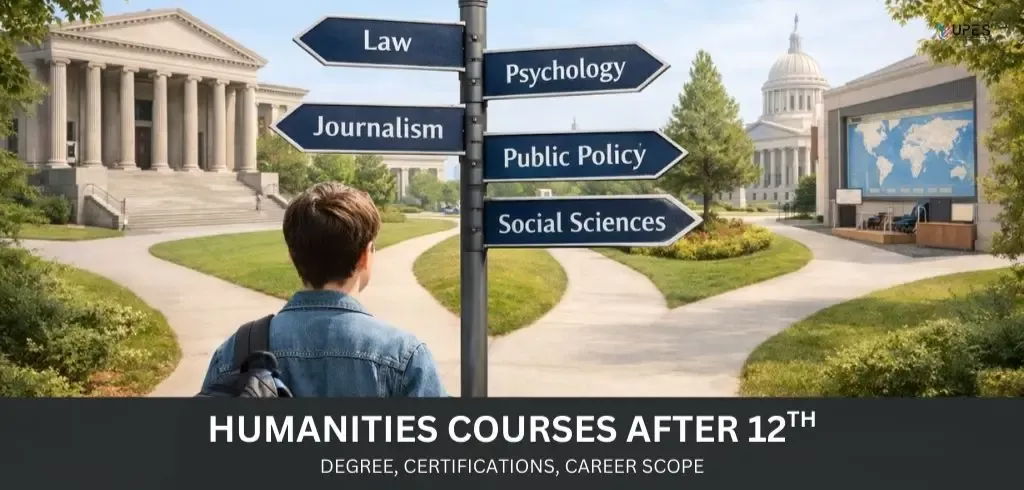
- What are the best humanities courses after 12th?
- The Taxonomy of Courses After 12th Humanities
- Humanities Degree Courses: Specialized Professional Pathways
- 6 Month Humanities Certifications & Course: Strategic Skill Acquisition
- The Essential Skill Set for the 21st Century Scholar
- Career Scope of Humanities by Subject: From Classical Studies to Social Sciences
- Comparison of Salary & Growth Potential for Humanities Graduates
Humanities education is gaining renewed importance as industries demand human-centric innovation and analytical thinking. As global industries pivot toward human-centric innovation, the demand for rigorous academic training in the humanities has reached a critical juncture. For a student evaluating humanities courses after 12th, the choice is no longer merely an aesthetic one; it is a strategic investment in cognitive flexibility and analytical depth.
This discourse examines the multi-dimensional pathways available to humanities scholars, ranging from foundational social sciences to integrated professional degrees and skill-intensive certifications.
Become future-ready with our Liberal Studies programs
Know MoreWhat are the best humanities courses after 12th?
Some of the most popular humanities courses include:
- BA English
- BA Psychology
- BA Political Science
- BA Journalism
- BA Sociology
- BA Economics
- BA History
These courses lead to careers in media, policy, research, law, analytics, and communications.
The Taxonomy of Courses After 12th Humanities
The humanities spectrum is broadly categorized into classical disciplines, social sciences, and vocational media studies. Selecting the appropriate humanities courses after 12th requires an understanding of the specific epistemological framework each subject offers.
1. The Classical Humanities Subjects: Literature and Philosophy
- English Literature: Beyond the study of prose and poetry, a degree in English Literature involves critical theory, post-colonial studies, and linguistic analysis. It prepares students for high-level editorial, academic, and creative strategy roles.
- Philosophy: This discipline cultivates the highest order of logic and ethics. Scholars engage with metaphysics, epistemology, and moral philosophy, forming a foundation for careers in law, international relations, and bioethics.
- Hindi & Sanskrit: These courses offer deep dives into philology, classical Indian philosophy, and historical texts. They are essential for research, translation, and cultural diplomacy.
2. The Social Sciences: Analyzing Society and Power
- Psychology: A cornerstone of modern humanities, psychology explores human cognition and behaviour. Students engage with brain anatomy, mental health, and developmental theories. It serves as a bridge between biological science and social inquiry.
- Political Science: A rigorous study of political theory, international relations, and public policy. It is the premier pathway for those aiming for the civil services and political consultancy.
- History: Modern history degrees focus on historiographical research, archival digitization, and the socio-economic forces shaping contemporary geopolitics.
- Sociology: This involves the empirical study of social institutions, stratification, and collective behaviour. It is vital for roles in social policy and market research.
- Geography: Modern geography bridges the gap between social and physical science, focusing on GIS (Geographic Information Systems) and urban sustainability.
Humanities Degree Courses: Specialized Professional Pathways
B.A. LL.B. (Integrated Five-Year Program)
The B.A. LL.B. is a hybrid program designed for students who seek to combine the socio-political context of humanities with legal jurisprudence.
- Core Focus: Constitutional Law, Criminal Justice, and Legal Writing.
- Career Scope: Corporate litigation, judicial services, and legal consultancy.
Economics: The Quantitative Edge
Economics is the most mathematically rigorous of the courses for humanities students, preparing scholars to interpret market volatility through econometric modeling.
Journalism and Media Studies
In the era of information warfare, these disciplines focus on the ethics of communication and digital storytelling.
- Journalism: News-gathering and investigative reporting.
- Media Studies: Digital culture and media effects.
6 Month Humanities Certifications & Course: Strategic Skill Acquisition
For the modern scholar, a 6 month humanities course acts as a professional catalyst, providing technical proficiency to complement theoretical knowledge.
| Discipline | 6-Month Specialization | Academic Application | Industry Outcome |
| English/Journalism | Digital Copywriting & SEO | Rhetorical Analysis | Content Strategy |
| Sociology/Psychology | UX Research Certifications | Ethnographic Methods | Product Design |
| History/Geography | GIS & Archival Digitization | Spatial Data Analysis | Urban Planning |
| Philosophy/Pol Science | Public Policy & Advocacy | Ethics & Governance | Think Tank Research |
The Essential Skill Set for the 21st Century Scholar
In the 2025 job market, humanities graduates are prized for their "hybrid" skills, combining deep qualitative insights with technical fluency.
Core Cognitive Skills (Soft Skills)
- Critical Inquiry: The ability to deconstruct complex arguments and identify logical fallacies.
- Narrative Intelligence: Crafting persuasive stories that drive brand loyalty or social change.
- Cultural Competence: Navigating diverse global environments with empathy and situational awareness.\
- Ethical Reasoning: Applying moral frameworks to modern dilemmas in AI, bioethics, and corporate governance.
Technical Proficiencies (Hard Skills)
- Data Visualization: Using tools like Tableau to turn sociological or psychological data into visual insights.
- Digital Literacy: Proficiency in SEO, CMS (Content Management Systems), and digital archival tools.
- Foreign Language Proficiency: B1/B2 level certifications in languages like French, German, or Japanese for global diplomacy.
- Research Methodology: Mastery of qualitative interviews, ethnographic surveys, and statistical software (SPSS/R).
Career Scope of Humanities by Subject: From Classical Studies to Social Sciences
Every year many students choose to study humanities. Let us delve into the details of career scope of humanities courses after 12th.
1. English Literature
The scope of English Literature has transitioned from traditional teaching to the "Knowledge Economy." Graduates are highly valued for their ability to synthesize complex information and communicate it persuasively.
- Key Career Paths: Digital Copywriting, Publishing & Editorial, Corporate Communications, Public Relations (PR), and Content Strategy for Global Tech Brands.
- Advanced Roles: Literary Critic, Academic Researcher, or Screenwriter.
2. Philosophy
Philosophy provides the rigorous logic required for high-stakes decision-making. It is one of the most common undergraduate degrees for successful law students and CEOs.
- Key Career Paths: AI Ethics Consultant, Bioethics Advisor, Mediator, Conflict Resolution Specialist, and Strategic Consultant.
- Advanced Roles: Think Tank Researcher or Jurisprudence Expert.
3. Hindi & Sanskrit
With the push for cultural preservation and global linguistic research, scholars of classical Indian languages have unique niche opportunities.
- Key Career Paths: Philologist, Translation & Interpretation (especially for diplomatic missions), Archaeological Research, and Manuscriptology.
- Advanced Roles: Cultural Diplomat or Language Analyst for the Intelligence Bureau.
4. Psychology
This is currently the fastest-growing field in the humanities, moving rapidly into the corporate and tech sectors.
- Key Career Paths: Industrial-Organizational (I-O) Psychologist, UX Researcher (analysing user behaviour for apps), Mental Health Counsellor, and Career Coach.
- Advanced Roles: Neuropsychologist or Forensic Psychologist.
5. Political Science
This remains the premier choice for students interested in power structures, governance, and the machinery of the state.
- Key Career Paths: Civil Services (UPSC), Legislative Assistant, Election Strategist, Political Risk Analyst, and International Relations Officer.
- Advanced Roles: Diplomat or Political Consultant.
6. History
History graduates today work at the intersection of heritage and technology, managing how the world archives and interprets information.
- Key Career Paths: Museum Curator, Archivist, Heritage Manager, Cultural Resource Consultant, and Researcher for Historical Media/Documentaries.
- Advanced Roles: Records Manager or Historiographer.
7. Sociology
Sociology is essential for understanding demographic shifts and social trends, making it vital for policy-making and marketing.
- Key Career Paths: Social Policy Analyst, Market Research Analyst, Urban Planner, Community Development Officer, and Corporate Social Responsibility (CSR) Manager.
- Advanced Roles: Demographer or Social Researcher.
8. Geography
Modern geography is a "spatial science" that heavily utilizes technology to solve environmental and urban problems.
- Key Career Paths: GIS (Geographic Information Systems) Specialist, Cartographer, Environmental Consultant, Urban Planner, and Disaster Management Expert.
- Advanced Roles: Climatologist or Logistics and Supply Chain Strategist.
9. Economics
Economics offers a quantitative pathway into the world of finance and global markets.
- Key Career Paths: Financial Analyst, Actuary, Economic Consultant, Data Analyst, and Policy Advisor.
- Advanced Roles: Econometrician or Central Bank Officer.
10. Journalism & Media Studies
The scope here covers the entire gamut of the "Creator Economy" and digital news distribution.
- Key Career Paths: Digital News Producer, Social Media Strategist, Broadcast Journalist, Photojournalist, and Media Planner.
- Advanced Roles: Editor-in-Chief or Multimedia Investigative Journalist.
11. BA LLB (Integrated Law)
This provides a direct professional pathway into the legal framework of society and business.
- Key Career Paths: Corporate Lawyer, Legal Consultant for Startups, Human Rights Advocate, Judicial Officer, and Legal Process Outsourcing (LPO) Specialist.
- Advanced Roles: Supreme Court Advocate or Judge.
Read More: Top BA Specializations for Students in 2025
Comparison of Salary & Growth Potential for Humanities Graduates
| Subject | Industry Demand | Entry-Level Roles | Avg. Starting Salary (LPA) |
| Psychology | Very High | UX Research, HR, Counseling | ₹5 – 9 LPA |
| Economics | High | Finance, Analytics | ₹7 – 12 LPA |
| BA LLB | Very High | Corporate Law, Judiciary | ₹8 – 15 LPA |
| Pol. Science | Moderate | Policy, Civil Services | ₹6 – 10 LPA |
| English | High | Media, Content, PR | ₹4 – 8 LPA |
Sources: Glassdoor, Naukri | |||
Strategic Integration: The UPES Pedagogy
Selecting an institution that recognizes the interdisciplinary nature of the modern world is paramount. The UPES School of Liberal Studies and Media has pioneered a curriculum that integrates classical humanities with future-ready technology. The School of Liberal Studies and Media stands out for its transdisciplinary approach, where students are encouraged to transcend traditional silos.
Liberal Subjects offered at UPES:
UPES School of Liberal Studies and Media programs spans four years and offers a balanced curriculum combining theoretical knowledge and practical skills.
Top ranked as India’s No. 1 private university as per QS World University Rankings 2025, UPES provides a class-leading, industry-first curriculum, and knowledge partnership, ensuring 100% professional relevance through practitioner-led learning. UPES School of Liberal Studies and Media blends global exposure with local relevance to help students analyse complex issues, shape public discourse, and influence policy through an interdisciplinary, experiential approach.
Students learn with faculty from IITs, IIMs, and Ivy League institutions, including Fulbright, Chevening, and Rhodes Scholars, and regularly engage with diplomats, economists, CTOs, policymakers, and civil servants in the classroom. Global learning is strengthened through seminars by faculty from Yale University, Harvard University, and Duke University, visiting faculty from the University of Bologna (Italy), UMass Amherst (University of Massachusetts Amherst), and the University of Chicago, plus international pathways like a semester abroad with Berkeley Global (University of California, Berkeley).
Students can also access collaborations and exchange opportunities with University of Bologna (Italy), HSE University, St. Petersburg (Russia) and partner institutions including the University of Gothenburg (Sweden), Goldsmiths, University of London, University of Warsaw (Poland), HEIP: School of International and Political Studies (France), UCSI University (Malaysia), and Hankuk University of Foreign Studies (South Korea).
The campus also hosts exchange cohorts from France, adding cultural diversity and global awareness. Backed by strong academic recognition, structured mentoring, and a large recruiter network plus internships and experiential opportunities, the school prepares graduates to lead in an interconnected, fast-changing world.
FAQs: Academic and Career Clarifications
1. Is Psychology at UPES more science or arts-focused?
- At UPES, the BSc (Hons.) Psychology and Behaviour program is a blend of both. It employs empirical research and neuroscientific perspectives (science) while applying them to social and behavioral contexts (arts).
2. What is the benefit of a Liberal Studies degree over a traditional BA?
- Liberal Studies offers greater breadth and flexibility, allowing you to combine disparate subjects (e.g., Literature and Big Data) to create a unique professional niche that a standard BA doesn't allow.
3. Can I pursue BA LLB directly after 12th?
- Yes, the Integrated BA LLB is a 5-year program designed for students to enter the legal profession immediately following secondary education.
4. How do Hindi and Sanskrit fit into the modern job market?
- Scholars are in demand for international linguistics research, cultural heritage management, and diplomatic roles.
5. What are the benefits of the 4-year undergraduate program under NEP?
- The 4-year program allows for a dedicated research year, often a prerequisite for admission into top-tier global PhD programs.

Our counsellors are just a click away.
Conclusion
The pursuit of humanities courses after 12th is an invitation to understand the complexities of the human condition. From the linguistic nuances of English and Sanskrit to the analytical depths of Psychology and Economics, these disciplines provide the foundational intelligence required to navigate a volatile world.
Choosing a path that integrates traditional depth with modern application such as those offered at the UPES School of Liberal Studies and Media ensures that your academic journey leads to a career of significance. Enrol Today!

UPES Editorial Team
Written by the UPES Editorial Team
UPES Admission Enquiry
Trending Post
-

-

Exploring the Past, Building the Future: My Journey as a History Student at UPES
03/08/2026By Pritha Agarwal
-


Related Articles
















Subscribe to UPES Blogs
Join our community for exclusive stories, insights, and updates
By clicking the "Subscribe" button, I agree and accept the privacy policy of UPES.


