Logical Thinking vs Critical Thinking: Differences, Examples, Applications & How it Helps in your Philosophy Career?
- UPES Editorial Team
- Published 13/07/2026


- Logical thinking vs Critical thinking: What is the difference?
- What is Logical Thinking?
- What is Critical Thinking?
- Logical Thinking vs Critical Thinking: How are they Different
- How Logical and Critical Thinking Work Together
- Logical Thinking and Critical Thinking Examples
- Importance of Logical and Critical Thinking in Philosophy Careers
- Careers Where Logical and Critical Thinking Matter
- Applications of Logical and Critical thinking skills in philosophy careers
Logical and critical thinking are essential cognitive skills that help individuals analyze information, solve problems, and make informed decisions. While logical thinking focuses on reasoning through facts and structured steps, critical thinking emphasizes evaluating evidence, questioning assumptions, and examining different perspectives. Both skills play an important role in academics, professional careers, and everyday life by improving judgment, communication, and decision-making abilities. In Philosophy, these thinking approaches are especially valuable, as they help professionals understand complex arguments, identify biases, and develop rational and ethical conclusions across various fields and situations.
In this article, we will explore a detailed analysis of logical thinking vs critical thinking, their characteristics, the differences between both, and their importance in philosophy careers.
Become future-ready with our Liberal Studies programs
Know MoreLogical thinking vs Critical thinking: What is the difference?
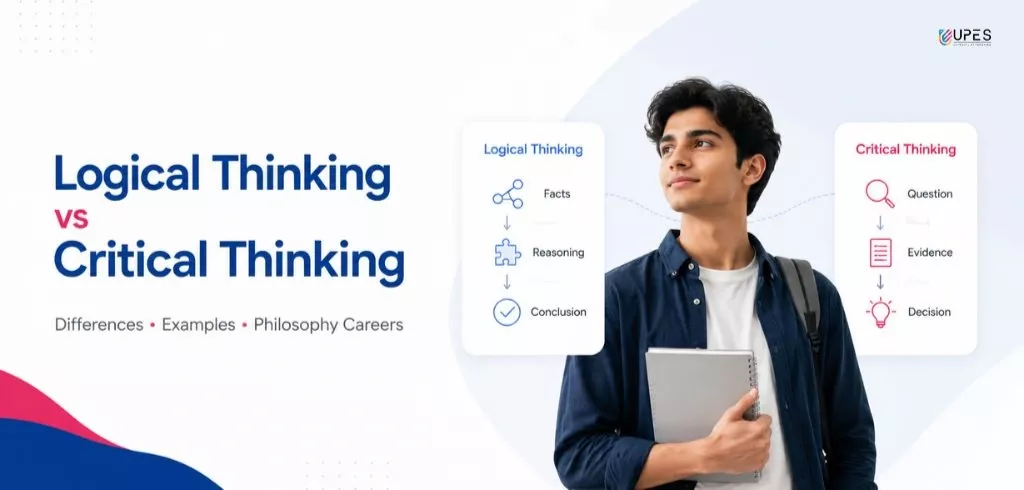
Logical thinking follows rules and facts to determine whether a conclusion follows correctly from given information. Critical thinking goes a step further by questioning the information itself, checking evidence, identifying assumptions, and considering alternative explanations. In simple terms, logical thinking asks, “Does this conclusion follow?”, while critical thinking asks, “Should I trust the information and assumptions behind it?”
What is Logical Thinking?
Logical thinking is a process of solving a problem in gradual steps. This process requires facts, reasoning, and rules to determine whether a consequence makes sense. Logical thinking helps in following patterns and making decisions based on clear reasoning and logic.
Characteristics of Logical Thinking
The following are some of the common characteristics of logical thinking:
- Logic is used to test the validity of arguments based on assumptions
- It studies validity of arguments, consistency, logical truth, and properties of logical systems.
- It identifies patterns, relationships, and inconsistencies.
- It creates a link between knowledge and opinions within the mind.
- Logic helps the mind organize and construct reasoning.
- Without logic, knowledge and opinions remain unstructured, disconnected, fragmented.
- Logic links together all knowledge within the mind
It aims to produce conclusions that are coherent and logically valid.
What is Critical Thinking?
The critical thinking process requires careful analysis of information before believing or accepting the results. Critical thinking emphasizes questioning ideas, checking evidence, and considering different perspectives before coming to a conclusion. Critical thinking helps in avoiding misinformation, making informed decisions, and understanding deeper meanings and biases.
Characteristics of Critical Thinking
The following are some of the common characteristics of critical thinking:
- It involves making decisions based on reason rather than emotion
- It questions assumptions instead of accepting them automatically.
- It checks the credibility and relevance of evidence.
- It considers different perspectives and possible explanations.
- It distinguishes fact, interpretation, and opinion.
- It recognises bias, including one’s own bias.
It revises conclusions when better evidence becomes available.
Logical Thinking vs Critical Thinking: How are they Different
While both logical and critical thinking involve deep brainstorming and analysis of a problem, they differ from one another in terms of objective, approach, and decision-making. Let’s try to understand the key differences between logical thinking and critical thinking from the table below:
| Basis | Logical Thinking | Critical Thinking |
Meaning | Step-by-step reasoning to reach a conclusion | Analyzing and evaluating information carefully |
Focus | Correctness of reasoning | Validity and reliability of information |
Main Question | “Does this make sense?” | “Is this true or reliable?” |
Approach | Structured and rule-based | Analytical and questioning |
Use of Assumptions | Accepts given assumptions | Questions assumptions |
Decision-Making | Based on logic and facts | Based on evaluation and judgment |
Problem Solving | Uses logical sequences | Uses analysis and evidence |
Example | Solving a math problem | Checking whether news is trustworthy |
Outcome | Logical conclusion | Informed judgment |
If budget is your top concern, government colleges in Dehradun for commerce are very attractive. Fees can be a fraction of private colleges, though you may need to compromise on infrastructure or corporate exposure.
How Logical and Critical Thinking Work Together
Logical and critical thinking are not competing abilities. Critical thinking helps a person decide whether the evidence and assumptions are trustworthy, while logical thinking helps determine whether the conclusion follows from them. A strong decision normally requires both: reliable inputs and sound reasoning.
Example: A news post may present a logically structured argument, but critical thinking is still needed to check whether its data, source, and assumptions are reliable.
Logical Thinking and Critical Thinking Examples
| Situation | Logical thinking | Critical thinking |
Solving a mathematics problem | Applies formulas and steps correctly | Checks whether the right formula and assumptions were chosen |
Reading a news report | Follows the argument from claim to conclusion | Verifies the source, evidence, context, and possible bias |
Choosing a university | Compares fees, eligibility, and course duration | Questions marketing claims and assesses outcomes, fit, and evidence |
Evaluating a workplace decision | Determines whether the proposed steps support the target | Examines risks, ethical effects, missing information, and alternatives |
Reviewing an AI-generated answer | Checks whether the response is internally consistent | Verifies facts, sources, limitations, and possible hallucinations |
Importance of Logical and Critical Thinking in Philosophy Careers
Logical thinking and critical thinking skills are at the core of Philosophy concepts. While logical thinking emphasizes reasoning based on logic and facts, the critical thinking approach focuses on questioning the facts and analyzing information carefully. While different approaches in practice, both skills have great implications in Philosophy, as professionals analyze complex arguments, identify biases, and make sound decisions in fields like law, business, and technology.
Experts emphasize on the importance of logical and critical thinking for analytics roles, by applying these skills professionals ensure that decisions are based on logic, facts, verification, rather than emotion, crucial for navigating automated work environments.
Careers Where Logical and Critical Thinking Matter
| Career area | How the Skills are used |
Law | Testing arguments, interpreting evidence, identifying contradictions |
Public policy | Evaluating policy consequences, evidence, trade-offs, and ethics |
Research and academia | Building valid arguments and questioning assumptions |
Journalism | Verifying claims, sources, context, and misinformation |
Business strategy | Comparing alternatives, risks, and likely outcomes |
AI ethics and governance | Assessing fairness, accountability, bias, and responsible use |
Healthcare ethics | Evaluating difficult decisions involving patients, families, and institutions |
Civil services | Analysing public issues and making evidence-based decisions |
Applications of Logical and Critical thinking skills in philosophy careers
The following are some of the aspects of logical and critical thinking applications in Philosophy careers:
1. Advance problem solving
By applying Philosophy concepts to complex problems, professionals analyze them in a structured manner and get informed decisions.
2. Ethical reasoning & decision making
Critical and Logical thinking allows professionals to assess the pros and cons of a particular problem and analyze the ethical consequences of an action. This allows them to make fair and well-informed decisions.
3. Argumentation
Professionals working in careers involving high-level policy, law, and communication often utilize Philosophy concepts to present comprehensive, detailed, and reasonable arguments which are crucial for policy and strategy making processes.
4. Spotting misinformation
- The logical and critical thinking skills help professionals to identify logical fallacies, challenge assumptions, and navigate a world filled with information, ensuring sound judgment in leadership.
How Can Students Improve Logical and Critical Thinking?
Students can strengthen both skills by:
- Breaking complicated problems into smaller parts.
- Asking what evidence supports each claim.
- Separating facts from opinions and assumptions.
- Looking for counterarguments before forming a conclusion.
- Practising logic puzzles, debates, case studies, and analytical writing.
- Comparing information from more than one credible source.

Our counsellors are just a click away.
Conclusion
Logical and critical thinking are fundamental skills that support effective reasoning, problem-solving, and decision-making. While logical thinking ensures structured and fact-based conclusions, critical thinking promotes analysis and evaluation of information. Together, these skills strengthen philosophical understanding and prepare professionals to handle complex challenges, ethical issues, and real-world situations confidently.

UPES Editorial Team
Written by the UPES Editorial Team
UPES Admission Enquiry
Trending Post
-

-

Exploring the Past, Building the Future: My Journey as a History Student at UPES
03/08/2026By Pritha Agarwal
-


Related Articles

























Subscribe to UPES Blogs
Join our community for exclusive stories, insights, and updates
By clicking the "Subscribe" button, I agree and accept the privacy policy of UPES.


