Sociology vs Psychology: Differences, Overlap, Careers, Salary
- UPES Editorial Team
- Published 30/06/2026


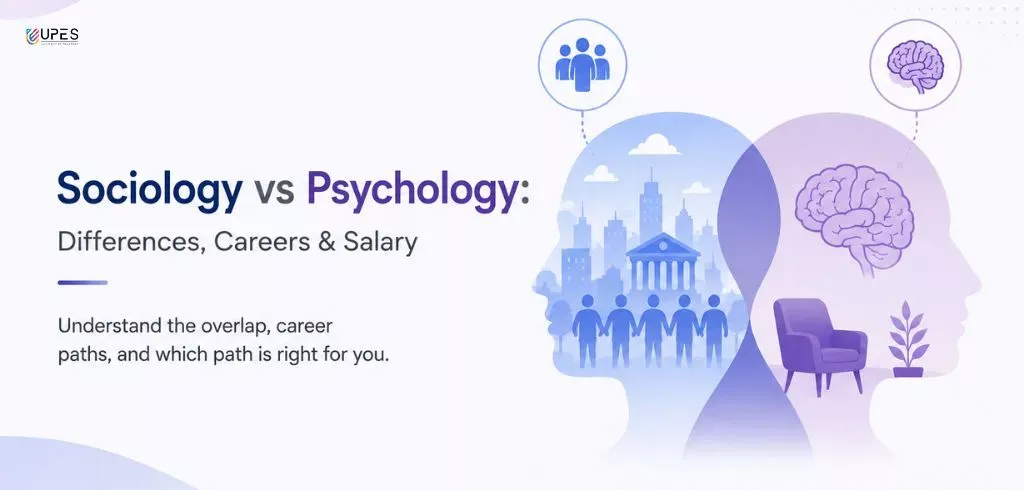
Understanding human behavior is at the core of both Sociology and Psychology, two popular academic fields that often confuse students. While Sociology focuses on how society, culture, and social structures influence people, Psychology dives into individual thoughts, emotions, and behavior. With increasing interest in careers related to mental health, social research, and human development, choosing the right path has become more important than ever.
Whether you are considering a BA (Hons.) Psychology or a BA Sociology (Hons.) course, it is essential to understand their differences, similarities, career scope, and outcomes to make an informed decision that aligns with your interests and long-term goals.
Become future-ready with our Liberal Studies programs
Know MoreSociology vs Psychology: What is the main difference?
Sociology studies society, groups, institutions, culture, and social behaviour at a larger level. Psychology studies the individual mind, emotions, thoughts, personality, and behaviour. In simple terms, Sociology focuses on how society shapes people, while Psychology focuses on how individuals think, feel, and act.
What are Sociology and Psychology Studies?
Broadly, sociology and psychology studies examine human behavior with fundamental differences in perspective. Let’s try to understand what Sociology and Psychology stand for:
What is Sociology?
Sociology is defined as the study of societies, communities, and how people interact within a social group. The study of Sociology largely includes understanding how cultures, demographics, and social structures influence human behavior. Generally, a Sociology course includes topics such as social inequality, communities, family systems, education, and social change.
What is Psychology?
Psychology is the study of the human mind and behavior. Psychology studies mainly focus on the human mind, consciousness, thoughts, and actions. A Psychology course typically includes mental health studies, cognition, human behavior, and individual personality. Furthermore, Psychology studies utilize scientific methods to understand which factors influence human behavior.
Sociology vs Psychology: How are they Different?
Often misunderstood as similar disciplines, Sociology and Psychology are vastly different in terms of objectives of study, theoretical approaches, research methods, and more. Let’s have a look at the key differences between both based on different metrics:
1. Study objectives
While the objective of Sociology studies mainly focuses on understanding how groups of people in a community influence human behavior, Psychology digs deeper into understanding individual experiences and motivations. Therefore, while Sociology largely works at a macro level in studies of societies, cultures, and institutions, Psychology studies work at a micro level, understanding the internal thought processes and motivations of individuals.
2. Theoretical differences
Sociological theories generally encompass subjects such as social structures, cultural influence on human behavior, community building, and interpersonal relationships between people. On the other hand, psychological theories typically include the study of the human mind, neuroscientific concepts, mental health concepts, thought processes, etc.
3. Research methodology
Sociological research is usually conducted through fieldwork such as surveys, demographic studies, historical trends, and polls. On the other hand, psychological research typically utilizes experimental methods, psychological analysis, and individual case studies to derive conclusions and observations.
4. Applications
The findings gathered from sociological studies are typically used to make public policies, address socio-economic issues, and support the collective growth of society. The applications of psychological studies are utilized for individual counselling, therapy, mental health evaluation, and more.
Let’s have a detailed look at some of the key differences between the two from the table provided below:
Particulars | Sociology | Psychology |
Focus | Society, groups, and social systems | Individual mind and behavior |
Level of Study | Macro (large-scale: communities, institutions) | Micro (individual thoughts, emotions) |
Core Concern | How society shapes behavior | How mental processes drive behavior |
Approach | Social patterns, cultural norms, structures | Cognitive, emotional, and behavioral analysis |
Methods Used | Surveys, interviews, social data analysis | Experiments, observations, clinical studies |
Applications | Public policy, social work, research | Therapy, counseling, HR, mental health |
Examples | Studying poverty, gender roles, education systems | Studying anxiety, memory, personality |
Sociology vs Psychology: Overlaps and Key Similarities
Often intersecting in concepts and research methodologies, Sociology and Psychology share several similarities.
1. Human Behavior at the Center
While the applications of both subjects differ significantly, the core of Sociology and Psychology studies is the understanding of human behavior.
2. Scientific Methods
Several scientific approaches in both subjects use similar methods. For example, similar methodologies are often used to test theories about human behavior and social processes with respect to data collection, surveys, and data analysis.
3. Interdisciplinary Prospect
- By integrating sociological studies with psychological research, scientists and social workers can build a more in-depth understanding of human behavior.
Aspect | Similarity Between Sociology and Psychology |
Study Focus | Both study human behavior, actions, and interactions |
Research Methods | Both use scientific methods such as surveys, observations, and data analysis |
Social Interactions | Both examine how individuals interact with others and their environment |
Interdisciplinary Nature | Both overlap in areas like social psychology, behavioral studies, and cultural analysis |
Real-World Applications | Both are applied in education, healthcare, public policy, and organizations |
Objective | Both aim to understand challenges and improve individual and societal well-being |
Sociology vs Psychology: Career and Salary Prospects
Both Sociology and Psychology disciplines offer promising career prospects to students in diverse roles with competitive salaries.
1. Career prospects in Sociology
- Students pursuing a BA in Sociology or MA in Sociology often pursue careers in public services, administrative roles, and government sectors. Some of the popular roles include Social Worker, NGO Coordinator, Policy Analyst, Public Service Officer, and more. The following are some of the top roles along with average salaries:
Role | Avg. Fresher Salaries |
Social Worker | 2.8 LPA to 3.5 LPA |
Policy Analyst | 5 LPA to 7 LPA |
Teacher/Sociology Professor | 4 LPA to 7 LPA |
Journalist | 3.7 LPA to 5.3 LPA |
Human Resource Specialist | 3 LPA to 5 LPA |
Source: Naukri, Indeed | |
2. Career prospects in Psychology
A professional degree in Psychology opens many doors in the healthcare sector. Graduates often pursue roles such as mental health experts, counsellors, therapists, etc. The following are some of the top roles and salaries in Psychology:
Role | Avg. Fresher Salaries |
Clinical Psychologist | 2 LPA to 3.5 LPA |
Research Psychologist | 16 LPA |
Social Scientist | 3.5 LPA to 4 LPA |
Forensic Psychologist | 5.1 LPA to 5.5 LPA |
Industrial/Organizational Psychologist | 4.1 PA to 5 LPA |
Source: Naukri, Indeed | |

Our counsellors are just a click away.
Sociology vs Psychology: Which is Best for you!
Choosing between Sociology and Psychology ultimately depends on your interests and career goals. If you are curious about society, culture, and social systems, a BA (Hons.) Sociology course may be the right fit. On the other hand, if you are interested in understanding individual behavior, mental processes, and emotional well-being, a BA (Hons.) Psychology course could be more suitable. Both fields offer diverse career opportunities and meaningful impact. Rather than asking which is better, focus on which aligns with your strengths and aspirations, as both Sociology and Psychology provide strong foundations for rewarding and future-ready careers.

UPES Editorial Team
Written by the UPES Editorial Team
UPES Admission Enquiry
Trending Post
-

-

Exploring the Past, Building the Future: My Journey as a History Student at UPES
03/08/2026By Pritha Agarwal
-


Related Articles


























Subscribe to UPES Blogs
Join our community for exclusive stories, insights, and updates
By clicking the "Subscribe" button, I agree and accept the privacy policy of UPES.


