Career Options After MA: Scope, Skills & Salary For Different Specializations
- UPES Editorial Team
- Published 08/05/2026


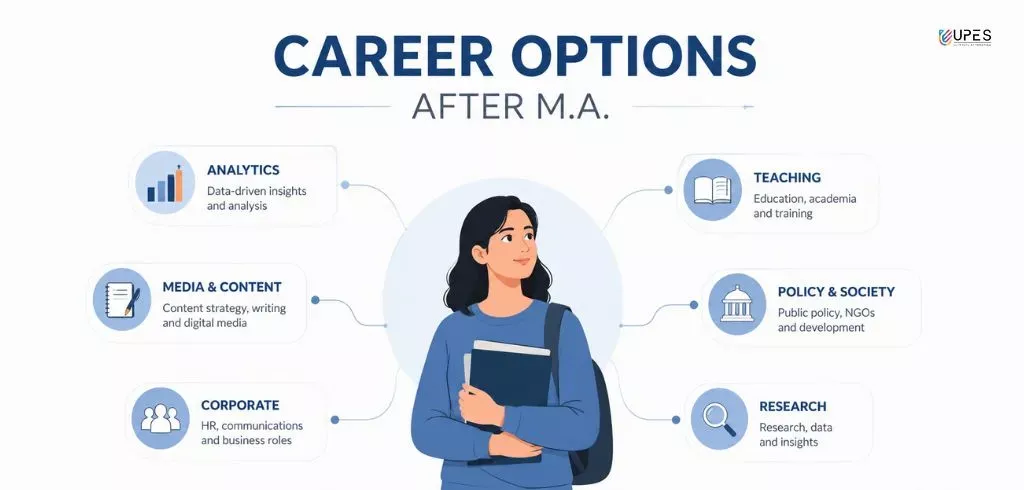
Is an MA degree still a "safe" bet in an AI-driven economy? This is a question many Indian students and parents grapple with. The reality is that the Master of Arts has evolved from a purely academic pursuit into a versatile launchpad for high-stakes corporate and creative roles.
Whether you are looking at the analytical depth of Economics or the digital storytelling of Mass Communication, ma career options in 2026 are no longer confined to the classroom. Today, an MA graduate is just as likely to be found in a fintech boardroom as they are in a research lab.
Become future-ready with our Liberal Studies programs
Know MoreWhat are the best career options after MA?
The best career options after MA include teaching, research, policy roles, content strategy, corporate communications, HR, UX research, journalism, analytics, CSR, and government jobs. The right path depends on your specialization, skill stack, and portfolio.
What is the Future of MA?
The future of MA lies in the “human-plus” advantage of combining deep humanities knowledge with digital literacy. While technical skills automate tasks, the ability to interpret complex social data, manage human behaviour, and craft persuasive narratives remains a premium skill. In India, the rise of the digital economy and a renewed focus on mental health and social policy have also created a real vacuum for skilled postgraduates who can combine domain depth with communication, research, and decision-making under ambiguity.
Definition: A Master of Arts (MA) is a postgraduate degree focusing on humanities, social sciences, or fine arts. It typically spans two years and equips students with advanced critical thinking, research, and specialized domain knowledge required for leadership roles in sectors like education, media, corporate strategy, and public policy
Career options after MA: 12 pathways that hire
These are not “random job titles.” They are clusters that repeatedly show up in hiring across India.
- Teaching and academia (schools, colleges, coaching)
- Research roles (think tanks, survey firms, universities, corporate research)
- Government and PSU track (exam-driven, varies by domain)
- Policy and development (consultancies, NGOs, impact orgs)
- Analytics and insights (research analyst, business analyst, market intelligence)
- Banking and finance support roles (economics, risk, research support)
- HR and people roles (L&D, talent, DEI, org development)
- Content strategy and SEO (education, tech, consumer brands, agencies)
- Corporate communications and PR (internal comms, brand comms)
- Media and journalism (digital newsrooms, broadcasting, production)
- UX writing and UX research (product teams, startups, IT services)
- Social sector program roles (monitoring and evaluation, program design)
Your specialization influences which of these become easier, but your skills decide how fast you enter.
MA Career Options by Specialization
Choosing the right specialization is the biggest lever for your future salary and job satisfaction. Here is a breakdown of the most in-demand tracks in India for 2026.
MA Economics career options
If you want a strong mix of employability + long-term upside, MA Economics is one of the most adaptable choices offering wide opportunities in economics field, especially when paired with data skills.
Roles that fit MA Economics well
- Economic/Research Analyst (policy or consulting support)
- Market Research and Consumer Insights
- Credit or Risk Analytics support roles (banking, fintech)
- Program Evaluation (development sector)
- Teaching/UGC NET track
Salary reality
Many sources cite entry salaries commonly starting around ₹4–₹6 LPA for analytics, banking, or teaching, with potential to reach ₹8–₹12 LPA as you specialize (data, policy, domain depth). Government economics roles can also start around ₹35,000–₹45,000 per month in some contexts, but structures vary by department and recruitment route. (Salary Sources: Glassdoor, Indeed)
Skills that change outcomes
- Excel + statistics (non-negotiable)
- SQL basics (even a little helps)
- One programming tool: Python or R
- Policy writing + clear slides (economics is often communicated, not just calculated)
MA Psychology career options
Psychology has strong demand signals, but also one of the biggest misunderstanding traps: not every psychology job is clinical practice, and clinical practice can require specific licensing routes.
High-fit roles after MA Psychology
- Counsellor / Mental health practitioner roles (in schools, NGOs, clinics)
- HR roles: Talent, L&D, org development (psychology is valued here)
- UX Research (behaviour + research methods are highly relevant)
- Program roles in health and wellbeing initiatives
Salary reality (and why it varies)
- For psychology-linked roles, pay differs sharply by setting and qualification. Many role-based estimates in India show ranges like ₹3–₹8 LPA for counselling and similar roles, with higher ranges for specialized work. If you pursue a licensed clinical psychologist route, higher qualification requirements can apply, and some salary guides for psychology cite strong monthly pay at advanced qualification levels. (Salary Sources: Glassdoor, Indeed)
The “licensing clarity” checklist (avoid a costly mistake)
Before committing, verify:
- Do you want therapy practice, or are you aiming for HR/UX research?
- Are you willing to follow the required clinical pathway in India (as applicable)?
- Are you building supervised experience, not just theory?
This clarity alone saves many students 1–2 years of confusion.
MA English career options
MA English is not “only teaching.” It is a writing and interpretation degree, and those skills map well to modern careers if you build proof of work.
Strong career tracks for MA English
- Content writer, editor, content strategist (brand or SEO)
- Publishing (editorial, rights, production coordination)
- Corporate communications and PR
- Teaching and UGC NET path
- UX Writing (product microcopy, onboarding, help content)
Salary and employability signals
- Role-based guides commonly show ₹3–₹6 LPA for content roles and ₹3.5–₹7 LPA for teaching tracks depending on institution and level. UX writing can pay significantly higher in product companies; one salary aggregator in India reports an average in the low double-digit LPA range, though it depends heavily on portfolio and company tier. (Salary Sources: Glassdoor, Indeed)
Tools that give you an edge
- SEO basics (Search Console understanding, on-page structure)
- CMS workflows (WordPress or similar)
- Editing frameworks (style guides, consistency checks)
- UX writing fundamentals (clarity, accessibility, information architecture)
MA Sociology career options
Sociology is powerful when treated as a research and systems specialization, not just as “theory.”
Common roles after MA Sociology
- Social researcher, survey research associate
- CSR and sustainability program roles
- Monitoring and Evaluation (M&E) in NGOs/impact orgs
- Policy support roles
- HR roles that value people understanding
Salary reality
- Many career guides cite ₹3–₹6 LPA for entry roles across NGOs, research, and some government-linked projects, with growth into higher brackets in consulting or specialized policy work. Treat this as directionally useful, not a guarantee. (Salary Sources: Glassdoor, Indeed)
Skill add-ons that change the game
- Research methods: surveys, interviewing, sampling basics
- Excel (cleaning data) + simple dashboards
- Qualitative analysis tools (even basic coding frameworks)
Read More: Top BA Specializations for Students in 2026
MA Career Options and Salary in India (2026): Comparison
| Specialization | Entry-Level Role | Avg. Starting Salary (LPA) | Mid-Senior Salary (LPA) |
Economics | Financial Analyst | ₹6.5 | ₹15 - ₹25 |
Psychology | I/O Psychologist | ₹5.0 | ₹12 - ₹18 |
Mass Comm | Digital Producer | ₹4.5 | ₹10 - ₹18 |
English | Content Lead | ₹4.0 | ₹9 - ₹15 |
Sociology | CSR Specialist | ₹3.8 | ₹8 - ₹14 |
Salary Sources: Glassdoor, Indeed | |||
The "If...Then" Decision Tool: Which MA is for You?
If you are stuck between choices, use this logic to narrow down your path:
- If you love numbers and want to work in high-finance or government policy → Choose MA Economics.
- If you are fascinated by human behavior and want to work in healthcare or corporate culture → Choose MA Psychology.
- If you have a flair for storytelling and want to lead in the digital media or publishing space → Choose MA English or Digital Media.
- If you want to solve large-scale social problems or work in NGOs/CSR → Choose MA Sociology.
Aligning with Industry 4.0
Universities like UPES have redesigned the MA experience by integrating digital-first curricula. For instance, their MA (Mass Communication) with Specializations in Journalism and Digital Media , Advertising & Public Relations, and Film Studies & TV Production or MA Clinical Psychology isn’t just teach theory; it involves hands-on work in state-of-the-art infrastructure, ensuring that when you search for career options after MA, you are already equipped with a portfolio that speaks louder than your degree.
Why choose UPES?
UPES School of Liberal Studies and Media combines humanities, social sciences, media, and psychology with practical, industry-focused learning. Its MA programs, including MA Mass Communication and MA Clinical Psychology, are designed to build strong research, communication, critical thinking, and real-world problem-solving skills.
Students benefit from experienced faculty, interdisciplinary learning, global exposure, internships, mentoring, and access to industry interactions. With a curriculum that connects theory with practical application, UPES helps MA students prepare for careers in media, research, psychology, policy, communication, and other emerging fields.
Common Mistakes: Why MA Graduates Struggle
Many students finish their MA and find themselves underemployed. Here is the "fix" for the most common errors:
- The "Academic-Only" Trap: Relying solely on textbooks without learning tools like SEO, Tableau, or SPSS.
- The Fix: Take a 3-month certification in a technical tool related to your field.
- The Fix: Take a 3-month certification in a technical tool related to your field.
- Neglecting Networking: Waiting until after graduation to build a LinkedIn profile.
- The Fix: Connect with at least 5 alumni in your target roles every month during your first year.
- The Fix: Connect with at least 5 alumni in your target roles every month during your first year.
- Ignoring the "Digital" in Humanities: Believing that tech doesn't apply to Arts.
- The Fix: Understand how AI and data analytics are impacting your specific specialization.
MA Jobs in India: Skills That Improve Employability
There is no single “best.” For many students, the best job is the one that matches their strengths, type of work they naturally enjoy and the skills they are willing to build alongside the degree.
If You Like: | |||
| Numbers and Analysis | Writing, Communication, and Creativity | Human Behaviour and People-Focused Work | Structured and Academic Career Paths |
|
|
|
|
Skills:
| Skills:
| Skills:
| Skills:
|
Roles:
| Roles:
| Roles:
| Roles:
|
Across all MA specializations, employers increasingly value:
- Proof of work (projects, portfolios, internships)
- Communication and presentation ability
- Digital literacy and AI awareness
- Research and analytical thinking
- Consistency and problem-solving skills
Fees, Eligibility and Admissions reality check
Across India, MA fees vary widely by institution type and specialization. Many education guides cite approximate ranges such as ₹5,000–₹50,000 per year in many government settings and ₹50,000–₹2,00,000 per year in many private settings, while premium programs can be much higher.
Eligibility Basics
A common baseline is graduation in a relevant discipline, but specifics differ by university and program.
- If your goal is media, journalism, digital communication, or psychology, UPES lists MA options such as Journalism and Digital Media , Advertising & Public Relations, Film Studies & TV Production, and Clinical Psychology, with admissions details published on its site.
- If you are comparing MA pathways in media and communication, review program curriculum, eligibility, and selection steps directly on the UPES site so you can map them to your target roles.
90-day roadmap: from MA student to employable candidate
This works whether you are targeting economics, psychology, English, or sociology.
Days 1–30: pick a track + build foundations
- Choose one track: Analytics / Teaching / Counselling or People roles / Content and UX / Graphic/ Research and Policy
- Start one core skill: Excel (analytics), research methods (psych/sociology), writing portfolio (English), stats (economics)
- Create a simple proof folder: 2 mini projects
Days 31–60: turn learning into proof
- Build one portfolio project you can show:
- Economics: a small dataset analysis + insights deck
- Psychology: a survey study + analysis + reflection (ethical and non-clinical if needed)
- English: 6 writing samples with before-after edits
- Sociology: a mini field study or secondary research brief
- Get feedback from one mentor or peer group weekly
Days 61–90: internships + targeted applications
- Apply to 20–30 precise roles, not 200 random ones
- Customize CV for the track (skills and proof first)
- Practice 6 interview stories tied to your projects
FAQs (India-focused)
- What is the future of MA?
- The future of MA depends on how well you connect it to job-ready skills. Specializations that translate into research, analytics, communication, and people-focused roles tend to stay relevant because every sector needs those capabilities.
- The future of MA depends on how well you connect it to job-ready skills. Specializations that translate into research, analytics, communication, and people-focused roles tend to stay relevant because every sector needs those capabilities.
- Which MA has the highest salary in India?
- Salary outcomes are driven by role and skill stack more than MA title. Economics plus data skills, and English plus UX writing portfolio, can offer strong upside. Some advanced psychology routes can pay well too, but may require structured qualification pathways.
- Salary outcomes are driven by role and skill stack more than MA title. Economics plus data skills, and English plus UX writing portfolio, can offer strong upside. Some advanced psychology routes can pay well too, but may require structured qualification pathways.
- Can I get a government job after MA?
- Yes, but most government outcomes are exam-driven. Your MA can help with subject depth, especially for teaching and research tracks, but you still need to align with the recruitment route.
- Yes, but most government outcomes are exam-driven. Your MA can help with subject depth, especially for teaching and research tracks, but you still need to align with the recruitment route.
- Is teaching a good option after MA in India?
- It can be, particularly if you plan for eligibility exams and long-term progression. Many salary summaries for assistant professor roles reference 7th pay commission level structures, though actual in-hand varies by allowances and institution.
- It can be, particularly if you plan for eligibility exams and long-term progression. Many salary summaries for assistant professor roles reference 7th pay commission level structures, though actual in-hand varies by allowances and institution.
- Can I do MA and still work full-time?
- Many people do, but outcomes are best when you choose a specialization where you can build proof of work alongside your job (content, analytics, research). If your path requires supervised practice or intensive exam prep, plan time realistically.
- Many people do, but outcomes are best when you choose a specialization where you can build proof of work alongside your job (content, analytics, research). If your path requires supervised practice or intensive exam prep, plan time realistically.
- How do I choose between MA Psychology and MA Sociology?
- Choose psychology if you want individual-level work (behaviour, counselling, HR, UX research). Choose sociology if you want systems-level work (social research, CSR, policy, development). Both benefit massively from research methods and strong writing.

Our counsellors are just a click away.
Conclusion
Choosing an MA is rarely the hard part. Choosing the right MA career options for your goals (salary, stability, meaning, location, growth) is where most students get stuck. The same degree can lead to a predictable government or teaching path, or a fast-moving private-sector role in analytics, research, content, or media, depending on the specialization and the skill stack you build alongside it. Make sure to choose a specialization that aligns with your interest and the career you wish to pursue.

UPES Editorial Team
Written by the UPES Editorial Team
UPES Admission Enquiry
Trending Post
-

-

Exploring the Past, Building the Future: My Journey as a History Student at UPES
03/08/2026By Pritha Agarwal
-


Related Articles





























Subscribe to UPES Blogs
Join our community for exclusive stories, insights, and updates
By clicking the "Subscribe" button, I agree and accept the privacy policy of UPES.


