Fire and Safety Interview Questions - For all Levels
- UPES Editorial Team
- Published 05/02/2026


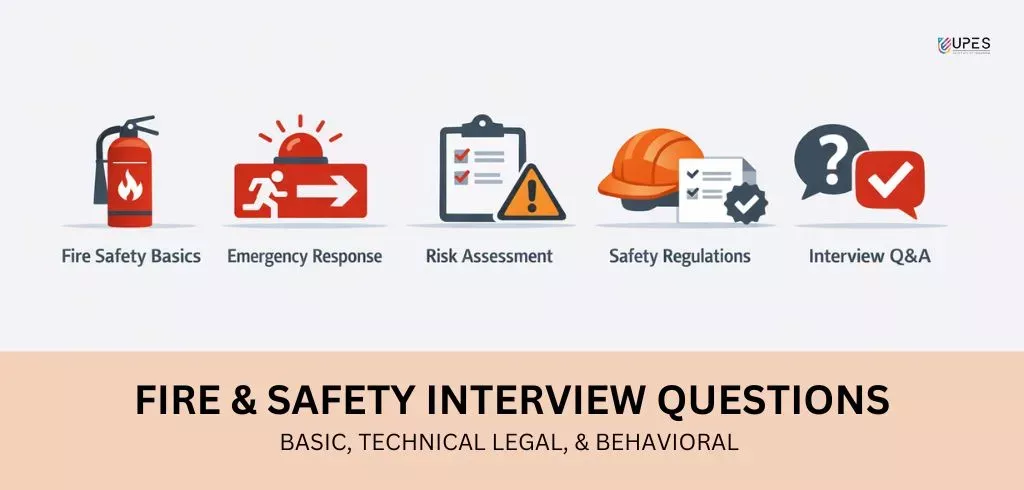
Entering the safety industry is a commitment to high-stakes responsibility. Interviewers today look for a blend of technical mastery, legal awareness, and psychological resilience. Whether you are a newcomer or a seasoned professional, these fire and safety interview questions are designed to test the full spectrum of your expertise.
Become future-ready with our Advanced Engineering programs
Know More1. Basic & Technical Questions (For Freshers)
When you are entering the fire and safety industry as a fresher, in your job interview be ready to get tested on your Foundational knowledge and understanding of equipment. Some questions you can expect as a fresher are listed below:
- Explain the difference between a Fire Alarm and a Fire Suppression System.
- Answer: An alarm system is designed to detect and notify (smoke detectors, sirens), while a suppression system is designed to extinguish the fire (sprinklers, CO2 flooding).
- What is the 'Flashover' point?
- Answer: It is the near-simultaneous ignition of most of the directly exposed combustible material in an enclosed area.
- Explain the 'Starvation' and 'Smothering' methods of extinguishing a fire.
- Answer: Starvation is the removal of fuel; Smothering is the removal of oxygen (often using foam or CO2).
- What are the components of a Fire Hydrant System?
- Answer: It includes a water reservoir, main pumps, jockey pumps, piping network, hydrant valves, and hose boxes.
- What is 'Combustion'?
- Answer: It is a high-temperature exothermic redox chemical reaction between a fuel and an oxidant.
2. Process & Hazard Questions (For Mid-Level)
As Mid-level professionals, you are expected to have a strong grasp of industrial standards and risk mitigation. Related questions are listed below:
- What is a 'Work Permit System' and name three types?
- Answer: It is a formal written system used to control certain types of work that are identified as potentially hazardous. Types include: Cold Work, Hot Work, Confined Space Entry, and Height Work permits.
- Answer: It is a formal written system used to control certain types of work that are identified as potentially hazardous. Types include: Cold Work, Hot Work, Confined Space Entry, and Height Work permits.
- Define 'Lower Explosive Limit' (LEL) and 'Upper Explosive Limit' (UEL).
- Answer: LEL is the lowest concentration of a gas in air capable of producing a flash of fire in presence of an ignition source. UEL is the highest concentration.
- Answer: LEL is the lowest concentration of a gas in air capable of producing a flash of fire in presence of an ignition source. UEL is the highest concentration.
- What is the significance of the NFPA 704 Diamond?
- Answer: It is a standard system for the identification of hazards of materials for emergency response. It uses colours: Blue (Health), Red (Flammability), Yellow (Instability), and White (Special hazards).
- Answer: It is a standard system for the identification of hazards of materials for emergency response. It uses colours: Blue (Health), Red (Flammability), Yellow (Instability), and White (Special hazards).
- What are 'Engineering Controls' in the context of the Hierarchy of Controls?
- Answer: These are physical changes to the workplace to isolate people from hazards, such as machine guarding, local exhaust ventilation, or sound dampening.
- Answer: These are physical changes to the workplace to isolate people from hazards, such as machine guarding, local exhaust ventilation, or sound dampening.
- Explain the purpose of an 'Emergency Shutdown Valve' (ESDV).
- Answer: It is a valve designed to stop the flow of a hazardous fluid or gas upon the detection of a dangerous event.
3. Leadership & Legal Questions (For Experienced Professionals)
As Senior professionals working at leadership roles of fire and safety industry, you are mostly catering to demands of strategic planning, compliance, and crisis management. That’s the knowledge you will be tested on. Some questions to expect can be found below:
- How do you develop a 'Safety Culture' in an organization where workers ignore PPE?
- Answer: Focus on leading by example, implementing a "Behavior-Based Safety" (BBS) program, conducting interactive training, and ensuring the management demonstrates that safety is valued over production speed.
- Answer: Focus on leading by example, implementing a "Behavior-Based Safety" (BBS) program, conducting interactive training, and ensuring the management demonstrates that safety is valued over production speed.
- What is 'ALARP' and how is it used in risk assessment?
- Answer: It stands for "As Low As Reasonably Practicable." It means that a risk must be reduced to a point where the cost of further reduction is grossly disproportionate to the benefit gained.
- Answer: It stands for "As Low As Reasonably Practicable." It means that a risk must be reduced to a point where the cost of further reduction is grossly disproportionate to the benefit gained.
- How would you handle a major chemical spill that threatens a nearby community?
- Answer: Immediate activation of the On-Site Emergency Plan (OEP), notifying local authorities for Off-Site response, containment of the spill, and coordination of evacuation zones based on wind direction.
- Answer: Immediate activation of the On-Site Emergency Plan (OEP), notifying local authorities for Off-Site response, containment of the spill, and coordination of evacuation zones based on wind direction.
- Explain the 'Root Cause Analysis' (RCA) process after an accident.
- Answer: It involves techniques like the "5 Whys" or "Fishbone Diagram" to look beyond the immediate cause (human error) to identify systemic failures (lack of training, faulty equipment).
- Answer: It involves techniques like the "5 Whys" or "Fishbone Diagram" to look beyond the immediate cause (human error) to identify systemic failures (lack of training, faulty equipment).
- What are the key provisions of the Factories Act 1948 regarding industrial safety in India?
- Answer: It mandates the appointment of Safety Officers, maintenance of machinery, fencing of dangerous equipment, and provision of adequate washing and first-aid facilities.
4. Psychological & Behavioural Questions
Have a look at some Psychological & Behavioural Questions you can be tested upon in fire and safety interviews to test your ability for stress management, integrity, and decision-making.
- How do you stay calm and make decisions during a real fire emergency?
- Answer: By relying on rigorous training and pre-planned SOPs. Muscle memory and familiarity with the emergency plan prevent panic.
- Describe a time you had to stop work because of a safety hazard. How did you handle the pushback from the production team?
- Answer: Highlight your communication skills—explaining the "Why" behind the stop, emphasizing that an injury would cause a longer delay than the safety fix.
- How do you balance the need for safety with the company's need for production speed?
- Answer: By demonstrating that "Safe Production" is the most efficient form of production, as it avoids the massive costs and downtime associated with accidents.
- What is your approach to delivering bad news (e.g., an accident report) to the board of directors?
- Answer: Be transparent, provide the facts, present the root cause, and most importantly, offer a concrete plan to ensure it never happens again.
- How do you handle a worker who is consistently negligent about safety rules despite warnings?
- Answer: Investigate if there is a psychological barrier or lack of understanding. If it persists, follow the disciplinary policy, as one person's negligence can endanger the entire team.
Make sure to master these questions before you walk into the interview room of your dream job. Remember to be smart, confident, and knowledgeable. Pursuing a degree in fire and safety prepares you well for the outside world. Read below to know more.
Mastering the Science of Safety at UPES
Preparing for these fire and safety interview questions is the first step toward a career of impact. However, to move from a "compliance officer" to a "safety leader," a deep technical foundation is required.
The UPES B.Tech in Fire and Safety Engineering is the premier choice for aspiring safety professionals in India.
- Technical Depth: Master the chemistry of combustion, structural engineering, and fluid mechanics.
- Industry Integration: Benefit from the School of Advanced Engineering's deep ties with energy, manufacturing, and construction giants.
- Psychological Preparedness: Training modules include crisis leadership and disaster psychology, preparing you for the mental demands of the field.
UPES is ranked as India's #1 Private University, as per QS World University Rankings 2025 for Academic Reputation. Students are mentored by world-class faculty from IITs, IISc, and Ivy League institutions, leveraging state-of-the-art infrastructure and a dedicated Centre for AI. Through high-impact industry alliances with AWS and IBM, students gain a competitive edge, contributing to a stellar placement record with alumni packages reaching up to INR 1.3 Crore. With global pathways, international credit transfers, and the “Runway” incubator, UPES transforms students into industry-ready assets equipped to solve real-world challenges.

Our counsellors are just a click away.
Conclusion
Whether you are answering fire and safety interview questions for an entry-level role or a directorial position, your goal is to show that you are a guardian of the workforce. If you want to back your confidence with a world-class degree, explore the programs at the UPES School of Advanced Engineering.

UPES Editorial Team
Written by the UPES Editorial Team
UPES Admission Enquiry
Trending Post
-

Career Opportunities in Space Technology & Satellite Engineering for Students
26/10/2025By UPES Editorial Team
-

-


Related Articles











































Subscribe to UPES Blogs
Join our community for exclusive stories, insights, and updates
By clicking the "Subscribe" button, I agree and accept the privacy policy of UPES.


