ROI Driven Education and How UPES Helps you Achieve it
- UPES Editorial Team
- Published 09/06/2026


- What is ROI driven education?
- ROI driven education: what it means (and what it doesn’t)
- The ROI on education equation Indian families should use
- The “tier college” question: why it’s the wrong lens (and what to use instead)
- How to Evaluate UPES Through an ROI Lens
- What is the NIRF ranking of UPES Dehradun?
- UPES Dehradun: private or government (and why people get confused)
- When was UPES Dehradun established?
- What is UPES Dehradun famous?
- What is the average package of UPES Dehradun?
- How is UPES Dehradun for Law?
- How good is UPES Dehradun for MBA?
- What is the fees of UPES Dehradun? (and how to evaluate it for ROI)
- How to get admission in UPES Dehradun?
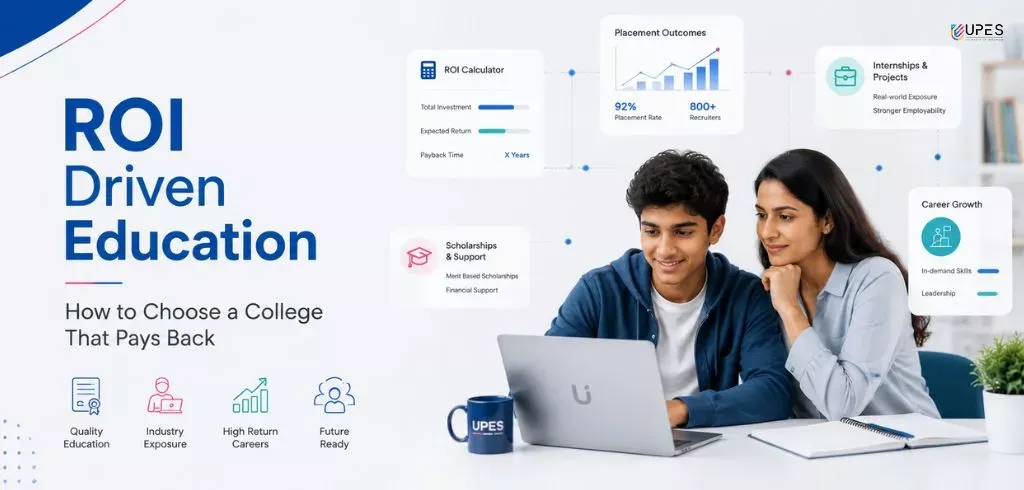
A degree is a major investment in terms of money, years, and opportunity cost. That’s why roi driven education is becoming the smarter way to choose a college in India: not by hype, but by outcomes you can measure (skills, internships, placements, network, and career mobility). If you’re comparing options like UPES, the right question isn’t “Is it good?”, it’s “Will this choice pay back in real life, for my goals?”
What is ROI driven education?
ROI driven education means choosing a college or course by comparing total cost with measurable outcomes such as employability, internships, placements, skill development, alumni network, and long-term career growth. It is not about choosing the cheapest college or chasing the highest package, but about selecting a program that gives strong career returns for your goals.
ROI driven education: what it means (and what it doesn’t)
ROI driven education means selecting a course and college based on the return you’re likely to get your employability, salary trajectory, and career options, relative to the total cost (tuition + living + time + lost earnings). It’s not just about the highest package; it’s about consistent outcomes, leadership skill-building[YK1.1], and faster career compounding.
What it’s not:
- Not “cheap = best ROI” (low fees with weak outcomes can still be bad ROI)
- Not “highest package screenshots” (outliers don’t equal typical outcomes)
- Not “rankings-only” (rankings help, but don’t replace fit + execution)
The ROI on education equation Indian families should use
Most people calculate roi on education using a single number: average package. That’s a common trap.
A more useful way is to think in payback time:
Payback time (simple):
- Total Cost of Education ÷ Expected Annual Incremental Earnings
- “Incremental” matters. If you’d earn ₹4 LPA without the degree and ₹7 LPA with it, the increment is ₹3 LPA—not ₹7.
Total cost: a practical checklist (not just tuition)
- Tuition + academic fees (year-wise)
- Hostel + food + local transport
- Laptop/software/tools (stream-specific)
- Coaching/exams (CUET/entrance/aptitude)
- Opportunity cost (especially for PG programs)
- Internships: paid vs unpaid, location costs
UPES publishes a program-wise fee structure on its admissions portal (so you can plan with real numbers instead of guesswork).
The “tier college” question: why it’s the wrong lens (and what to use instead)
Searches like “upes dehradun is which tier college” are common, but there’s no official “tier” system. “Tier” is usually internet shorthand for a mix of:
- Rankings (NIRF/others)
- Brand recall
- Alumni outcomes
- Recruiter mix
- Student quality
A better approach: use an ROI scorecard (below) and decide based on your goals.
The ROI Scorecard: a decision tool you can use in 10 minutes
Score each college 0–2 on every parameter:
- 0 = weak/unclear, 1 = decent, 2 = strong/verified
| ROI Lever | What to check | Why it matters |
Curriculum-market fit | Updated specialisations, skill focus | Avoids “outdated degree” risk |
Project depth | Capstones, real briefs, labs | Evidence for interviews |
Internship pipeline | Support, structure, industry access | Converts learning into employability |
Career services | Resume, mocks, employer connects | Better conversion rate |
Outcomes transparency | Published reports, clarity on metrics | Reduces marketing fog |
Brand + credibility | Recognition, rankings, approvals | Signal value in shortlists |
Peer quality | Competitive intake, learning culture | Strong peer effects |
Faculty + industry exposure | Mentors, practitioners | Faster real-world context |
Total cost control | Fees clarity + living costs | Payback feasibility |
Location/industry access | Ecosystem + recruiters | More opportunities, less friction |
Decision rule:
- 16–20: strong ROI setup (if you execute)
- 11–15: good, but you must self-drive more
- ≤10: high risk unless cost is very low and you have a strong personal plan
How to Evaluate UPES Through an ROI Lens
Students considering UPES can evaluate the university using the same ROI framework discussed earlier: curriculum relevance, industry exposure, internships, placements, global opportunities, entrepreneurship support, and total cost of education.
For example, UPES publishes program-wise fee structures, placement statistics, rankings, eligibility criteria, and admission routes, making it easier for students to compare costs and outcomes across institutions. The university also offers structured internship opportunities, industry collaborations, international pathways, research initiatives, and startup incubation support through Runway.
From an ROI perspective, the key question is not whether a university is "good" or "bad," but whether its outcomes align with your career goals, budget, and target industry. Students should compare placement trends, recruiter mix, internship access, specialisations, and overall payback period before making a decision.
What is the NIRF ranking of UPES Dehradun?
UPES appears in multiple NIRF 2025 discipline lists, including:
- Law: Rank 18
- Management: Rank 36
- Engineering: Rank 43
- University category: Rank 45
- QS Ranking: UPES has been ranked the No. 1 private university in academic reputation in India by the QS World University Rankings 2026.
How to use this for ROI: rankings help as a credibility signal, but ROI still depends on fit + execution + outcomes transparency.
UPES Dehradun: private or government (and why people get confused)
A frequent query is: “upes dehradun is private or government” / “upes dehradun is government or private”.
UPES is a private university, and it is recognised by UGC; it was established through an Act passed by the Uttarakhand state legislature.
What that means in plain terms:
- It’s not a government college (like a state government engineering college)
- It operates as a private university within the regulatory framework
When was UPES Dehradun established?
UPES was established in 2003.
What is UPES Dehradun famous?
Historically, UPES highlights its origins as an energy and core-sector-focused university, and later expansion into multiple schools (including law and design). A practical way to interpret this for ROI:
- Universities that started with a strong niche often build industry alignment earlier
- Expansion matters only if the newer schools maintain outcomes and clarity
What is the average package of UPES Dehradun?
UPES’s average package is of 6-8 LPA, with a placement record of 92%, along with 800+ recruiters. Through high-impact industry alliances with AWS and IBM, students gain a competitive edge, contributing to a stellar placement record with alumni packages reaching up to INR 1.3 Crore.
How is UPES Dehradun for Law?
Ranked #18 in India (Law Category) by NIRF and recognized as India’s #1 Private University as per QS World University Rankings 2025, UPES offers a class-leading, industry-first curriculum. Students learn directly from the best, with top law firm partners serving as Professors of Practice. Learners benefit from a dedicated and modern moot court facilities that simulate high-stakes legal environments. With a proven track record of placements and a powerful network of alumni serving as law firm partners, judges, and corporate leaders, UPES provides a clear pathway to success.
How good is UPES Dehradun for MBA?
The UPES School of Business, currently ranked #36 in the Management Category by NIRF 2025, has emerged as a premier choice for MBA aspirants due to its industry-first curriculum. Students are mentored by a world-class faculty hailing from IITs, IIMs, and Ivy League institutions, gaining the expertise needed to secure placements at 270+ top-tier firms like Amazon, Deloitte, and Accenture. It boasts of a robust professional ecosystem that has facilitated a highest placement package of INR 30 LPA and fostered over 240 successful startup stories with more than INR 110 Crore in funding, transforming MBA students into industry-ready leaders equipped to solve complex business challenge.
What is the fees of UPES Dehradun? (and how to evaluate it for ROI)
Fees vary by program and year. UPES provides a fee structure section on its admissions site for program-wise planning. Hostel/other fees are also published (useful for real cost estimation).
A smarter “fees to ROI” checklist
Before reacting to tuition numbers, ask:
- What are the career outcomes typical for this stream?
- Will I get projects/internships that reduce my “job-ready time”?
- What’s my payback timeline in a conservative scenario?
If you’re shortlisting, compare program-wise fees + eligibility criteria + selection routes directly on the UPES admissions pages so your ROI estimate is based on real inputs, not assumptions.
How to get admission in UPES Dehradun?
UPES outlines a step-based application flow and publishes eligibility/selection criteria by program.
How to get admission in UPES Dehradun (steps):
- Choose your course/school
- Fill the application form
- Pay the application fee
- Submit and track updates
- If selected, pay acceptance fee to reserve the seat
Eligibility and selection routes vary by program (for example, B.Tech routes include options like UPESEAT/JEE-Mains/board merit depending on the specific program).
Common ROI mistakes and Fixes
The concept of ROI is simple yet confusing. To make sure yours is clear, have a look below:
Mistake 1: Treating “highest package” as your expected outcome
Fix: Plan using conservative numbers and focus on your skill-to-role pathway.
Mistake 2: Choosing a degree first, then hoping for a career
Fix: Pick a target role family (e.g., product, analytics, corporate law, digital marketing, consulting) and reverse-map skills + internships.
Mistake 3: Ignoring opportunity cost
Fix: If you’re leaving a job for a PG program, calculate lost earnings as part of total cost.
Mistake 4: Betting everything on campus placements
Fix: Build a parallel pipeline: internships, competitions, portfolio projects, LinkedIn outreach, and referrals.
Next steps: 3 actions you can take this week
- Pick a target outcome (role + industry) and list the top 10 skills/tools that role needs.
- Run the ROI Scorecard for 3 colleges and shortlist based on score + affordability + fit.
- Build proof early: one portfolio project + one internship outreach plan (even before admissions close).
If UPES is on your shortlist, use its official admissions pages to verify eligibility routes, selection criteria, and program fee structure—then plug those numbers into your ROI estimate and compare apples-to-apples.
Conclusion
Choosing a college is ultimately a return-on-investment decision of time, money, and effort. Prioritise programs that build job-ready skills, real project experience, and clear career pathways, not just a brand name. Compare your options using total cost, likely outcomes, and personal fit, then commit fully to internships and portfolio-building to maximise your ROI.

UPES Editorial Team
Written by the UPES Editorial Team
Tags
- Guest Blogs
UPES Admission Enquiry
Trending Post
-
![]()
Best Private Engineering Colleges in North India 2026: Rankings, Fees & Admissions
08/10/2026By UPES Editorial Team
-
![]()
MBA Colleges in North India 2026: Government, Private, Rankings & Fees
28/09/2026By UPES Editorial Team
-
![]()
Professional Courses After 12th – Full Details for Science, Arts & Commerce
30/09/2025By UPES Editorial Team


Related Articles

















Subscribe to UPES Blogs
Join our community for exclusive stories, insights, and updates
By clicking the "Subscribe" button, I agree and accept the privacy policy of UPES.


