How Business Analytics Skills Improve Career Growth in Management
- UPES Editorial Team
- Published 08/08/2026


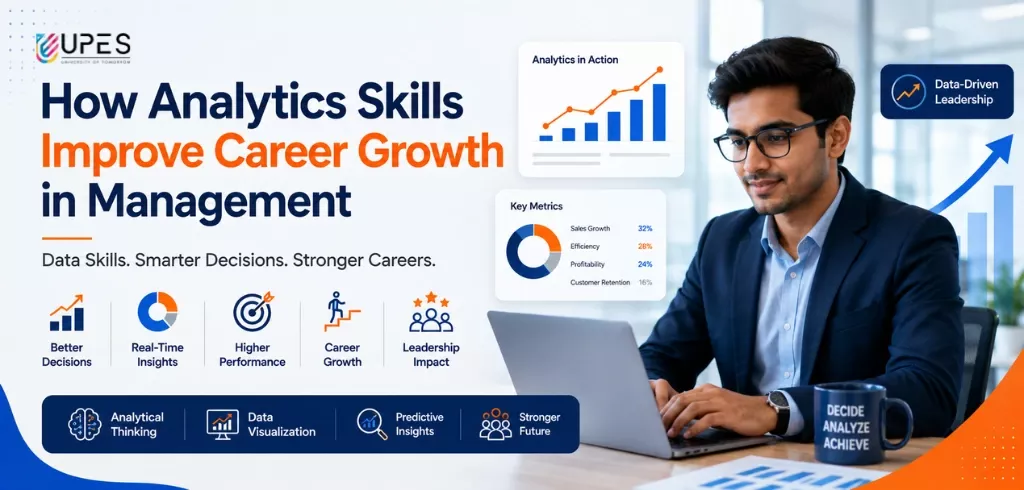
- How Do Analytics Skills Improve Career Growth in Management?
- Why Business Analytics Skills Matter for Managers Today
- Top Business Analytics Skills That Drive Career Growth in Management
- How Business Analytics Skills Help Accelerate Career Growth
- Which Industries Value Analytics Skills in Management Roles?
- How MBA Help Develop Business Analytics Skills?
According to the World Economic Forum's Future of Jobs Report 2025, analytical thinking remains the most sought-after workplace skill globally, underscoring the essential need for such skills among emerging managers and in managerial roles. MBA programs today are increasingly incorporating business analytics skills into the curriculum, and even specialized programs such as MBA Business Analytics are gaining popularity. This change is not just because of new technologies. It reflects how businesses today are using data to make better decisions, improve operations, and create value in a more informed and strategic way. In this article, we will discuss the importance of business analytics skills in modern business and how an MBA can help future managers to gain these skills.
Become future-ready with our Business programs
Know MoreHow Do Analytics Skills Improve Career Growth in Management?
Analytics skills can help you make smarter, data-driven decisions and understand how a business is performing. By learning how to analyze data, forecast outcomes, and communicate insights clearly, you can prepare for roles in areas such as strategy, consulting, product management, marketing, finance, and operations. These skills can also support your growth in leadership positions where you are expected to use data to solve problems, guide teams, and make important business decisions.
| Analytics Skill | How It Helps Managers | Career Value |
| Data analysis | Identifies trends and performance gaps | Better decision-making |
| Data visualization | Communicates complex insights | Stronger stakeholder influence |
| Predictive analytics | Forecasts outcomes and risks | Strategic planning |
| SQL | Enables direct access to business data | Faster analysis |
| AI/ML literacy | Helps evaluate AI-driven insights | Future-ready leadership |
| Critical thinking | Challenges assumptions | Better judgment |
| Data storytelling | Converts analysis into action | Executive communication |
| Business communication | Explains recommendations clearly | Leadership readiness |
Why Business Analytics Skills Matter for Managers Today
Modern businesses are incorporating technologies such as AI, automation, and machine learning to speed up production, and find new customer markets. This shift has made business analytics skills a key requirement among managers. Using these skills, modern managers are able to process raw data and receive instant feedback, get real-time forecasts and trends, optimize daily operations, and maintain a sustainable competitive advantage.
The importance of business analytics skills can be understood by the following points:
1. Helps in making strategic decisions: Using different analytics methodologies, modern managers can easily assess KPIs, risks, and measure ROI across departments and projects. This helps them take data-supported informed decisions, instead of relying on guesswork.
2. Improves overall operational efficiency: Using business analytics skills, managers can instantly identify critical issues such as bottlenecks and technical challenges with a project. Additionally, managers can also use business analytics to increase the efficiency of supply chains, manage inventory, and allocate resources effectively.
3. Provides real-time customer insights: Business analytics help analyze consumer behavior; managers can personalize marketing campaigns, implement dynamic pricing, and increase customer lifetime value.
4. Allows a predictive approach: Modern managers often use predictive analytics tools to analyze past data based on which, they can predict future business outcomes. This further helps managers avoid market risks and take informed actions in the best business interests.
Top Business Analytics Skills That Drive Career Growth in Management
Mastering business analytics skills helps managers turn data into meaningful insights that support better business decisions. These skills are becoming increasingly important for managers across industries and can open up new career growth opportunities.
| Technical analytical skills | Managerial analytics skills |
| Excel | Critical thinking |
| SQL | Data storytelling |
| Power BI/Tableau | Decision-making |
| Predictive analytics | Business communication |
| Statistics | Problem framing |
| Python/R | Commercial understanding |
| AI/ML literacy | Data Visualization |
Here are the key technical and soft skills in business analytics that can help you grow in a management role:
Excel
Excel remains one of the easiest and most useful analytics tools for managers. You can use it to build financial models, compare different scenarios, forecast results, create dashboards, and track business performance. Before moving on to advanced analytics tools, you should be comfortable with basics such as cleaning data, using formulas and lookup functions, creating pivot tables, and reading charts. These skills can give you a strong foundation for working with data in a management role.
Data Storytelling and Data Visualization
Managers in modern data-driven business scenarios are required to have a strong command of data storytelling to help non-technical stakeholders to understand insights. Today’s managers often use business intelligence tools such as Tableau and Microsoft Power BI to design interactive executive dashboards that easily depict business processes in a simplified manner to convey ideas across departments.
Predictive Analytics & Business Forecasting
Data is the key to success in modern businesses. Firms and managers nowadays heavily rely on past business data to make informed decisions. Using previous datasets, models are able to identify patterns and anomalies and help managers foresee potential business risks.
Database Management (SQL)
SQL is a useful skill for managers and analysts because it helps you find, filter, combine, and summarise data stored in business databases. You don't need to become a database expert, but knowing basic commands such as SELECT, WHERE, JOIN, and GROUP BY can help you explore data on your own, answer business questions faster, and rely less on reporting teams.
Machine Learning & AI Literacy
Managers don't need to become AI or machine-learning experts, but having a basic understanding of these technologies is becoming increasingly important. You should know concepts such as prediction, classification, model accuracy, bias, and limitations. This knowledge can help you understand AI-generated insights, work more effectively with technical teams, and identify areas where AI can solve business problems and create measurable value.
Statistical Languages
Python and R are popular programming languages used in business analytics which helps in organizing, cleaning, and maintaining large and complex datasets. Unlike spreadsheets, they can handle massive amounts of structured and unstructured data quickly and efficiently. Libraries such as Pandas and NumPy make it easier to process and manipulate data, allowing managers and analysts to work faster and more accurately.
Statistical Software and Models
Business professionals also use specialized Business analytics tools such as SAS and SPSS to analyze large datasets. Statistical analysis helps businesses understand whether changes in performance or customer behavior are meaningful or simply due to chance. For example, it can help determine if a new marketing campaign has genuinely improved sales or if the results are temporary.
Critical Thinking
Critical thinking helps managers ask the right questions before analyzing data and focus on solving real business problems. Instead of looking at numbers alone, it involves understanding what information is needed and why it matters.
Decision Making
Technical skills such as predictive analytics, machine learning, and database management allow managers access to data-supported insights. Therefore, in a competitive market, managers are required to take informed decisions.
Business Communication
In business, operations are conducted at multiple levels at once, requiring managers to collaborate with other teams on a regular basis. Strong business communication skills help managers to convey ideas, information, and decisions clearly.
Read More: What is Forecasting in Business?
How Business Analytics Skills Help Accelerate Career Growth
Business analytics skills offer managers essential career skills such as strategic planning and operational optimization. At a time when analytics is driving businesses across all sectors, business analytics skills allow students to secure good jobs and explore diverse career potential. Let’s have a quick look here:
1. Secure high-growth management roles: Business analytics skills are some of the most in-demand skills in modern times, offering high-growth opportunities in roles such as analysts, business managers, and strategists. Businesses today are looking for managers who can interpret complex data, come up with innovative ideas, and solve business challenges.
2. Improve leadership potential: Business analytics skills such as critical thinking, decision-making, and cross-department communication help in improving the chances of managers transitioning into leadership roles.
3. Increase career flexibility: Analytical skills are implemented across industries including but not limited to consulting, finance, marketing, technology, healthcare, retail, E-commerce, and manufacturing. This gives future managers flexibility to switch between different industries and roles.
4. Drive organizational impact: Business analytics skills also help managers to adapt to new business changes and drive organizational impact. These skills allow for customer-centric decision-making, crafting effective business growth strategies, and giving businesses competitive advantages.
Top Roles Using Business Analytics Skills
The following are some of the top roles where managers are required to implement business analytics skills on a regular basis:
| Role | Average salary |
| Business Analyst | INR 5 to 11 LPA |
| Product Manager | INR 10.4 to 26.9 LPA |
| Marketing Manager | INR 8 to 18 LPA |
| Operations Manager | INR 5 to 12 LPA |
| Strategy Consultant | INR 12.8 to 30 LPA |
| Supply Chain Manager | INR 8 to 27.5 LPA |
| Financial Analyst | INR 3 to 8 LPA |
| Management Consultant | INR 16.5 to 28.2 LPA |
Note: Salaries may vary based on roles, organization, level of experience, and other factors. The data mentioned above is based on Glassdoor data.
Which Industries Value Analytics Skills in Management Roles?
The implications of business analytics skills expand across all major industries. The following are some of the major industries regularly hiring professionals with business analytics skills:
| Industry | Top Roles | Key Business Analytics Skills Used |
| Banking and Financial Services | Business Analyst, Financial Analyst, Risk Analyst, Investment Analyst, Operations Manager | Financial forecasting, risk assessment, data visualization, predictive analytics, strategic decision-making |
| Consulting | Management Consultant, Business Consultant, Strategy Analyst, Project Manager | Problem-solving, business intelligence, data analysis, market research, strategic planning |
| Retail and E-commerce | Category Manager, Product Manager, Business Analyst, Marketing Manager, Supply Chain Manager | Customer analytics, demand forecasting, pricing analysis, performance reporting, data-driven decision-making |
| Healthcare Management | Healthcare Analyst, Hospital Operations Manager, Healthcare Consultant, Program Manager | Data interpretation, operational analytics, resource planning, predictive modelling, performance analysis |
| Information Technology | Product Manager, Data Analyst, Business Analyst, IT Project Manager, Operations Manager | Business intelligence, KPI analysis, product analytics, data visualization, process optimization |
| Marketing and Advertising | Marketing Manager, Brand Manager, Digital Marketing Manager, Marketing Analyst, Growth Manager | Marketing analytics, consumer behavior analysis, ROI measurement, campaign performance tracking, data storytelling |
| Supply Chain and Logistics | Supply Chain Analyst, Operations Manager, Logistics Manager, Procurement Manager | Inventory analysis, demand forecasting, process optimization, operational reporting, predictive analytics |
| Manufacturing | Operations Manager, Production Manager, Business Analyst, Quality Assurance Manager | Quality analysis, performance monitoring, operational analytics, process improvement, predictive maintenance analysis |
| FMCG | Category Manager, Sales Manager, Brand Manager, Business Development Manager, Market Research Analyst | Market analysis, sales forecasting, consumer insights, business reporting, strategic planning |
| EdTech and Digital Businesses | Product Manager, Growth Manager, Business Analyst, Customer Success Manager, Strategy Associate | User behavior analytics, performance measurement, business intelligence, growth analytics, data-driven strategy |
How MBA Help Develop Business Analytics Skills?
MBA is a popular postgraduate program designed for students who wish to pursue careers in business management. As modern businesses rely more on automation and AI integration, the demand for business analytics skills has also increased significantly, resulting in the rising popularity of specialized management courses such as MBA in Business Analytics, MBA in Data Analytics, MBA AI for Business, and more. An MBA degree can help students gain essential skills in the following areas:
- Curated curricula: Most MBA programs offer curated courses designed to offer students key analytics skills in a planned manner. As students progress through semesters, they gain essential knowledge of soft skills, core concepts, and practical learnings.
- Specialized programs: Dedicated programs such as MBA in Business Analytics offer an in-depth understanding of key business analytics frameworks, data visualization, interpretation, and industry-relevant tools.
- Business intelligence tools: Most modern MBA programs incorporate industry-relevant business intelligence tools such as Microsoft Power BI, SQL, and other skills into their curriculum, offering students hands-on learning.
- Industry internships: During MBA programs, students are required to complete mandatory industry internships, which help students gain valuable industry experience and gain insights, preparing them for a data-driven career.
- Real-world case studies and projects: During MBA programs, students get opportunities to learn from real-world case studies and build their own projects to gain real-time experience. Students get to implement their knowledge and skills in the projects and solve complex business problems.

Our counsellors are just a click away.
Conclusion
The growing use of AI, automation, and business intelligence tools is increasing the demand for professionals with business analytics skills. Companies are looking for managers who can use data to predict trends, understand customer needs, and make smarter business decisions. As businesses become more data-driven, these skills are becoming valuable across industries.
FAQs
1. What are business analytics skills?
Business analytics skills are the abilities that help professionals collect, understand, and use data to make better business decisions. These skills include data analysis, problem-solving, critical thinking, data visualization, and using tools such as Excel, SQL, Python, and Power BI. They help businesses identify trends, improve performance, and plan effective strategies.
2. Is business analytics useful for MBA students?
Yes, business analytics is highly useful for MBA students. It helps them develop data-driven decision-making skills that are valuable across management roles such as marketing, finance, operations, human resources, and consulting. Learning business analytics can also improve job opportunities and prepare MBA graduates for leadership roles in today's data-focused business environment.
3. Which industries require business analytics skills?
Business analytics skills are in demand across almost every industry. Sectors such as finance, healthcare, retail, e-commerce, information technology, consulting, manufacturing, logistics, education, and digital marketing regularly hire professionals with analytics expertise. As organizations increasingly rely on data to improve efficiency and customer experiences, the demand for business analytics professionals continues to grow.
4. What are the most in-demand business analytics tools?
Some of the most widely used business analytics tools include Microsoft Excel, SQL, Python, R, Power BI, Tableau, SAS, SPSS, and Google Analytics. These tools are used for tasks such as data cleaning, visualization, reporting, statistical analysis, and predictive modelling. Learning even a few of these tools can provide a strong foundation for a career in business analytics.
5. Can non-technical students learn business analytics?
Yes, non-technical students can successfully learn business analytics. Many concepts begin with basic data analysis and do not require advanced programming knowledge. With the right learning approach, students from commerce, management, humanities, and other academic backgrounds can build both analytical and technical skills over time. Several business analytics programs are also designed specifically for beginners and working professionals.

UPES Editorial Team
Written by the UPES Editorial Team
UPES Admission Enquiry
Trending Post
-

-

Business Intelligence vs Data Analytics: Differences, Careers, Skills & Salary
05/10/2026By UPES Editorial Team
-


Related Articles

























































Subscribe to UPES Blogs
Join our community for exclusive stories, insights, and updates
By clicking the "Subscribe" button, I agree and accept the privacy policy of UPES.


