ESG Reporting Software: Top Tools, Features, Benefits & How to Choose
- UPES Editorial Team
- Published 15/10/2026


- What does an ESG Reporting Software Do?
- Why is ESG Reporting Software Important for Businesses?
- Advantages of ESG Reporting Software
- Top ESG Reporting Software Tools
- ESG Reporting Frameworks to Consider
- How to Choose the Right ESG Reporting Software
- Common Challenges When Implementing ESG Reporting Software
- ESG Reporting Software vs Manual Reporting Methods
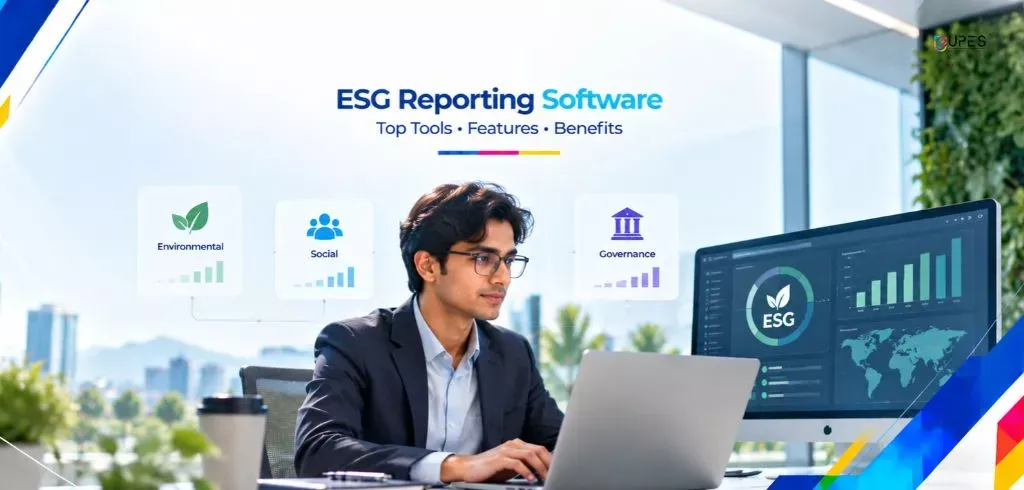
ESG reporting software helps organisations collect, validate, manage and disclose environmental, social and governance (ESG) data through a centralised system. Depending on the platform, it can support emissions accounting, sustainability reporting, disclosure workflows, evidence management and reporting against frameworks such as GRI Standards, IFRS S1 and S2, and India's BRSR requirements.
Depending on its features, the software may also support greenhouse gas emissions calculations, reporting framework mapping, audit trails, and ESG target tracking. Businesses use these tools to reduce spreadsheet dependence, improve data traceability and coordinate reporting across departments. However, software does not automatically ensure accurate ESG disclosures or regulatory compliance. Reliable reporting still requires appropriate methodologies, quality controls, human review and, where applicable, independent assurance.
This guide compares selected ESG reporting platforms, explains their capabilities and outlines how to choose software based on reporting needs, integrations, data quality and implementation costs.
Become future-ready with our Business programs
Know MoreWhat does an ESG Reporting Software Do?
The core functions of an ESG reporting software involve collecting and validating ESG data, calculating greenhouse-gas emissions, mapping metrics to reporting standards or regulatory requirements, managing disclosure workflows, tracking targets and maintaining supporting evidence for review or assurance.
- Centralized data collection: ESG reporting software brings ESG information from multiple business functions and systems into a centralized repository or platform, reducing dependence on disconnected spreadsheets and files.
- Framework Mapping: Depending on the platform and configuration, ESG software can help organise data and disclosures according to applicable requirements and standards, including India's BRSR, GRI Standards, IFRS S1 and IFRS S2, and the European Sustainability Reporting Standards (ESRS).
- Carbon accounting: Carbon accounting measures and calculates greenhouse gas emissions in Scope 1, 2, and 3 categories.
- Audit readiness: Maintaining versions of histories, approval of workflows, and traceable data points can help firms prepare external assurance and regulatory checks.
Why is ESG Reporting Software Important for Businesses?
ESG reporting in 2026 is no longer limited to meeting compliance and regulatory requirements. Businesses increasingly need effective ESG frameworks to build and maintain trust among customers, investors, employees, and other stakeholders. Investors are also paying closer attention to how organizations manage climate risks, human capital, governance practices, and supply chain resilience. ESG reporting software can help businesses organize and manage this information more efficiently, improve data transparency, and support more consistent ESG reporting.
Reduces Spreadsheet Dependence and Manual Errors
ESG reporting software automates data collection, reducing manual effort in maintaining complex spreadsheets. ESG tools automate, validate, and sanitize data, store it centrally. Typically, ESG software includes built-in calculators to help reduce arithmetic errors. Furthermore, the ESG programs also automatically map acquired data to many framework standards that a business may use.
Supports More Consistent Data Collection Across Teams
An ESG reporting software conveniently collects data from several business functions, including human resources, finance, marketing, and operations. This eliminates the need for separate platforms for each team. The program also aids in determining ownership of data collecting tasks, allowing the business to assign a specialized team for ESG reporting. Furthermore, reporting tools save time by highlighting inconsistencies and decreasing silos.
Improves Audit Readiness and Data Traceability
ESG reporting tools enable firms to collect data from multiple sources, including HR platforms, power bills, ERP software, and supply chain spreadsheets. Moreover, ESG solutions help provide audit readiness by maintaining a full trail of business activity, with timestamped updates and adjustments documented throughout.
Helps Manage Multiple Reporting Frameworks
Often organizations work under different ESG frameworks including GRI, CSRD, and BRSR. Modern ESG reporting software is designed to automatically map the collected ESG data for suitable frameworks, allowing organizations for efficient reporting.
Supports ESG Target Tracking and Decision-Making
ESG reporting software ensures efficient reporting through real-time monitoring, automatic data gathering, and framework alignment, allowing firms to efficiently follow their aims. The platform uses predictive analytics, insights, and forecasting capabilities to help leaders make informed decisions about potential environmental and governance issues.
Advantages of ESG Reporting Software
ESG tools help businesses to streamline compliance and reduce manual effort in maintaining environmental, sustainability, and governance data by storing the same in one single repository. The following are some of the key benefits of ESG reporting software:
Better ESG Data Quality
ESG reporting software enables firms to collect, organize, and verify ESG data in one place. This decreases manual errors, missing data, and inconsistencies in ESG reports, making them more accurate and reliable.
Greater Reporting Efficiency
Businesses can automate most of the reporting process, rather than manually gathering ESG information from several teams and spreadsheets. This saves time and makes it easier to create ESG reports.
Improved Cross-Functional Collaboration
ESG encompasses various divisions, including HR, finance, operations, and sustainability. ESG software enables teams to share information, assign responsibilities, and collaborate on ESG reporting through a centralized platform.
Stronger Governance and Accountability
The software may assign tasks, establish deadlines, and keep track of who entered or approved specific data. This increases openness and ensures that teams are accountable for their ESG duties.
Easier Target and Initiative Tracking
Businesses can use ESG software to establish sustainability objectives and monitor their progress over time. For example, a corporation can track its efforts toward reducing carbon emissions, increasing staff diversity, and minimizing waste.
Greater Preparedness for Assurance and Stakeholder Review
Auditors, investors, regulators, and other stakeholders may all analyze ESG reports. ESG software organizes important data, records, and supporting papers, making it easier for firms to present evidence and respond to review requests.
Top ESG Reporting Software Tools
There are several ESG reporting software tools available on the market. While no single software can be labelled as the best, they have unique features and functionalities that sets them apart from others.
How these tools were selected
The following platforms represent different approaches to ESG data management, sustainability reporting, emissions accounting, governance and disclosure workflows. They are presented as examples for evaluation, not as a verified ranking of market share, software quality or customer satisfaction. Features, integrations, pricing and framework support may change, so businesses should confirm current capabilities directly with vendors. The following are some of the top ESG reporting software tools used by corporations:
| Software category | Platform | Typical strengths to assess | Potential fit |
| ESG reporting and management | beSirius | ESG data management, disclosure workflows and sustainability-performance tracking | Organizations seeking an integrated ESG-management platform |
| ESG reporting and management | Breathe ESG | ESG data collection, reporting workflows and sustainability disclosures | Businesses looking for a guided ESG-reporting solution |
| Governance and ESG management | Diligent | Governance, risk, compliance and ESG disclosure management | Boards, compliance teams and organizations linking ESG to governance oversight |
| Enterprise ESG data and reporting | IBM Envizi | ESG data management, emissions accounting, reporting frameworks and audit trails | Enterprises managing large, multi-source ESG datasets |
| Enterprise ESG data and reporting | Metrio | ESG performance management, data collection and sustainability reporting | Organizations building structured ESG reporting and stakeholder disclosures |
| Sustainability operations | Microsoft Sustainability Manager | Data integration and sustainability-data management within Microsoft ecosystems | Organizations with established Microsoft technology environments |
| Supply-chain and ESG compliance | osapiens HUB | ESG compliance, supply-chain transparency, due diligence and reporting workflows | Companies managing value-chain ESG requirements and regulatory obligations |
| Sustainability operations | Sphera | EHS, operational risk, sustainability and compliance management | Asset-intensive and operationally complex industries |
| Carbon and climate management | Watershed | Carbon measurement, value-chain emissions and decarbonization workflows | Organizations focused on emissions and climate action |
| Enterprise ESG data and reporting | Workiva | Connected reporting, collaboration, data lineage and disclosure workflows | Finance, legal and sustainability teams preparing controlled disclosures |
What to Look for in an ESG Reporting Software
As a business when selecting the right ESG software for your business, you should be mindful of several factors including how does the program manages data, what frameworks does it comply with, and how it manages workflow across teams. The following are some of the key factors you should consider while selecting the right ESG reporting software:
Feature | Why it matters |
ESG data management | Centralizes environmental, social and governance metrics |
Emissions accounting | Supports Scope 1, 2 and, where relevant, Scope 3 calculations |
Framework mapping | Helps organize disclosures for BRSR, GRI, ISSB, and other standards |
Data lineage and audit trail | Shows data source, calculation logic, edits and approvals |
Workflow management | Assigns data owners, deadlines, review steps and accountability |
Supplier engagement | Helps gather value-chain and supplier ESG information |
Dashboard and analytics | Helps leaders monitor targets, risks and progress |
Integration capability | Connects with ERP, HRIS, utility, procurement and finance systems |
Assurance support | Helps prepare evidence and records for internal or external review |
Security and access controls | Protects confidential corporate and employee information |
ESG Reporting Frameworks to Consider
Different companies use different ESG frameworks based on business needs, regulatory compliance, and varied standards. The following are some of the key ESG reporting frameworks used by companies:
BRSR and BRSR Core
The Securities and Exchange Board of India (SEBI) introduced Business Responsibility and Sustainability Reporting (BRSR) as an ESG reporting framework for Indian listed companies. It enables firms to share information on their environmental effects, employee welfare, corporate ethics, and social responsibilities.
BRSR Core is a subset of BRSR that focuses on key performance indicators (KPIs) for ESG performance. It comprises measurable variables including greenhouse gas emissions, energy use, water usage, and personnel data.
GRI Standards
The Global Reporting Initiative (GRI) Standards enable organizations to report on how their operations influence the environment, people, and the economy. They address issues like climate change, waste management, employee well-being, human rights, and business ethics. The standards provide general, sector-specific, and topic-specific guidelines.
IFRS S1 and IFRS S2
The International Sustainability Standards Board (ISSB) issued these sustainability disclosure requirements in June 2023. They focus on sustainability-related information that may have an impact on a company's financial performance, prospects, and investment decisions.
- IFRS S1: Covers sustainability-related risks and opportunities that could affect a company's financial prospects, such as resource shortages or changing regulations.
- IFRS S2: Focuses specifically on climate-related risks and opportunities, including the potential financial effects of climate change.
CDP, SASB and Other Applicable Frameworks
Businesses may also use additional frameworks and disclosure systems depending on their industry, reporting objectives, and stakeholder requirements.
- CDP: A system in which businesses and other entities disclose environmental data, particularly climate change, water security, and forests.
- SASB Standards: The Sustainability Accounting Standards Board (SASB) Standards enable firms to identify and disclose industry-specific sustainability issues that may affect their financial performance. They can also help businesses implement IFRS S1 and S2.
- Other applicable frameworks: Businesses may also consider the European Sustainability Reporting Standards (ESRS), the Greenhouse Gas Protocol, and other applicable industry or governmental norms, depending on their reporting requirements.
How to Choose the Right ESG Reporting Software
Before selecting an ESG reporting software, companies must ensure that the program is well suited for their business needs, offers functionalities that ease their operations, and is able to reduce manual efforts in maintaining data. The following are some of the key steps that can help you ensure that you are selecting the right ESG reporting software:
1. Identify your ESG Requirements: First step before signing up for an ESG software is to identify your ESG requirements including carbon emission, employee diversity, energy use, or supply chain. Furthermore, you should also consider ESG software that aligns with the framework that your business complies with.
2. Assess Data Availability: Assess if you have access to data that ESG program will require for processing. You should have past records including invoices, audit reports, and key data points that are required for efficient reporting.
3. Validate Program Auditability: You should check the ESG software tool for auditability, ensure that it provides detailed evaluation of data and accurate insights. Make sure that the tool can identify the source of changes along with necessary tagging.
4. Evaluate Value-Chain Data Capability: Make sure that the software you are using also supports data process at every stage of the supply chain lifecycle. Often, you may not require data within your premises; therefore, check if the tool is able to collect accurate data from suppliers and vendors.
5. Test Integration and Compatibility: Ensure that the software you choose integrates smoothly with systems your organizations already use. Efficient software will help you reduce dependency on manual efforts in maintaining complex spreadsheets and data.
6. Consider Cost and Scalability: Finally, before finalizing an ESG software tool, you should consider the overall implementation cost including training, setup, and integration costs. Choose software that aligns well with your budget.
Common Challenges When Implementing ESG Reporting Software
Selecting the right ESG reporting software involves understanding the business requirements, cost, and scalability of the program. However, business may face the following challenges while selecting an appropriate software:
- Inconsistent definitions across departments
- Missing or low-quality historical data
- Weak ownership of ESG metrics
- Complex Scope 3 and supplier-data collection
- Treating software implementation as a compliance-only project
- Insufficient validation and assurance processes
- Selecting a tool before defining reporting needs
- Poor integration with finance, HR, procurement and operations systems
ESG Reporting Software vs Manual Reporting Methods
While ESG reporting software automates ESG reporting by collecting data from multiple sources onto one centralized repository, manual reporting requires businesses to maintain different spreadsheets for different business functions. Check out the key differences between ESG reporting software here:
Factor | ESG reporting software | Manual reporting methods |
Data collection | Centralizes data from teams, systems and suppliers | Relies on spreadsheets, emails and separate files |
Data consistency | Uses defined fields, workflows and validation rules | Higher risk of inconsistent definitions and formats |
Audit trail | Can record source data, edits, approvals and evidence | Often difficult to trace changes across files |
Reporting frameworks | Can map metrics to BRSR, GRI, ISSB and other frameworks | Requires manual interpretation and mapping |
Collaboration | Assigns data owners, deadlines and review steps | Coordination depends on follow-ups and version control |
Scalability | Better suited to multi-location and value-chain reporting | Becomes harder as business units and data volumes grow |
Analysis and dashboards | Supports ongoing performance tracking and reporting | Requires manual consolidation and dashboard creation |
Cost and effort | Requires software investment and implementation | May appear cheaper initially but can increase staff time and error risk |

Our counsellors are just a click away.
FAQs
What is ESG reporting?
ESG reporting is the process of disclosing a company's performance and practices related to environmental, social, and governance factors. It helps stakeholders and investors understand how a business manages environmental impacts, employee welfare, business ethics, and governance practices.
Is ESG still relevant today?
Yes, ESG remains relevant as businesses face growing expectations around sustainability, transparency, risk management, and responsible business practices. ESG reporting can help organizations track their environmental and social impact, communicate with stakeholders, and identify potential risks and opportunities.
What is the best ESG reporting software?
The best ESG reporting software depends on a company's size, industry, reporting requirements, and budget. Businesses should compare tools based on features such as ESG data collection, emissions tracking, reporting framework support, audit trails, data integration, and compliance management before choosing a solution.
Is ESG reporting mandatory for companies?
ESG reporting requirements depend on the country, regulatory framework, and type of company. In India, SEBI requires the Business Responsibility and Sustainability Report (BRSR) from the top 1,000 listed entities by market capitalization, subject to applicable regulations. Other companies may follow different requirements or report voluntarily.
Is ESG and CSR the same?
No, ESG and CSR are related but different concepts. ESG evaluates a company's environmental, social, and governance performance, often through measurable indicators used by investors and other stakeholders. Corporate Social Responsibility (CSR) generally refers to a company's initiatives and responsibilities toward society and communities. CSR activities may contribute to a company's broader ESG performance.

UPES Editorial Team
Written by the UPES Editorial Team
UPES Admission Enquiry
Trending Post
-

-

Business Intelligence vs Data Analytics: Differences, Careers, Skills & Salary
05/10/2026By UPES Editorial Team
-


Related Articles





























































Subscribe to UPES Blogs
Join our community for exclusive stories, insights, and updates
By clicking the "Subscribe" button, I agree and accept the privacy policy of UPES.


