What is Forecasting in Business? Methods, Mistakes, Best Practices & How MBA in AI Helps
- UPES Editorial Team
- Published 23/06/2026


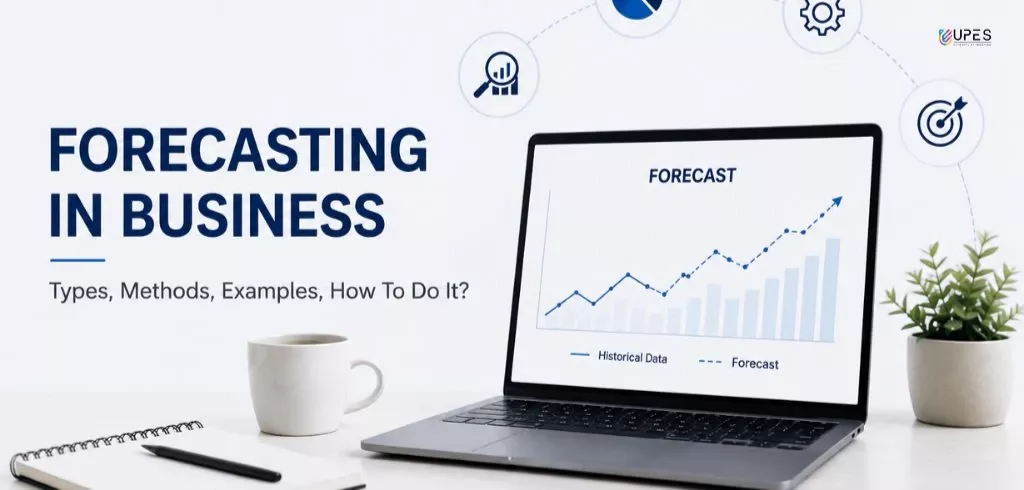
Forecasting in Business plays a critical role in helping organizations anticipate future trends and make informed decisions. By analyzing historical data, market conditions, and consumer behavior, businesses can plan their operations, manage resources, and set realistic goals. From sales and financial planning to inventory and production management, forecasting supports various business functions across industries. With the integration of advanced technologies such as artificial intelligence and machine learning, forecasting has become more accurate, dynamic, and data-driven, allowing for MBA in AI graduates to discover diverse career options. These advancements are enabling companies to respond quickly to market changes, improve efficiency, and develop long-term strategies for sustainable growth in an increasingly competitive business environment.
This article explores questions such as, what is the importance of forecasting in business, methods and different types of forecasting in business, and some real-word forecasting in business examples.
Become future-ready with our Business programs
Know MoreDifferent Types of Forecasting in Business
Business Forecasting is the process of analyzing historical data and trends to make informed assessments of future business possibilities. Businesses use forecasting to plan their future goals and agendas for fore coming budget cycles. Typically, businesses implement qualitative and quantitative forecasting methods to obtain different forecasting results.
Methods of Business Forecasting
There are different types of forecasting in business often referred to as forecasting methods. Methods of business forecasting can generally be classified into two major methos:
1. Qualitative Business Forecast
Qualitative business forecasting methods involve taking factors such as human judgment, feedback, and consumer opinions into consideration to make assessments of future business outcomes. Also called the judgment method, the objective of qualitative forecasting is to drive short-term and expert-driven success of products, organizations, or services offered. Typically, the following processes are utilized to perform a qualitative business forecast:
- Market Research: Organizations implement several market research tactics, such as consumer surveys, feedback forms, and polls, to receive detailed responses about their services. This data is then analyzed to make an informed forecast of sales and product performance for a specified time period. Additionally, companies also use market research to implement improvement initiatives for existing products.
- Delphi Method: Organizations conducting a qualitative forecast may also utilize the Delphi method, which involves inviting several experts and gathering their opinions on different business cases. Typically, organizations use questionnaires and collect anonymous responses from experts. Companies take expert suggestions into consideration while drafting future policies, launching products, or offering services.
2. Quantitative Business Forecast
Quantitative forecasting methods involve utilizing numerical and statistical methods to make business predictions. Companies today are also incorporating AI and machine learning models to make more efficient business predictions. The objective of quantitative forecasting is to make long-term and data-driven predictions for products, services, and sales. Quantitative forecasting techniques in business analytics typically involves the following models:
- Indicator Model: Through this model, companies analyze relationships between one or more indicators to make predictions. The indicator model typically processes data from variables (indicators) against target variables (sales, demand, price, etc.) and analyzes the relationship between them to make informed predictions about how changes in one will affect the other. For example, automobile companies often analyze interest rates for vehicle loans. When interest rates are low, customers are more likely to make purchases, resulting in increased demand for vehicles.
- Econometric Modeling: Econometric modeling involves an in-depth mathematical analysis of datasets procured from economic indicators. The idea behind econometric modeling is to understand how different factors affect the relationship between one or more economic indicators. Through econometric modeling, companies introduce custom indicators to have more targeted predictions while considering different economic scenarios.
- Time Series Methods: Through time series methods, companies study historical data from previous economic cycles to identify data points and trends and make future business predictions. Time series methods involve analyzing factors such as sales cycles, consumer behavior, and seasonal trends. Time series methods further include the following:
- Naive method: This is the simplest method to make business predictions based on the analysis of the last economic period. In this method, companies study datasets from the most recent economic period to analyze trends and predict future outcomes.
- Simple Moving Average: This approach takes a simple average of datasets from previous economic cycles. Companies may use any number of past cycles to calculate an average and make predictions for the upcoming cycle.
- Weighted Moving Average: This approach is like the simple moving average; however, companies also apply weights to each data point to make assessments and predictions
- Naive method: This is the simplest method to make business predictions based on the analysis of the last economic period. In this method, companies study datasets from the most recent economic period to analyze trends and predict future outcomes.
What are the Steps to Business Forecasting
Implementing effective forecasting techniques in business analytics is crucial for businesses to plan, budget, and set sales targets for upcoming cycles. Therefore, a clear and defined roadmap is essential to produce an efficient business forecast report. The following are some of the common steps that businesses often follow for an accurate forecast:
1. Define forecast objective
The first step is to define a clear objective for a business forecast to achieve effective results. Defining the objective involves setting goals, identifying key indicators, and establishing time frames for a particular forecast.
You should consider questions such as: Why is this forecast necessary? Is the forecast aimed at increasing sales, improving customer satisfaction, optimizing product placement, or serving other purposes? What is the time frame for the forecast, short-term, or long-term?
2. Collect data and information
Once you have clearly defined the objectives of your forecast, you should now focus on gathering the raw data. This includes collecting historical data, market changes, or foreseen economic conditions.
3. Select a forecast method
Following the collection of the raw data, based on the objective of your business forecast, you should select a forecasting method. For short-term business goals, companies often opt for qualitative methods, while for long-term and data-driven objectives, quantitative methods are preferred.
4. Analyze data
Now, select an appropriate model to analyze your data. This process includes identifying patterns, trends, user behavior, etc.
5. Make forecast
Based on the analyzed data, make your business forecast for the upcoming economic cycle. It is also important to validate your forecast by analyzing past forecasts and their impact.
6. Review and adapt
- As new information is collected over time and the economic landscape changes, keep reviewing your forecasts and making necessary adjustments for smooth business operations.
Advantages and Limitations of Business Forecasting
While business forecasting helps companies make informed predictions and plan future outcomes, there are several limitations to its methodologies. In the following table, we have provided a detailed comparison of the advantages and limitations of both qualitative and quantitative forecasting methods in business:
Forecasting Method | Advantages | Limitations |
Qualitative Method | Useful when data is limited | Can be subjective |
Integrates expert insights, knowledge, and real-world experiences | May incorporate bias | |
Considers volatile situations like disasters and crisis, thus preferred method for constantly changing economic scenarios | May not include long-term trends or patterns | |
Quantitative Method | More objective and data-driven approach | Difficult to incorporate human insight and real-world scenarios |
Offers consistent and structured datasets | Data heavy approach, and may require large sums of historical data for efficient predictions |
Real-World Applications & Examples of Forecasting in Business
Forecasting in business management has several functions that companies utilize in real time to make accurate predictions. The following are some of the more common real-world applications of forecasting:
1. Sales and Demand Forecasting
One of the most common applications of business forecasting is predicting sales and demand for a particular product. Several companies use forecasting methods to understand demand patterns such as economic fluctuations, seasonality, and interest rates to assess potential customer behavior and make informed business decisions. Forecasting in business helps organizations set realistic sales targets and plan promotions and pricing strategies accordingly.
2. Financial Forecasting:
Business forecasting has essential applications in financial forecasting for determining costs, revenues, and future financial outcomes. Financial forecasting helps businesses plan their operations, scaling strategies, and investments efficiently. Furthermore, this forecasting also helps in understanding the overall health of the business and revenue generation across different economic cycles.
3. Production and Operations Management:
Businesses also utilize forecasting methods to understand production and operational trends. Accurate forecasting helps businesses identify factors such as production volume, production cycles, and demand.
4. Inventory Management:
- Organizations supplying products in high volumes, such as e-commerce and quick commerce platforms, use forecasting to manage inventory and ensure optimal supply. Forecasting methods help businesses understand demand, reduce holding costs and overstocking, and maintain a continuous supply.

Our counsellors are just a click away.
How AI Driven Forecasting is Changing Business Strategy and Planning
As artificial intelligence continues to streamline business processes and improve organizational efficiency, forecasting methodologies have significantly evolved through AI-driven techniques. AI integration in business forecasting is transforming it into a continuous, predictive, and increasingly autonomous process that is not only more efficient but also faster and growth-oriented.
Artificial intelligence and machine learning models can process large volumes of historical data to perform quantitative analysis and generate accurate predictions allowing accurate forecasting in business management. Furthermore, these technologies enable companies to deliver more personalized forecasts for specific business scenarios, helping them better serve end customers and enhance service quality and trust. Real-time forecasting capabilities and adaptability also support continuous and dynamic decision-making processes.
These advancements have encouraged businesses to look beyond traditional numerical analysis and leverage AI and machine learning technologies to strategize their decisions more effectively. As a result, there is a growing demand for professionals who can manage large datasets, interpret insights, and develop sustainable long-term solutions. This has led to a surge in interest in professional programs such as an MBA in AI. Such professionals are not only proficient in AI technologies but are also trained to design innovative, long-term business solutions.
FAQs
Q1. What is the difference between Forecasting vs. Planning?
- Forecasting is a process of using historical data and analytics to predict a business outcome. On the other hand, planning is a process of laying out and strategizing execution methods in advance. The planning process involves creating a detailed course of action plan to achieve a business goal.
Q2. What software is used for forecasting?
- Businesses use several software and digital platforms for business forecasting. Some of the popular forecasting software include IBM Planning Analytics for financial and operational forecasting, SAP Integrated Business Planning for scenario-based business forecasting, and ZOHO Analytics for reporting, dashboarding, and forecasting analytics.
Q3. Which method is best for forecasting?
- The choice of the best business forecasting method depends on your data, business objectives, and context. Businesses typically use qualitative, quantitative, and time series forecasting methods for accurate business forecasting.
Q4. What is the difference between a forecast and a financial model?
- In simple words, business forecasts predict possible outcomes based on historical data, and a financial model presents what is possible with the present data. The forecasting helps businesses to pick the best financial model to get the most efficient business outcomes.
Q5. How does AI improve modern forecasting over traditional Excel sheets?
- AI integration has revolutionized how businesses predict future outcomes and plan their business strategies. Gone are the days of comparing long lists of excel sheets and hefty calculations. Using business analytics and data-driven models, businesses are now able to process large historical data to identify patterns and get accurate future predictions and trends.

UPES Editorial Team
Written by the UPES Editorial Team
UPES Admission Enquiry
Trending Post
-

-

Business Intelligence vs Data Analytics: Differences, Careers, Skills & Salary
05/10/2026By UPES Editorial Team
-


Related Articles










































Subscribe to UPES Blogs
Join our community for exclusive stories, insights, and updates
By clicking the "Subscribe" button, I agree and accept the privacy policy of UPES.


