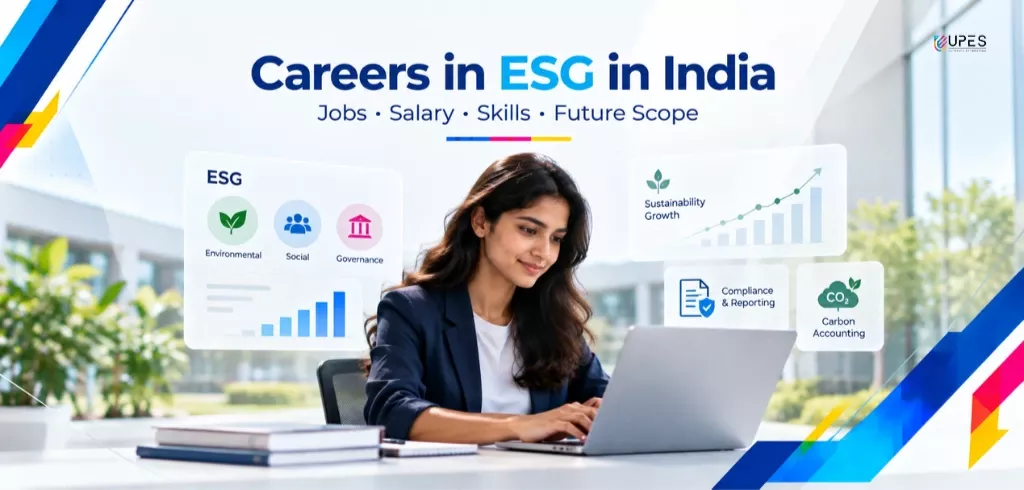
Careers in ESG in India: Jobs, Salary, Skills & Future Scope
- UPES Editorial Team
- Published 01/10/2026


- Why ESG Careers & Skills in India are Growing?
- ESG Careers in India: Roles, Responsibilities & Salary
- ESG Jobs for Freshers: How to Start?
- What Qualifications Can Lead to ESG Careers?
- What Skills Do Employers Look for in ESG Jobs?
- Factors Influencing ESG Salary in India
- What is the Future of ESG Careers?
ESG occupations include sustainability reporting, carbon accounting, climate research, responsible investing, governance, compliance, consultancy, supply chain sustainability, and ESG data management. In India, graduates can work as ESG Analysts, Sustainability Analysts, Carbon Analysts, ESG Reporting Specialists, ESG Consultants, and ESG Investment Analysts.
Entry pathways differ by role. Graduates in business, finance, economics, environmental science, engineering, law, analytics, and allied fields can pursue ESG professions by honing their reporting, data, climate, governance, and sustainability abilities. Career requirements and compensation vary greatly depending on function, experience, industry, region, and employer.
Become future-ready with our Business programs
Know MoreWhy ESG Careers & Skills in India are Growing?
ESG is no longer just about meeting regulatory requirements; it has also become an important business priority for organizations seeking to build customer trust, strengthen stakeholder relationships, and protect their reputation.
In India, SEBI have increased the need for listed entities to collect, manage and disclose sustainability-related information through the Business Responsibility and Sustainability Report (BRSR). This can create a need for professionals who understand ESG data, reporting, carbon accounting, governance, risk and sustainability management.
ESG-related skills are becoming increasingly relevant across sustainability reporting, finance, consulting, risk, compliance, supply chains and corporate strategy.
As businesses focus on ESG reporting, risk management, and responsible business practices, career opportunities are increasingly growing. Investor interest in sustainability disclosures and corporate accountability further highlights the value of professionals who can help organizations measure, manage, and communicate their ESG performance.
What does ESG Stand For?
ESG stands for Environmental, Social and Governance. It refers to environmental, social and governance factors that organisations, investors and other stakeholders may consider when assessing business practices, sustainability-related impacts, risks and opportunities.
- Environmental (E): This pillar of ESG evaluates how an organization affects the environment, which includes its carbon footprints, waste management, energy efficiency, and conservation measures.
- Social (S): This dimension of ESG deals with how a company treats communities, people, and society. This includes labor laws, workplace safety, diversity, and human rights measures.
- Governance (G): Governance is an important pillar of the ESG framework which defines how a company is governed. This includes board members, management, transparency, and shareholder rights.
ESG Careers in India: Roles, Responsibilities & Salary
ESG frameworks provide diverse career options across different domains. Some of the top ESG careers in India include ESG Analyst, Sustainability Manager, ESG Specialist, and more. Check the details of top ESG careers in India here along with indicative salaries in India. Explore some of the top ESG jobs along with typical responsibilities:
ESG job role | Typical responsibilities | Entry route or relevant background | Indicative Salary* |
ESG Analyst | Research, data collection, reports and benchmarking | Business, finance, economics, sustainability | INR 5.3 to 5.9 LPA (Source: Naukri, Indeed, AmbitionBox, Glassdoor) |
Sustainability Manager | Metrics, initiatives, climate and resource analysis | Environmental studies, engineering, business | INR 18.6 to 20.5 LPA (Source: Naukri, Indeed, AmbitionBox, Glassdoor) |
ESG Reporting Associate | Disclosure support, framework mapping and evidence management | Commerce, business, finance, reporting | INR 4 to 4.5 LPA (Source: Naukri, Indeed, AmbitionBox, Glassdoor) |
Carbon Analyst | GHG inventories and decarbonization analysis | Environmental science, engineering, analytics | INR 10 to 10.5 LPA (Source: Naukri, Indeed, AmbitionBox, Glassdoor) |
ESG Consultant | Client projects, strategy and reporting | MBA, consulting, sustainability or finance | INR 6.5 to 7.3 LPA (Source: Naukri, Indeed, AmbitionBox, Glassdoor) |
Supply-chain Sustainability Specialist | Supplier ESG data and responsible sourcing | Operations, logistics, procurement | INR 7.3 to 8.1 LPA (Source: Naukri, Indeed, AmbitionBox, Glassdoor) |
ESG Investment Analyst | ESG risk and company analysis | Finance, investment research, economics | INR 3 to 7 LPA (Source: Naukri, Indeed, AmbitionBox, Glassdoor) |
ESG Data Analyst | Reporting systems, data quality and dashboards | Analytics, IT, business intelligence | |
Governance And Compliance Associate | Policies, controls and regulatory tracking | Law, finance, compliance or business | |
Sustainability Manager | Organization-wide ESG strategy and execution | Relevant experience plus sustainability expertise | |
| ESG Compliance Officer | Regulatory monitoring, compliance checks, ESG disclosures, documentation, internal controls, and coordination with audit and legal teams. | Law, finance, compliance | INR 8.3 to 9.1 LPA (Source: Naukri, Indeed, AmbitionBox, Glassdoor) |
| Corporate Governance Manager | Governance policies, board processes, compliance monitoring, risk management, disclosures, and stakeholder accountability. | INR 15.1 to 16.7 LPA (Source: Naukri, Indeed, AmbitionBox, Glassdoor) |
Disclaimer: Salary figures are indicative and should not be interpreted as guaranteed compensation or starting salaries. Actual pay varies by experience, role scope, employer, industry, location and skills. Public salary platforms may also use different job-title definitions and sample sizes. Salary data in this article was reviewed in October 2026.
ESG Jobs for Freshers: How to Start?
If you are a fresh graduate from college looking for job opportunities in ESG across industries, the right pathway is to start by gaining relevant knowledge in the field, gaining practical experience, and working on building an impressive resume. Let's have a detailed look at how to start preparing for ESG jobs as a fresher:
Learn the fundamentals of ESG: Understand environmental, social, and governance factors, along with reporting frameworks such as BRSR, GRI, and ISSB. Start with the frameworks relevant to your target roles.
Develop practical skills: Learn Excel, data validation, basic data visualization, research, and report writing. Candidates interested in carbon accounting can also explore greenhouse gas emissions measurement and Scope 1, 2, and 3 reporting.
Build a portfolio: Create a sample ESG dashboard, analyze a company's publicly available sustainability report, or prepare a mock ESG disclosure using publicly available information. Clearly label independent exercises as sample projects rather than professional experience.
Apply for relevant entry-level roles: Explore positions such as ESG Analyst, ESG Reporting Associate, Sustainability Analyst, ESG Data Analyst, and Junior Carbon Analyst. Review individual job descriptions to understand their education and experience requirements.
Gain practical exposure: Look for internships, research projects, relevant certifications, and opportunities to work with sustainability or compliance teams.
Build professional connections: Follow ESG professionals, attend relevant webinars, and connect with people working in sustainability, consulting, reporting, and climate-related roles.
Learn from real ESG disclosures: Review BRSR disclosures, annual reports and sustainability reports published by listed companies. Compare how organisations report emissions, targets, governance, risks and ESG metrics to understand how reporting works in practice.
What Qualifications Can Lead to ESG Careers?
There is no single mandatory degree for a career in ESG. Entry requirements depend on the role, and professionals can come from backgrounds such as business, finance, economics, environmental science, engineering, law, data analytics, sustainability and public policy.
Specialised undergraduate, postgraduate or certification programs in ESG, sustainability, sustainable finance or related areas can help students develop domain-specific knowledge, but they are one of several possible pathways.
- BBA or Undergraduate degree: If you are a class 12th pass-out students planning to build a career in ESG, you can join a BBA in ESG program or a similar undergraduate degree program. Typically delivered in around 3-year time, a BBA in ESG offers comprehensive education on key ESG frameworks and concepts.
- MBA or Postgraduate degree: Similarly, if you are looking for higher education in ESG, you can join an MBA in Environmental, Social, and Governance (ESG) program that offers an in-depth and practical knowledge of ESG frameworks, sustainability management, ESG analysis, and more.
- Short-Term Certifications for ESG Careers: You can also join a short-term certification program in ESG that offers specialized skill development in the domain.
What Skills Do Employers Look for in ESG Jobs?
If you are planning a career in ESG, you must prepare yourself by building essential practical and technical skills. Some of the key skills that employers may demand are provided here:
Skill category | Examples |
ESG Reporting and standard knowledge | BRSR/BRSR Core, GRI Standards, IFRS S1/S2 and other role-relevant requirements |
Data and analytics | Excel, dashboards, data validation and basic analysis |
Reporting | Disclosure mapping, writing, evidence management and audit trails |
Climate literacy | GHG emissions, Scope 1, 2 and 3, climate risk and targets |
Business understanding | Finance, operations, supply chains and strategy |
Research | Regulatory tracking, benchmarking and stakeholder analysis |
Communication | Report writing, executive presentations and cross-functional coordination |
Governance and ethics | Accountability, privacy, controls and responsible decision-making |
Technology | ESG software, data platforms and workflow tools |
| Materiality | Identifying and prioritising sustainability impacts, risks and opportunities |
Read More: What is ESG in Business?
Factors Influencing ESG Salary in India
ESG salary may vary based on several factors including experience level, job type, industry you are working in, and overall skill set. The following are some of the key factors that often influence ESG salary in India:
Experience level: Seniority and responsibility increase with practical experience, resulting in higher pay for senior employees.
ESG role type: ESG roles differ in terms of responsibilities and KRAs, while an analyst works on analyzing different business verticals; a manager is responsible for managing teams, project pipelines, and cost.
Type of industry: Different industries may offer different pay packages for the same roles. BFSI, consulting, technology, manufacturing and energy have varied demand.
Technical skills: Pay scale may also vary based on your technical skills in the ESG domain. Professionals with carbon accounting, ESG data and reporting skills can strengthen role fit and may attract higher salaries.
Employer type: MNCs, consulting firms, ESG platforms and corporates use different pay models. Compensation can vary between multinational corporations, consulting firms, financial institutions, ESG technology companies, startups and other employers.
Location: Salary levels can also vary by location because employer concentration, labour-market conditions and role availability differ across cities.
How AI Is Changing ESG Jobs & Reporting
Companies are increasingly using artificial intelligence to streamline ESG reporting and data collection. AI tools can assist in gathering information from different business functions and organize it within a centralized system. Advanced AI-powered ESG reporting software can also reduce manual data entry, help map data to different ESG reporting frameworks, and support more efficient emissions calculations. These developments are changing how ESG professionals collect, analyze, and report sustainability data. Let’s explore how AI is transforming ESG jobs and reporting.
Data collection: AI can extract ESG information from utility bills, ERP systems, supplier submissions, audit records and policy documents, reducing manual consolidation.
BRSR mapping: AI tools can map internal data and narrative disclosures against BRSR/BRSR Core requirements and flag gaps.
Emissions calculations: AI-enabled tools can assist with activity classification, emissions-factor matching, data-gap identification and processing supplier or activity data. Final Scope 3 calculations still require appropriate methodologies, reporting boundaries, source validation and human review.
Data-quality checks: Machine learning can identify anomalies, such as unusual energy, waste, injury or supplier figures, before the report is submitted.
Supplier ESG assessment: AI can review supplier questionnaires, contracts, certifications and public records at scale.
Drafting and summarization: Generative AI can prepare first drafts, summarize policies and help create stakeholder-specific report narratives.
Assurance readiness: ESG platforms with AI-enabled workflows can help organise supporting evidence, cross-check KPIs and flag inconsistencies between disclosures and underlying information.
Will AI Replace ESG Careers?
Even though artificial intelligence technology has prominent use case in ESG reporting and functions, it is not likely to replace ESG careers, rather, AI is more likely to reduce repetitive tasks and streamline efficient reporting and framework mapping for businesses. Human intervention is essential to ensure data validation, define boundaries, and resolve missing or contradictory inputs
As AI adoption develops, professionals may benefit from combining ESG knowledge with data-quality management, AI-output evaluation, reporting expertise and responsible technology use.
Future-Ready ESG Skills in the AI Era
In the modern business environment, where businesses are increasingly using artificial intelligence tools to streamline ESG reporting, professionals must possess essential ESG skills including:
- Data verification and quality management
- AI-output evaluation
- ESG reporting and assurance awareness
- Climate and business-risk interpretation
- Stakeholder communication
- Governance and ethical judgement
- ESG technology and software literacy
What is the Future of ESG Careers?
ESG roles are evolving as sustainability information becomes increasingly connected with corporate reporting, finance, risk management, supply chains, climate strategy, governance and data systems. Professionals are therefore likely to encounter more cross-functional work involving both sustainability expertise and business or technical skills. Additionally, technology is also changing the nature of ESG work. Automation and AI can reduce some manual data-processing and reporting tasks, while increasing the importance of data quality, assurance readiness, regulatory interpretation, climate analysis, governance, and professional judgement.
Rather than focusing on a single ESG job title, students and professionals can build transferable capabilities that apply across sustainability reporting, carbon management, sustainable finance, consulting, compliance, supply chains, and ESG technology.
Where Do ESG Professionals Work?
| Sector | Example ESG Work |
| Consulting | ESG strategy, reporting and advisory |
| Banking & finance | Sustainable finance, ESG research and risk |
| Manufacturing | Emissions, energy and supply-chain sustainability |
| Energy | Climate strategy and decarbonisation |
| Technology | ESG data, reporting systems and governance |
| FMCG & retail | Responsible sourcing, packaging and supplier ESG |
| ESG software | Platform implementation, ESG data and customer advisory |
| Professional services | Reporting, controls and assurance support |
| Corporate sustainability teams | ESG strategy, reporting and governance |
What Can ESG Career Progression Look Like?
- Entry level: ESG Analyst / Sustainability Analyst / Reporting Associate
- Mid-level: Senior Analyst / ESG Consultant / Sustainability Specialist
- Experienced: ESG Manager / Sustainability Manager / Reporting Manager
- Leadership: Head of ESG / Head of Sustainability / other senior sustainability roles

Our counsellors are just a click away.
FAQs
What are ESG careers?
ESG careers focus on helping organizations manage their environmental impact, social responsibilities, and governance practices. Professionals in this field work on sustainability reporting, carbon emissions, responsible investments, regulatory compliance, and ethical business practices.
What are the top ESG job roles in India?
Some common ESG job roles in India include ESG Analyst, Sustainability Manager, ESG Reporting Specialist, Carbon Analyst, ESG Consultant, ESG Investment Analyst, and ESG Compliance Officer. These professionals help organizations track ESG performance, manage sustainability risks, and meet applicable reporting requirements.
Are there ESG jobs for freshers?
Yes, freshers can explore entry-level ESG opportunities such as Junior ESG Analyst, Sustainability Associate, ESG Research Analyst, and ESG Reporting Assistant. Internships, relevant certifications, and basic knowledge of sustainability frameworks, data analysis, and ESG reporting can help you prepare for these roles.
What qualifications are needed for ESG jobs?
ESG jobs may require a bachelor's or master's degree in fields such as environmental science, sustainability, finance, business management, economics, or engineering. The specific requirements depend on the role. Relevant ESG certifications, reporting knowledge, and practical experience can also strengthen your profile.
What skills are required for ESG careers?
- ESG professionals need a combination of analytical, communication, research, and problem-solving skills. Knowledge of ESG reporting frameworks, sustainability regulations, data analysis, carbon accounting, and risk assessment can also be useful, depending on the role.

UPES Editorial Team
Written by the UPES Editorial Team
UPES Admission Enquiry
Trending Post
-

ESG Reporting Software: Top Tools, Features, Benefits & How to Choose
15/10/2026By UPES Editorial Team
-

Business Intelligence vs Data Analytics: Differences, Careers, Skills & Salary
05/10/2026By UPES Editorial Team
-


Related Articles


























































Subscribe to UPES Blogs
Join our community for exclusive stories, insights, and updates
By clicking the "Subscribe" button, I agree and accept the privacy policy of UPES.


