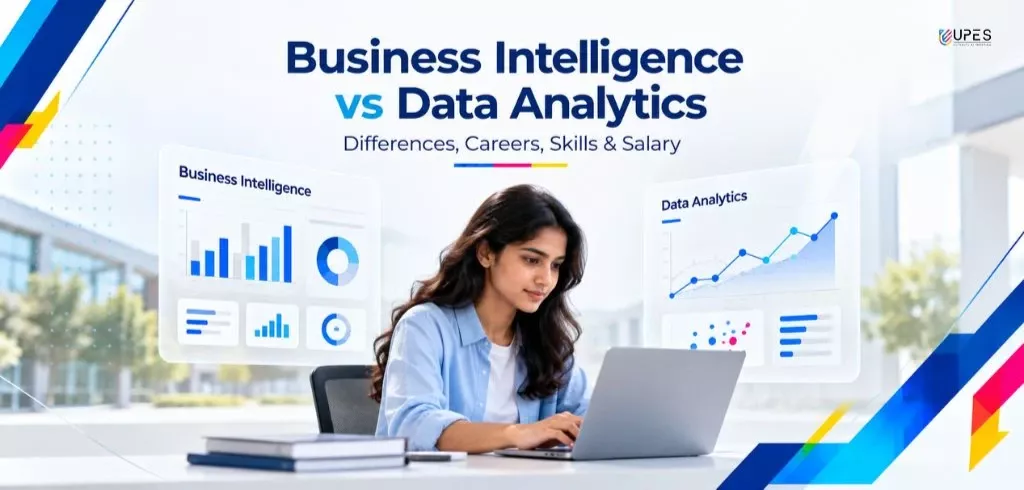
Business Intelligence vs Data Analytics: Differences, Careers, Skills & Salary
- UPES Editorial Team
- Published 05/10/2026


- Business Intelligence vs Data Analytics at a Glance
- What is Business Intelligence?
- What is Data Analytics?
- Business Intelligence vs Data Analytics: Key Differences
- How Business Intelligence and Data Analytics Work Together: Real World Examples
- Top Business Intelligence & Data Analytics Careers and Salaries
- Skill Required for Business Intelligence and Data Analytics
- Factors That Influence Business and Data Analytics Salaries
Business Intelligence (BI) and Data Analytics both use data to support better decision-making, but they differ in scope and typical application. Business Intelligence primarily focuses on monitoring business performance through reports, dashboards and KPIs, while Data Analytics uses a broader range of analytical methods to explore data, explain patterns, test hypotheses and, in some cases, predict or recommend outcomes.
The two fields frequently overlap. BI professionals may perform analytical work, while data analysts may build dashboards and reports. The distinction therefore depends on the business question, analytical method, tools and expected output rather than simply whether the data relates to the past or future.
Become future-ready with our Business programs
Know MoreBusiness Intelligence vs Data Analytics at a Glance
| Factor | Business Intelligence | Data Analytics |
| Primary focus | Monitoring and communicating business performance | Investigating data to answer business questions |
| Typical questions | What happened? What is happening? | What happened? Why? What may happen? What should we do? |
| Common outputs | Dashboards, reports, KPIs | Analyses, models, forecasts, recommendations |
| Typical methods | Reporting, aggregation, visualisation | Descriptive, diagnostic, predictive and prescriptive analysis |
| Common tools | Power BI, Tableau, Looker, SQL | Excel, SQL, Python, R, BI/visualisation tools |
| Typical users | BI analysts, managers, business teams | Data analysts, analytics teams, data scientists |
| Overlap | Both use data, SQL, visualisation and business context to support decisions | - |
What is Business Intelligence?
Business intelligence is the act of collecting and analyzing business data to help firms make better informed decisions. It helps businesses understand what is happening in their operations by converting large amounts of data into clear reports, dashboards, and insights. Business Intelligence enables organizations to monitor performance, identify patterns, and make informed decisions that boost productivity, customer experience, and business success.
Examples of Business Intelligence
Business intelligence examples are widespread across industries. Some of the common examples include:
- Retail and e-commerce: Retail companies use BI & Business Analytics tools to track sales trends, identify their best-selling products, manage inventory levels, and understand customer preferences. This helps them make smarter decisions about stock management and marketing campaigns.
- Finance and banking: Banks and financial institutions use Business Intelligence to monitor financial transactions, detect unusual activities or fraud, analyze customer behavior, and assess financial risks more effectively.
- Manufacturing and supply chain: Manufacturers use BI dashboards to track production performance, identify bottlenecks in operations, monitor product quality, and improve supply chain efficiency.
- Marketing and sales: Companies use Business Intelligence to measure campaign performance, track customer engagement, and understand which marketing strategies generate the best results.
What is Data Analytics?
Data Analytics is the process of collecting and analyzing data to find meaningful patterns, trends, and insights. It helps businesses and organizations make smarter decisions by turning raw data into useful information. The process usually involves gathering data, cleaning and organizing it, analyzing it to identify trends or solve problems, and presenting the findings through charts, graphs, or dashboards. From improving customer experiences to predicting future trends, data analytics plays an important role in helping organizations make informed and data-driven decisions.
Mainly there are four types of data analytics:
Type of Data Analytics | One-Line Description / Definition |
Descriptive Analytics | Analyzes historical data to understand what happened and identify trends or performance patterns. |
Diagnostic Analytics | Examines data to determine why a particular event or outcome occurred. |
Predictive Analytics | Uses historical data and patterns to forecast future trends, behaviors, or outcomes. |
Prescriptive Analytics | Recommends the best actions or strategies to achieve desired business goals and improve results. |
Examples of Data Analytics
The following are some of the key examples of data analytics across industries:
- Healthcare: Hospitals use data analytics to identify high-risk patients, monitor health trends, reduce hospital readmissions, and support medical research and treatment planning.
- Finance: Banks and financial institutions use data analytics to detect fraudulent transactions, evaluate credit scores, manage financial risks, and improve customer services.
- Retail and e-commerce: Companies analyze customer behavior and purchasing patterns to predict demand, recommend products, and optimize inventory management.
- Logistics and supply chain: Delivery and logistics companies use data analytics to optimize delivery routes, predict shipping times, and improve operational efficiency by analyzing factors such as traffic and weather conditions.
- Marketing: Businesses use data analytics to measure campaign performance, understand customer preferences, and create personalized marketing strategies.
Business Intelligence vs Data Analytics: Key Differences
Business Intelligence focuses on understanding what is happening in a business by using dashboards, reports, and historical data to track performance and support day-to-day decisions. Data Analytics goes a step further by analyzing data to uncover patterns, identify the reasons behind trends, and predict future outcomes. In simple terms, BI helps businesses understand their current performance, while Data Analytics helps them make smarter decisions about the future.
Comparison Factor | Business Intelligence | Data Analytics |
Primary purpose | Monitor and report business performance | Discover patterns and generate insights |
Main question | What happened and what is happening? | Why did it happen and what may happen next? |
Data focus | Mostly historical and current data | Historical, current, and predictive data |
Outputs | Dashboards, reports, and KPIs | Models, forecasts, patterns, and recommendations |
Users | Managers, executives, business teams | Analysts, data scientists, strategy teams |
Technical complexity | Low to moderate | Moderate to high |
Common tools | Power BI, Tableau, Looker | SQL, Python, R, SAS |
Decision-making | Operational and tactical | Strategic and predictive |
How Business Intelligence and Data Analytics Work Together: Real World Examples
Business Intelligence and Data Analytics work together to help businesses make better decisions using data. Business Intelligence focuses on tracking and reporting what is happening in a business, while Data Analytics helps uncover patterns and predict future outcomes. Together, they transform raw data into meaningful insights that leaders can use to plan and grow their organizations.
Tracking and Reporting
- Data generation: Businesses collect large amounts of data every day through sales, customer interactions, websites, and other operations.
- Data collection and organization: The data is cleaned, sorted, and organized so that it can be analyzed accurately.
- BI dashboards: Business Intelligence tools present this information through reports and dashboards, helping organizations monitor their current performance in real time.
Pick the Best: AI Courses After 12th
Deep Analysis and Decision-Making
- Data analysis: Data analysts study the information to identify trends, patterns, and areas that need attention.
- Predictive models: Advanced analytics tools use historical data to predict future trends, customer behavior, and business outcomes.
- Business decisions: Leaders use these insights to make informed decisions, improve strategies, and achieve their business goals.
Top Business Intelligence & Data Analytics Careers and Salaries
Business Intelligence and Data Analytics both offer several promising careers. While not the same, both streams often work together and are highly relevant in modern business where companies rely on data-driven approaches to make informed decisions.
Top Business Intelligence Careers and Salaries in India
The following are some of the top Business Intelligence jobs along with average fresher salaries in India:
Job Role | Average Annual Salary (INR) |
Business Intelligence Analyst | INR 6 to 12 LPA |
Business Intelligence Developer | INR 5 to 10.9 LPA |
BI Consultant | INR 5 to 11.5 LPA |
Data Visualization Specialist | INR 5 to 10 LPA |
BI Manager | INR 13.8 to 27.5 LPA |
BI Architect | INR 10.9 to 22.0 LPA |
Reporting Analyst | INR 4 to 8 LPA |
Note: Salaries for particular roles may differ based on several factors including roles, responsibilities, industries, experience level, etc. The above-mentioned salaries are sourced from AmbitionBox and Glassdoor data.
Top Data Analytics Careers and Salaries in India
Check the list of top data analytics careers and salaries in India from the table below:
Job Role | Average Annual Salary (INR) |
Data Analyst | INR 4 to 10 LPA |
Business Analyst | INR 4 to 10 LPA |
Data Scientist | INR 7 to 17.1 LPA |
Financial Analyst | INR 3 to 8 LPA |
Marketing Analyst | INR 5 to 6 LPA |
Product Analyst | INR 7 to 15 LPA |
Machine Learning Engineer | INR 6 to 16 LPA |
Analytics Consultant | INR 9 to 17.5 LPA |
Note: Salaries for particular roles may differ based on several factors including roles, responsibilities, industries, experience level, etc. The above-mentioned salaries are sourced from AmbitionBox and Glassdoor data.
Skill Required for Business Intelligence and Data Analytics
To build a successful career in Business Intelligence (BI) and Data Analytics, you need a combination of technical, analytical, and business skills. Learning how to work with data is just as important as understanding how businesses use that data to make decisions. Some of the most important skills include:
- SQL and database management: Helps you collect, manage, and query large datasets from databases.
- Data visualization tools: Tools such as Power BI and Tableau allow you to create dashboards and reports that make data easy to understand.
- Basic statistics and analytics: Helps you identify patterns, trends, and insights from data.
- Spreadsheet skills: Proficiency in Microsoft Excel or Google Sheets is useful for data cleaning, analysis, and reporting.
- Programming skills: Knowledge of languages such as Python or R can help automate tasks and perform advanced data analysis.
- Business and problem-solving skills: Understanding business goals and asking the right questions are essential for turning data into meaningful decisions.
- Communication skills: Being able to explain complex data insights in simple terms helps stakeholders make informed business decisions.
Business Intelligence Analyst vs Data Analyst
While Business Intelligence Analyst and Data Analyst often collaborate closely in day-to-day operations, their roles differ significantly in terms of responsibilities, tasks, and outcomes. The following table provides a detailed comparison between the two:
Area | Business Intelligence Analyst | Data Analyst |
Main responsibility | Develop dashboards and performance reports | Analyze data and answer business questions |
Common tasks | Reporting, KPI tracking, data visualization | Data cleaning, statistical analysis, forecasting |
Key tools | Power BI, Tableau, SQL | Excel, SQL, Python, R |
Main stakeholders | Business managers and executives | Business, product, marketing, and strategy teams |
Typical outcome | Business performance visibility | Actionable insights and recommendations |
Factors That Influence Business and Data Analytics Salaries
Business Intelligence and Data Analytics salaries are influenced by several factors, including your work experience, technical skills, industry, and location. Professionals with specialized skills and relevant experience often earn higher salaries. Some of the key factors that affect salary growth include:
- Work experience and job role: Entry-level professionals typically work on data collection, reporting, and basic analysis. Mid-level professionals manage projects and collaborate with business teams, while senior professionals lead analytics strategies and teams, resulting in higher salaries.
- Technical skills and tools: Expertise in tools and technologies such as SQL, Python, R, Power BI, Tableau, cloud platforms, and machine learning can significantly improve your earning potential.
- Industry and company type: Industries such as finance, banking, technology, consulting, and e-commerce often offer competitive salaries because of their growing reliance on data-driven decision-making. Large organizations and multinational companies may also provide higher compensation packages.
- Location: Professionals working in major technology and business hubs generally receive higher salaries due to greater demand for analytics talent and higher living costs.
- Education and certifications: A degree in fields such as business analytics, computer science, statistics, or management, along with industry-recognized certifications, can enhance your job prospects and salary potential.
- Specialization: Skills in areas such as data visualization, predictive analytics, business intelligence, cloud analytics, and artificial intelligence can further increase your market value and career opportunities.
Business Intelligence or Data Analytics: Which Is Better?
Objectively, neither business intelligence nor data analytics are better than one another. Both streams have distinct functions, applications, and career prospects, and selecting one from another is based on your career aspirations and goals. The following table will help you understand the major difference between the two:
Choose Business Intelligence If | Choose Data Analytics If. |
You enjoy working with business strategy and decision-making. | You enjoy working with data, statistics, and predictive models. |
You want to create dashboards, reports, and performance metrics for businesses. | You want to uncover trends, patterns, and insights from large datasets. |
You are interested in translating data into actionable business recommendations. | You are interested in solving complex business problems using analytical techniques. |
You prefer working closely with management teams and business stakeholders. | You prefer working with analytical tools, programming, and data-driven methodologies. |
You want to pursue roles such as Business Intelligence Analyst, BI Consultant, or BI Manager. | You want to pursue roles such as Data Analyst, Data Scientist, or Analytics Consultant. |
You are interested in business performance management and operational efficiency. | You are interested in forecasting, predictive analytics, and data modeling. |
You prefer a balance of business knowledge and technical skills. | You are comfortable developing advanced technical and analytical skills. |

Our counsellors are just a click away.
FAQs
Which is better business intelligence analyst or data analyst?
Business Intelligence Analyst and Data Analyst both have distinct roles with specific responsibilities and focus areas, and therefore, neither of both are better than another. A Business Intelligence Analyst works with business data to make reports to help managers analyze the current state of business. Data Analyst uses past data, identifies patterns, and makes predictions on future outcomes. A choice between the two should be based on personal career objectives and interests.
Is business intelligence the same as data analytics?
Often business intelligence and data analytics are used interchangeably; however, they both essentially solve different problems. Business intelligence provides current truthful positioning of the business, while data analytics provides a prediction of future outcomes based on past trends.
What is the salary of data analyst and business intelligence analyst in India?
As per Glassdoor data, the entry level salary for a Data Analyst in India is around INR 4 to 10 LPA, while entry level salary for Business Intelligence Analyst is INR 6 to 12 LPA. The salaries may vary and change as individuals progress in their careers.
Is business intelligence still in demand?
Yes, Business Intelligence is still relevant and in-demand in 2026 as businesses increasingly adopt modern technologies such as AI, automation, and machine learning to process data. Business today requires methods to read and interpret large amounts of data to turn it into useful information and make better decisions.
Which course is best for business intelligence?
- Several courses such as MBA in AI for Business and MBA Business Analytics are some of the best PG courses to pursue roles in business intelligence.

UPES Editorial Team
Written by the UPES Editorial Team
UPES Admission Enquiry
Trending Post
-

ESG Reporting Software: Top Tools, Features, Benefits & How to Choose
15/10/2026By UPES Editorial Team
-

-


Related Articles






























































Subscribe to UPES Blogs
Join our community for exclusive stories, insights, and updates
By clicking the "Subscribe" button, I agree and accept the privacy policy of UPES.


