Top ESG Courses in India: Degree, Certifications, Fees & Eligibility
- UPES Editorial Team
- Published 27/07/2026


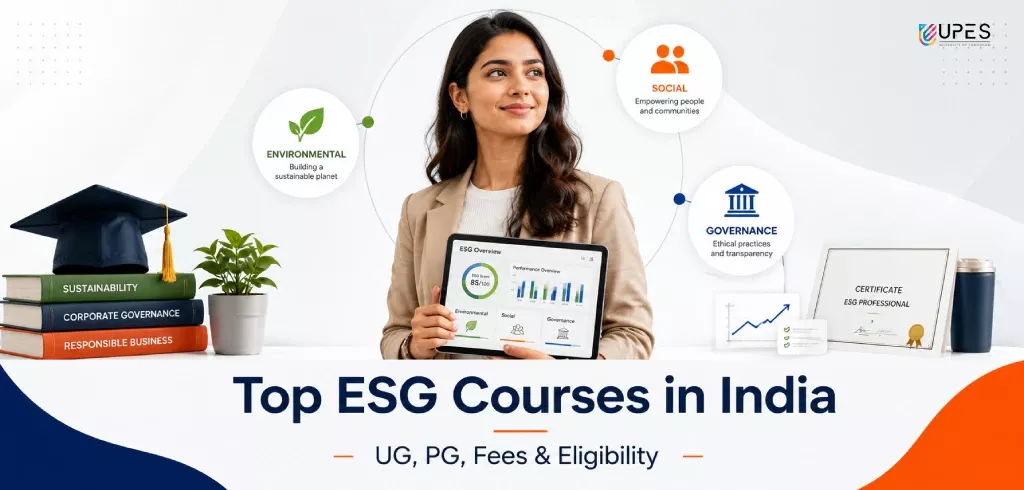
ESG stands for Environmental, Social, and Governance and is a framework used by businesses to evaluate how their operations affect these three factors. As organizations across sectors adopt more environmentally friendly, sustainable, and socially considerate policies, the importance of ESG in corporations and management roles has increased significantly. ESG courses in India are gaining popularity among future managers as these courses offer promising career pathways with niche roles among leading recruiters across industries.
ESG skills are becoming more relevant as companies face increasing expectations around climate risk, responsible supply chains, corporate governance and sustainability reporting. In India, SEBI’s BRSR framework requires the top 1,000 listed entities by market capitalisation to disclose standardised sustainability information. BRSR Core and value-chain reporting have also been developed through phased requirements, with SEBI issuing further changes in March 2025 covering assessment or assurance, value-chain disclosures and voluntary green-credit reporting.
This global push towards responsible corporate governance has led to a growing number of enrolments for top ESG courses in India. In this article, we will discuss top UG and PG ESG courses along with certification courses in detail.
Become future-ready with our Business programs
Know MoreWhat are the best ESG Courses in India?
ESG education in India is available through undergraduate degrees, postgraduate programmes, executive courses and professional certifications. Class 12 students can begin with business, sustainability, environmental studies or sustainability-engineering programmes. Graduates seeking management roles can pursue an MBA in ESG, while working professionals can choose shorter certifications in BRSR, carbon accounting, sustainable finance, ESG reporting or climate-risk management. The right course depends on your qualification, career goal, time commitment and preferred industry.
An ESG course teaches you how to examine a company's environmental practices, ethical impact, and governance standards. These programs teach professionals to work with frameworks such as BRSR, BRSR Core, GRI Standards, ISSB (IFRS S1 & S2), SASB industry standards, carbon accounting frameworks and materiality assessments.
Why are ESG Courses Important in 2026?
Companies are expected to operate responsibly and follow sustainability requirements, thus ESG courses will be more relevant than ever in 2026. Learning ESG allows you to comprehend how firms limit their environmental effect, implement ethical standards, and comply with national and international regulations. These talents are becoming increasingly valuable across industries, and they can help you establish a career that is ready for the future.
- Understanding global regulations: Businesses require professionals who can assist them in effectively meeting these standards.
- Managing sustainable supply chains: Companies are now evaluating whether their suppliers and business partners follow ESG practices.
- Building reliable ESG reports: ESG professionals help businesses collect, verify, and report sustainability data.
- Strong career opportunities: As sustainability becomes a business priority, organizations are actively hiring professionals with ESG expertise. These skills can lead to diverse career opportunities across consulting, finance, technology, manufacturing, and corporate sustainability roles.
Types of ESG Courses in India
Students interested in pursuing a course in ESG in India can opt for courses at different levels. Mainly there are three different types of ESG courses in India:
- Undergraduate ESG programs
- Postgraduate ESG programs
- Certification ESG programs
Top Undergraduate ESG Courses after 12th in India
If you've completed class 12th and are interested in sustainability, business, or environmental issues, an undergraduate ESG program can be a great place to start. These 3-to-4-year degree programs help you understand how businesses can grow responsibly while protecting the environment and creating positive social impacts. You'll learn about topics such as sustainable business practices, environmental policies, climate change, economics, and corporate ethics in a simple and practical way. These programs are designed to build a strong foundation for careers in sustainability, consulting, policy, and business management. In India, institutions such as UPES Dehradun offer specialized undergraduate programs in sustainability and environmental sciences in technology and humanities streams.
Some of the popular UG ESG courses in India are:
Course | Subjects Covered | Duration | Fees |
BBA in Environment, Sustainability, Governance (ESG) | Sustainability Science & Climate Action, Carbon Accounting & Net-Zero Strategies, Corporate Social Responsibility, ESG Risk Assessment & Mitigation, ESG Reporting Frameworks | 3 Years | INR 2,40,000 to INR 10,50,000 |
Other Related UG Courses | |||
Environment sustainability and climate change, Environmental engineering, Renewable & smart energy systems, Environmental laws, audits & ESG | 4 years | INR 10,68,000 | |
BA (Hons.) Environmental & Sustainability Studies | Environment, Society & Development, Ecology and Ecosystems, Environment Sociology and Politic, Environmental Impact Assessment, | 3+1 years | INR 9,73,200 |
Top Postgraduate ESG Courses in India
If you're a graduate or a working professional looking to specialize in sustainability and leadership roles, postgraduate ESG programs can help you take the next step. Typically, lasting 2 years, these courses teach you how companies manage ESG risks, comply with sustainability regulations, and create long-term business strategies. The course is designed to focus on areas such as sustainable finance, ESG reporting, climate risk management, and global sustainability standards that businesses increasingly rely on today. These programs are particularly useful if you want to work in management, consulting, or ESG-focused roles across industries. Institutions such as UPES Dehradun offer advanced postgraduate and executive programs in sustainability and ESG strategy.
Some of the top ESG PG courses in India include:
Course | Subjects Covered | Duration | Fees |
Environmental, Social and Governance, Integrated Marketing Communication, Innovation and Entrepreneurship, Social and Digital Media Marketing | 2 Years | INR 15,51,600 | |
Other Related PG Courses | |||
M.Tech Renewable Energy | Renewable Energy Systems, Biomass Processing technologies, Renewable Energy Based Power Plant Design, Energy Efficiency and | 2 years | INR 2,56,600 |
Sustainable Development | 2 years | INR 2,56,600 | |
Top Certification Courses in India
If you're a graduate or a working professional looking to upskill without pursuing a full-time degree, ESG certification courses can be an excellent option. These short-term programs help you develop practical skills in sustainability reporting, ESG auditing, and corporate compliance that employers are actively seeking. For example, the IICA Certified ESG Professional program focuses on ESG leadership, business responsibility, and sustainability frameworks used by Indian companies. These certifications are particularly valuable if you want to transition into ESG-related roles or strengthen your expertise alongside your current job.
Let’s have a look at a quick comparison between different ESG courses here:
Certification type | Best suited for | Typical learning areas |
Certified ESG professional programme | Experienced managers and ESG leaders | ESG strategy, leadership and implementation |
BRSR reporting course | Compliance, finance and reporting teams | BRSR disclosures, KPIs and reporting |
GRI reporting course | Sustainability and reporting professionals | GRI Standards and impact reporting |
Sustainable-finance certification | Finance and investment professionals | ESG investing, climate risk and financial analysis |
Carbon-accounting course | Sustainability, operations and climate teams | Emissions inventories, scopes and decarbonization |
ESG data and analytics course | Analysts and technology professionals | ESG datasets, dashboards, metrics and assurance |
ESG Degree vs Certification Courses: Which Is Better?
An ESG degree is better suited to students and professionals seeking an in-depth academic foundation, campus exposure and long-term career opportunities in sustainability, consulting, finance or corporate strategy. It usually takes two to four years and covers ESG alongside broader business or technical subjects. An ESG certification is more suitable for working professionals, career switchers and graduates who want to build specific skills in a shorter period. It is generally more flexible and affordable but may not provide the same depth or academic recognition as a full degree. The better choice depends on your current qualification, experience and career objective.
Let’s look at a quick comparison between ESG degree and certification courses here:
Parameter | Degree | Certification |
Duration | 2 to 4 Years | Weeks to Months |
Fees | Higher | Lower |
Career Switch | Moderate | Excellent |
Leadership Roles | High | Moderate |
Working Professionals | Limited | Excellent |
Industry Exposure | High | Moderate |
Direct vs Related ESG Courses
Programmes such as Renewable Energy, Sustainability Engineering and Environmental Studies are related to ESG
Direct ESG Programme | Related sustainability programmes |
MBA in Environmental, Social and Governance
| B.Tech Sustainability Engineering |
BBA or business degree explicitly specialising in ESG | M.Tech Sustainability Engineering |
Certified ESG Professional programmes | M.Tech Renewable Energy |
ESG reporting, BRSR or carbon-accounting certifications | BA Environmental and Sustainability Studies |
Sustainable-finance or ESG-investing certifications | Environmental engineering programmes |
- | Climate science or public-policy programmes |
ESG Courses Eligibility Criteria
Students seeking admissions to different ESG courses are required to meet certain eligibility criteria, such as:
Course Type | Eligibility Criteria | Additional Requirements (if any) |
Undergraduate ESG Courses | Completion of 10+2 from a recognized board with a minimum of 50%–60% aggregate marks | Some universities may conduct entrance examinations or personal interviews. |
Postgraduate ESG Courses | A bachelor's degree in any discipline from a recognized university, usually with 50% to 60% aggregate marks | MBA programs may accept entrance exam scores such as CAT, XAT, MAT, CMAT, or institution-specific tests. Some executive programs prefer prior work experience. |
ESG Certification Courses | Eligibility varies by provider. Most programs are open to undergraduate students, graduates, and working professionals | Some advanced certifications in sustainable finance or ESG investing may recommend prior knowledge of finance, accounting, or business management, but it is not always mandatory. |
What Skills are Taught in ESG Courses?
ESG courses teach you how businesses measure and improve their environmental, social, and governance practices. You learn how companies track sustainability goals, identify and manage risks, and comply with important regulations and reporting standards. The curriculum also helps you build practical skills in analyzing ESG data, preparing sustainability reports, and understanding how organizations create responsible and ethical business strategies. These skills are increasingly valuable as companies across industries work towards building more sustainable and future-ready operations.
- ESG Reporting & Frameworks
- Data Literacy & Analysis
- Risk Management & Materiality Assessment
- Sustainable Finance & Investment
- Stakeholder Engagement
- Carbon Accounting
- Climate Risk Assessment
- ESG Auditing
- Green Finance
- BRSR Reporting
- Materiality Assessment
- Sustainable Supply Chain Management
- ESG Data Analytics
- Impact Investing
Read More: Careers in Sustainable Engineering
What are Career Prospects after ESG Courses?
After completing a professional course in ESG, students can pursue several career options including:
Job Role | Key Responsibilities | Average Salary |
ESG Analyst | Conduct ESG assessments, analyze sustainability data, and prepare reports | INR 3 to 7 LPA |
Sustainability Consultant | Advise organizations on ESG strategy and sustainability initiatives | INR 4 to 10 LPA |
Sustainability Manager | Lead sustainability projects and organizational ESG goals | INR 9 to 24 LPA |
Sustainable Finance Analyst | Evaluate ESG investment opportunities and financial risks | INR 4 to 10 LPA |
CSR Manager | Design and manage corporate social responsibility programs | INR 6 to 17 LPA |
Climate Change Consultant | Assess climate-related financial and operational risks | INR 12.1to 13 LPA |
Note: Salaries may change based on several factors such as experience level, role, organization, and more. The above-mentioned salaries are based on Glassdoor data.
Which ESG Course Should You Choose?
| Learner profile | Recommended route |
Class 12 student interested in business | BBA or related sustainability-focused business degree |
Class 12 science student | B.Tech Sustainability Engineering or a related environmental programme |
Graduate seeking management roles | MBA in ESG |
Finance professional | ESG investing or sustainable-finance certification |
Compliance or reporting professional | BRSR, GRI, carbon accounting or ESG reporting certification |
Senior professional | Executive ESG leadership programme |
Career switcher | Short certification followed by projects or internships |
Is MBA in Environmental, Social and Governance Worth it?
An MBA in ESG (Environmental, Social, and Governance) or Sustainability can be a valuable choice if you want to build leadership skills while contributing to responsible and sustainable business practices. As companies increasingly focus on climate action, ethical governance, and sustainability goals, they are actively looking for professionals who can balance business growth with social and environmental responsibility. An ESG-focused MBA prepares you for diverse career opportunities in areas such as sustainability consulting, climate risk management, sustainable finance, and corporate strategy. Unlike a traditional MBA, it combines core business subjects like finance, marketing, and operations with specialized knowledge of ESG frameworks, regulatory compliance, and green finance, helping you develop future-ready skills that are relevant across industries.

Our counsellors are just a click away.
FAQs
Which course is best for ESG?
The choice of courses to pursue ESG education depends on your career aspirations and eligibility criteria. If you are looking for an ESG course after Class 12th, you can opt for BBA in ESG. On the other hand, if you are a UG graduate, you can pursue an MBA in Environment, Sustainability, and Governance course. Additionally, working professionals and students looking for skill development in this stream can pursue several professional certification programs such as IICA Certified ESG Professional.
How to get ESG certification in India?
To get ESG certification in India, you are required to register for the course from the official website and pay the required course fee. Most of the certification programs require professionals to pass an assessment test to earn the certification. Additionally, it is important to verify the credibility of certificate, its industry relevance, and the kind of skills it offers to the student before joining the course.
What are ESG course fees in India?
The ESG course fee in India can vary depending on the level of course and stream. While BBA in ESG fee may range from INR 2,40,000 to INR 10,50,000, and MBA in ESG fee can go up to INR 15.5 Lakh.
Is ESG a good career after 12th?
Yes, ESG can be an excellent career choice after 12th with several promising career prospects and opportunities. After completing your studies, you can explore career options such as ESG Analyst, Sustainability Consultant, Sustainability Manager, Sustainable Finance Analyst, CSR Manager, etc.
What is ESG course eligibility?
The eligibility criteria for ESG courses in India may vary based on the level of course. For UG level courses, students are required to have passed a minimum of 10+2 level education from a recognized board. On the other hand, for PG level ESG courses such as MBA in ESG, students are required to have a minimum of 10+2 and UG degree from a recognized university in India.
How to start a career in ESG?
- To start a career in ESG, you can pursue a professional degree course such as a BBA in ESG or an MBA in ESG. A professional degree strengthens your chances of securing a job with leading firms and organizations. Working professionals can also opt for certification programs to gain ESG skills for career switches and transitioning roles.

UPES Editorial Team
Written by the UPES Editorial Team
UPES Admission Enquiry
Trending Post
-

-

Business Intelligence vs Data Analytics: Differences, Careers, Skills & Salary
05/10/2026By UPES Editorial Team
-


Related Articles
























































Subscribe to UPES Blogs
Join our community for exclusive stories, insights, and updates
By clicking the "Subscribe" button, I agree and accept the privacy policy of UPES.


