Business courses after 12th: Popular Options, Specialised Paths & How to Choose One
- UPES Editorial Team
- Published 05/05/2026


Choosing business courses after 12th can feel stressful because “business” is not one course. It is a wide set of degrees and skill paths that lead to very different careers. One friend says BBA, another says B.Com., someone pushes digital marketing, and parents usually ask, “Which one has scope?”
This guide helps you pick the right course based on your stream and goals, with clear comparisons, high salary pathways, and a practical decision tool. We have also included a dedicated list of business courses you can study at UPES.
Become future-ready with our Business programs
Know MoreWhat are the best business courses after 12th?
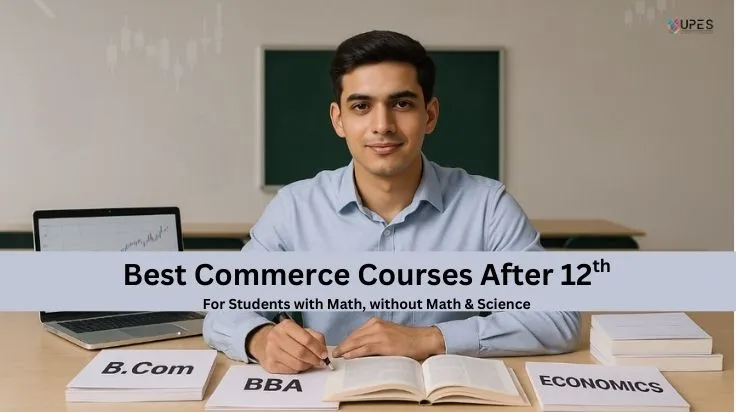
If you want a quick answer, the most popular business courses after 12th include:
- BBA (Bachelor of Business Administration) – best for management, marketing, and leadership roles
- B.Com (Bachelor of Commerce) – ideal for finance, accounting, and banking careers
- BA Economics / Business Economics – strong for analytics, consulting, and policy roles
- Specialised BBA programs – such as Business Analytics, Digital Business, Logistics, Aviation
- Short-term courses – like digital marketing, Excel, Power BI, or financial modelling
The “best” course depends on your interest, career goals, and skill development, not just popularity.
What counts as a business course?
Business courses after 12th are undergraduate degrees, diplomas, or certifications that teach how organisations work: money, markets, customers, operations, people, and strategy.
Some are broad (BBA, B.Com.), some are specialised (analytics, logistics, aviation), and some are short, skill-first routes (digital marketing, Excel, Power BI) that help you start early.
Basic eligibility for business courses after 12th:
- Completion of Class 12 from a recognised board
- Most courses accept students from all streams (science, commerce, arts)
- Some colleges may require minimum marks (typically 50–60%)
- Entrance exams like CUET or university-specific tests may apply for top colleges
They can lead to careers in management, finance, marketing, analytics, sales, HR, entrepreneurship, and corporate roles across sectors.
The most popular business courses after 12th (and what they lead to)
Broad, flexible degrees
- BBA (Bachelor of Business Administration): Great if you want marketing, HR, operations, general management, sales, entrepreneurship.
- B.Com (Bachelor of Commerce): Strong foundation for accounting, finance, banking, insurance, and commerce roles.
- BA Economics / BA Business Economics
Specialised degrees (faster role alignment)
- BBA in Analytics and Big Data, Digital Business, Logistics, Aviation, Foreign Trade, Healthcare Management and more.
These can be strong if you already know the direction you want.
Short term business courses after 12th (skill-first)
If you want employable skills quickly, short courses can help alongside a degree:
- Digital marketing basics (SEO, paid ads, analytics)
- Excel plus Power BI
- Tally plus GST
- CRM and sales basics
- Beginner financial modelling
Checkout the comparison table to help you decide fast and saves you hours.
| Course type | Duration | Best for | Typical fees range (India)* | Early roles | Long-term advantage |
| BBA / BMS / BBM | 3 yrs | Broad management foundation | ₹1–6L total | Sales, ops, marketing trainee, analyst (entry) | Strong base for MBA, consulting, leadership tracks |
| B.Com / B.Com (Hons) | 3 yrs | Accounts, finance, commerce pathways | ₹0.5–4L total | Accounts exec, finance ops, analyst | Great for finance careers + MBA/CA/CFA route |
| BA Economics | 3 yrs | Data + economics + policy/business | ₹0.5–4L total | Research assistant, analyst (entry) | Strong for analytics/consulting/MBA |
| Specialised BBA (Analytics/FinTech/DM) | 3 yrs | Skill-aligned business roles | ₹2–8L total | Analyst intern, marketing/ops roles | Faster alignment to high-growth jobs |
| Diploma/Certification (Digital/Excel/CRM) | 2–12 months | Quick job readiness | ₹5k–₹1.5L | Internships, junior roles | Adds employable skills alongside any UG course |
*Fee ranges vary heavily by city, college type, and facilities—use this for direction, not as an exact quote. | |||||
Business courses after 12th science
Yes, business courses after 12th science can be a smart switch. Science students often do well in analytics, operations, and tech-enabled business roles because they are used to structured problem-solving. High-fit options:
- BBA in Analytics and Big Data
- BBA in Data Science and AI
- BBA in Operations or Logistics
- BBA in Healthcare Management (popular for PCB students)
- B.Com (International Finance) if you want a finance-heavy direction and are willing to build numeracy
Read More: Professional Courses After 12th
Business courses after 12th commerce
Commerce students have a natural head start in business basics. High-fit options:
- B.Com (Hons.) or B.Com (Accounting and Finance) if you like accounts and accuracy
- BBA Finance Management if you want corporate finance or banking-aligned roles
- B.Com (Banking and Insurance) if you are targeting BFSI roles
- BBA Marketing Management if you prefer growth, consumer strategy, brand, and sales
A useful shortcut: If you enjoy accounts and structure, choose B.Com routes. If you enjoy leadership, people, and execution, choose BBA routes.
Business courses after 12th arts
Arts students often underestimate their advantage. Communication, critical thinking, creativity, and empathy are valuable in business roles.
Good options:
- BBA Marketing Management
- BBA Human Resource Management
- BBA (Events, Public Relations and Corporate Communications)
- BBA (Digital Business)
- BBA (Aviation Management) or BBA (Hospitality, Travel and Tourism) if you want service industry career tracks
- BA Economics / Business Economics for strong for analytics-minded students.
To compete strongly, arts students should add a measurable tool skill early, such as Excel, Power BI, or digital marketing analytics.
Business courses after 12th high salary: what actually drives higher pay
If you are searching for business courses after 12th high salary, here is the honest truth: salary grows fastest when you combine a degree with scarce skills and strong internships.
Courses that often align well with higher-paying tracks over time:
- Business Analytics, Big Data, Data Science and AI
- Finance, International Finance, FinTech and banking-aligned programs
- Digital Business (when paired with performance marketing, analytics, or product skills)
- Specialised sector programs (oil and gas, logistics, aviation) when you target the right companies and roles
Skills that lift salary potential across any business degree
- Excel, PowerPoint, business writing
- Data comfort (Power BI, basic SQL, or analytics thinking)
- Communication and stakeholder management
- Internship proof (projects, case competitions, measurable work)
Business courses after 12th at UPES: popular and specialised options
If you are considering UPES for undergraduate business pathways, here are the business courses you can study at UPES (as provided), including specialisations where applicable.
| Program | Specialisation or focus areas |
| BBA | Marketing Management, Finance Management, Human Resource Management, Operations Management |
| BBA (Oil and Gas Marketing) | Petroleum Business, Oil and Gas Operations |
| BBA (Analytics and Big Data) | Programming for Analytics, Big Data Analytics and Mining |
| BBA (Digital Business) | Technology Infrastructure Management, Digital Marketing |
| BBA (Logistics Management) | Logistics Management, Service Operations and Procurement |
| BBA (Aviation Management) | Aviation Service Operations, Travel and Ground Handling Operations |
| BBA (Events, Public Relations and Corporate Communications) | Media Management, Marketing Campaigns and Strategic Communications, Social Media, Marketing and Analytics |
| BBA (Events, Public Relations and Corporate Communications) Global | 2 years at UPES campus plus 2 years at overseas campus, partner university: Goldsmiths, University of London, specialisation as per partner university |
| BBA (Foreign Trade) | International Trade Negotiations, Analytics and Market Research |
BBA (Hospitality, Travel and Tourism) BBA (Healthcare Management) BBA (Data Science and AI) B.Com (Hons.) B.Com (Accounting and Finance) B.Com (Banking and Insurance) B.Com (International Finance) |
This list helps if you want a clearer match between your interest and an industry route, such as analytics, logistics, aviation, oil and gas, or communications.
A practical “How to choose” framework that works for any stream
Rate each course option out of 10 on these four factors:
- Interest fit (0–10): Would you enjoy the daily work it leads to?
- Aptitude fit (0–10): Do you have (or can you build) the needed skills?
- Market fit (0–10): Are there internships/jobs in your target cities/sectors?
- Ecosystem fit (0–10): Does your college support projects, internships, exposure?
Pick the option with the highest total and then build a plan around it. This beats choosing based on “popularity” every time.
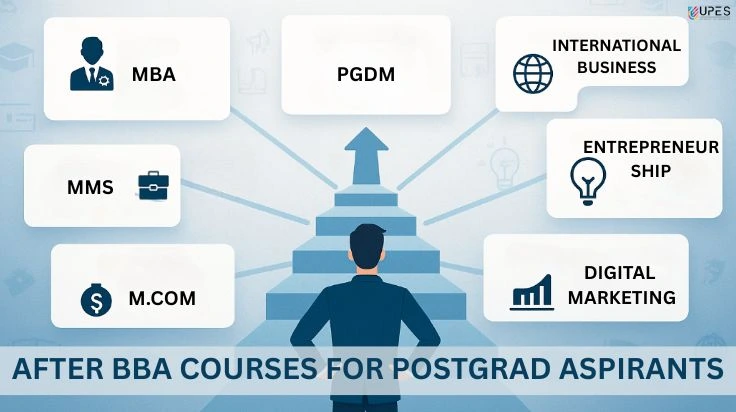
The long-term pathway: UG business course → MBA → leadership roles
For many students, business courses after 12th are just the starting point and then they pursue an industry-relevant MBA specializations. The typical career path looks like this:
- Step 1: Undergraduate degree (BBA, B.Com, BA Economics)
- Step 2: Internships and early work experience
- Step 3: MBA for career acceleration and leadership roles
An MBA becomes relevant when you want to:
- Move into management or leadership roles
- Shift industries or domains
- Increase salary potential significantly
- Build expertise in areas like consulting, product, finance, or strategy
If you're evaluating long-term growth, it helps to understand what a strong MBA ecosystem offers.
For example, the UPES School of Business (ranked #36 in Management by NIRF 2025) focuses on industry-aligned curriculum, real-world exposure, and placement outcomes, with recruiters like Amazon, Deloitte, and Accenture.
Instead of thinking of MBA as a default next step, treat it as a strategic upgrade once you’ve built clarity through your undergraduate experience.

Our counsellors are just a click away.
Conclusion
Choosing the right business courses after 12th is less about picking the “most popular” option and more about matching your interests, strengths, and career goals. Once you shortlist a course, start building skills and internships early, because that is what truly drives outcomes. If you stay consistent with projects, exposure, and learning, you will create strong opportunities regardless of your stream.
FAQs: Business courses after 12th
1) Which are the best business courses after 12th?
BBA/BMS, B.Com (Hons), and BA Economics are strong mainstream options. If you want specialised alignment, consider business analytics, fintech/finance, digital marketing, or operations pathways.
2) Are there business courses after 12th science?
Yes. Science students commonly choose BBA, business analytics, operations/supply chain, and sector-specific management options like healthcare management. Your stream doesn’t restrict you—your skills and internship profile matter more.
3) Which business courses after 12th commerce have the best scope?
B.Com (Hons) is strong for finance/accounting tracks, and BBA/BMS is strong for management, marketing, sales, and entrepreneurship. For higher-growth roles, finance + analytics combinations tend to help.
4) What are good business courses after 12th arts?
BBA/BMS, BA Economics, BBA Marketing, and BBA HR are high-fit options. Arts students do well when they build practical tools early (Excel, presentations, basic analytics, digital skills).
5) Which business courses after 12th high salary should I consider?
Analytics, finance/fintech, and consulting-oriented pathways often connect to higher salary growth over time—especially if you build proof through internships and projects. Salary depends heavily on skills and college ecosystem.
6) What are the best short term business courses after 12th?
Digital marketing, Excel + Power BI, Tally + GST, sales/CRM training, and basic financial modelling are commonly useful. The best short course is one you can apply through projects or internships.
7) Can I do an MBA directly after 12th?
Not a full MBA. Typically, you do an undergraduate degree first (BBA/B.Com/BA Econ), then pursue an MBA after graduation (often with or without work experience depending on the program).
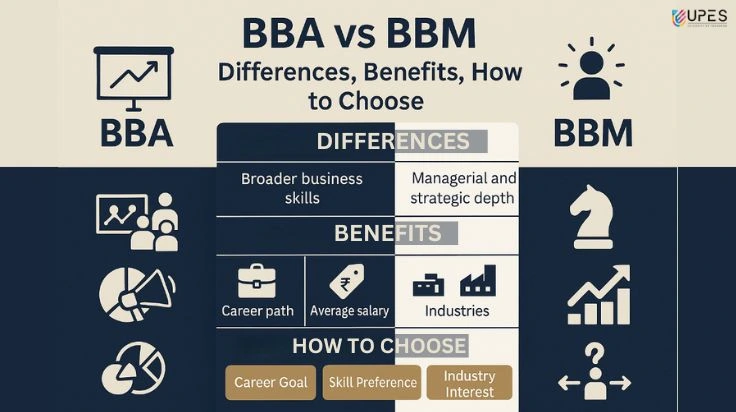
8) How do I choose between BBA and B.Com?
Choose B.Com if you prefer finance/accounts and structured numerical work. Choose BBA if you prefer management, marketing, operations, leadership, and broader business exposure.

UPES Editorial Team
Written by the UPES Editorial Team
UPES Admission Enquiry
Trending Post
-

-

Business Intelligence vs Data Analytics: Differences, Careers, Skills & Salary
05/10/2026By UPES Editorial Team
-


Related Articles











































Subscribe to UPES Blogs
Join our community for exclusive stories, insights, and updates
By clicking the "Subscribe" button, I agree and accept the privacy policy of UPES.


