MBA Requirements You Need: Academic, Exam Score, Resume
- UPES Editorial Team
- Published 13/05/2026


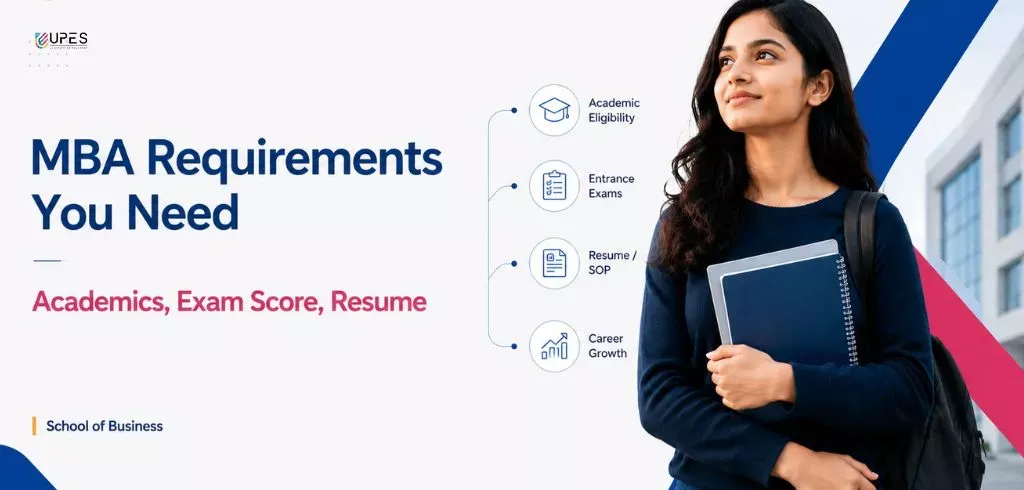
- What are the Requirements to study MBA?
- MBA Eligibility in India: The National Landscape
- MBA Academic Requirements: Your Educational Foundation
- MBA Entrance Exams Requirement: Clearing the Entrance Hurdle
- MBA Application Requirements: Beyond the Scores
- MBA Work Experience Requirements
- How to become Eligible for an MBA? A Step-by-Step Checklist
Deciding to pursue a Master of Business Administration (MBA) is a career-defining move. Whether you’re a final-year student looking to jumpstart your career or a working professional aiming for the C-suite, the first hurdle isn't the syllabus, it’s the entry gate.
Navigating MBA requirements can feel like piecing together a complex puzzle. From maintaining a specific GPA and clearing competitive entrance exams to drafting the perfect resume, there is a lot to track.
This guide breaks down everything you need to know about the journey. We will cover the specific MBA requirements in India, academic prerequisites, and how to build an application that stands out to top-tier institutions.
Become future-ready with our Business programs
Know MoreWhat are the Requirements to study MBA?
While specific criteria vary between global universities and Indian B-schools, the core MBA requirements generally include:
- A recognized Bachelor’s degree.
- A valid entrance exam score from a management entrance test (CAT, MAT, XAT, GMAT, etc.).
- A professional resume or CV.
- Letters of Recommendation (LORs) and Statements of Purpose (SOP).
- Optional work experience (preferred but not mandatory)
Before diving to MBA specializations or mammoth paperwork, it is essential to understand the "Big Three" pillars of a successful application: Academic Foundation, Entrance Performance, and Professional Narrative.
If you are looking for a program that aligns these requirements with industry-ready specializations, the UPES School of Business MBA offers a streamlined path focusing on high-growth sectors like Digital Business, Oil & Gas, Logistics, and more.
MBA Eligibility in India: The National Landscape
In India, the MBA landscape is governed by a mix of national-level exams and university-specific criteria. Unlike many international programs that prioritize years of work experience, Indian B-schools are often open to "freshers" (recent graduates), provided they show high academic merit.
The Standard Eligibility Framework
For most Indian programs, eligibility for MBA after graduation must meet the following:
- Citizenship: Open to Indian nationals, NRIs, and international students (usually via a different quota).
- Age Limit: Generally, there is no upper age limit for an MBA in India.
- The 50% Rule: Most universities require a minimum aggregate in graduation (usually 50% for General and 45% for Reserved categories).
MBA Academic Requirements: Your Educational Foundation
Your past academic performance is the first thing an admissions committee looks at. It serves as a "proxy" for your ability to handle the rigorous quantitative and analytical workload of a business program.
1. Undergraduate Degree
- You must hold a Bachelor’s degree from a recognized university. While many believe an MBA is only for Commerce or Engineering students, that is a myth. Diversity is highly valued; students from Arts, Science, Law, and Medicine are encouraged to apply.
2. Minimum Percentage/GPA
- Most top-tier institutes look for:
- 10th & 12th Scores: High scores here (80%+) can give you an edge during the final selection (shortlisting) process.
- Graduation: A minimum of 50% aggregate. If you are in your final year, you can apply "provisionally," provided you maintain the minimum percentage upon completion.
3. Subject Prerequisites
- While not always mandatory, having a basic grasp of Mathematics or Statistics is beneficial. Some specialized MBAs, like Data Analytics or FinTech, Marketing or Finance might prefer candidates with a background in STEM, Business, or Economics.
MBA Entrance Exams Requirement: Clearing the Entrance Hurdle
Entrance exams are the great equalizer. They allow B-schools to compare candidates from different academic backgrounds on a level playing field.
| Exam Type | Popular Exams | Best For |
| National Level | CAT, XAT, MAT, CMAT | IIMs, IITs, and Private Universities |
| University Specific | UPESMET, NMAT, SNAP | Specific high-ranking private B-schools |
| Global Level | GMAT, GRE | International MBA programs and Executive MBAs |
What do these tests measure?
- Quantitative Aptitude: High-school level math, logic, and data interpretation.
- Verbal Ability: English grammar, reading comprehension, and vocabulary.
- Logical Reasoning: Ability to identify patterns and solve complex puzzles.
- General Awareness: Current affairs and business news (specifically in exams like XAT or CMAT).
Pro Tip: Don't just aim for one exam. Diversifying your attempts increases your chances of landing in a top-tier program.
MBA Application Requirements: Beyond the Scores
Once you have your scores, the "Paperwork Phase" begins. This is where you transform from a set of numbers into a living, breathing candidate.
1. The Statement of Purpose (SOP)
- The SOP is your personal essay. It should answer: Why an MBA? Why now? And why this specific university? This is your chance to explain any gaps in your resume or highlight unique achievements.
2. Letters of Recommendation (LOR)
- Most programs require 2–3 LORs. If you are a student, these should come from professors. If you are working, at least one should be from a current or former manager.
3. Transcripts and Certificates
- Keep your digital and physical copies of all mark sheets (10th, 12th, and Graduation) ready. You will also need category certificates if you are applying under any reserved quota.
MBA Work Experience Requirements
Is work experience mandatory for an MBA? The short answer is: It depends.
- For Freshers: Many Indian programs (including the IIMs and UPES) welcome fresh graduates. Your selection will rely heavily on your entrance scores and academic record.
- For Professionals: 2–5 years of experience is often considered the "sweet spot." It allows you to contribute practical insights to classroom discussions.
- For Executive MBA: Executive MBA programs strictly require 5–10+ years of experience and are designed for mid-to-senior level management roles.
Benefits of Having Work Experience:
- Better understanding of organizational dynamics.
- Higher weightage during the interview process.
- Often leads to higher salary packages during campus placements.
How to become Eligible for an MBA? A Step-by-Step Checklist
If you are feeling overwhelmed, use this chronological checklist to ensure you meet all MBA requirements:
- Check Graduation Status: Ensure you have (or will have) a 50% aggregate score.
- Pick Your Exam: Register for exams like CAT or the UPESMET.
- Prepare Your Resume: Highlight leadership roles, internships, or volunteer work.
- Identify Specializations: Do you want General Management, or something niche like Supply Chain or Aviation Management?
- Draft Your SOP: Start writing your story early; don't leave it for the last week.
Read More: Top MBA specialization to Pursue in India
Why Choose UPES School of Business for Your MBA?
When comparing MBA options, it helps to look at programs that clearly define their admission criteria, specialisations, and industry alignment.
For instance, institutions like UPES outline their MBA requirements transparently—typically including a minimum of 50% in Class X, XII, and graduation, along with entrance exam scores and a selection process. This makes it easier for applicants to benchmark their eligibility early.
From a program perspective, some universities also structure their MBA offerings around emerging industry needs such as analytics, fintech, logistics, and digital business, often in collaboration with industry partners. This reflects a broader shift in management education toward role-specific learning rather than purely general management.
While evaluating MBA programs, it’s useful to compare:
- Clarity of eligibility and selection process
- Relevance of specialisations to current job markets
- Industry exposure through projects, internships, or collaborations
- Placement ecosystems and recruiter diversity
Looking at such structured programs can help you assess what a “job-ready” MBA should offer, and whether it aligns with your career goals.

Our counsellors are just a click away.
Conclusion
Understanding the MBA requirements is the first step toward your professional transformation. While the list of exams, transcripts, and essays might seem daunting, remember that every successful CEO was once exactly where you are today looking at a checklist.
Focus on maintaining a solid academic record and preparing diligently for your entrance exams. If you are looking for a program that values innovation and industry-readiness, explore how a specialized MBA can set you apart.
FAQs
- Can I do an MBA with a background in Arts?
- Absolutely. Most MBA requirements specify a degree in "any discipline." In fact, B-schools value "academic diversity" as it brings different perspectives to the classroom.
- Absolutely. Most MBA requirements specify a degree in "any discipline." In fact, B-schools value "academic diversity" as it brings different perspectives to the classroom.
- What is the minimum CAT score required for a good MBA college?
- While IIMs often require 95-99+ percentile, many excellent private universities and Tier-2 colleges accept students in the 70-85 percentile range.
- While IIMs often require 95-99+ percentile, many excellent private universities and Tier-2 colleges accept students in the 70-85 percentile range.
- Is work experience compulsory for an MBA in India?
- No, it is not compulsory for a standard 2-year full-time MBA. However, for an Executive MBA (1-year program), it is a mandatory requirement.
- No, it is not compulsory for a standard 2-year full-time MBA. However, for an Executive MBA (1-year program), it is a mandatory requirement.
- Are there any age limits for MBA admissions?
- In India, there is typically no upper age limit for a Master’s in Business Administration. As long as you meet the academic and entrance exam criteria, you can apply.
- In India, there is typically no upper age limit for a Master’s in Business Administration. As long as you meet the academic and entrance exam criteria, you can apply.
- What should I include in my MBA resume?
- Focus on "quantifiable" achievements. Instead of saying "I managed a team," say "Managed a team of 5 to increase sales by 20% over 6 months." Include internships, certifications, and extracurricular leadership.

UPES Editorial Team
Written by the UPES Editorial Team
UPES Admission Enquiry
Trending Post
-

-

Business Intelligence vs Data Analytics: Differences, Careers, Skills & Salary
05/10/2026By UPES Editorial Team
-


Related Articles




















































Subscribe to UPES Blogs
Join our community for exclusive stories, insights, and updates
By clicking the "Subscribe" button, I agree and accept the privacy policy of UPES.


