Aerospace Engineering Interview Questions- For All Levels
- UPES Editorial Team
- Published 15/04/2026


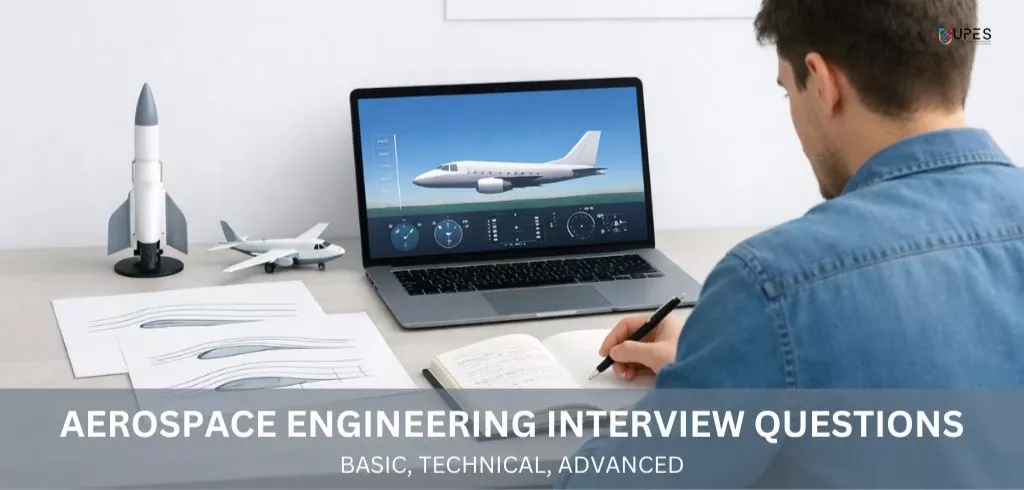
- What are the most common aerospace engineering interview questions?
- Aerospace Engineering Technical Interview Questions: The Fundamentals
- Aerospace Systems Engineering Interview Questions
- Behavioral and Situational Interview Questions
- Career Pathways and Salary Scope in India
- Frequently Asked Questions (FAQs)
The dream of designing the next generation of supersonic jets, sustainable aircraft, or deep-space probes is exhilarating, but the path to getting hired in this elite industry can feel like a high-pressure re-entry mission. If you are a student or a young professional in India, you know that the stakes are high. Companies like ISRO, DRDO, HAL, and private giants like Airbus or Boeing don’t just look for high CGPAs; they look for technical intuition and problem-solving grit.
Preparing for aerospace engineering interview questions requires more than just memorizing formulas from a textbook. You need to understand the "why" behind fluid dynamics, the "how" of structural integrity under extreme heat, and the logic of complex flight control systems.
In this comprehensive guide, we have curated the most relevant aerospace engineering interview questions, ranging from fundamental aerodynamics to sophisticated systems engineering. Whether you are preparing for a campus placement or a lateral move into the private sector, this roadmap will help you navigate the interview process with authority and ease.
Become future-ready with our Advanced Engineering programs
Know MoreWhat are the most common aerospace engineering interview questions?
Common aerospace engineering interview questions include:
- four forces acting on an aircraft
- Bernoulli’s principle and lift
- stall condition
- turbojet vs turbofan vs turboprop
- Mach number
- fly-by-wire technology
- redundancy in aerospace systems
- thermal stress in spacecraft
- software tools like CATIA, ANSYS, and MATLAB
Aerospace Engineering Technical Interview Questions: The Fundamentals
The demand for aerospace engineers has increased and the technical round is the heart of the selection process of your dream job. Interviewers typically start with core physics and fluid mechanics to see if your foundation is stable before moving into specialized niche areas. Expect questions that challenge your understanding of how forces interact in high-velocity environments.
1. Can you explain the four fundamental forces acting on an aircraft?
This is the most common of all aerospace engineering interview questions. The four forces are:
- Lift: The upward force produced by the wings (airfoils) as they move through the air.
- Weight: The downward force caused by gravity.
- Thrust: The forward force produced by the engines (propulsion system).
- Drag: The backward resistance force caused by air friction and pressure differences.
2. How does Bernoulli’s Principle explain lift?
Bernoulli’s Principle states that as the speed of a moving fluid (like air) increases, the pressure within that fluid decreases. An airfoil is shaped so that air travels faster over the curved top surface than the flatter bottom surface. This creates lower pressure on top and higher pressure on bottom, resulting in an upward force—Lift.
3. What is the "Stall" condition in aerodynamics?
A stall occurs when the Angle of Attack (AoA)—the angle between the wing's chord line and the oncoming air—exceeds a critical value. At this point, the smooth airflow over the upper surface of the wing separates, creating turbulence and causing a sudden loss of lift.
4. Differentiate between Turbojet, Turbofan, and Turboprop engines.
- Turbojet: All air passes through the core engine. Best for high-speed, high-altitude flight (supersonic).
- Turbofan: Features a large fan at the front. Much of the air "bypasses" the core. It is quieter and more fuel-efficient for commercial airlines.
- Turboprop: The jet engine drives a propeller. Ideal for low-speed, short-distance, regional flights.
5. What are the three primary axes of aircraft rotation and their control surfaces?
To prove your technical literacy, you must know these by heart:
- Pitch: Rotation around the lateral axis (controlled by the Elevators).
- Roll: Rotation around the longitudinal axis (controlled by the Ailerons).
- Yaw: Rotation around the vertical axis (controlled by the Rudder).
6. What is the significance of the Mach Number?
The Mach Number ($M$) is the ratio of the speed of the object to the speed of sound in the surrounding medium.
- Subsonic: $M < 1$
- Transonic: $M$ around $0.8$ to $1.2$
- Supersonic: $M > 1$
- Hypersonic: $M > 5$
7. Why do high-speed aircraft have swept-back wings?
Swept wings are designed to delay the onset of "wave drag" caused by supersonic flow over the wing. By sweeping the wing, only the component of the airflow perpendicular to the wing’s leading edge affects the pressure distribution, allowing the aircraft to fly at higher Mach numbers before encountering shockwaves.
Aerospace Systems Engineering Interview Questions
In modern aviation, an aircraft is no longer just a frame and an engine; it is a "system of systems." Aerospace systems engineering interview questions focus on how different components—avionics, hydraulics, software, and structures—work together to ensure mission success and safety.
8. What is "Fly-by-Wire" (FBW) technology?
FBW replaces traditional manual flight controls (cables and pulleys) with an electronic interface. The pilot's movements are converted into electronic signals, processed by a flight control computer, which then determines how the actuators should move the control surfaces. This allows for better stability and weight reduction.
9. Explain the concept of Redundancy in aerospace systems.
Redundancy is the duplication of critical components or functions of a system with the intention of increasing reliability. In aerospace, "Triple Redundancy" is common—if one system fails, the second takes over; if the second fails, the third ensures the aircraft can still land safely.
10. How do you manage "Thermal Stress" in spacecraft design?
Spacecraft face extreme temperature fluctuations. Systems engineers use:
- Passive Control: Multi-layer insulation (MLI), thermal coatings, and heat pipes.
- Active Control: Heaters and louvers that open/close to radiate heat away from sensitive electronics.
11. What is the "V-Model" in Systems Engineering?
The V-model is a graphical representation of a systems development lifecycle. It starts with requirement definitions on the left, moves down to design and implementation at the base, and then ascends on the right through various stages of testing and verification.
12. Describe the importance of the Avionics Full-Duplex Switched Ethernet (AFDX).
AFDX is a data network used for safety-critical applications. It provides a guaranteed "Quality of Service" (QoS) and deterministic timing, ensuring that flight-critical data (like altitude or engine health) is never delayed by less important data (like cabin entertainment).
Behavioral and Situational Interview Questions
Technical brilliance is only half the battle. Aerospace is a safety-first industry where teamwork and ethics are non-negotiable.
13. Describe a time you found an error in your calculations. What did you do?
The interviewer is looking for Integrity. In aerospace, a hidden error can cost lives. Explain how you identified the mistake, took responsibility, and implemented a check-and-balance system to ensure it didn't happen again.
14. How do you handle working with a team from different engineering backgrounds?
Systems engineering requires collaborating with mechanical, electrical, and software engineers. Focus on your Communication skills and your ability to understand the constraints of other departments.
15. What is the most significant challenge facing the aerospace industry today?
A great answer shows you are staying updated. Mention Sustainability (reducing carbon emissions) or the Congestion of Low Earth Orbit (space debris management).
Career Pathways and Salary Scope in India
The aerospace sector offers some of the most intellectually stimulating and financially rewarding career paths in engineering. Here is a breakdown of what to expect:
| Job Role | Key Responsibilities | Average Starting Salary (LPA) | Mid-Career Salary (LPA) |
| Aerodynamics Engineer | Designing airfoil shapes, wind tunnel testing. | ₹6.5 - ₹9.0 | ₹18 - ₹25 |
| Avionics Engineer | Developing flight control and navigation systems. | ₹7.0 - ₹10.0 | ₹20 - ₹28 |
| Systems Engineer | Integrating complex aircraft subsystems. | ₹6.0 - ₹8.5 | ₹15 - ₹22 |
| Propulsion Engineer | Designing and testing jet/rocket engines. | ₹7.5 - ₹11.0 | ₹22 - ₹35 |
Note: Salaries vary based on skills, location (Bengaluru and Hyderabad are hubs), and the specific organization (Private vs. PSU).
Preparing for the Industry: The UPES Advantage
While studying aerospace engineering interview questions is vital, where you learn these concepts matters just as much. The Indian aerospace sector is currently undergoing a massive transformation with the "Make in India" initiative and the rise of private space startups.
The UPES B.Tech in Aerospace Engineering is specifically tailored to meet these new industry demands. Unlike traditional programs that remain stuck in theory, UPES focuses on:
- Specializations: Students can dive deep into domains like Space Technology or Computational Fluid Dynamics (CFD).
- Advanced Labs: Access to wind tunnels, flight simulators, and propulsion labs that mirror real-world industrial environments.
- Industry Tie-ups: Collaborative learning with global aerospace leaders ensures that the curriculum is always updated with the latest trends like UAV design and sustainable aviation fuels.
If you are aiming for a career at Boeing, Airbus, or ISRO, having a degree from an institution that prioritizes industry-aligned skills can be your biggest competitive edge.
Frequently Asked Questions (FAQs)
- Q1. Are aerospace engineering interview questions different for ISRO vs. private companies?
Yes. ISRO and DRDO often focus more heavily on fundamental physics, structural mechanics, and rocketry basics. Private companies like Airbus or GE may lean more towards your proficiency in software tools (like CATIA, ANSYS, or MATLAB), systems integration, and your ability to work in agile teams.
- Q2. What software skills should I highlight in my interview?
For design roles, mention CATIA or SolidWorks. For analysis, highlight ANSYS (Fluent/Mechanical) or MATLAB/Simulink. Proficiency in Python for data analysis is also increasingly becoming a requirement.
- Q3. Is a Master’s degree necessary to get an Aerospace job in India?
While a B.Tech is sufficient for entry-level roles, a Master's (M.Tech or MS) or a specialized certification can help you get into niche R&D roles. However, a strong project portfolio during your B.Tech often carries more weight than just a degree.
Q4. How do I answer questions about a "Gap Year" in an aerospace interview?
- Be honest. If you used the time to learn a new tool (like CFD), work on a personal project (like a drone), or do an internship, emphasize the skills you gained. The aerospace industry values continuous learning.
- Q5. What is the scope of Aerospace Engineering for Indian students abroad?
- The scope is vast, especially in the US, France, and Germany. However, many defense-related roles abroad have citizenship restrictions (like ITAR in the US). Indian students often find great success in commercial aviation and satellite tech companies globally.
- The scope is vast, especially in the US, France, and Germany. However, many defense-related roles abroad have citizenship restrictions (like ITAR in the US). Indian students often find great success in commercial aviation and satellite tech companies globally.

Our counsellors are just a click away.
Conclusion
Preparing for aerospace engineering interview questions is a marathon, not a sprint. It’s about building a mental library of how machines defy gravity and how systems stay resilient under pressure. Remember, the interviewer isn't just checking your knowledge; they are checking if they can trust you with a multi-million dollar project.
The field is evolving, and the line between traditional aerospace and computer science is blurring. This is why choosing a forward-looking program is essential.
Don't leave your career to chance. If you want to build the expertise needed to answer these questions with confidence and land your dream job, start with a foundation that matters.

UPES Editorial Team
Written by the UPES Editorial Team
UPES Admission Enquiry
Trending Post
-

Career Opportunities in Space Technology & Satellite Engineering for Students
26/10/2025By UPES Editorial Team
-

-


Related Articles






























Subscribe to UPES Blogs
Join our community for exclusive stories, insights, and updates
By clicking the "Subscribe" button, I agree and accept the privacy policy of UPES.


