Chemical Engineering Interview Questions- For Freshers & Experienced
- UPES Editorial Team
- Published 18/03/2026


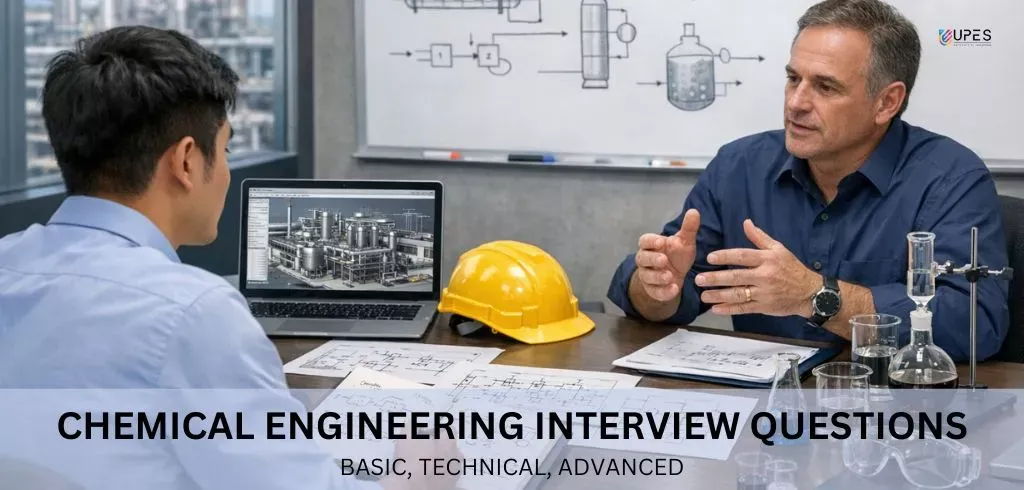
- Chemical Engineering Interview Questions for Freshers
- Basic Chemical Engineering Interview Questions
- Core Chemical Engineering Interview Questions
- Chemical Reaction Engineering (CRE) Interview Questions
- Chemical Engineering Technical Interview Questions
- Chemical Engineering Experience-Based Interview Questions
- Navigating the Career Landscape: Salary and Scope in India
Preparing for a career in the process industries can feel like trying to balance a complex chemical equation. You have the theoretical knowledge but translating that into a high-pressure interview setting is a different challenge altogether. Whether you are a final-year student or a professional looking to pivot, knowing the right Chemical Engineering Interview Questions is the first step toward landing your dream role.
The field is evolving rapidly. Today, recruiters aren't just looking for someone who can calculate mass balance; they want engineers who understand sustainability, digital twins, and safety protocols. This guide breaks down the essential questions you’ll face, categorized by difficulty and specialization, to help you walk into that interview room with total confidence.
Become future-ready with our Advanced Engineering programs
Know MoreChemical Engineering Interview Questions for Freshers
Chemical engineering has a vast and ever-evolving landscape of opportunities. For freshers, the interview is less about your past projects and more about your fundamental clarity. Recruiters want to see if you’ve truly grasped the "why" behind the "how.".
What is the difference between Unit Operations and Unit Processes?
Unit Operations involve physical changes. Examples include distillation, evaporation, and filtration. No chemical reaction occurs here. Unit Processes, on the other hand, involve chemical transformations. Examples include nitration, hydrogenation, and oxidation.
What is the difference between Molarity and Molality?
- Molarity (M): The number of moles of solute per liter of solution. It is temperature-dependent because volume changes with temperature.
- Molality (m): The number of moles of solute per kilogram of solvent. It is temperature-independent, making it more accurate for thermodynamic calculations.
What is an Ideal Fluid versus a Real Fluid?
- An ideal fluid is incompressible and has zero viscosity (no friction). A real fluid possesses viscosity, is somewhat compressible, and experiences surface tension.
Define the Significance of the Reynolds Number ($Re$).
- The Reynolds Number helps predict flow patterns. $Re < 2100$ indicates laminar flow, while $Re > 4000$ indicates turbulent flow. This is critical for determining pressure drop and heat transfer coefficients.
What is the Equation of Continuity?
- It is based on the principle of conservation of mass. For a steady flow, the mass flow rate is constant throughout the system: $\rho_1 A_1 v_1 = \rho_2 A_2 v_2$.
Pro Tip for Freshers: If you find these fundamentals fascinating, a structured B.Tech program can turn this curiosity into an amazing career path in the chemical industry. Exploring the B.Tech Chemical Engineering at UPES provides students with world-class labs where these concepts come to life through hands-on experimentation.
Basic Chemical Engineering Interview Questions
These questions bridge the gap between classroom theory and general industrial knowledge.
What is a "Black Box" in process engineering?
- A Black Box is a conceptual tool where a process is viewed solely in terms of its inputs and outputs, ignoring the internal complexity. It’s the first step in performing a total mass balance.
What is the difference between a Pipe and a Tube?
- Pipe: Used for fluid transport; sized by Nominal Pipe Size (NPS).
- Tube: Used in heat exchangers; sized by outside diameter (OD) and Birmingham Wire Gauge (BWG).
What is the purpose of a P&ID (Piping and Instrumentation Diagram)?
- A P&ID shows the interconnection of process equipment and the instrumentation used to control the process. It is the "blueprint" of a chemical plant.
Explain the concept of Bypass, Recycle, and Purge.
- Recycle: Returning an unreacted stream to the feed to increase conversion.
- Bypass: Skipping a unit to control the composition of the final exit stream.
- Purge: Removing a small stream to prevent the buildup of inert materials in a recycle loop.
What is an Azeotrope?
- An azeotrope is a liquid mixture that has a constant boiling point and the same composition in the liquid and vapor phases, meaning it cannot be separated by simple distillation.
Core Chemical Engineering Interview Questions
These delve into Thermodynamics, Heat Transfer, and Mass Transfer.
Explain the Three Laws of Thermodynamics.
- 1st: Energy cannot be created or destroyed ($\Delta U = Q - W$).
- 2nd: The entropy of the universe always increases.
- 3rd: Entropy of a perfect crystal at absolute zero is zero.
What is the difference between Sensible Heat and Latent Heat?
- Sensible heat results in a temperature change (e.g., heating water from 30°C to 90°C). Latent heat causes a phase change at a constant temperature (e.g., water boiling at 100°C).
Why is a Counter-current Heat Exchanger preferred over Co-current?
- Counter-current flow provides a more uniform Log Mean Temperature Difference (LMTD), allowing for higher heat recovery and efficiency.
Define Fouling in Heat Exchangers.
- Fouling is the accumulation of unwanted material (like scale or algae) on heat transfer surfaces, which increases resistance to heat flow and pressure drop.
What is Fick’s First Law of Diffusion?
- It states that the molar flux is proportional to the concentration gradient: $J = -D \frac{dc}{dx}$.
Chemical Reaction Engineering (CRE) Interview Questions
CRE is the heart of chemical engineering. If you can’t design a reactor, you aren't a chemical engineer. Expect these technical deep-dives:
Compare Batch, CSTR, and PFR Reactors.
| Reactor Type | State | Application | Pros/Cons |
| Batch | Unsteady | Small scale/Pharmaceuticals | High labor cost; flexible. |
| CSTR (Continuous Stirred Tank) | Steady | High volume; liquid phase | Easy temperature control; lower conversion per volume. |
| PFR (Plug Flow Reactor) | Steady | Gas phase; high pressure | High conversion; difficult temperature control. |
What is the "Thiele Modulus"?
- In catalysis, the Thiele Modulus relates the reaction rate to the diffusion rate. A high Thiele Modulus indicates that the reaction is limited by internal diffusion, whereas a low value suggests the reaction rate is the controlling factor.
What is an autocatalytic reaction?
- This is a reaction where one of the products acts as a catalyst for the reaction. A famous example is the oxidation of oxalic acid by potassium permanganate.
What is the Arrhenius Equation?
- It shows the dependence of the rate constant ($k$) on temperature: $k = A e^{-E_a/RT}$. It explains why reaction rates usually increase exponentially with temperature.
Define Catalyst Selectivity.
- Selectivity is the ratio of the desired product formed to the undesired products. A high selectivity is often more important than high conversion in industrial settings.
Chemical Engineering Technical Interview Questions
These questions test your ability to troubleshoot real-world equipment and processes.
What is Cavitation in a pump and how do you prevent it?
- Cavitation occurs when the pressure at the pump suction drops below the vapor pressure of the liquid, causing bubbles to form and collapse violently.
- Prevention: Increase the Net Positive Suction Head Available (NPSHa) by raising the suction tank height or lowering the pump.
How do you choose between a Co-current and Counter-current Heat Exchanger?
- Counter-current flow is almost always more efficient because it maintains a more uniform temperature difference (LMTD) across the length of the exchanger, allowing the cold fluid to reach a higher temperature than the exit temperature of the hot fluid.
What is the role of Reflux in a distillation column?
- Reflux involves returning a portion of the overhead liquid to the column. It provides the necessary liquid-vapor contact to increase the purity of the top product.
How do you choose between a centrifugal and a positive displacement pump?
- Centrifugal pumps are best for high flow/low viscosity (like water). Positive displacement pumps are better for high viscosity or high-pressure requirements (like heavy oils).
What is the purpose of a Steam Trap?
- A steam trap is an automatic valve that filters out condensate (liquid water) and non-condensable gases without letting the live steam escape.
Chemical Engineering Experience-Based Interview Questions
If you have internships or a few years of work under your belt, the interviewer will pivot toward "soft skills" and "situational judgment."
Tell me about a time you identified a safety hazard.
- During a lab/pilot run, I noticed a solvent container kept near a heat source and the MSDS clearly flagged it as flammable. I immediately stopped the activity, informed the supervisor, moved the container to the designated storage area, and ensured proper labeling and ventilation. We also reminded the team of storage protocols in the next briefing. After that, the lab re-organised the storage layout and there were no repeat observations in subsequent safety checks.
How would you handle a situation where a batch did not meet quality specifications?
- I would first quarantine the batch and check the specification that failed (e.g., purity, viscosity, pH). Then I’d do a quick RCA: review raw material COAs, verify calibration of critical sensors, check operator logs for deviations (temperature, agitation, residence time), and inspect any alarms or trend data from the control system. Based on findings, I’d decide whether rework is possible, whether the deviation is due to measurement error, or whether the batch must be rejected—documenting the CAPA so the issue doesn’t repeat.
Explain a complex process you worked on to a non-technical person.
- Distillation is like separating liquids the way you boil water in a kitchen. When you heat a mixture, the component that boils at a lower temperature turns into vapor first. We capture that vapor and cool it back into liquid—so we collect a “cleaner” version of that component. A distillation column just does this repeatedly in stages, so each stage makes the separation a bit better until we get the purity we need.
What would you do if a sensor gave a conflicting reading?
- I wouldn’t change the process based on a single conflicting sensor. First, I’d cross-check the reading with a manual gauge or sample test (if applicable). Then I’d compare it with redundant sensors or related indicators (for example, pressure vs flow trends). I’d also check calibration status, recent maintenance, and whether the signal is noisy or drifting. If uncertainty remains, I’d inform the control room/supervisor, move the process to a safe operating window, and raise a maintenance request before making any major adjustment.
How do you handle a team disagreement during a project?
- I try to bring the discussion back to data and safety standards. I clarify what we’re disagreeing on (assumptions, targets, or method), then suggest a quick comparison using process data, design criteria, and SOP/safety guidelines. If needed, I propose a small test or simulation to validate the best option. This keeps it objective, reduces ego clashes, and ensures the decision is aligned with both performance and safety.
Navigating the Career Landscape: Salary and Scope in India
Chemical engineering remains one of the most lucrative engineering disciplines in India due to the massive presence of the oil and gas, pharmaceutical, and specialty chemical sectors.
| Role | Entry-Level Salary (Per Annum) | Mid-Level Salary (Per Annum) |
| Process Engineer | ₹4.5L - ₹7L | ₹12L - ₹20L |
| Plant Manager | ₹6L - ₹8L | ₹18L - ₹30L |
| HSE Officer | ₹4L - ₹6L | ₹10L - ₹15L |
| R&D Scientist | ₹5L - ₹9L | ₹15L - ₹25L |
Sources: Indeed, PayScale, Glassdoor. | ||
Why the Right Education Matters
To answer these Chemical Engineering Interview Questions effectively, you need more than just a textbook. You need exposure to industry-standard software like ASPEN HYSYS and MATLAB, and experience in pilot-scale plants. The UPES School of Advanced Engineering focuses on "tomorrow-ready" skills, ensuring that by the time you sit for an interview, you've already solved real-world industrial problems through their extensive industry tie-ups and specialized tracks in Refining or Petrochemicals.

Our counsellors are just a click away.
Conclusion
Preparing for Chemical Engineering Interview Questions isn't just about memorizing formulas; it's about developing the "engineer's mindset." Companies are looking for problem-solvers who can stay calm when a reactor pressure spikes or a distillation column floods.
If you find yourself feeling overwhelmed by the depth of the field, remember that every expert was once a beginner. The key is to choose a learning path that combines rigorous theory with practical, industry-aligned training.
FAQs: Chemical Engineering Interview Questions
1. What are the most common topics in a chemical engineering interview?
- The most common topics include Fluid Mechanics, Heat Transfer, Mass Transfer, Chemical Reaction Engineering, and Process Control. Safety (HSE) is also a major focus in modern interviews.
2. How should I prepare for a technical interview as a fresher?
- Focus on your final year project and your internship experience. Be ready to draw Process Flow Diagrams (PFDs) and explain the basic logic behind equipment selection (like why a specific pump or heat exchanger was used).
3. What is the role of "Simulation" in interviews?
- Many companies now ask if you are familiar with simulation tools like Aspen Plus or PSpice. You don't need to be a master, but knowing how these tools assist in steady-state modeling is a huge plus.
4. Is the gate score important for private sector chemical engineering jobs?
- While PSU jobs (ONGC, IOCL) require a GATE score, most private giants like Reliance, Tata Chemicals, or Dr. Reddy’s focus on your technical round, aptitude, and fundamental understanding during their own recruitment drives.
5. How do I answer "Why did you choose Chemical Engineering?"
- Avoid generic answers. Connect it to your interest in transforming raw materials into valuable products, your fascination with sustainable energy, or the diverse career paths—from skincare to rocket fuel—that the field offers.

UPES Editorial Team
Written by the UPES Editorial Team
UPES Admission Enquiry
Trending Post
-

Career Opportunities in Space Technology & Satellite Engineering for Students
26/10/2025By UPES Editorial Team
-

-


Related Articles

















































Subscribe to UPES Blogs
Join our community for exclusive stories, insights, and updates
By clicking the "Subscribe" button, I agree and accept the privacy policy of UPES.


