Electronics Engineering Interview Questions - Freshers & Experienced
- UPES Editorial Team
- Published 17/04/2026


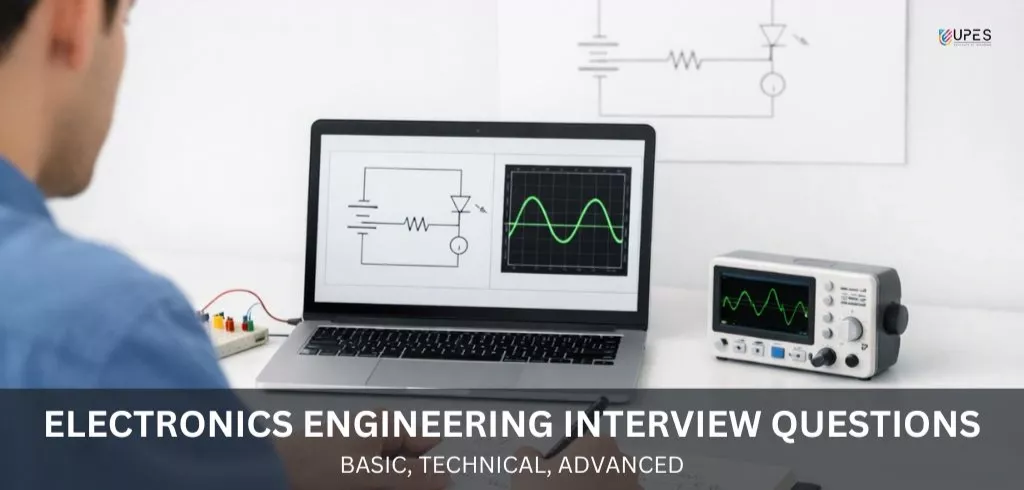
Preparing for your first big break in the tech industry can feel like navigating a complex circuit board. You’ve spent years mastering the laws of physics and the intricacies of semiconductors, but when it’s time for the interview, the pressure is on. Whether you are a fresh graduate or an early-career professional, knowing the right electronics engineering interview questions can be the difference between a "thank you" and a "welcome aboard."
The electronics field is evolving rapidly. From IoT and 5G to AI-integrated hardware, the demand for engineers who understand both hardware and software is at an all-time high. This guide is designed to help you brush up on core fundamentals, tackle complex technical scenarios, and present yourself with confidence.
In this deep dive, we will cover everything from basic circuit theory to advanced electronics and communication engineering interview questions, ensuring you are ready for top-tier recruiters.
Become future-ready with our Advanced Engineering programs
Know MoreCore Electronics Engineering Interview Questions: The Fundamentals
The foundation of any core branch of engineering role lies in your grip on basic laws and components. Before we dive into complex systems, your interviewer will likely test your ability to visualize how current and voltage behave at a granular level. Master these five questions to prove you have a solid technical base.
1. What is the difference between an Analog and a Digital circuit?
In an Analog circuit, signals are continuous and vary over time (like a sine wave). They represent physical quantities like temperature or sound directly.
In a Digital circuit, signals are discrete, usually represented by two levels: High (1) and Low (0). These are more noise-resistant and easier to process via computers.
2. Explain the working of a P-N Junction Diode.
A P-N junction is formed when a P-type semiconductor (excess holes) is joined with an N-type semiconductor (excess electrons).
- Forward Bias: When the positive terminal is connected to the P-side, the depletion layer narrows, allowing current to flow.
- Reverse Bias: When the positive terminal is connected to the N-side, the depletion layer widens, preventing current flow.
3. What is the difference between BJT and MOSFET?
This is a staple in electronics engineering interview questions.
- BJT (Bipolar Junction Transistor): A current-controlled device. It has a low input impedance and is generally used for amplification.
- MOSFET (Metal-Oxide-Semiconductor Field-Effect Transistor): A voltage-controlled device. It has a very high input impedance and is preferred in modern digital switching and VLSI design.
4. What is Kirchhoff’s Current Law (KCL) and Voltage Law (KVL)?
- KCL: The total current entering a junction or node is exactly equal to the charge leaving the node (Conservation of Charge).
- KVL: The algebraic sum of all voltages around any closed loop in a circuit is equal to zero (Conservation of Energy).
5. Define "Gain" and "Bandwidth" and their relationship.
- Gain: The ratio of the output signal to the input signal (Power, Voltage, or Current).
- Bandwidth: The range of frequencies over which a circuit functions effectively.
In many amplifiers, the Gain-Bandwidth Product is constant; as you increase gain, you typically sacrifice bandwidth.
By nailing these fundamental questions, you demonstrate that you haven't forgotten the "roots" of your degree. This clarity is essential before moving into specialized domains like communication or computer architecture.
Electronics and Communication Engineering Interview Questions
Communication engineering is the backbone of our connected world. In this section, interviewers look for your understanding of how signals are processed and transmitted across distances. These questions bridge the gap between pure hardware and the protocols that run our networks.
6. What is Modulation and why do we need it?
Modulation is the process of varying a property of a high-frequency carrier signal (like amplitude, frequency, or phase) in proportion to a low-frequency message signal.
Why we need it?
- To reduce the size of the antenna (Antenna size is inversely proportional to frequency).
- To allow long-distance transmission.
- To multiplex multiple signals over a single channel.
7. Explain the "Sampling Theorem" and Aliasing.
The Nyquist-Shannon Sampling Theorem states that to perfectly reconstruct a signal, the sampling frequency ($f_s$) must be at least twice the highest frequency component ($f_m$) present in the signal: $f_s \geq 2f_m$.
If this condition isn't met, Aliasing occurs, where high-frequency components overlap and distort the reconstructed signal.
8. What is the difference between Latency and Throughput?
- Latency: The time delay for a data packet to travel from the source to the destination.
- Throughput: The actual amount of data transmitted over a network in a given period of time.
9. What is a "Handover" in mobile communication?
A handover (or handoff) is the process of transferring an ongoing call or data session from one base station (cell) to another as the user moves, ensuring the connection is not dropped.
10. What is the purpose of an Equalizer in a communication receiver?
An equalizer is used to reverse the distortion caused by a signal passing through a communication channel. It minimizes "Inter-Symbol Interference" (ISI) to ensure data integrity at the receiving end.
Understanding these communication-centric concepts is vital, especially as India moves toward 6G and advanced satellite communication. These topics show you understand the "flow" of information, not just the components it travels through.
Bridging the Gap: Electronics and Computer Engineering
In today's industry, the line between hardware and software is blurring. Most modern electronics engineering interview questions now include elements of computer architecture and embedded systems.
This is exactly where a specialized program like the B.Tech in Electronics and Computer Engineering adds immense value. Unlike traditional courses, this curriculum is designed to create engineers who are equally comfortable writing high-level code and designing low-level hardware.
Key benefits of this interdisciplinary approach:
- Industry Readiness: You learn to design smart devices, not just simple circuits.
- AI & IoT Integration: Gain the skills to implement machine learning algorithms directly onto hardware (Edge AI).
- Versatility: You qualify for roles in both core electronics (like Intel or Nvidia) and software giants (like Google or Amazon).
Interview Questions on Intermediate Concepts
Beyond individual components, an engineer must understand how systems interact. These five questions focus on integrated circuits (ICs), operational amplifiers, and the logic that governs modern computing devices.
11. What are Active and Passive components?
- Active Components: Can amplify a signal or provide power gain (e.g., Transistors, Op-Amps, Diodes).
- Passive Components: Cannot provide power gain; they consume or store energy (e.g., Resistors, Capacitors, Inductors).
12. Explain the working of an Operational Amplifier (Op-Amp).
An Op-Amp is a high-gain electronic voltage amplifier with a differential input. Key characteristics of an "Ideal" Op-Amp include:
- Infinite Input Impedance
- Zero Output Impedance
- Infinite Open-loop Gain
13. What is the difference between a Combinational and a Sequential circuit?
- Combinational: The output depends only on the current inputs (e.g., Multiplexers, Adders).
- Sequential: The output depends on current inputs AND previous states/memory (e.g., Flip-flops, Counters).
14. What is a Schmidt Trigger?
A Schmidt Trigger is a comparator circuit with hysteresis. It converts an analog input signal into a digital output signal. It is particularly useful for removing "noise" from signals that would otherwise cause multiple false transitions.
15. What is the significance of the Power Factor in AC circuits?
The Power Factor is the ratio of real power ($W$) to apparent power ($VA$). A low power factor means the circuit is drawing more current than necessary to perform work, leading to energy inefficiency and heat.
Mastering these intermediate topics proves you can handle system-level design. Whether you're building a power supply or a logic gate, these principles remain the same across the board.
Technical Scenarios and Troubleshooting Interview Questions
The true test of an engineer isn't what they know, but how they think when things go wrong. These questions simulate real-world lab or workplace scenarios where you must diagnose and solve a problem under pressure.
16. If a circuit is overheating, what are the first three things you check?
- Current Draw: Is the load drawing more current than the components are rated for?
- Short Circuits: Is there an unintended path for the current, perhaps due to a solder bridge?
- Heat Dissipation: Are the heat sinks adequate, or is the thermal paste applied correctly?
17. How do you choose between a Microcontroller and a Microprocessor?
- Microcontroller (MCU): Choose this for specific, low-power tasks where RAM, ROM, and I/O ports are on a single chip (e.g., a smart washing machine).
- Microprocessor (MPU): Choose this for high-computational tasks where external memory and high processing speeds are required (e.g., a laptop).
18. Describe how you would debug a non-functional PCB.
Start with a Visual Inspection (burnt components, bad solder). Use a Multimeter to check for continuity and power rail voltages. Finally, use an Oscilloscope to trace signals and identify where the logic fails.
19. What is "Debouncing" in switches, and how do you fix it?
When a mechanical switch is pressed, it "bounces" physically, creating multiple electrical signals. This can be fixed using a Hardware solution (RC filter) or a Software solution (delay or state check in code).
20. Why do we use Decoupling Capacitors?
Decoupling capacitors are placed close to the power pins of an IC to suppress high-frequency noise and provide a local reservoir of energy during quick current spikes, ensuring stable operation.
Troubleshooting questions reveal your practical experience. Companies value candidates who can save time and resources by quickly identifying faults in a design or production line.
Advanced Topics: VLSI and Digital Electronics
For high-end roles in chip design or hardware architecture, the complexity of electronics engineering interview questions increases. Here, we look at the timing, logic, and manufacturing aspects of very-large-scale integration.
21. What is Setup Time and Hold Time?
- Setup Time: The minimum time before the clock edge that the data signal must be stable.
- Hold Time: The minimum time after the clock edge that the data signal must remain stable.
If these are violated, the flip-flop enters a metastable state.
22. What are the advantages of CMOS technology?
- Extremely low static power consumption.
- High noise immunity.
- High packing density, allowing millions of transistors on a single chip.
23. What is the difference between Moore and Mealy Machines?
- Mealy Machine: The output depends on the current state AND the current inputs.
- Moore Machine: The output depends ONLY on the current state.
24. Explain "Fan-in" and "Fan-out."
- Fan-in: The number of inputs a logic gate can handle.
- Fan-out: The number of standard loads (inputs of other gates) that the output of a single logic gate can drive without signal degradation.
25. What is the difference between SRAM and DRAM?
- SRAM (Static RAM): Faster, more expensive, uses flip-flops, does not need refreshing. Used for Cache.
- DRAM (Dynamic RAM): Slower, cheaper, uses capacitors, needs periodic refreshing to maintain data. Used for Main Memory.
- Advanced knowledge in VLSI is the gateway to the semiconductor industry and lucrative VLSI placements. As India builds its own chip manufacturing plants, these skills are becoming the most lucrative in the engineering sector.
Career Scope and Salary Insights (India 2026)
The electronics landscape is shifting toward specialized engineering. Below is a look at the current market trends for professionals who can navigate both hardware and software.
| Job Role | Key Skill | Entry-Level Salary (Per Annum) | Mid-Level Salary (5+ Yrs) |
| VLSI Design Engineer | Verilog, VHDL, Cadence | ₹7 - 14 Lakhs | ₹22 - 40 Lakhs |
| Embedded Systems Developer | C, RTOS, Microcontrollers | ₹5 - 9 Lakhs | ₹14 - 28 Lakhs |
| Firmware Engineer | Hardware/Software Interface | ₹6 - 11 Lakhs | ₹18 - 32 Lakhs |
| IoT Solutions Architect | Sensors, Cloud, Python | ₹8 - 15 Lakhs | ₹25 - 50 Lakhs |
| RF Engineer | Antenna Design, 5G/6G | ₹5 - 10 Lakhs | ₹15 - 30 Lakhs |
Sources: Naukri, Indeed, PayScale | |||
Why Choose Electronics and Computer Engineering?
The future of technology isn't just "faster computers" or "better circuits"—it is the seamless integration of both. By choosing a specialization like Electronics and Computer Engineering at UPES, you are positioning yourself at the forefront of the Silicon Revolution.
With state-of-the-art labs, industry-aligned curriculum, and a focus on hands-on project work, students are prepared to tackle the very electronics engineering interview questions that stop others in their tracks.
Frequently Asked Questions (FAQs)
Q1. What are the most common electronics engineering interview questions for freshers?
Freshers are mostly asked about their final year projects, basic circuit laws (Ohm's Law, KCL/KVL), and semiconductor physics. Expect questions on your favorite subjects and basic coding logic.
Q2. How should I prepare for a technical round in an electronics company?
Focus on your fundamentals. Re-read notes on Network Analysis and Digital Logic. Also, practice explaining your projects clearly using the STAR (Situation, Task, Action, Result) method, as interviewers often dive deep into your practical work.
Q3. Is coding important for Electronics Engineers?
Absolutely. Proficiency in C, C++, or Python is now a standard requirement. Most modern electronics involve "programmable hardware," meaning you need to understand how to write drivers and firmware.
Q4. What is the scope of ECE in the semiconductor industry?
With the India Semiconductor Mission, the scope is massive. Global giants are setting up R&D centers in India, looking for engineers skilled in VLSI, chip design, and verification.
Q5. What is the difference between ECE and Electronics and Computer Engineering?
While ECE focuses heavily on communication protocols, RF, and signal processing, Electronics and Computer Engineering leans more towards computer architecture, hardware-software integration, and digital system design.

Our counsellors are just a click away.
Conclusion
Mastering electronics engineering interview questions is about more than just memorizing definitions; it’s about demonstrating a logical thought process. Employers are looking for problem-solvers who can navigate the complexities of modern digital systems while keeping an eye on efficiency and cost.
Don't be discouraged if you don't know the answer to every technical question. Often, interviewers are more interested in how you approach a problem you’ve never seen before. Stay curious, keep practicing, and consider a curriculum that gives you the best of both worlds—hardware and software.

UPES Editorial Team
Written by the UPES Editorial Team
UPES Admission Enquiry
Trending Post
-

Career Opportunities in Space Technology & Satellite Engineering for Students
26/10/2025By UPES Editorial Team
-

-


Related Articles










































Subscribe to UPES Blogs
Join our community for exclusive stories, insights, and updates
By clicking the "Subscribe" button, I agree and accept the privacy policy of UPES.


