What Are Immersive Technologies? Types, Applications, Benefits
- UPES Editorial Team
- Published 08/06/2026


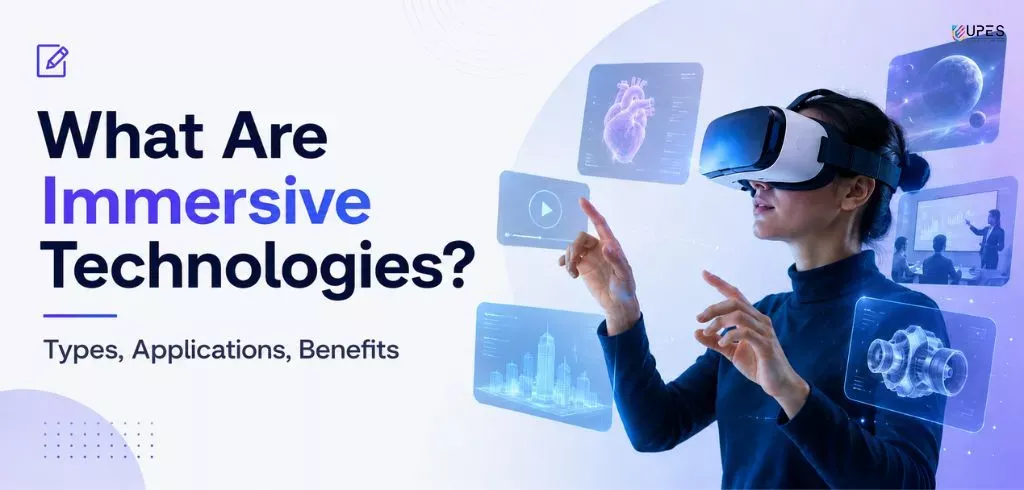
Immersive technologies examples are all around us today, as the technology advances, different facets of immersive tech, such as Augmented, Virtual, and Mixed Realities, offer businesses more interactive tools to train, collaborate, and perform day-to-day business processes smoothly. The immersive technology benefits are not just limited to the operational level; rather, they go further by helping businesses increase customer engagement and increase sales.
Through this article, we attempt to examine what are immersive technologies? The different types of immersive technology, their advantages, and their practical uses.
Become future-ready with our Computer Science programs
Know MoreWhat are Immersive Technologies?
Immersion technology is the ability to move oneself anywhere in the world and beyond without moving an inch. Imagine yourself in a virtual environment. A regulated, simulated area where a user can interact with and experience a virtual environment is created by immersive technology using sophisticated technologies. The term Extended Reality (XR) refers to the combination of Augmented Reality (AR), Virtual Reality (VR), and Mixed Reality (MR). By employing these technologies, immersive tech models produce experiences that are similar to the actual world, enabling businesses to provide better customer service, training, and internal teamwork. Major areas, including healthcare, technology, gaming, and entertainment, are all included in the scope of immersive technology.
Extended Reality (XR) & Different Types of Immersive Technologies
Extended Reality uses different technologies to offer users a combination of physical and virtual realities at the same time. Extend Reality is also used as an umbrella term for a culmination of Augmented Reality, Virtual Reality, and Mixed Reality. Through Extended Reality models, users can interact with the virtual world, while also experiencing the present physical dimension. Extended Reality is prominently used in gaming and entertainment and has far-reaching applications in diverse industries. As per the market reports, the global market for Extended Reality technology is expected to grow by 25% each year and expand to $2 trillion by 2034.
To understand Extended Reality better, one must know its three main types of Immersive Technologies:
- Augmented Reality (AR)
- Virtual Reality (VR)
- Mixed Reality (MR)
- Augmented Reality (AR)
You have encountered augmented reality if you have ever interacted with Google Lens, Snapchat filters, or casually played Pokémon GO. By superimposing virtual items onto a physical location, augmented reality, to put it simply, enables users to interact with them in the real world. Users can interact with virtual digital graphics through augmented reality. Additionally, users can now interact with spatial digital things in a simulated environment thanks to increasingly immersive Augmented Reality devices.
Virtual Reality (VR)
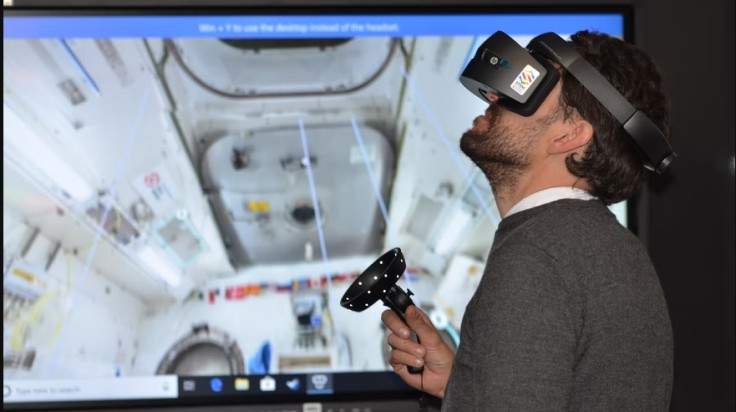
With virtual reality, users can fully immerse themselves in an artificial setting, interacting and moving around in a virtual world that has been constructed. Through VR headgear, specially constructed rooms, or 3D experiences, virtual reality technology generates lifelike virtual environments. It allows users to explore and engage in a completely virtual environment while being physically in one location.
Mixed Reality (MR)
Immersion technology known as "mixed reality" enables real-time interaction between users and both virtual and tangible items. It creates a more responsive and dynamic world by fusing aspects of AR and VR technology. Virtual and augmented worlds are combined by gadgets like the Apple Vision Pro to create a smooth and engaging experience.
What are Key Benefits of Immersive Technologies
There are several benefits to immersive technologies for businesses. These technologies help businesses improve customer retention rates, offer better training, and enhance overall performance. Check out some of the key benefits of immersive technologies here:
1. Improved user engagement
By introducing interactive tools such as virtual try-ons or feedback forms, companies can improve user engagement and offer a more personalized experience to customers. These additions help enhance business visibility and drive higher engagement.
2. Effective training opportunities
Immersive technologies greatly help businesses offer more intricate and effective training opportunities. Virtual simulations enable industries such as healthcare, aviation, and technology to provide real-time feedback and simulate real-world scenarios for comprehensive training.
3. Increased sales & marketing
By offering AR/VR product experiences and virtual try-ons, businesses are more likely to secure sales compared to traditional methods. Therefore, immersive tech plays a significant role in enhancing sales and marketing efforts.
4. Continuous collaboration
By sharing virtual spaces and interactive tools, companies encourage remote teams to collaborate on projects, allowing them to stay connected and remain on timeline.
Applications of Immersive Technologies in Real World
Applications of immersive technologies are far-reaching, with crucial implications in diverse industries. The following are some of the major real-word industry-wise immersive technologies examples:
1. Healthcare training and surgical procedures
Immersive technologies have significant implications in healthcare training, especially when it comes to intricate surgical procedures. Medical students can access more accurate, real-world-like scenarios and receive real-time feedback. Therefore, healthcare models based on immersive tech aim to make surgical operations more efficient and training more comprehensive.
2. Edtech and virtual learning
Immersive tech is revolutionizing modern education. With interactive classrooms, students not only learn concepts but also understand them more effectively. Furthermore, educators are able to interact with students more openly. In colleges, immersive labs allow research students to simulate realistic virtual environments to conduct in-depth research work.
3. Gaming and entertainment
AR/VR games have gained significant popularity following the emergence of immersive tools and gadgets. These technologies allow users to enjoy hyper-realistic gameplay. Furthermore, the entertainment industry also utilizes immersive tech to present 3D and even 5D movie experiences, which allow action scenes to be more elaborate and provide a more immersive experience for the audience.
4. Retail and manufacturing
Retail and manufacturing leverage AR/VR and immersive tech to offer a more comprehensive customer experience. Online retail stores now offer virtual try-ons to help customers make informed decisions. On the other hand, companies use MR tools for prototyping and to ensure smoother manufacturing processes.

Our counsellors are just a click away.
Future of Immersive Technologies
Immersive technology is no longer an up-and-coming phenomenon, and businesses are aware of what immersive technologies are and how to utilize them to scale up their sales, customer reach, and processes. The future of immersive technologies is set to transform how businesses and individuals interact with digital environments. As advancements continue in Augmented Reality, Virtual Reality, and Mixed Reality, these tools will become more accessible, scalable, and integrated into everyday operations. From enhanced remote collaboration to more intuitive customer experiences, immersive tech will drive innovation across industries. As adoption grows, organizations that embrace these technologies early will be better positioned to stay competitive in an increasingly digital-first world.
FAQs
Q1. In immersive technology, what does MR stand for?
In immersive technology, MR (Mixed Reality) combines the concepts of Augmented and Virtual Reality. MR technology allows users to interact with real-world and virtual objects in real-time. Together, AR, VR, and MR, they make XR, or extended reality.
Q2. What are 5 types of immersive technologies?
5 types of immersive technologies include 5 major different types of technologies that offer distinctive methods to mix the physical and digital worlds through virtual environments. The 5 main types of immersive technologies are VR, AR, MR, 360-Degree Content, and Haptic Technology.
Q3. What are some of the immersive technology examples?
Immersive technology such as VR and AR has several use cases, including VR gaming headsets, Snapchat, Pokémon Go, Microsoft HoloLens, YouTube VR, etc.
Q4. What is XR vs VR vs AR?
VR, or virtual reality, is a technology that transports users to a simulated virtual world, where they can interact with virtual objects and experience a hyper-realistic digitally produced environment. AR, on the other hand, overlays virtual objects onto a real-world screen, such as AR games, Snapchat filters, etc. XR is an umbrella term used collectively for AR, VR, and MR (Mixed Reality).
Q5. Is AI an immersive technology?
While AI is not an immersive technology on its own, it is a powerful engine that helps enable virtual environments. Engineers combine AI with hardware and software such as AR and VR tools to create immersive and detailed experiences.

UPES Editorial Team
Written by the UPES Editorial Team
UPES Admission Enquiry
Trending Post
-

Full Stack Developer Interview Questions- Freshers to Experienced & High Level
08/08/2025By UPES Editorial Team
-

Gender Digital Divide: Challenges in Undergraduate Computer Science Programs
29/09/2025By Dr. Avita Katal
-

How to Create a Web Developer Portfolio & Why is it important (Examples, Templates, Ideas, Content & Website)
11/02/2025By UPES Editorial Team


Related Articles



































Subscribe to UPES Blogs
Join our community for exclusive stories, insights, and updates
By clicking the "Subscribe" button, I agree and accept the privacy policy of UPES.


