What is Embedded AI? Applications, Benefits, Examples & Scope
- UPES Editorial Team
- Published 21/07/2026


- What is Embedded AI?
- Traditional AI vs Embedded AI
- Core Technologies in Used in Embedded AI
- How Does Embedded AI Work?
- Industry Wise Practical Applications of Embedded AI Systems
- What are the Benefits of AI in Embedded Systems
- Challenges of Embedded AI
- Real World Embedded AI Examples & Use Cases
- Top Embedded AI Jobs and Salaries
Every time your smartwatch detects an irregular heartbeat, your car automatically applies emergency braking, or your smart doorbell recognises a familiar face, artificial intelligence is making decisions directly on the device, not in a distant cloud server. This is known as Embedded AI.
Embedded AI offers users a hyper-personalized experience, more secure AI enabled devices, and split-second decision making. Using AI in Embedded systems, users can get AI applications exactly where they want and do not need to shuffle between different applications and models. The applications of embedded AI systems spread across industries such as automotive, robotics, manufacturing, healthcare, and more.
This artificial intelligence technology aims to offer high-speed, efficient, and data-backed insights to users.
Become future-ready with our Computer Science programs
Know MoreWhat is Embedded AI?
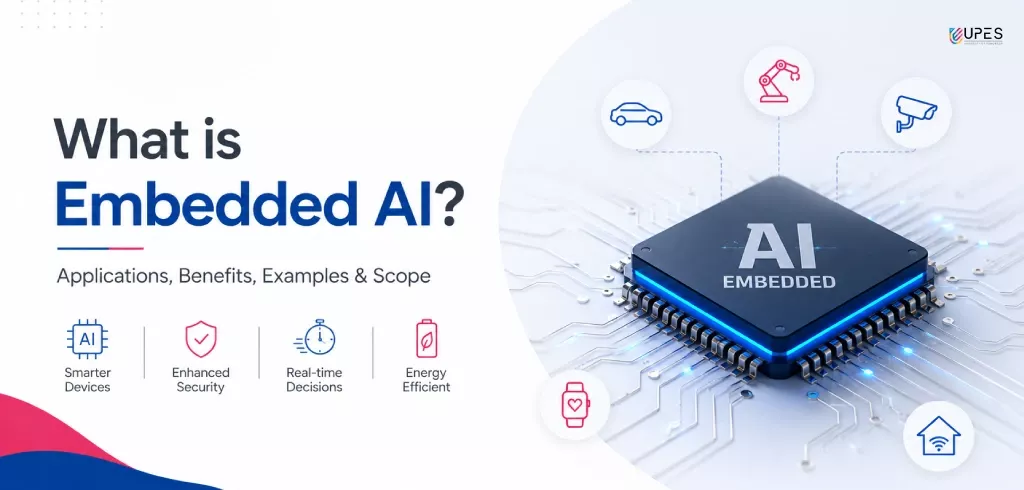
Embedded AI is a technology that deploys artificial intelligence capabilities onto a device's microcontrollers or processors. By embedding AI within a localized device such as a camera, thermostat, watch, or car, these devices can be transformed into highly intelligent smart gadgets. While traditional AI technologies often use cloud computing to store and process data, embedded AI uses on-device memory and processing to perform AI tasks locally. Depending on the application, some embedded AI systems can also support continuous or incremental learning to adapt to user preferences and deliver hyper-personalized experiences.
Where Do You Already Use Embedded AI?
You might not be aware but you’re already using embedded AI in your:
- Apple Watch
- Pixel Phone
- Samsung Galaxy AI
- Tesla Autopilot
- Alexa devices
- Meta Ray-Ban Glasses
- Smart TVs
- Smart washing machines
- Security cameras
- Robot vacuum cleaners
Traditional AI vs Embedded AI
Traditional AI technology relies on cloud storage and requires constant internet connectivity to process large amounts of data. On the other hand, Embedded AI processes data directly onto the local devices and are typically used for instant actions. The following table explains the key differences between the two in detail:
Feature | Traditional AI | Embedded AI |
Processing | Cloud servers or massive data centers | Directly on local hardware or devices |
Connectivity | Requires constant internet connection | Works offline or in remote environments |
Latency | High as data travels back and forth between device and cloud | Low as data doesn’t need access to cloud |
Data privacy | Low (Cloud storage is prone to online threats and cyber-attacks) | High (Data stays on the device, making it more secure) |
Model size & complexity | Massive | Smaller |
Key insights:
- The global Embedded AI market is expected to grow with a 14.1% CAGR, rising from USD 9.97 billion in 2024 to USD 21.93 billion by 2030 (Grand View Research Report).
- Automotive, Consumer Electronics, and Healthcare industries are the fastest growing Embedded AI sectors.
- By the end of 2033, the global Edge AI market is expected to grow to USD 118.7 billion market size (Grand View Research Report).
Core Technologies in Used in Embedded AI
Embedded AI systems rely on three fundamental technologies to integrate intelligent processing into hardware to enable on-device decision making without requiring constant cloud connectivity. The three core technologies used are:
1. Embedded Machine Learning
Through Embedded Machine Learning (E-ML), machine learning algorithms are trained in cloud before embedding them to local devices such as microcontrollers or IoT nodes. Using E-ML technology, edge devices store data on the device, making it secure and offering near zero latency.
2. TinyML
TinyML is focused on executing machine learning models on highly resource-constrained, battery-operated edge devices. Using TensorFlow Lite and Edge Impulse frameworks engineers drastically compress data to fit tiny hardware.
3. Sensor Data Processing
Using hardware capabilities and algorithms, sensor data processing captures physical inputs and translates them into usable features for machine learning models. The process utilizes Sensor Fusion and Digital Signal Processing to combine data from multiple sensors and to condition raw data.
How Does Embedded AI Work?
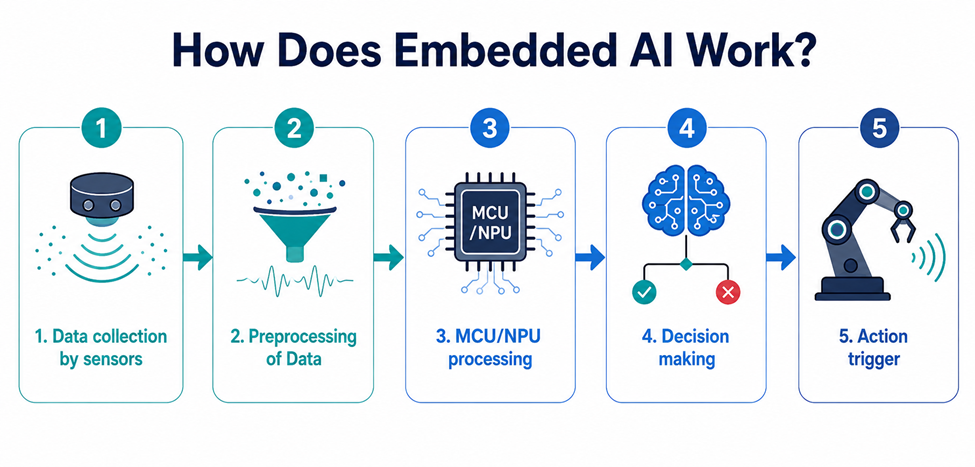
Embedded AI architecture is designed to process data locally and produce instant reactions or outputs. Typically, following steps are followed in producing an output from Embedded AI system:
1. Data collection by sensors
Hardware components receive data and process the same to measure the physical environment and output continuous raw data.
2. Preprocessing of Data
System then cleans up data to remove background noise or translate data to help model understand the inputs.
3. MCU/NPU processing
Using Main Processor (MCU) and specialized processors (NPU), data goes through machine learning model.
4. Decision making
AI identifies a pattern and implements logic in microseconds.
5. Action trigger
Based on the logic applied, the AI triggers an action as output.
Industry Wise Practical Applications of Embedded AI Systems
Embedded AI has major applications across several sectors and is quickly becoming a key technology in driving innovation. The following are some of the applications of Embedded AI systems:
Automotive
The automotive industry widely uses AI in embedded systems in advanced driver assistance systems (ADAS) and driver monitoring. Modern self-driving cars heavily rely on TinyML and edge AI devices such as on-board camera sensors and radar utilize embedded computer vision to avoid collisions, lane-keeping, and automated emergency breaking. Furthermore, using Infrared cameras, edge devices can track eye and head movements to detect drowsy or distracted driving and send immediate alerts.
Robotics
Robotics has widespread adoption and applications for embedded AI. Delivery robots and drones heavily rely on edge computing to track terrain and obstacles on their paths. Robotic arms use are trained to have adaptive manipulation and are able to adjust grip based on the shape and weight of the object.
Manufacturing
Manufacturing firms use microcontrollers that are embedded with heavy machineries; these smart edge devices map temperature and vibrations from the machine to predict maintenance cycles. Furthermore, edge devices such as smart cameras are used across assembly lines to identify faulty products at high speeds.
Smart Homes
Several smart home gadgets, such as smart doorbells and speakers, use TinyML to process speech to recognize trusted faces. Similarly, smart thermostats track user behavior to automate temperature settings.
Agriculture & Energy
Edge devices such as soil sensors detect moisture and nutrient levels in a soil sample to help farmers understand the quality of the soil. Additionally, drone cameras equipped with advanced cameras help detect pests and disease in plants.
Logistics & Retail
Smart factories and warehouses use robots and automated guided vehicles to transport goods from one location to another. Furthermore, using smart cameras and sensors, firms can manage stock levels in real time.
Healthcare
Wearable devices are common examples of embedded AI systems in healthcare. Smartwatches and Glucose Monitoring Patches monitor several parameters in the human body including sugar, oxygen, and water levels, along with heartrates.
What are the Benefits of AI in Embedded Systems
The following are key benefits of Embedded AI systems:
1. Personalized UX
Edge AI tools continuously track user behavior and understand patterns. By identifying user habits, preferences, and daily patterns, smart devices such as smart thermostats and smartwatches can offer hyper-personalized recommendations and actions.
2. Improved Decision Making
Embedded AI uses sensor data to identify anomalies and discrepancies and offer quick real time alerts. High risk sectors such as aerospace and automotive heavily rely on edge devices to make split second decision making.
3. Efficient Cost Saving
By storing data in a localized system, AI in embedded systems saves significant costs in cloud storage. Furthermore, smart devices can also optimize their workload based on power consumption and prevent costly breakdowns in heavy machines.
4. Access to real-time insights
Edge AI gadgets are able to process data quickly as data is not required to travel to cloud for processing. Real-time insights allow users to make quick decisions.
5. Enhanced Privacy & Security
Since data is stored locally with the device's memory itself, the chances of data threatening attacks remain slim in comparison to cloud-based systems offering higher privacy and security to users.
Challenges of Embedded AI
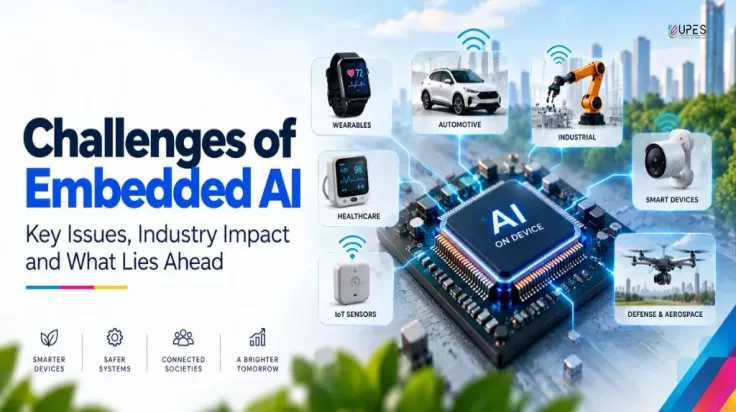
Despite its advantages, Embedded AI also presents several technical and operational challenges.
1. Limited Processing Power
Embedded devices usually have less computing power than cloud servers. Developers must therefore design compact models that can operate efficiently on microcontrollers, NPUs, or low-power processors.
2. Memory Constraints
Many embedded devices have limited storage and RAM. Large AI models may need to be compressed using techniques such as quantisation, pruning, or knowledge distillation before deployment.
3. Power Consumption
Battery-powered devices must balance AI performance with energy efficiency. Continuous sensor monitoring and inference can reduce battery life if models are not carefully optimised.
4. Hardware Compatibility
An AI model built for one processor may not run efficiently on another. Developers must account for different chip architectures, operating systems, accelerators, and toolchains.
5. Model Accuracy
Smaller embedded models may sometimes be less accurate than larger cloud-based models. Developers must find the right balance between speed, model size, power usage, and prediction quality.
6. Security Risks
Although local processing can improve privacy, embedded devices may still be vulnerable to firmware attacks, physical tampering, insecure updates, and malicious data inputs.
7. Updating Deployed Models
Updating thousands of connected devices can be complex. Over-the-air updates must be secure, reliable, and compatible with existing hardware.
8. Heat Management
Running AI workloads on compact devices can generate heat. Poor thermal management may reduce device performance, shorten hardware life, or create safety concerns.
9. Data Quality
Embedded AI relies heavily on sensor data. Inaccurate, noisy, or incomplete inputs can lead to poor decisions, particularly in safety-critical environments.
10. Testing and Validation
Embedded AI systems used in healthcare, automotive, aerospace, and defence must undergo extensive testing. Developers need to validate performance across different environments, operating conditions, and edge cases.
11. Skills Gap
Embedded AI requires knowledge across multiple areas, including machine learning, electronics, firmware, embedded C/C++, sensor processing, hardware architecture, and model optimisation. Professionals with this combination of skills remain relatively limited.
12. Ethical and Regulatory Concerns
Embedded AI systems may make decisions involving safety, privacy, surveillance, or personal data. Organisations must ensure transparency, accountability, bias control, and compliance with applicable regulations.
Real World Embedded AI Examples & Use Cases
The following are some of the most common and popular use cases and examples of embedded AI in real world:
1. Advanced Driver-Assistance Systems (ADAS)
A popular example of AI in Embedded Systems is Tesla Autopilot, which is an Advanced Driver-Assistance Systems (ADAS) offering functions such as pedestrian detection, lane-keeping assist, and automatic emergency braking. The system uses integrated vision-language-action AI models which are directly embedded to vehicle processors to instantly interpret road hazards, fog, or cyclist movements and make quick decisions.
2. Wearable Devices
Smartwatches such as Apple Watch use embedded AI systems to monitor user’s heart rate, oxygen level, sleep quality, stress level, and physical activities. Additionally, Ray-Ban Meta Smart Glasses use embedded AI to offer hands-free activities such as taking pictures, recording videos, navigating maps, and real-time language translation.
3. Smart Home Tools
Smart home tools such as smart doorbells, speakers, smart lights, and thermostats use TinyML to understand user behavior and offer a dynamic and hyper-personalized user experience.
4. Portable ECG Monitors
Using AI algorithms, portable ECG monitors help identify early signs of heart conditions such as arrhythmias and heart failure, before they become life-threatening. Furthermore, ECG monitors can be integrated with other healthcare management systems for more comprehensive reports and diagnostics.
5. Autonomous Mobile Robots (AMRs)
Through embedded AI systems, Autonomous Mobile Robots (AMRs) improve their navigation and decision-making abilities such as identifying obstacles, following the routes, and performing automated tasks.
6. Smart Irrigation & Nutrient Management
Smart irrigation and nutrient management systems use AI algorithms to process soil quality, temperature, nutrient levels, weather reports to schedule irrigation schedules and offer farming recommendations.
What is the Scope & Career Prospects in Embedded AI
Embedded AI systems have promising scope driven by rapid development in the industry and adoption of edge AI tools across industries to automate tasks. While manufacturing, automotive, and IoT industries have long been the primary users of the AI in embedded systems, today, industries such as healthcare, education, irrigation, and aerospace are also increasingly using embedded AI.
As per a Grand View Report, the global Embedded AI market is expected to rise to USD 21.93 billion by 2030, thanks to industry wide adoption and technological advancements. This growth also signals towards increasing job opportunities for students pursuing AI courses like Btech in Artificial Intelligence & Machine Learning.
Skills Required
- Embedded C
- C++
- Python
- TensorFlow Lite
- Edge Impulse
- TinyML
- RTOS
- ARM Cortex
- Linux
- Computer Vision
- DSP
- AI Optimization
Top Embedded AI Jobs and Salaries
The following are some of the top Embedded AI jobs along with average salaries for the same:
| Role | Average Salary | Key Responsibilities |
Embedded AI Engineer | 15 to 25 LPA | Model Optimization & Compression, Hardware-Software Integration, |
Edge AI Architect | 19 to 31 LPA | Hardware & Model Optimization, Edge Infrastructure & System Design, |
Roboticist / IoT Engineer | 18 to 20 LPA | Software and Firmware Development, IoT and Cloud Connectivity, |
Embedded Systems Engineer | 6.9 to 7.6 LPA | Software Development & Coding, System Design & Architecture, |
Computer Vision Engineer | 10.8 to 11.9 LPA | Algorithm & Model Development, Data Pipelines & Annotation, |
Autonomous Systems Engineer | 12.5 to 13.5 LPA | Algorithm Development, Sensor Fusion, System Integration, |
Note: Average salaries for different roles may vary depending on several factors including level of experience, industry, and organization. The above-mentioned salaries are sourced from online resources such as Glassdoor, AmbitionBox, and SalaryExpert.
Why Embedded AI is the Future of Technology
Embedded AI technology is expected to drive future advancements across several fields due to its increasing integration into automotive, consumer electronics, and Industry 4.0 applications. Furthermore, Edge AI is accelerating Embedded AI adoption by enabling AI processing directly on devices, while TinyML is making it possible to deploy AI models on resource-constrained hardware for the development of smart devices. Consumer electronics account for the largest end-use segment, while hardware represented over half of the global Edge AI market revenue, according to a Grand View Research report, resulting in more jobs and opportunities across industries.

Our counsellors are just a click away.
FAQs
Q1: What is the difference between embedded AI and AI?
Embedded AI technology integrates artificial intelligence capabilities into a localized device to transform it into smart electronics. Some examples of embedded AI include smart speakers, self-driving car systems, and portable ECG monitors. On the other hand, traditional AI or AI uses cloud computing to store and process data to offer automated and data-backed responses.
Q2: What is the difference between embedded AI and edge AI?
While both embedded AI and edge AI integrates AI technologies within a localized system, the scale of implementation differs for both. Embedded AI functions within an individual hardware component, while Edge AI represents broad AI ecosystem of a smart device.
Q3: What are examples of embedded AI?
Smart wearables, automotive systems, robotics arms, and smart home devices are some of the common examples of AI in embedded systems.
Q4: What is TinyML?
- TinyML or Tiny Machine Learning technology is used to embed artificial intelligence capabilities within very small, localized devices such as microcontrollers.
Q5. Is Embedded AI a good career after 12th?
- Yes, embedded AI is an excellent career choice after 12th. The technology has widespread implementation across industries including robotics, manufacturing, automotive, healthcare, and more. Some of the top embedded AI jobs include Embedded AI Engineer, Autonomous Systems Engineer, and Edge AI Architect.

UPES Editorial Team
Written by the UPES Editorial Team
UPES Admission Enquiry
Trending Post
-

Full Stack Developer Interview Questions- Freshers to Experienced & High Level
08/08/2025By UPES Editorial Team
-

Gender Digital Divide: Challenges in Undergraduate Computer Science Programs
29/09/2025By Dr. Avita Katal
-

How to Create a Web Developer Portfolio & Why is it important (Examples, Templates, Ideas, Content & Website)
11/02/2025By UPES Editorial Team


Related Articles









































Subscribe to UPES Blogs
Join our community for exclusive stories, insights, and updates
By clicking the "Subscribe" button, I agree and accept the privacy policy of UPES.


