Challenges in Embedded AI? How It Works, Applications, Benefits & Challenges
- UPES Editorial Team
- Published 09/09/2026


Artificial Intelligence (AI) has shifted from being a futuristic concept to an integral part of our daily lives—powering recommendation systems, self-driving cars, chatbots, and medical diagnostics. For students aspiring to pursue computer science or careers in AI, working on artificial intelligence projects for students is the most effective way to bridge theoretical knowledge with real-world application.
At UPES School of Computer Science, the curriculum emphasizes project-based learning, enabling students to translate concepts into practical innovations. Whether you are in high school, pursuing a B.Tech in CSE, or exploring AI as a passion, these 10 projects will enhance your skills and portfolio.
Become future-ready with our Computer Science programs
Know MoreWhy is Embedded AI Difficult to Deploy?
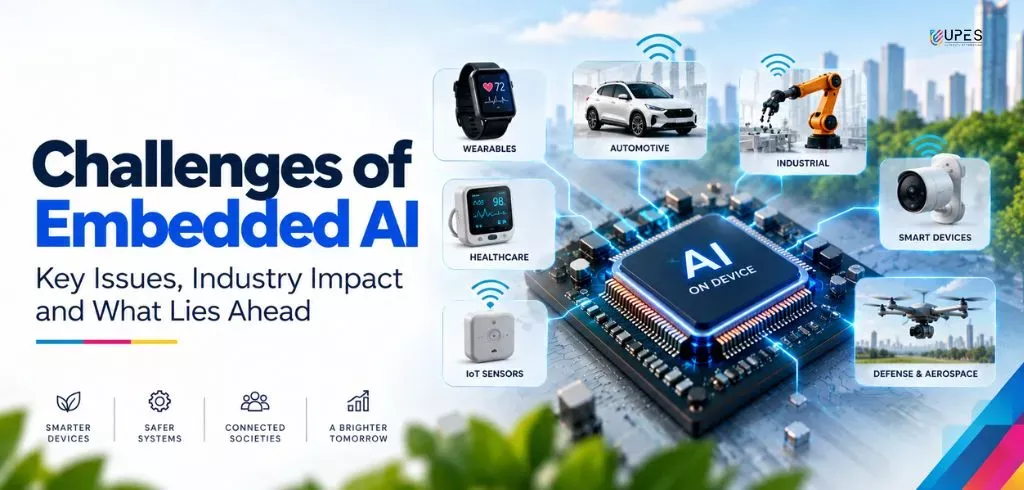
Embedded AI is difficult to deploy because devices have limited processing power, memory, storage, battery capacity, and thermal headroom. Embedded AI systems introduce artificial technology among physical devices such as smartwatches, mobile phones, cameras, automobiles, and more. However, to make these devices work efficiently with AI, these systems are required to process data in much strict limits on memory, computing power, energy use, response time and cost. Therefore, while developing efficient AI systems engineers must ensure that the data processes smoothly on real hardware.
What is an Embedded AI System?
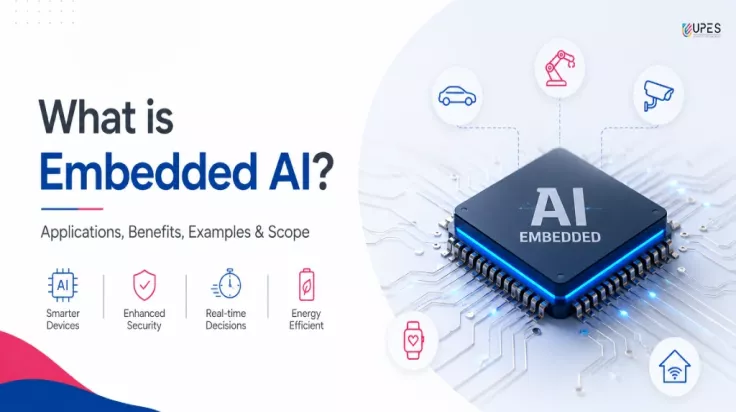
Embedded AI refers to the integration of artificial intelligence capabilities into embedded devices so that AI models can perform inference locally on the device or at the edge. Embedded AI systems are designed to operate within constraints such as limited processing power, memory, energy, storage, and latency.
Key Challenges of Embedded AI Systems
Unlike cloud-based artificial technology that allows for larger data storage, and limited power constraints, embedded AI systems pose significant challenges among engineers in developing smart and efficient systems. While Embedded AI has several advantages, the technology also poses significant challenges such as:
1. Limited Processing Power
Embedded AI systems have processing limitations since many AI models require more computing power and memory than compact; low-power devices can offer. This can make real-time processing difficult and may generate excessive heat. Limited storage, slower CPUs, and temperature limits can all impact how fast and reliably embedded systems do complicated AI tasks.
2. Memory and Storage Constraints
Restricted memory and storage used in embedded AI systems can cause significant data processing constraints, since small CPUs may only provide kilobytes or megabytes of accessible space. This limits the size of the AI models that can be run and makes it difficult to retain the data required for processing. Additionally, memory bandwidth and wasteful memory use can have an impact on performance and real-time operation.
3. Power Consumption and Battery Life
Running complex AI tasks can quickly drain the limited batteries used in small devices, raising significant power consumption and battery life challenges with embedded AI. Gadgets such as smartwatches and security cameras have little space for larger batteries, while AI processing requires continuous calculations that make the processor work harder and consume more power.
4. Real-Time Latency Requirements
Embedded AI systems like self-driving vehicles and industrial robots require rapid data processing and decision-making capabilities. However, limited processing power and memory might cause complicated AI models to run slowly. To guarantee AI systems respond quickly, developers must balance speed, accuracy, and model size, while also handling memory problems.
5. Balancing Model Accuracy with Resource Efficiency
Balancing model accuracy and resource efficiency in embedded AI refers to selecting an AI model that produces consistent results without surpassing the device's capabilities. Small gadgets typically have limited memory, computing power, battery life, and cooling capacity. To ensure that the technology works effectively on small systems, engineers are required to maintain a balance between model size, accuracy, speed, power consumption, and real-time performance.
6. Data Quality and Real-World Variability
Sensors used in embedded AI systems can often produce noisy, missing, or incorrect data, while several environmental changes such as weather, temperature, and location can affect performance. Additionally, these sensors may also wear out over time, creating data drifts. At the same time, limited memory, battery power, and processing speed make it difficult to handle complex data quickly, especially when instant decisions are needed.
7. Hardware-Software Integration
As Embedded AI systems have limited memory, power, and processing capacity, integrating hardware and software devices can be especially challenging for engineers and developers, as AI models are often required to be compressed to fit. Furthermore, embedded AI systems also need to manage heat, respond quickly, and work reliably with different hardware and software. Strong security and regular updates are equally important to keep these systems safe and functional.
8. Security and Privacy Risks
Since AI is directly processed on the device, embedded AI systems on devices provide significant security and privacy threats. Weak firmware or network security can allow attackers to access or modify equipment, whilst specifically prepared inputs can deceive AI models. Devices may also store or communicate sensitive information, such as health or camera data, which can be exposed if not adequately secured.
9. Reliability, Safety and Explainability
Embedded AI systems can be difficult to make reliable, safe, and easy to understand. Unlike traditional software, AI can produce uncertain results and may become less accurate as conditions change. In safety-critical devices, such errors can cause serious problems. AI models can also act like “black boxes,” making it harder for engineers to explain decisions, detect failures, or meet safety requirements.
10. Model Updates, Maintenance and Lifecycle Management
Managing embedded AI systems throughout their lifecycle can be difficult because devices are frequently distant and rely on unstable networks. AI models may require constant updates as real-world situations change, whereas hardware might age and become obsolete. Maintaining security, monitoring device performance, and safely upgrading big fleets necessitates thorough testing and administration.
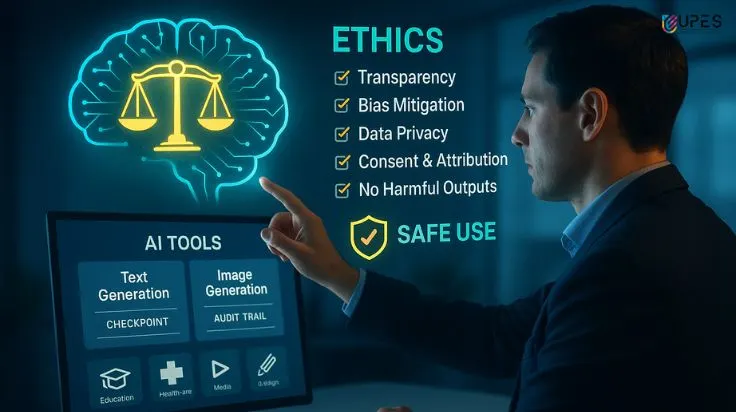
11. Ethical and Regulatory Challenges
AI models may produce biased or unclear results, creating fairness and accountability issues, and significant ethical and regulatory challenges. Privacy is another concern when devices collect personal information from users. Regulations also vary across industries, making compliance difficult, especially when devices receive frequent updates or lack common safety and ethical standards.
Challenges in Embedded Systems Beyond AI Technology
While developers face several technological challenges in terms of memory, power processing, and privacy risks. There are several operational challenges with deploying embedded AI systems such as cost of development, hardware, and issues with scalability:
Embedded-systems challenge | Impact on AI-enabled devices |
Cost constraints | Limits processor, memory and sensor choices |
Thermal limits | Can reduce sustained AI performance |
Hardware durability | Affects use in industrial, outdoor or automotive settings |
Connectivity limitations | Requires offline or edge-processing capability |
Device size | Restricts battery and component capacity |
Scalability | Makes testing and updating large device fleets difficult |
Compliance | Adds design and documentation requirements |
How Engineers are Addressing Embedded AI Challenges
Engineers use different approaches of addressing different embedded AI challenges including:
Challenge | Common approaches |
Limited compute | Lightweight models, hardware acceleration |
Memory constraints | Quantization, pruning, distillation |
Power consumption | Dynamic power management, event-driven processing |
Latency | Edge inference, NPUs, model optimization |
Accuracy/resource trade-off | Quantization-aware training, model selection |
Security | Secure boot, encryption, signed updates |
Maintenance | OTA updates, rollback mechanisms |
Let's explore some of the key challenges and common approaches used by modern engineers to tackle challenges with embedded AI:
1. Selecting the Right Model for the Device
Engineers often select AI models for embedded systems by balancing accuracy against available memory, power, and computing speed. They frequently choose lightweight models created for smaller hardware and use techniques such as quantization, pruning, and knowledge distillation to reduce model size. Optimized runtimes and hardware accelerators can increase speed and efficiency while maintaining real-time performance reliability.
2. Using Edge AI and TinyML Techniques
Edge AI and TinyML provide artificial intelligence directly to small devices, rather than relying on the cloud. Engineers employ pruning algorithms and low-power NPUs to efficiently tackle demanding workloads. Smart sensors can process data locally, allowing devices to save power, respond rapidly, and function consistently with little memory.
3. Optimizing Hardware and Software Together
Engineers are now tackling embedded AI concerns by combining hardware and software design to handle performance, power, memory, and response time issues. Engineers utilize specialized hardware like NPUs and FPGAs to accelerate AI operations, while event-driven processing and dynamic power management save energy.
4. Testing in Real Operating Conditions
Embedded AI systems are now tested under realistic settings to ensure their reliability before deployment. Hardware-in-the-loop testing measures speed, timing, and heat. Shadow mode allows systems to learn from real sensor data without commanding the device. Stress testing also helps identify issues caused by unexpected inputs, memory restrictions, power outages, and large workloads.
5. Building Security from the Start
Embedded AI systems have limited resources and may operate for many years. Therefore, engineers are required to build security systems from the start. Engineers use secure boot and hardware-based security to protect firmware, AI models, and encryption keys. Furthermore, they also optimize models to reduce resource use and monitor devices for unusual activity, helping detect tampering, data poisoning, and other threats.
6. Planning for Monitoring and Updates
Managing embedded AI after deployment requires continued monitoring and secure, dependable updates. To reduce risk and bandwidth usage, engineers generally deploy backup system partitions, automated rollbacks, and smaller differential updates. Encryption, hardware-based key protection, and digital signatures are all security techniques that serve to prevent tampering and unauthorized software.
Industry Adoption of Embedded AI
Embedded AI is no longer just for research labs or experimental projects; it is becoming an essential component of the technology you use every day. From smartwatches and healthcare devices to self-driving cars, industrial machinery, and smart cities, embedded AI allows systems to make faster and more intelligent decisions in real time. As businesses implement intelligent and connected technologies, professionals with embedded AI skills will play an important role in designing dependable, efficient, and future-ready solutions.
Industry | How Embedded AI Is Used | Common Examples |
Automotive | Processes camera, radar, and sensor data inside vehicles for real-time driving assistance and safety decisions | ADAS, driver monitoring, lane detection, emergency braking |
Healthcare | Enables continuous monitoring and early detection without sending all patient data to the cloud | Smartwatches, portable ECG monitors, glucose monitors, hearing aids |
Manufacturing | Monitors machine health, inspects products, and predicts failures directly on factory equipment | Predictive maintenance, visual defect detection, robotic automation |
Consumer Electronics | Personalizes devices and enables intelligent features with lower internet dependence | Smartphones, smart TVs, earbuds, cameras, home appliances |
Retail | Supports faster inventory tracking, customer analytics, and automated checkout | Smart shelves, cashier less checkout, footfall analysis |
Aerospace | Supports real-time navigation, equipment monitoring, fault detection, and autonomous decision-making | Flight-control systems, onboard diagnostics, unmanned aerial systems |
Defense | Enables autonomous systems to operate in low-connectivity or high-risk environments | Surveillance drones, target recognition, navigation systems |
Telecommunications | Improves network performance by analyzing traffic and faults close to network hardware | Edge-based network optimization, anomaly detection, 5G infrastructure |
Agriculture | Uses local sensors and cameras to support faster farming decisions | Smart irrigation, crop monitoring, pest detection |
Logistics | Helps robots, scanners, and tracking systems make real-time operational decisions | Warehouse robots, route optimization, automated sorting |
Embedded AI vs Cloud AI: Key Differences
Unlike traditional cloud AI, where data is processed on remote cloud servers, with large to unlimited storage and memory, embedded AI is processed locally on to the device to produce instant responses. The key differences among the two can be explained from the table below:
Factor | Embedded AI | Cloud AI |
Processing location | On-device or near the device | Remote cloud servers |
Computing resources | Limited | Usually scalable |
Latency | Must often be very low | Depends on network connectivity |
Internet dependency | Can work offline | Often relies on connectivity |
Power constraints | Critical for battery-operated devices | Less constrained at server level |
Updates | More complex after deployment | Easier to update centrally |
Privacy | Can keep data local | May involve data transmission |
What Skills are Required to Work on Embedded AI Systems
If you are planning to pursue a career in embedded AI, you must possess key technical skills in artificial intelligence, programming languages, and TinyML. The following are some of the key skills required to work on embedded AI systems:
Skill area | Why it matters |
Embedded C/C++ and Python | Supports firmware, device logic and AI prototyping |
Machine learning fundamentals | Helps select, train and evaluate models |
TinyML and model optimization | Enables AI deployment on constrained devices |
Microcontrollers and processors | Supports hardware-aware development |
Sensors and IoT | Helps collect and interpret real-world data |
Computer vision or signal processing | Relevant for cameras, audio and sensor applications |
Cybersecurity basics | Supports secure device and data design |
Testing and debugging | Essential for reliable real-world deployment |
Cloud and edge computing | Helps build hybrid device–cloud architectures |
Career Opportunities in Embedded AI Systems
Embedded AI systems offer engineering graduates plenty of career opportunities in areas such as software development, computer vision, IoT, robotics, and more. The following are some of the popular career paths you can take:
Role | Indicative salary in India |
Embedded Software Engineer | INR 7.1 to 7.9 LPA |
Computer Vision Engineer | INR 11 to 12.1 LPA |
Systems Engineer | INR 5.5 to 6 LPA |
IoT Developer | INR 6.8 to 7.5 LPA |
Robotics Engineer | INR 5.2 to 5.7 LPA |
Firmware Engineer | INR 10.9 to 12.1 LPA |
Automotive Software Engineer | INR 5.9 to 7.7 LPA |
Embedded-Systems Engineer | INR 6.8 to 7.5 LPA |
| Source: Naukri, Ambitionbox, Glassdoor | |
Note: Salaries may vary based on different factors including experience, skill level, organization, etc. The above-mentioned salaries are sourced from AmbitionBox data.
Future of Embedded AI Systems
Engineers currently confront substantial power, energy, and latency difficulties while designing smart embedded AI models. The future of embedded AI relies on overcoming difficulties including limited computer capacity, energy consumption, latency, data drift, safety, and cybersecurity. Instead of depending solely on massive cloud-based models, future systems will employ smaller, more specialized models capable of making quick, trustworthy judgments directly on devices. The most effective solutions will incorporate edge intelligence, secure cloud support, continuous monitoring, and human-centered safety controls. The following are some of the future possibilities in embedded AI:
1.More Efficient AI Accelerators
More efficient AI accelerators, such as NPUs, TPUs, and low-power FPGAs, are making embedded AI faster and more realistic by allowing for strong processing within tight power and space constraints. Furthermore, TinyML technology advancements enable AI for small, battery-powered devices.
2. Growth of Edge AI and TinyML
Continuous progress in Edge AI and TinyML have allowed engineers to deploy AI algorithms and data processing directly onto the devices instead of hosting data on a remote server. Further advancements in Edge AI and TinyML help engineers achieve lower latency, improve power efficiency, and enhance privacy.
3. On-device Personalization
On-device personalization enables embedded AI to learn user behaviors and preferences without transferring private data to the cloud. This enhances privacy, speeds up responses, and enables customizing even without an internet connection.
4. AI-enabled Robotics and Automation
Edge AI and TinyML in embedded AI systems reduce latency, while NPUs, TPUs, and FPGAs aid achieve efficient processing. In robotics, sensor fusion enables machines to adapt to changing circumstances. These technologies also provide real-time control, predictive maintenance, and more efficient energy management.
5. Smarter Industrial IoT Systems
Embedded AI and Industrial IoT work together to help factories process data locally, make faster decisions, and reduce reliance on the cloud. Security features such as secure boot and encrypted firmware also help protect smart industrial systems from cyber threats.
6. Privacy-focused On-device Processing
The future of embedded AI is shifting toward privacy-conscious on-device processing, in which AI tasks operate locally rather than transferring sensitive data to the cloud. This method provides increased privacy, faster answers, offline reliability, and lower energy use.

Our counsellors are just a click away.
Conclusion
Embedded AI offers faster, more efficient, and privacy-focused intelligence by processing data closer to where it is generated. However, limited computing resources, memory, power, latency, security, and scalability create deployment challenges. Lightweight models, hardware acceleration, TinyML, edge processing, secure updates, and continuous testing can help engineers build reliable, embedded AI systems.
FAQs
What are the major challenges faced by embedded AI systems?
- Embedded AI systems present issues because they must give AI capabilities within tight constraints on computing power, memory, storage, and energy. Unlike cloud-based AI, which runs on powerful servers, embedded AI is often run on low-power microcontrollers or edge processors. These constraints necessitate effective resource utilization, minimal power consumption, and rapid real-time processing for dependable performance.
What are the advantages of embedded systems?
- Embedded systems offer several advantages because they are designed for specific tasks. Their optimized hardware and software provide fast, reliable performance while using less power, making them suitable for battery-powered devices. Embedded can also reduce production costs and provide predictable real-time responses for applications such as robotics, automotive systems, and medical devices.
What are embedded AI system examples?
- Some of the popular examples of embedded AI systems include self-driving cars, smartwatches, washing machines, anti-lock braking systems, and smart doorbells.
What is TinyML in embedded systems?
- TinyML, or Tiny Machine Learning, is a branch of AI that runs machine learning models directly on small, low-power devices such as microcontrollers. Unlike traditional AI, which often depends on cloud servers, TinyML processes data and makes predictions locally on the device.

UPES Editorial Team
Written by the UPES Editorial Team
UPES Admission Enquiry
Trending Post
-

Full Stack Developer Interview Questions- Freshers to Experienced & High Level
08/08/2025By UPES Editorial Team
-

Gender Digital Divide: Challenges in Undergraduate Computer Science Programs
29/09/2025By Dr. Avita Katal
-

How to Create a Web Developer Portfolio & Why is it important (Examples, Templates, Ideas, Content & Website)
11/02/2025By UPES Editorial Team


Related Articles


















































Subscribe to UPES Blogs
Join our community for exclusive stories, insights, and updates
By clicking the "Subscribe" button, I agree and accept the privacy policy of UPES.


