What is ESG in Business? Importance, Key Components, Examples, Related Concepts
- UPES Editorial Team
- Published 01/09/2026


- What is ESG in Business?
- What are the Three Components of ESG
- Why is ESG Important for Business?
- Examples of ESG in Everyday Business Operations
- How is ESG Measured, Reported and Common ESG Metrics?
- ESG Reporting in India: What is BRSR?
- Top ESG Careers in India
- Skills Needed for ESG Careers
- ESG vs CSR: What is the Difference
- How Can a Business Develop an ESG Strategy?
- Related Concepts You Should Know
Businesses today are expected to do more than generate profits. Investors, customers, employees, and regulators increasingly evaluate companies based on how responsibly they operate. Environmental, Social, and Governance (ESG) has emerged as a framework that helps businesses measure their sustainability efforts, ethical practices, and long-term value creation. According to PwC's Global Investor Survey, three-quarters of surveyed investors said that how companies manage sustainability-related risks and opportunities is an important factor in investment decision-making. Ensuring an effective ESG strategy enables organizations to balance financial performance with social and environmental responsibility. Let’s explore what is ESG in business and its importance with this article.
Become future-ready with our Business programs
Know MoreWhat is ESG in Business?
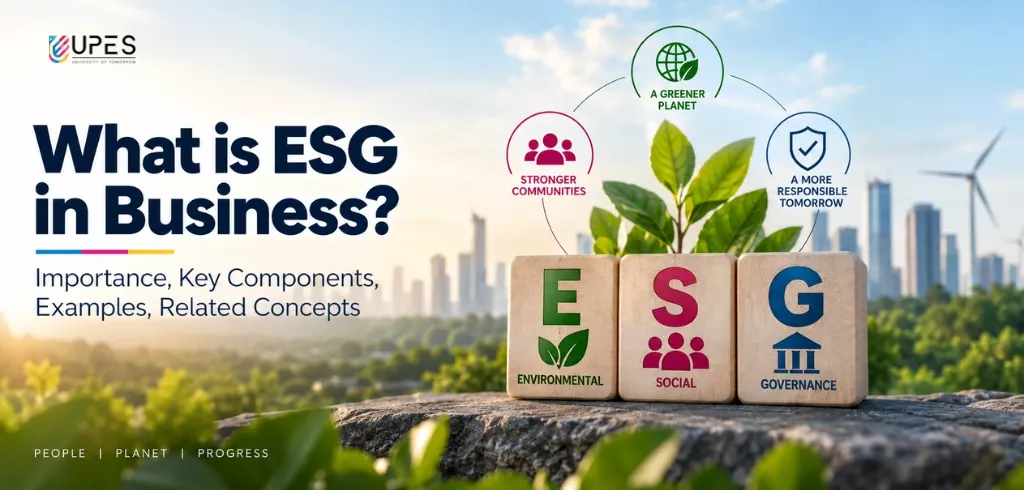
ESG stands for Environmental, Social, and Governance. In business, ESG refers to environmental, social and governance factors used to understand how a company manages sustainability-related risks, opportunities and responsibilities. It covers issues such as emissions and resource use, workforce practices, human rights, business ethics, board oversight, transparency and accountability.
In simple terms, ESG provides businesses and stakeholders with a structured way to evaluate how environmental, social and governance issues are managed alongside broader business objectives.
| ESG Pillar | What It Covers | Examples |
| Environmental | Impact on and dependence on the environment | Emissions, energy, water, waste, biodiversity |
| Social | Relationships with employees, customers, suppliers and communities | Safety, diversity, human rights, labor practices |
| Governance | How the business is directed and controlled | Board oversight, ethics, audits, executive compensation, anti-corruption |
What are the Three Components of ESG
ESG comprises three main components, including Environmental, Social, and Governance. Together, these provide organizations with a constructive plan to manage their operations and take on responsibilities across different sectors. Let's understand these three factors in detail here:
Environmental Factors
Environmental factors examine how a business affects and depends on the natural environment. Common areas include greenhouse-gas emissions, energy consumption, climate-related risks, water use, waste management, pollution, resource efficiency and biodiversity.
Social Factors
Social components of ESG define how an organization treats people; this can include stakeholders, employees, and even members of the society. Organizations incorporate social components with inclusive policies, non-discriminatory rules, offering a safe space for people, maintaining safe working conditions, protecting human rights, and timely engagement with local communities.
Governance Factors
Governance factors examine how a company is directed, controlled and held accountable. They can include board composition and independence, executive compensation, shareholder rights, audit practices, business ethics, anti-corruption controls, risk management and transparency.
Why is ESG Important for Business?
Modern businesses are increasingly adopting effective ESG practices as they help businesses establish long-term financial performance, identify operational risks, and meet potential investor expectations.
1. Helps improve risk management: ESG frameworks allow organizations to identify risks related to the supply chain, environmental impact, reputational risks, and regulatory penalties. Using ESG, companies can assess these risks in advance to maintain their image, ensure accountability, and foster long-term business relationships.
2. Supports investors and capital: Clear ESG governance, measurable targets and transparent disclosures can help investors better understand how a company manages sustainability-related risks and opportunities.
3. Improves brand reputation: An organization actively taking steps to improve social interactions, community collaboration, and environmentally cautious decisions is likely to have a positive reputation and long-time trust among consumers and stakeholders alike.
4. Supports employee retention: The modern workforce prefers to work for organizations that provide economic, social, and professional security with transparent policies. Fair wages, employee rights, and a smooth grievance resolution process encourage employees to remain with the organization for a long period of time.
5. Encourages long-term business growth: By adopting sustainable and responsible business practices, companies can reduce costs, use resources more efficiently, and improve the way they operate. ESG also encourages innovation by helping businesses find smarter and more sustainable ways to grow. This not only benefits the environment and society but also supports long-term business success and financial stability.
Examples of ESG in Everyday Business Operations
ESG framework examples are widespread across daily business operations, as more and more companies are adopting sustainable measures and maintaining professional integrity. The following table provides some common examples of ESG:
| ESG component | Business practice | Potential Business Benefit |
| Environmental | Using renewable energy in offices or factories | Lower emissions and energy risk |
| Environmental | Reducing packaging and production waste | Lower material and disposal costs |
| Social | Introducing employee safety and wellness programs | Better retention and productivity |
| Social | Auditing suppliers for fair labor practices | Reduced supply-chain and reputation risk |
| Governance | Appointing independent board members | Stronger oversight and accountability |
| Governance | Publishing transparent ESG reports | Greater stakeholder and investor trust |
Real World ESG Examples
The following are some of the real-world examples of ESG practices among corporations:
1. Microsoft’s renewable energy and carbon reduction policy: Microsoft has set goals to become carbon negative, water positive, and zero waste by 2030.
- ESG area: Environmental
- Key practices: Renewable energy, carbon removal, water conservation, and waste reduction.
2. Tata Group’s commitment to decarbonization, circularity and nature conservation: Through its ESG initiative, Project Aalingana, Tata Group aims to achieve net-zero emissions by 2045.
- ESG area: Primarily environmental, supported by group-level governance
- Key practices: Net-zero planning, circular economy, renewable energy, and ecosystem restoration.
3. Infosys working for carbon neutrality, digital skills and board oversight: According to Infosys' FY2025–26 annual/ESG reporting, the organization remained carbon neutral for the seventh consecutive year. Additionally, the company also reported having reached over 15 million people through digital-skilling initiatives and enabling over 220,000 individuals with job offers.
- ESG areas: Environmental, social, and governance
- Key practices: Carbon neutrality, digital education, community development, and independent board oversight.
Read More: Building a Green & Sustainable Engineering Careers: Skills, Education, Preparation & Challenges
How is ESG Measured, Reported and Common ESG Metrics?
ESG is measured by looking at both numbers and business practices. This includes factors such as a company's carbon emissions, water usage, workforce diversity, and its policies on ethics and sustainability. Companies usually share this information in sustainability reports, which are then reviewed by rating agencies to assess how responsibly and sustainably the business operates. These assessments help investors, customers, and other stakeholders understand a company's long-term performance and potential risks.
How is ESG Measured?
The following methods are used to measure different components of an ESG policy:
| ESG component | How it is measured |
| Environmental | Tracking greenhouse gas emissions, energy consumption, waste diversion/recycling rates, and water usage. |
| Social | Assessing employee turnover rates, health and safety records, gender and ethnic pay equity, and diversity of of metrics across all levels of employment. |
| Governance | Evaluating board independence, executive compensation structures, whistleblower programs, and data privacy and cybersecurity safeguards. |
How is ESG Reported?
Companies bring together information and ESG data in sustainability reports, annual reports, or other official disclosures. To make the data reliable and easy to compare, they follow widely accepted global reporting standards such as Global Reporting Initiative standards, SASB, Task Force on Climate-related Financial Disclosures, and BRSR standards. This helps investors, customers, and other stakeholders better understand a company's sustainability efforts and overall business performance.
What are Common ESG Metrics?
The following are common ESG Metrics used for evaluations:
| Pillar | Example Metrics |
| Environmental | Scope 1, 2 and relevant Scope 3 emissions; energy use; renewable energy share; water withdrawal; waste generated/recycled |
| Social | Employee turnover; injury rates; workforce diversity; training; pay equity; human-rights/supplier indicators |
| Governance | Board independence; board diversity; executive compensation; ethics violations; whistleblower mechanisms; audit/risk oversight |
Is There a Universal ESG Score?
There is no single universal ESG score or measurement system. Businesses typically identify relevant ESG issues, select appropriate KPIs and collect quantitative and qualitative data. ESG rating providers may use different datasets, methodologies and weightings, which means the same company can receive different ESG assessments from different providers.
ESG Reporting in India: What is BRSR?
The Business Responsibility and Sustainability Report (BRSR) is an ESG-related disclosure framework prescribed by the Securities and Exchange Board of India (SEBI) for applicable listed entities. It requires disclosures across environmental, social, governance and responsible-business topics. BRSR reporting became mandatory for the top 1,000 listed entities by market capitalisation from FY 2022–23.
SEBI has also introduced BRSR Core, a subset of key ESG indicators designed to improve the reliability and comparability of sustainability disclosures. Its applicability has been introduced through a phased framework.
ESG reporting-framework
| Standard / Framework | Primary Focus | Relevant For |
| GRI Standards | Organisational impacts on economy, environment and people | Broad sustainability/impact reporting |
| IFRS S1 | Sustainability-related financial disclosures | Investor-focused reporting |
| IFRS S2 | Climate-related financial disclosures | Climate risks and opportunities |
| SASB Standards | Industry-specific sustainability topics | Industry-based investor information |
| BRSR | Business responsibility and sustainability disclosure in India | Applicable Indian listed entities |
Top ESG Careers in India
If you are pursuing ESG course in India, you can work analyst, research, and management roles. In the following table, we have provided the list of top ESG roles along with indicative salaries:
| Job Role | Indicative Salary in India |
| ESG Analyst | INR 5.4 to 6 LPA |
| ESG Consultant | INR 5.9 to 6.5 LPA |
| Sustainability Manager | INR 18.5 to 20.5 LPA |
| Sustainability Analyst | INR 7.9 to 9.1 LPA |
| ESG Data Analyst | INR 3 to 8 LPA |
| ESG Research Analyst | INR 4.9 to 5.5 LPA |
| Strategy Consultant | INR 25 to 27.5 LPA |
Note: Salaries may vary based on several factors such as experience level, skill set, organization, etc. The above-mentioned figures are sourced from AmbitionBox and Glassdoor data.
Skills Needed for ESG Careers
The following are essential skills needed to succeed in ESG careers:
| Skill | Why It Matters |
| Sustainability reporting | Preparing and interpreting ESG disclosures |
| Data analysis | Measuring ESG KPIs and trends |
| Climate literacy | Understanding emissions and climate risks |
| Finance | Connecting sustainability risks with business decisions |
| Regulation | Understanding ESG disclosure requirements |
| Stakeholder management | Working across investors, employees, suppliers and communities |
| Business strategy | Integrating ESG goals into operations |
ESG vs CSR: What is the Difference
ESG and CSR overlap but are not the same. Corporate Social Responsibility (CSR) generally refers to a company's policies, responsibilities and initiatives relating to society and the environment. ESG provides a broader framework for evaluating environmental, social and governance issues through business practices, risks, metrics and disclosures. ESG information is also frequently used by investors and other stakeholders to assess companies.
| ESG | CSR |
| A framework for evaluating environmental, social and governance performance | A company’s broader commitment to social and ethical responsibility |
| Often connected with measurable indicators and disclosures | May include volunteering, donations and community programs |
| Frequently considered by investors and regulators | Frequently associated with corporate values and social initiatives |
| Integrated into risk management and business strategy | May operate as a separate organizational program |
ESG vs Sustainability
Sustainability is a broad concept concerned with meeting present needs without undermining environmental, social and economic well-being in the future. ESG is a framework used to evaluate specific environmental, social and governance factors relevant to a business. In simple terms, sustainability describes a broader objective, while ESG provides a structured way to assess and disclose related business issues.
How Can a Business Develop an ESG Strategy?
Building a strong ESG strategy starts with understanding where a business stands today. Companies need to identify the sustainability issues that matter most to their business and stakeholders and set clear goals to address them. It is also important to track progress using recognized global reporting standards and reliable data collection methods. Regularly reviewing and reporting ESG performance helps businesses stay transparent, accountable, and focused on long-term improvement.
1. Assess current practices: Before setting up a new ESG goal, companies must assess what policies they currently have in effect.
2. Identify critical ESG issues: Companies must identify which ESG issues are most critical to their brand and where they want to improve. This helps in managing where the business can make the most impact.
3. Set measurable goals: Based on the issues you want to address, set clear and measurable goals. Additionally, businesses should also break these goals into KPIs to maintain accountability.
4. Select the right reporting framework & requirements: Businesses should determine which sustainability disclosure standards or regulatory requirements apply based on their jurisdiction, stakeholders and reporting objectives. Depending on the organisation, relevant approaches may include GRI Standards, IFRS S1/S2, SASB industry guidance or India's BRSR requirements.
5. Assign governance and accountability: Form a dedicated internal committee to offer strategic guidance. The committee may include senior executives and board members, and operational responsibilities can be shared between departments such as finance, operations, HR, and procurement.
6. Create an implementation plan: Companies should incorporate ESG into larger corporate plans. Organizations should involve department leaders in ensuring that the ESG standards are followed and prioritized as per the timeline.
7. Report, review and improve: Define KPIs for each component; for instance, you can establish metrics to measure carbon emissions, water usage, labor practices, diversity, and board accountability to track environmental, social, and governance for a project.
Challenges of Implementing ESG
Implementing ESG can involve challenges such as inconsistent data, changing disclosure requirements, difficulties measuring value-chain emissions, differences between ESG rating methodologies, reporting costs and uncertainty about which sustainability issues are most material to the business.
Companies therefore need clear governance, reliable data, transparent methodologies and appropriate internal controls when setting and communicating ESG objectives.
Related Concepts You Should Know
Along with ESG, there are several similar concepts and business practices that support responsible business operations. Let’s have a quick look at them here:
Sustainability
Sustainability means meeting today's needs without harming the ability of future generations to meet their needs. It encourages businesses to balance economic growth with environmental responsibility and social well-being. This approach, often called the "triple bottom line," focuses on creating value not just through profits, but also by making a positive impact on people and the planet.
Corporate Social Responsibility (CSR)
CSR is a business approach that encourages companies to contribute positively to society and the environment. It includes activities such as supporting community initiatives, promoting ethical workplace practices, and adopting environmentally responsible operations.
ESG Investing
ESG investing is an approach that looks beyond financial performance when making investment decisions. It considers how responsibly a company operates by evaluating its environmental, social, and governance practices. Many investors use ESG factors to identify businesses that are better prepared for long-term growth, manage risks effectively, and create a positive impact. It can form part of broader sustainable-investment approaches.
Impact Investing
Impact investing is an investment approach that aims to create positive social and environmental change while also generating financial returns. Investors intentionally support businesses and projects that address challenges such as sustainability, education, healthcare, or climate change.

Our counsellors are just a click away.
Conclusion
ESG provides businesses with a structured way to identify, manage and communicate environmental, social and governance issues that may affect the organisation, its stakeholders and wider society. Effective ESG management requires more than setting sustainability goals, it depends on identifying material issues, establishing accountability, collecting reliable data and reporting progress transparently.
FAQs
What is ESG in simple words?
ESG stands for Environmental, Social, and Governance. In simple terms, it is a way of understanding how responsibly a company operates. It looks at how a business cares for the environment, treats its employees and communities, and manages its leadership and business practices.
What is an example of ESG?
A simple example of ESG is a company that uses renewable energy to reduce its carbon emissions, provides fair wages and a safe workplace for its employees, and follows transparent and ethical business practices through an independent board of directors.
What are the 3 pillars of ESG?
The three pillars of ESG are Environmental, Social, and Governance. The Environmental pillar focuses on how a company manages its impact on the planet. The social pillar looks at how businesses treat their employees, customers, and communities. The Governance pillar focuses on how a company is managed, including ethical leadership, transparency, and accountability.
What are the top 3 ESG issues?
Some of the most important ESG issues for businesses today include climate change and carbon emissions, employee well-being and diversity, and corporate governance and transparency.
What is an ESG checklist?
An ESG checklist is a tool that helps businesses evaluate and improve their environmental, social, and governance practices. It includes key areas such as energy use, waste management, employee well-being, diversity and inclusion, ethical business practices, and data transparency.
What is Greenwashing in ESG?
Greenwashing occurs when environmental or sustainability claims create a stronger impression of positive performance than the underlying evidence supports. Businesses can reduce greenwashing risk by using specific and measurable claims, transparent methodologies, reliable data and appropriate review or assurance of sustainability disclosures.

UPES Editorial Team
Written by the UPES Editorial Team
UPES Admission Enquiry
Trending Post
-

-

Business Intelligence vs Data Analytics: Differences, Careers, Skills & Salary
05/10/2026By UPES Editorial Team
-


Related Articles































































Subscribe to UPES Blogs
Join our community for exclusive stories, insights, and updates
By clicking the "Subscribe" button, I agree and accept the privacy policy of UPES.


