Financial Technology Courses: Degree, Certifications, Short-Term & Career Outcomes
- UPES Editorial Team
- Published 31/07/2026


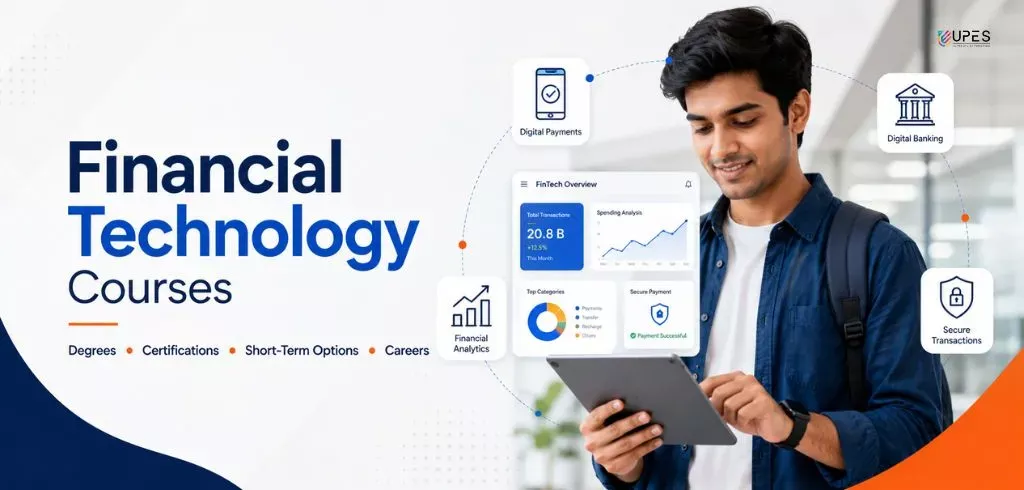
Indian economy is going through a digital revolution with widespread expansion of digital financial services giving boost to innovation and growth in FinTech or Financial Technology. UPI accounts for nearly 84% of India's digital retail payment transactions and processed approximately 22.7 billion transactions in June 2026 alone (Source- NPCI), creating significant demand for graduates who understand both finance and technology.
Students today are looking for emerging career opportunities in FinTech with high paying roles such as Fintech Product Manager, Blockchain Analyst, Digital Banking Specialist, Risk and Compliance Analyst. This shift has resulted into the growth of Financial Technology courses in India.
Become future-ready with our Business programs
Know MoreWhat are Financial Technology Courses?
Financial technology courses teach learners how technology is used to design, deliver and improve financial services. Depending on the course level, students may study digital payments, banking technology, financial analytics, artificial intelligence, blockchain, cybersecurity, regulatory technology, risk management and FinTech product development. These courses are available as undergraduate degrees, postgraduate programmes, professional certifications and short-term courses.
Financial Technology Courses in India at a Glance
| Course Type | Common Program options | Typical duration | Suitable for |
Undergraduate | BBA FinTech, B.Com FinTech, B.Tech with FinTech specialisation | 3–4 years | Class 12 students |
Postgraduate | MBA FinTech, M.Sc Financial Technology, M.Tech FinTech, PG diploma | 1–2 years | Graduates and professionals |
Certification | Digital payments, blockchain, FinTech analytics, RegTech | 2–12 months | Graduates and working professionals |
Short-term course | FinTech fundamentals, digital banking, UPI, blockchain basics | A few weeks to six months | Beginners and rapid upskilling |
What is Financial Technology?
Financial Technology, or more commonly known as FinTech, refers to the use of technology to deliver and improve financial products and services. In other words, FinTech combines finance, technology, data analytics, AI and digital infrastructure. FinTech allows consumers and businesses to access faster, convenient, and accessible financial solutions, ranging from mobile payment apps and digital banking to investment and wealth management services.
The following are some of the common categories and examples of financial technology:
Digital payments: Financial services for mobile applications such as PayPal, Apple Pay, PhonePe, Google Pay, and Paytm.
Mobile banking: Mobile-banking applications allow customers to open or manage accounts, transfer funds, pay bills, track expenses, access statements and use banking services remotely.
Investment & wealth tech: Mobile and web applications allowing consumers to invest in stock markets, automate investing actions, and recommend algorithm based financial advice. Examples include Groww, Zerodha, Robinhood, etc.
Lending and credit: P2P lending and credit platforms use algorithms to assess creditworthiness and sanction loans faster.
Cryptocurrency & Blockchain: Decentralized digital currencies and ledger networks that operate independently of central banks.
InsurTech: Digital insurance distribution, underwriting and claims
RegTech: Technology-assisted compliance and regulatory monitoring
WealthTech: Digital investments and portfolio management
Embedded finance: Financial services integrated into non-financial platforms
Open banking: Financial data exchange through APIs
Neo-banking: Digital-first banking services
Buy Now, Pay Later: Technology-enabled consumer credit
Cross-border payments: Digital remittances and international payment infrastructure
Cybersecurity and fraud prevention: Identity verification and transaction monitoring
Central bank digital currency: Digital sovereign currency systems
What are Financial Technology Courses?
FinTech education is essential in 2026, as digital skills are increasingly being implemented across financial and banking services. FinTech courses cover key areas such as blockchain, artificial intelligence, digital payments, and algorithmic trading. Often designed for students and working professionals, these programs offer students with industry-relevant skills such as financial data analysis, risk management, digital banking, and fintech innovation, preparing them for careers in the rapidly evolving financial services sector.
Types of Financial Technology Courses
Based on your learning objectives, level of education, and career prospect, there can mainly be three types of financial technology courses:
Financial Technology Degree Courses
FinTech degree courses are professional full-time programs that offer a comprehensive knowledge of the core financial technology concepts and are focused on offering long-term career prospects. Degree courses for FinTech are usually at two levels:
- Undergraduate Financial Technology Degree Courses: Typically for a duration of 3 years, these courses are focused on offering a strong foundation of FinTech concepts. Example, BBA in Financial Technology, B.Com in FinTech, B.Tech FinTech
- Postgraduate Financial Technology Degree Courses: Postgraduate FinTech programs offer a master’s degree in specialized subjects like Digital Banking, Financial Analytics and Blockchain Technologies, and an in-depth understanding of core subjects. These courses are generally delivered in 2 years. Example, MBA in Financial Technology, M.Tech in FinTech, M.Com in FinTech
Financial Technology Certification Courses
Certification courses for FinTech are specifically designed to offer a comprehensive skill development in Financial Technology and its different applications. These courses are typically designed for students and professionals alike who want to learn technology for practical use or upskilling purposes. Typically, the duration of these courses is from a few months to a year. After completion of the course, students receive a certificate of completion.
Short-term Financial Technology Courses
Short-term financial technology courses are designed to offer an introductory level knowledge of FinTech concepts and techniques. These courses are aimed at students who want to develop only the basic knowledge of the subject. The duration of such courses is generally only a few weeks or months.
Eligibility Criteria for Financial Technology Courses
Eligibility criteria for FinTech courses may differ based on the level of the course. You can check the detailed eligibility criteria here:
Course Type | General Eligibility |
Undergraduate degree (UG Degree) | Class 12 from a recognized board |
Postgraduate degree (PG Degree) | Bachelor’s degree from a recognized institution |
Fintech certification | Graduation or relevant professional experience, depending on the course |
Short-term course | Open to all students and professionals; requirements may vary |
How to Evaluate a Financial Technology Course
Students should compare the balance of finance, technology and practical learning before applying. A strong curriculum should include digital payments, financial analytics, regulation, cybersecurity and product innovation rather than focusing on only one emerging technology.
Check whether the program provides:
- Current FinTech curriculum
- Finance and technology balance
- Python, SQL or analytics exposure
- Digital-payments learning
- Cybersecurity and fraud-risk coverage
- Regulatory and compliance modules
- API or open-banking concepts
- Case studies and simulations
- Internships or capstone projects
- Faculty and practitioner exposure
- Placement and career support
Financial Technology Course Fees in India
| Course type | Indicative fee structure |
Short online course | Usually the lowest-cost route; varies by platform and course depth |
Professional certification | Depends on provider, assessment and duration |
Undergraduate degree | Multi-year tuition based on institution and programme format |
Postgraduate degree | Typically higher than short certifications because of academic depth and campus resources |
Executive programme | May carry premium fees because it targets experienced professionals |
What Skills are Taught in Financial Technology Courses
FinTech courses integrate financial concepts along with different technologies to enhance financial services. Students pursuing financial technology courses gain different finance, technical, analytical, and soft skills during a curated course. The following are some of the key skills that students gain:
| Particulars | Skills gained |
Programming and Software Engineering | Coding languages (R, Python, Java, JavaScript), database management, API integration |
Data Analytics and Visualization | Quantitative analysis using Python libraries and R, data visualization tools such as Tableau or Power BI |
Artificial Intelligence and Machine Learning | Predictive modeling, risk management, fraud detection, recommendation systems, and credit risk modelling. |
Blockchain and Distributed Ledgers | Cryptocurrency mechanics, smart contracts |
Regulatory Technology (RegTech) & Compliance | Compliance frameworks, anti-money laundering (AML), know-your-customer (KYC), and data protection laws |
Cybersecurity and Cloud Architecture | Encryption, secure API protocols, AWS, Azure |
What Should a FinTech Portfolio Include?
A portfolio helps students demonstrate that they can apply FinTech concepts rather than only describe them. Projects do not need to be commercially launched products; they should show structured problem-solving, data analysis, financial understanding and awareness of security and regulation.
Useful projects include:
- Digital-payment market analysis
- Fraud-detection model
- Credit-risk scoring project
- Financial dashboard
- Personal-finance application prototype
- Open-banking API concept
- Blockchain-based transaction case study
- FinTech product requirement document
- Regulatory-compliance checklist
- Customer journey for a digital-lending product
Common Subjects included in Financial Technology Courses
The following are some of the common subjects that students may study during a FinTech course:
- Financial markets and institutions
- Banking operations
- Digital payments
- Blockchain and distributed ledgers
- Artificial intelligence in finance
- Data science and analytics
- Financial modelling
- Cybersecurity
- Fintech regulations and compliance
- Product management
- Risk assessment
- Digital lending and credit scoring
- Embedded finance
- Open banking APIs
- Financial regulations
Career Prospects after Financial Technology Courses
After completing a Financial Technology course, students can pursue several promising careers in industries such as banking, finance services, FinTech companies, and more. The following are some of the top roles that students can explore:
Career stage | Example roles | What influences salary |
Entry level | FinTech Analyst, Business Analyst, Compliance Analyst | Qualification, internships, technical skills and location |
Early career | Financial Data Analyst, Digital Banking Specialist, Blockchain Analyst | Experience, domain expertise and company type |
Mid-career | FinTech Consultant, Risk Specialist, Product Analyst | Experience, domain expertise and company type |
Senior | FinTech Product Manager, Payments Lead, Digital Transformation Manager | Years of experience, business ownership and team scale |
Note: Salaries may vary based on factors such as roles, organization, level of experience, and industry. The above-mentioned salaries are sourced from Glassdoor.
How to Choose the Right Financial Technology Course
- Understand your skill level: Before joining a financial technology course, understand the skill level and determine which is best suited for you (UG, PG, Certification, or Short-term course).
- Assess curriculum: Secondly, go through the course curriculum to understand what will be covered and delivered throughout the program. Make sure the curriculum aligns with your learning objectives.
- Define objective: Understand and define your learning objective, what exactly do you wish to achieve with a course, a professional degree, or upskilling certification.
- Check practical exposure: Check for internships, capstone projects, simulations and industry assignments.
- Learning format: Compare classroom, online, hybrid and self-paced options.
- Recognition: Confirm the institution’s accreditation and the credibility of the certification.
Degree vs Certification vs Short-Term Fintech Course
Let’s have a look at the quick compression between degree, certification, and short-term FinTech courses:
Factor | Degree Course | Certification | Short-Term Course |
Duration | 2 to 3 years | A few months to one year | A few weeks to months |
Learning depth | Comprehensive | Specialized | Introductory or skill-focused |
Best suited for | Students seeking higher education and career switchers | Graduates and professionals | Beginners and working professionals |
Practical exposure | Projects and internships | Assignments and case studies | Limited practical exercises |
Career purpose | Building a long-term fintech career | Professional advancement | Rapid upskilling |
Which FinTech Degree Should You Choose?
| Learner goal | Suitable route |
Finance, management or product roles | BBA or MBA in FinTech |
Accounting, banking or financial analysis | B.Com with FinTech specialisation |
Software, blockchain or technical engineering roles | B.Tech or technology degree with FinTech exposure |
Financial data and quantitative roles | M.Sc Financial Technology, Data Science or Financial Analytics |
Working professional seeking specialisation | Certification or executive programme |
Beginner exploring the field | Short-term fundamentals course |
Future Scope of FinTech in India
The future of FinTech in India is likely to extend beyond payment applications into embedded finance, digital lending, open banking, regulatory technology, financial inclusion, AI-led risk assessment and secure digital identity. As financial services become increasingly integrated into retail, mobility, healthcare and digital platforms, employers will need professionals who can combine financial knowledge with product, data, technology and compliance skills.
Growth areas include:
- AI-assisted banking
- Embedded finance
- Fraud prevention
- RegTech
- Open-finance infrastructure
- Financial inclusion
- Digital lending
- WealthTech
- InsurTech
- Cross-border payments
- Cybersecurity
- Digital currency infrastructure

Our counsellors are just a click away.
Is FinTech Course Worth Pursuing in 2026?
Yes, pursuing a FinTech course in 2026 can be a worthwhile investment due to the growing demand for professionals who understand both finance and technology. FinTech programs equip learners with industry-relevant skills in artificial intelligence, blockchain, digital payments, cybersecurity, and financial data analysis, preparing them for careers across banking, fintech startups, consulting, and technology firms. They also open pathways to emerging roles such as FinTech Product Manager, Financial Data Analyst, Digital Banking Specialist, and Blockchain Analyst. With increasing focus on digital financial services, regulatory compliance, and financial innovation, FinTech professionals continue to enjoy strong career prospects, competitive salaries, and opportunities in both Indian and global job markets.
FAQs
What are Financial Technology courses?
Financial Technology (FinTech) courses combine finance, technology, and business concepts to teach learners about digital financial services, including blockchain, artificial intelligence (AI), digital payments, cybersecurity, financial analytics, and regulatory technologies. These programs prepare students for careers in banking, fintech startups, consulting, and financial services.
Which FinTech course is best after Class 12?
Students can pursue undergraduate programs such as BBA in Financial Technology, B.Com in FinTech, or B.Tech programs with FinTech specializations after Class 12. The best course depends on your career goals, BBA and B.Com are ideal for finance and management-oriented careers, while B.Tech is better suited for technology-focused roles in financial services.
Is an MBA in Financial Technology worth pursuing?
Yes, an MBA in Financial Technology can be valuable for professionals seeking leadership roles at the intersection of finance and technology. The program develops expertise in digital banking, fintech strategy, financial analytics, and innovation management, making graduates well-suited for managerial positions in a rapidly evolving industry.
What is the salary after a Financial Technology course?
Salaries vary based on the qualification, institution, job role, and work experience. In India, entry-level FinTech professionals can earn between ₹5–12 LPA (Glassdoor data), while specialized roles in areas such as data analytics, product management, blockchain, and cybersecurity may offer higher compensation packages.
Can working professionals pursue FinTech certification courses?
- Yes, many universities and online learning platforms offer flexible FinTech certification programs designed for working professionals. These courses allow learners to upskill in areas such as digital payments, blockchain, financial analytics, and AI while balancing their professional commitments.

UPES Editorial Team
Written by the UPES Editorial Team
UPES Admission Enquiry
Trending Post
-

ESG Reporting Software: Top Tools, Features, Benefits & How to Choose
15/10/2026By UPES Editorial Team
-

-

Business Intelligence vs Data Analytics: Differences, Careers, Skills & Salary
05/10/2026By UPES Editorial Team


Related Articles

























































Subscribe to UPES Blogs
Join our community for exclusive stories, insights, and updates
By clicking the "Subscribe" button, I agree and accept the privacy policy of UPES.


