Applications of Virtual Reality: Benefits, Platforms, Industries
- UPES Editorial Team
- Published 05/08/2026


- What is Virtual Reality?
- What are the Main Applications for Virtual Reality?
- Real World Applications of Virtual Reality
- The Core Benefits of Virtual Reality
- Leading VR Technologies that are Shaping Modern Industries
- Challenges in Virtual Reality Technology
- What Skills Are Needed to Work in Virtual Reality?
- Top Career Opportunities in Virtual Reality
- Conclusion
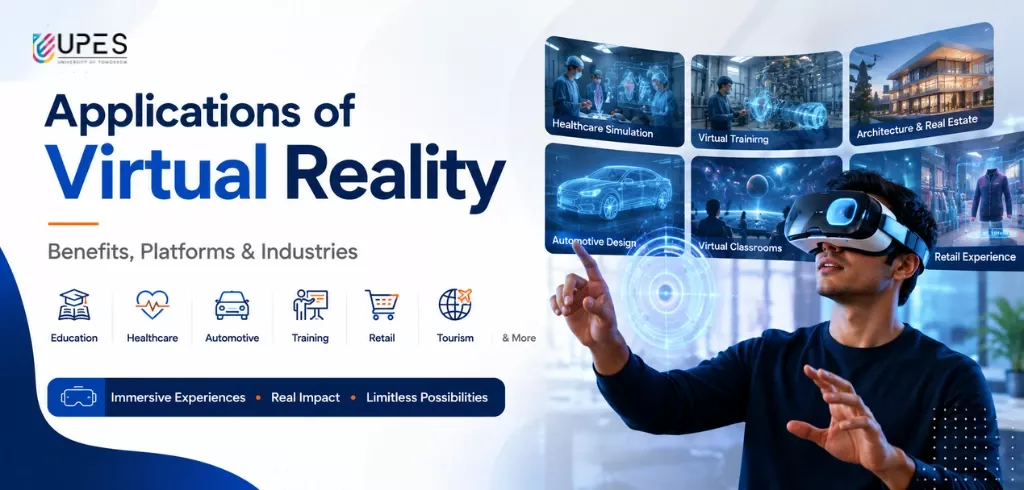
Whenever Virtual Reality (VR) technology is mentioned, most people immediately think of VR gaming and the metaverse. While the gaming industry is one of the fastest adopters of VR technology, the applications of virtual reality extend far beyond entertainment, with significant impact across healthcare, IT, automotive, and training industries.
By offering controlled, simulated, and interactive environments, VR enables companies to implement cost-effective, efficient solutions for corporate training while improving customer retention and user engagement. Read the article below to explore the various applications of virtual reality across industries, its benefits, and the challenges associated with the technology.
Become future-ready with our Advanced Engineering programs
Know MoreWhat is Virtual Reality?
Virtual Reality, or simply VR, is a computer-created digital world that lets you experience and interact with places, objects, and situations that may not exist in the real world. You usually use a VR headset along with motion sensors, controllers, or hand-tracking technology to look around and interact with the virtual environment. Depending on the VR system, you can use it while sitting, standing, or moving around within a tracked physical space.
What are the Main Applications for Virtual Reality?
Virtual Reality is used across many industries, including healthcare, education, automotive, manufacturing, retail, tourism, gaming, media, employee training, and software development. Organizations use VR to simulate real-world situations, train employees in safe environments, visualize products and spaces, improve customer experiences, and support remote collaboration. Its biggest advantage is that it allows people to experience and interact with realistic digital environments without being physically present at the location.
Real World Applications of Virtual Reality
With the expansion of artificial intelligence, machine learning, and computer technology, industries are adopting virtual reality to improve training, production, and management. The following table provides a quick look at common applications of VR technology across industries:
| Industry | Common VR Application |
| Education | Immersive lessons and simulations |
| Healthcare | Surgical training and rehabilitation |
| Automotive | Vehicle design and prototyping |
| Aviation | Pilot simulation |
| Retail | Virtual stores and showrooms |
| Tourism | Destination previews |
| Gaming | Immersive gameplay |
| Corporate Training | Scenario-based learning |
| Media | Virtual concerts and events |
Let’s explore the major real-world applications of virtual reality in detail here:
1. Education
The applications of virtual reality in the education sector involve improving student engagement, language learning, and older adult learning. The education sector leverages virtual reality to improve learning engagement, experiential learning, memory retention, spatial understanding, and language learning immersion. As per a recent study conducted at Tokyo Institute of Technology, adoption of VR-based language learning environments has significantly grown, with studies focusing on immersion, interaction, and contextual language acquisition. Furthermore, VR allows educators to reach remote locations through cost-effective measures.
2. Automotive
Automobile companies utilize VR technology to design and test vehicles before mass production and release in the market. As per Fortune Business Insights, the global VR market in the automotive industry was valued at USD 2.36 billion in 2023 and is projected to grow to USD 37.13 billion by 2032. The implications of virtual reality in the automotive industry include vehicle design, prototyping and testing, manufacturing and assembly, training and simulation, and virtual showrooms and customer experiences.
3. Software & IT
Applications of virtual reality in software & IT include developments such as VR SDKs, game engines, 3D modeling platforms, enterprise simulation software, and VR application development tools. According to the Global Growth Insights report, more than 61% of industries deploy VR software solutions in some form. Additionally, the virtual reality use cases in IT & software development encompass facets such as enterprise collaboration, employee training, cybersecurity and security testing, cloud-based VR, simulation software, and more.
4. Corporate Training & Employee Development
Organizations across industries are using VR technology for offering corporate training. The aviation industry uses VR-driven flight simulations to train pilots and cabin crews during the training period. Similarly, industries such as retail use VR technology to offer customer service training by simulating real-world scenarios. As per a PwC report, employees who went through VR training were 4 times faster to train than classroom learners and 275% more confident to apply skills.
5. Marketing
The marketing industry is one of the fastest VR- adapting sectors, utilizing this technology in customer engagement, improving brand recall, enhancing product visualization, creating virtual events, enabling experiential campaigns, and driving purchase intent. Brands use VR in virtual showrooms, digital storytelling, brand awareness, and product demos & training. According to the Econ Market Research, 81% of consumers who interacted with VR experiences were more likely to make a purchase.
6. Healthcare
Virtual reality has a growing impact on the healthcare industry, with meaningful applications across training, learning, and surgical practices. Healthcare professionals use VR for surgical training, anatomy education, rehabilitation, pain management, exposure therapy, and visualization of medical imaging. VR can also help clinicians and students explore reconstructed 3D models based on CT or MRI data for planning and training purposes. Furthermore, anatomy learning, emergency response training, neonatal resuscitation training, and remote healthcare education are among the areas where VR has significant applications in the healthcare industry.
7. Retail Industry
The retail industry has embraced VR technology to not only optimize complex tasks such as store management and supply chain management but also utilize VR simulations to improve customer support and experience through intense training programs for consumers as well as employees. Furthermore, immersive retail technologies, including VR and AR, support virtual showrooms, product visualization and virtual try-on experiences. VR technology also enables brands to offer virtual showrooms, product visualizations, and immersive shopping environments.
8. Gaming
The gaming industry has had massive effects due to progress in virtual reality technology. Gaming companies are developing VR video games that allow users to explore elaborate, detailed, and immersive virtual worlds. Through VR/AR headsets and gaming rooms, companies are now able to offer ultra-realistic gameplay experiences. As per a Business Research Company report, the global VR gaming market was valued at $24.33 billion in 2025 and is expected to grow to $31.92 billion by 2032 (CAGR of 31.2%).
9. Tourism
The global tourism economy has grown significantly thanks to developments in VR technology, 5G rollouts, and expansion of digital experiences. The applications of VR technology in tourism expand across sectors including destination marketing, hospitality booking, and cultural heritage preservation. As per a report by Research and Markets 2026, the VR in tourism market grew to $10.33 billion in 2026, rising with a compound annual growth rate of 38.1%. Tourism companies leverage VR technology through virtual tours, room previews, interactive travel booking, etc.
10. Media & Entertainment
While VR gaming is a starting point in the applications of virtual reality in the entertainment industry, the applications of the technology go beyond and also encompass media such as movies, concerts, and other virtual events. As per the YouGov 2023 report, globally around 36% of VR consumers preferred watching movies on VR. The report also signals that the demand for such entertainment channels is especially concentrated in the Asian market, with 56% demand among Indian VR users and 55% demand among users from China. Furthermore, virtual concerts are also gaining popularity among fans and artists, allowing them to have an immersive and personalized experience.
The Core Benefits of Virtual Reality
VR technology has revolutionized the modern tech and other industries, helping in every stage from training to execution. Let’s explore some of the key benefits of VR technology:
1. Enhanced immersion and engagement: Virtual reality technology greatly helps businesses in improving user engagement by offering a detailed, immersive, and interactive experience.
2. Safe simulation environments: Several industries such as healthcare and aviation use simulations during training and learning periods and offer real-world scenarios for intricate learning experiences for professionals.
3. Improved learning and retention: As per several studies, interactive learning methods such as VR, AR, and MR are more effective than traditional passive learning methods.
4. Cost efficiency in training: VR allows organizations to save big bucks on onboarding and training sessions by replacing physical training setups with simulated training programs.
5. Remote collaboration: Big organizations with a global presence leverage VR technology to create a virtually collaborative workspace. VR allows teams to connect virtually anywhere and foster a collaborative and productive workspace.
Leading VR Technologies that are Shaping Modern Industries
Modern hardware and software platforms power the VR industry. PlayStation VR, HTC Vive, Meta Platforms' Meta Quest series, and new mixed reality headsets are popular VR gadgets.
Developers may create immersive virtual reality applications with software platforms like Unity and Unreal Engine. Accessibility and performance are also being enhanced by cloud-based VR and AI integration.
| VR Hardware/Software Platform | Type | Key Applications | Strengths |
| Meta Platforms/Quest Series | VR headset | Gaming, fitness, social VR, education | Wireless, affordable, large app ecosystem, easy setup |
| HTC Vive | PC-tethered / standalone hybrid | Enterprise training, simulation, high-end VR | High precision tracking, strong enterprise adoption |
| Sony PlayStation VR2 | Console-based VR headset | Gaming (PlayStation ecosystem) | High-quality graphics, immersive haptics, OLED display |
| Apple Vision Pro | Spatial computing/ Mixed Reality (MR) headset | Productivity, premium experiences | Ultra-high resolution, advanced hand/eye tracking, premium UX |
| Unity | VR Development Engines | Mobile VR, education, enterprise apps, indie VR games | Easy learning curve, wide compatibility |
| Unreal Engine | VR Development Engine | AAA VR games, architecture, automotive design, simulations | Photorealistic visuals, powerful rendering |
Challenges in Virtual Reality Technology
Despite rapid growth, VR faces challenges such as high hardware costs, motion sickness issues, and limited content availability. However, advancements in AI, 5G connectivity, and lightweight headsets are expected to overcome these barriers. The following are some of the key challenges in VR technology:
1. High Cost of Hardware and Infrastructure: While standalone headsets have become more affordable, high-performance systems (PC-tethered VR setups, motion trackers, and enterprise-grade devices) remain expensive.
2. Hardware limitations: Current VR headsets still face constraints such as limited battery life, bulky form factors and user fatigue, lower graphical fidelity, and heat generation during extended use.
3. Accessibility and adoption barriers: VR adoption is uneven due to lack of awareness in developing markets, limited technical skills for content creation, physical constraints, space requirements for room-scale VR, etc.
4. Privacy and data concerns: VR systems collect sensitive biometric data such as eye movement, hand tracking, and spatial mapping. This raises concerns about data privacy, surveillance, and ethical usage.
What Skills Are Needed to Work in Virtual Reality?
If you are aspiring to pursue a career in VR technology, you must possess the following skills to succeed and secure high-paying roles:
- Unity
- Unreal Engine
- C# / C++
- 3D modelling
- Blender
- Computer graphics
- UX interaction design
- Spatial computing
- AR/VR SDKs
- Human-computer interaction
- Game development
- OpenXR
Top Career Opportunities in Virtual Reality
After completing your graduation with courses such as B.Tech CSE in Immersive Technology, you can pursue several promising career paths. Some of the top career roles are provided here:
| Role | Average Salaries |
| VR Developer | INR 3 to 7 LPA |
| Simulation Engineer | INR 5 to 9 LPA |
| Game Developer | INR 4 to 8 LPA |
| Computer Vision Engineer | INR 10.9 to 12 LPA |
| 3D Developer | INR 7.5 to 8.3 LPA |
| Unity Developer | INR 5.8 to 6.9 LPA |
| XR Developer | INR 6.5 to 7.9 LPA |
Note: Salaries may vary based on factors such as experience level, organization, and skill set. The above-mentioned salaries are sourced from Glassdoor and AmbitionBox data.

Our counsellors are just a click away.
Conclusion
In 2026, virtual reality technology will no longer only be used for gaming; it will be a game-changing technology that affects sectors all over the world. VR is poised to become an essential component of education, healthcare, business, and entertainment thanks to ongoing innovation from firms like Meta Platforms and developments in immersive systems.
Businesses and individuals can better prepare for a more immersive digital future by being aware of its applications, advantages, and platforms.
FAQs
1. What are the most common applications of Virtual Reality?
Virtual Reality is commonly used for gaming and entertainment, education, employee training, healthcare simulations, product visualization, tourism, automotive design, manufacturing, and immersive collaboration. Businesses also use VR to create realistic simulations, improve customer experiences, and train employees without exposing them to real-world risks.
2. How is VR used in education?
VR makes learning more interactive by allowing students to explore virtual environments and experience situations that may be difficult or expensive to recreate in a classroom. For example, students can take virtual field trips, explore historical places, conduct simulated experiments, or practice skills in a safe environment.
3. How is VR used in healthcare?
Healthcare organizations use VR for medical training, surgical simulations, patient rehabilitation, therapy, and treatment support. It allows medical professionals and students to practice procedures in controlled virtual environments before working with real patients.
4. What is the difference between VR, AR, and MR?
Virtual Reality creates a completely digital environment that replaces the user's view of the real world. Augmented Reality adds digital information or objects to the real-world environment, usually through a smartphone, tablet, or smart glasses, and Mixed Reality (MR) combines the real and digital worlds so that virtual objects can interact with and respond to the physical environment.
5. Which industries use VR the most?
VR is widely used across gaming and entertainment, healthcare, education, automotive, manufacturing, retail, tourism, media, employee training, and software development. Its use is particularly valuable in industries where organizations need realistic simulations, hands-on training, product visualization, or immersive experiences without requiring people to be physically present.

UPES Editorial Team
Written by the UPES Editorial Team
UPES Admission Enquiry
Trending Post
-

What is Smart Manufacturing? Key Technologies, Benefits, Examples & Applications
26/06/2026By UPES Editorial Team
-

-

Electronics Engineering Interview Questions - Freshers & Experienced
17/04/2026By UPES Editorial Team


Related Articles





















































Subscribe to UPES Blogs
Join our community for exclusive stories, insights, and updates
By clicking the "Subscribe" button, I agree and accept the privacy policy of UPES.


