What is Smart Manufacturing? Key Technologies, Benefits, Examples & Applications
- UPES Editorial Team
- Published 26/06/2026


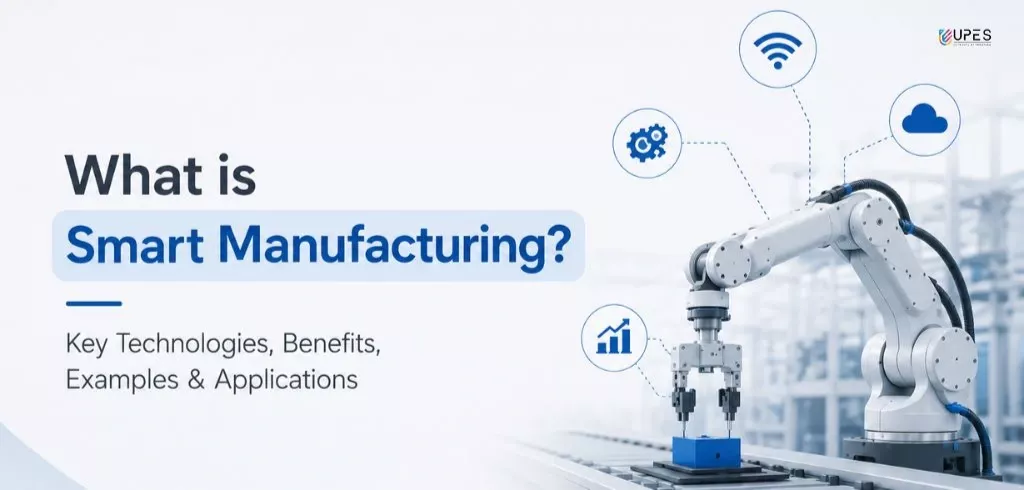
- What is Smart Manufacturing?
- Evolution of Smart Manufacturing & Industry 4.0: A Historical Context
- Key Technologies in Smart Manufacturing
- Real-World Smart Manufacturing Examples
- Benefits of Smart Manufacturing
- Applications and Examples of Smart Manufacturing
- Smart Manufacturing vs Traditional Manufacturing
Factories, laborers, and production facilities have all changed dramatically over the course of industrial history. Steam engines in the 18th century, electricity in the 19th century, and computers in the 20th century all changed how production is scaled in factories, which had previously relied on manual labor. In order to improve quality and output, smart manufacturing now employs a tech-driven strategy that makes use of industry 4.0 capabilities like IIoT, AI, and robotics.
This article will define smart manufacturing, provide examples, and discuss its uses in contemporary factories.
Become future-ready with our Advanced Engineering programs
Know MoreWhat is Smart Manufacturing?
AI, automation, robots, and predictive analytics are used in smart manufacturing, a tech-driven manufacturing approach, to scale production processes. Businesses can boost output, improve efficiency, and guarantee good quality by employing economical Smart Manufacturing systems. Furthermore, factories are becoming more intelligent, efficient, and flexible in response to contemporary issues thanks to Industry 4.0 technologies like IIoT, AI, robotics, and cyber-physical systems.
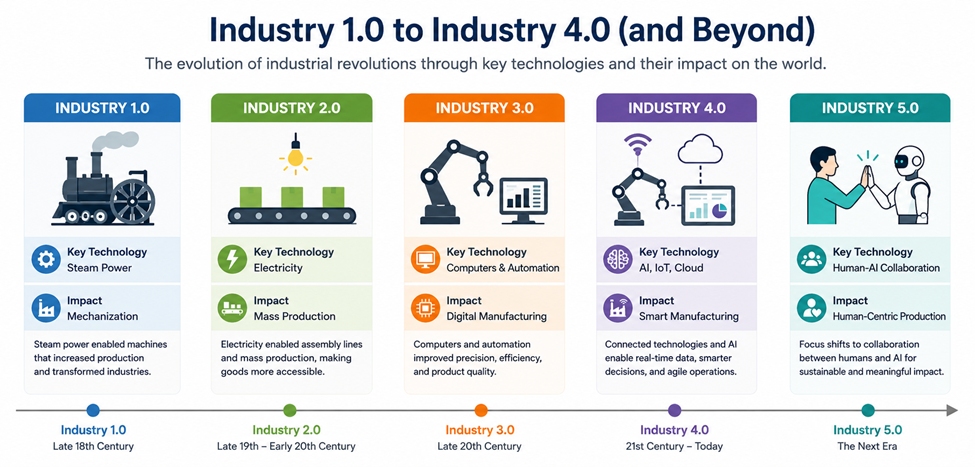
Evolution of Smart Manufacturing & Industry 4.0: A Historical Context
The evolution of smart manufacturing began with the First Industrial Revolution, which introduced steam-powered machinery and mechanized production. Industry 2.0 (Second Industrial Revolution) brought electricity, assembly lines, and mass production, while the Third Industrial Revolution integrated computers, automation, robotics, and digital technologies.
Today, Industry 4.0 represents the Fourth Industrial Revolution, combining AI, IoT, cloud computing, big data, and cyber-physical systems to enable connected, intelligent, and data-driven manufacturing environments that improve productivity, quality, flexibility, and operational efficiency.
Key Insights
- As per Smart Manufacturing Survey 2025 by Deloitte, 92% of manufacturers believe smart manufacturing will be the primary driver of competitiveness over the next three years.
- As per the World Economic Forum’s Smart Manufacturing Leaders report, factories using smart manufacturing reported 30 to 50% reductions in Scope 1 and Scope 2 emissions, 30% reductions in material waste, and 25% reductions in energy and water consumption.
- Smart manufacturing delivers 10 to 20% higher output and 7 to 20% higher workforce productivity as per the Deloitte report.
Key Technologies in Smart Manufacturing
Smart Manufacturing uses several modern technologies to enhance factory production, efficiency, and overall quality. The following are some of the common technologies used in smart manufacturing:
Internet of Things (IoT)
Internet of Things (IoT) is a network of interconnected devices that are powered by modern sensors and software technology and are used to gather and share data. Some of the common examples of IoT devices may include smart home devices, wearable technologies, motion sensors, etc. Factories use IoT to improve operational efficiency by enabling real-time monitoring of equipment, assets, and production processes.
Industrial Internet of Things (IIoT)
The use of IoT technology in industrial settings is known as the Industrial Internet of Things (IIoT). Through IIoT, factories enable automation, predictive maintenance, process optimization, and better decision-making throughout manufacturing facilities by connecting machinery, equipment, and systems to collect operational data.
AI/Machine Learning
Using modern AI/ML models, manufacturing units can evaluate data, identify trends, and make informed decisions. These detailed automated models significantly minimize human error and don’t require human intervention, eventually helping in process optimization, quality control, and predictive maintenance.
Big Data
Big data are massive amounts of structured and unstructured data produced by a factory or industrial unit throughout manufacturing operations. Processing such massive data requires sophisticated analytics tools which help in data-driven business choices, increase production efficiency, optimize supply chains, and unearth insights.
Robotics
Robotics has revolutionized modern industries by utilizing programmable machines to carry out specific factory operations such as hazardous, complicated, and repetitive activities. Articulated arms, palletizing robots, autonomous vehicles, and mobile robots are some of the common examples of robotics in factories. In addition to lowering operating costs and enabling continuous production with little downtime, modern industrial robots increase accuracy, productivity, and worker safety.
Edge and Cloud Computing
While edge computing handles data closer to its source, cloud computing offers scalable processing and storage capabilities. When combined, they facilitate efficient management of interconnected production systems, quicker decision-making, lower latency, and real-time data analysis.
Blockchain
Blockchain technology is a decentralized digital ledger that safely logs and validates transactions. By producing tamper-resistant recordings of operations, it improves supply chain transparency, product traceability, data security, and stakeholder trust in manufacturing.
Digital Twins
A digital twin is an electronic version of a real system, process, or asset. It helps manufacturers maximize productivity and lower operational risks by simulating performance, monitoring operations, forecasting problems, and testing improvements using real-time data.
3D Printing
Additive manufacturing, another name for 3D printing, uses computer plans to build products layer by layer. It makes manufacturing more flexible and economical by enabling quick prototyping, tailored production, decreased material waste, and quicker product development.
Predictive Analytics
- Predictive analytics forecast future outcomes using statistical models, machine learning algorithms, and historical and current data. It aids in equipment failure prediction, maintenance schedule optimization, downtime reduction, and overall operational performance enhancement in manufacturing.
Read More: Digital Twins in Healthcare
Real-World Smart Manufacturing Examples
Smart manufacturing examples are widespread across industry processes and factories. The following are some of the common examples in modern factories:
1. High-Fidelity Digital Twins
Automobile companies use digital twins to map out their vehicle assembly lines before installing new hardware. This approach allows virtual reality models to simulate the real-time movement of robots and workers across the assembly lines. In some cases, digital twins have reduced production planning time by 30%.
2. Integrated Gigafactory Casting
Factories utilize centralized automation frameworks to bypass traditional, slow multi-step auto frame assembly. Massive casting machines eliminate individual stamped components by stamping massive single-piece car underbodies.
3. AI-Driven Process Transformation
- Large manufacturing factories use predictive analytics to predict machine failure and plan maintenance. Machines use advanced IoT vibrations and temperature sensors to analyze the health of a machine unit. This helps factories to perform required maintenance procedures on time and reduce overall downtime.
Benefits of Smart Manufacturing
There are several benefits of Smart Manufacturing including:
1. Enhanced Productivity & Efficiency
Smart manufacturing increases operational efficiency, reduces resource waste, and speeds up production by automating repetitive processes and streamlining workflows.
2. Reduced Downtime & Maintenance Cost
Predictive maintenance and real-time monitoring aid in the early detection of possible equipment breakdowns, minimizing unplanned downtime and maintenance costs.
3. Enhanced Product Quality
Production processes are constantly monitored by sophisticated sensors, artificial intelligence, and analytics, guaranteeing constant quality and lowering faults.
4. Sustainability
By encouraging the economical use of energy, raw materials, and resources, smart manufacturing helps businesses minimize waste and their impact on the environment.
5. Agility and Adaptability
Manufacturers can react swiftly to shifting consumer tastes, supply chain interruptions, and market demands thanks to a connected manufacturing system.
6. Empowered Workforce
- Digital tools and intelligent systems support workers with real-time insights, improving decision-making, productivity, and workplace safety.
Faculty Expertise: Dr. Rana's research on self-healing materials, 3D printing, recyclable polymers, & more
Applications and Examples of Smart Manufacturing
The following are some of the key applications of Smart Manufacturing in modern factories:
1. Process Optimization and Quality Control
Sensors, artificial intelligence, and real-time analytics are used in smart manufacturing to continuously monitor production processes. This aids in locating inefficiencies, lowering errors, preserving constant product quality, and maximizing the use of resources throughout production processes.
2. Predictive Maintenance & Equipment Monitoring
Real-time equipment health monitoring is made possible for manufacturers by connected machinery and sophisticated analytics. By seeing possible problems before they happen, predictive maintenance lowers maintenance costs, prolongs the life of assets, and minimizes downtime.
3. Digital Twin and Simulation
Digital twins provide virtual copies of real-world equipment, manufacturing systems, and assets. These simulations are used by manufacturers to evaluate scenarios, forecast performance, streamline procedures, and spot any problems without interfering with real-world operations.
4. Human-Robot Collaboration
Cobots, also known as collaborative robots, assist human workers in carrying out physically taxing, complicated, or repetitive activities. This partnership increases workplace safety, boosts productivity, and frees workers to concentrate on higher-value tasks.
5. Sustainable and Energy-Efficient Production
Real-time monitoring of emissions, material usage, and energy consumption is provided by smart manufacturing technology. These insights assist manufacturers in lowering operating costs, increasing resource efficiency, cutting waste, and promoting environmental sustainability objectives.
6. Supply Chain & Resource Management
End-to-end supply chain visibility is made possible by sophisticated analytics and networked systems. Manufacturers are able to better allocate resources, estimate demand, optimize inventory levels, and react swiftly to supply chain interruptions.
7. Augmented Reality & Training
- By superimposing digital data on real-world settings, augmented reality (AR) assists workers with assembly, maintenance, and troubleshooting duties. Additionally, it offers immersive training experiences that enhance learning effectiveness and lower operational errors.
Smart Manufacturing vs Traditional Manufacturing
Traditional Manufacturing heavily relies on manual labor, stand-alone machines, and standardized production processes. On the other hand, smart manufacturing leverages modern technologies such as IIoT, Machine Learning, and AI to automate tasks, and relies on robotics for laborious tasks. The following is detailed comparison between the two:
Factor | Traditional Manufacturing | Smart Manufacturing |
Decision-making | Relies on historical reports, manual oversight, and managerial expertise. Often results in slow or delayed decision making | Uses real-time data, AI, and digital twins to offer data-based recommendations and autonomous operational decisions. |
Machine monitoring | Manual logging, routine physical walkthroughs, and periodic health checks | Uses IIoT tools and sensors to maintain 24/7 oversight of machines and track real-time usage and performance metrics |
Maintenance | Often fixing machines after they break down, timely manual inspections | Using AI and Predictive technology to predict maintenance and quality checks |
Production flexibility | Rigid, mass production focused, little to no room for customizations | Highly customizable, Automated workflows, mass customizations |
Quality control | Relies on past-production quality and human inspections | Real time continuous inspections using AI and ML tech |
Data usage | Generally stored in heavy and cluttered spreadsheets | Cloud based datasets for continuous workflow and optimization across the supply chain. |
Workforce role | Manual labor, physical assembly, and routine mechanical maintenance | Strategic oversight, system programming, and managing human-robot collaborations |
Career Scope in Smart Manufacturing and Industrial Intelligence
Career scope in Smart Manufacturing and Industrial Intelligence is promising and growing with an aggressive industry shift towards Industry 4.0. Modern factories are not only focused on speeding production, but the aim today is to optimize production as per consumer need, produce high-quality products, and speed up supply chains by automating heavy tasks.
These shifting trends allow for several career opportunities to emerge in the field, some of the most sought-after smart manufacturing jobs include:
Role | Average Salary | Hiring Industries |
Automation Engineer | 4 to 10 LPA | Manufacturing, Pharmaceutical, Technology, Finance |
IoT Specialist | 3 to 6 LPA | Healthcare, Manufacturing, Automotive, Logistics |
Robotics Technician | 4 to 7 LPA | Manufacturing, Logistics, Agriculture, Healthcare, Aerospace |
Smart Factory Manager | 5 to 14 LPA | Automotive, Manufacturing, Pharmaceuticals, Metals, Mining, Chemicals |
Industrial AI & Data Engineer | 6 to 14 LPA | Manufacturing, Supply Chain, Healthcare, Energy, Financial |
Digital Twin & Simulation Engineer | 5 to 10 LPA | Automotive, Aerospace, Defense, Manufacturing, Architecture, Engineering |
Manufacturing Automation Architects | 5 to 10 LPA | Electronics & Semiconductors, Food & Beverage, Oil, Gas & Energy, Supply Chain & Logistics |
Source: Ambitionbox, Glassdoor, Indeed | ||
What Skills are Required to Succeed in Smart Manufacturing Careers?
Students graduating with a degree in Smart Manufacturing must possess several technical and managerial skills to succeed in smart manufacturing careers. The following are some of the common key smart manufacturing skills:
- Industrial IoT & automation
- Data analytics & AI
- Robotics & additive manufacturing
- Cloud computing
- Cybersecurity
- Lean manufacturing & quality control
- Digital supply chain
- Problem-solving & critical thinking
- Cross-functional collaboration
- Adaptability
Future Trends in Smart Manufacturing
Advanced technologies are shaping the future of smart manufacturing by increasing the intelligence, connectivity, sustainability, and autonomy of factories. The increasing use of artificial intelligence and generative AI for supply chain optimization, production scheduling, quality control, and predictive maintenance is one of the most important developments. According to Deloitte's 2025 Smart Manufacturing Survey, 24% of manufacturers have adopted generative AI, and 29% of manufacturers have already deployed AI/ML at the facility or network level. Numerous more companies are actively testing these technologies.
The growth of digital twins, autonomous robotics, and Industrial Internet of Things (IIoT) networks, which enable real-time monitoring and self-optimizing production processes, is another new trend. To create robust and data-driven manufacturing ecosystems, industry leaders are spending more in linked sensors, cloud computing, factory automation, and data analytics. According to a Deloitte poll of 600 manufacturing executives, 92% of them think that over the next three years, smart manufacturing will be a major factor in competitiveness.
Manufacturers are utilizing smart technology to lower energy usage, emissions, and material waste, making sustainability a major concern as well. In order to create more adaptable, sustainable, and customized production environments, experts anticipate a shift toward Industry 5.0, where human-centric manufacturing, collaborative robots (cobots), explainable AI, and extended reality (AR/VR) technologies will collaborate with human workers.

Our counsellors are just a click away.
FAQs
What is the difference between Smart Manufacturing and Industry 4.0?
Industry 4.0 or the fourth industrial revolution is a global vision of the transformation in the manufacturing industries due to the growth in modern tech such as AI, automations, data analytics, and smart technologies. On the other hand, smart manufacturing is the process of increasing productions using industry 4.0 tools such as IIoT, Digital Twins, 3D Printing, Robotics, etc.
How does IoT help in Smart Manufacturing?
IoT tools help factories by integrating sensors, AI, and robotics to create smart data-driven solutions to scale productions. IoT helps factories increase their efficiency by reducing manual effort, limiting downtime by predictive machine health checks, and inventory management.
What are the benefits of Smart Manufacturing?
Smart manufacturing offers manufacturing factories and cost-effective, efficient, and scalable solutions that use modern tech to increase productivity and reduce downtime. Furthermore, smart manufacturing helps manage operational processes, worker management, and inventory management processes through data-driven actionable insights.
What technologies are used in Smart Manufacturing?
Smart manufacturing uses several modern technologies including AIML, robotics, 3D printing, blockchain, big data, digital twin, etc.
What is Industry 5.0 in Manufacturing?
Industry 5.0 in manufacturing refers to an evolving approach in manufacturing production. Industry 5.0 focuses on human-AI collaboration to create smart, future-ready, data-driven, and automated factories.

UPES Editorial Team
Written by the UPES Editorial Team
UPES Admission Enquiry
Trending Post
-

Career Opportunities in Space Technology & Satellite Engineering for Students
26/10/2025By UPES Editorial Team
-

-


Related Articles















































Subscribe to UPES Blogs
Join our community for exclusive stories, insights, and updates
By clicking the "Subscribe" button, I agree and accept the privacy policy of UPES.


